Introduction
Most websites don’t fail because of bad content. They fail because of bad strategy. In 2026, SEO has evolved from a list of tactics into a full-stack discipline that blends technical precision, content authority, and AI optimization — and if you’re still using a 2022 playbook, you’re leaving rankings (and revenue) on the table.
This SEO checklist was built for practitioners who want to move fast and get results. Whether you’re auditing an existing site, launching a new one, or scaling an agency’s workflow, this guide walks you through every critical SEO layer — from crawlability to content to backlinks to generative engine optimization (GEO) — in the right order.
By the end, you’ll have a complete, actionable SEO framework you can implement immediately.
2. Understanding SEO Fundamentals
What Is SEO?
SEO (Search Engine Optimization) is the practice of optimizing a website to increase its visibility in organic (unpaid) search engine results. The goal is to attract relevant traffic that converts — not just raw visits.
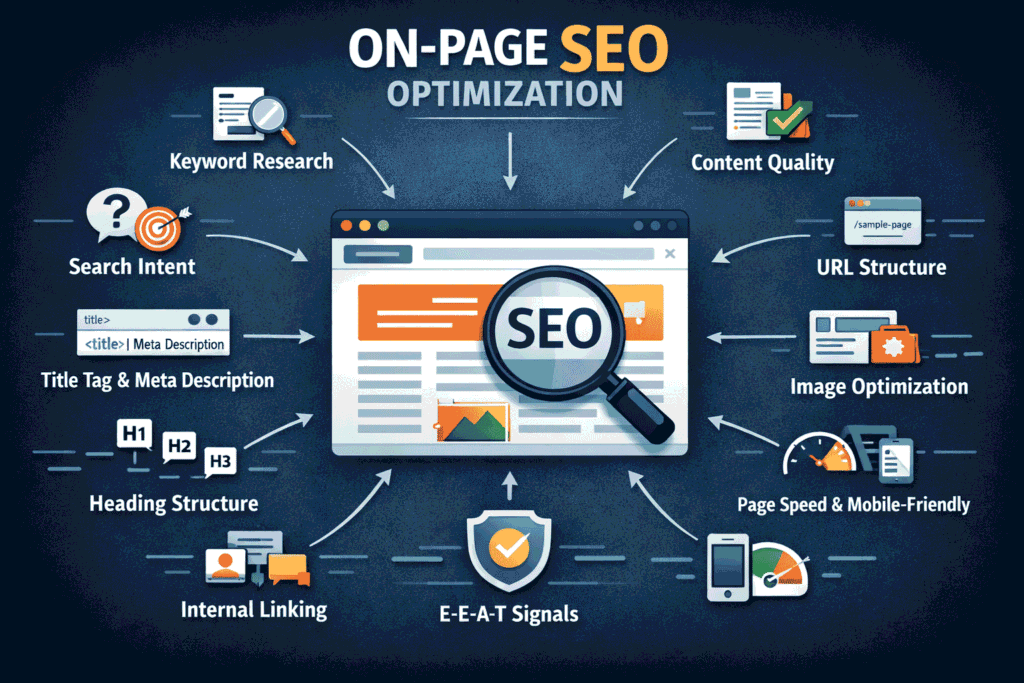
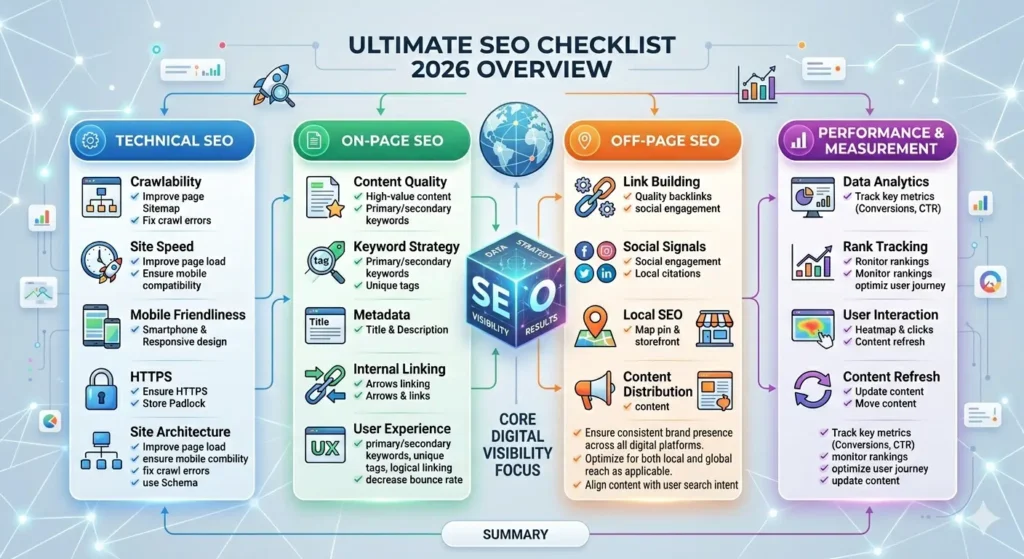
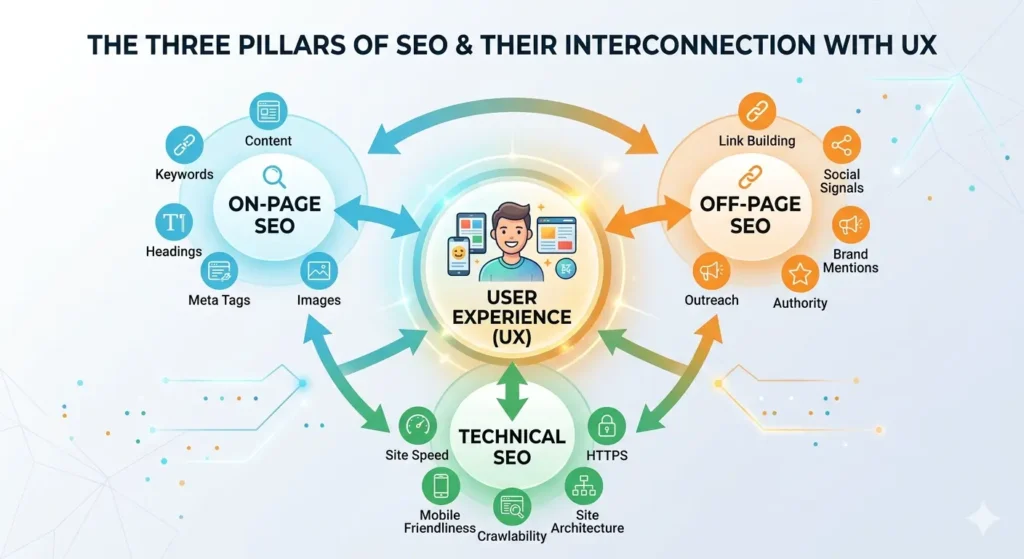
In 2026, SEO operates across three interconnected layers:
- On-page SEO — content quality, keyword targeting, title tags, headers, internal linking
- Off-page SEO — backlinks, brand mentions, digital PR, authority signals
- Technical SEO — site speed, crawlability, indexability, schema, Core Web Vitals
Remove any one of these layers and your rankings become structurally fragile.
Key Components of SEO
| SEO Pillar | Core Focus | Primary Tools |
|---|---|---|
| On-Page SEO | Content, keywords, HTML elements | Surfer SEO, Clearscope, Yoast |
| Off-Page SEO | Backlinks, authority, brand signals | Ahrefs, Moz, BuzzSumo |
| Technical SEO | Speed, crawling, indexing, schema | Screaming Frog, GSC, PageSpeed Insights |
| Local SEO | Google Business Profile, citations | BrightLocal, Whitespark |
| AEO/GEO | AI engine answers, citations | Perplexity, SGE tracking tools |
The Role of User Experience in SEO
Google’s Helpful Content System made UX a ranking factor, not a suggestion. Pages that frustrate users — with intrusive ads, slow loads, or shallow content — are systematically demoted. Google’s Core Web Vitals (LCP, INP, CLS) measure UX in concrete, measurable terms.
According to Google’s own research, pages that meet Core Web Vitals thresholds are 24% less likely to see users abandon before page load.
The takeaway: A technically perfect page with terrible UX won’t rank long-term. UX and SEO are now the same discipline.
3. Keyword Research and Optimization
Why Keyword Research Still Matters in 2026
Keyword research isn’t dead — it’s more nuanced. With Google’s natural language understanding and generative AI shifting how users search, the goal is no longer to “target keywords.” It’s to map content to search intent.
According to Backlinko, 92% of all search queries are long-tail (3+ words). That’s where the conversion-ready traffic lives.
Tools for Effective Keyword Research
| Tool | Best For | Pricing |
|---|---|---|
| Ahrefs Keywords Explorer | Search volume, KD, SERP analysis | From $99/mo |
| SEMrush Keyword Magic Tool | Intent clustering, gap analysis | From $139/mo |
| Google Keyword Planner | Free volume estimates | Free |
| AlsoAsked | People Also Ask mapping | Freemium |
| Surfer SEO | NLP-based content scoring | From $89/mo |
Long-Tail vs. Short-Tail Keywords
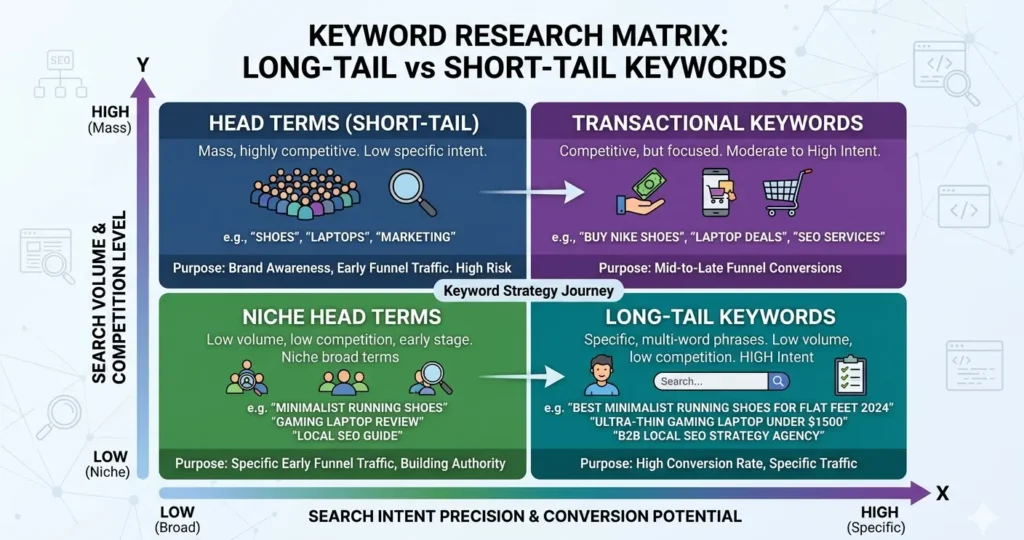
Short-tail keywords (e.g., “SEO checklist”) have high search volume and brutal competition. They take months or years to rank for without significant domain authority.
Long-tail keywords (e.g., “SEO checklist for ecommerce startups in 2026”) have lower volume but far higher conversion rates and are easier to rank quickly.
Recommended approach:
- Use short-tail as your pillar topic (topical anchor)
- Use long-tail as your supporting cluster content
- Map each piece of content to one primary intent and 3–5 semantic variations
Best Practices for Keyword Placement
Follow this keyword placement framework for every page:
- Title tag — include primary keyword near the start
- Meta description — include keyword naturally (it won’t affect ranking but impacts CTR)
- H1 tag — exact or close variant of primary keyword
- First 100 words — introduce the keyword early
- H2/H3 headers — use semantic variants and related terms
- Image alt text — describe the image, naturally including keywords
- URL slug — short, hyphenated, keyword-first
- Body content — maintain 1–1.5% keyword density naturally
Avoid keyword stuffing. Google’s Penguin algorithm and its modern successors penalize unnatural repetition. Write for humans; optimize for algorithms as a secondary layer.
Read more about Keyword Research here – Keyword Research Guide
4. On-Page SEO Techniques
On-page SEO is the layer you have complete control over. Done right, it signals to both users and search engines exactly what your page is about and why it deserves to rank.
Title Tags and Meta Descriptions
Your title tag is the single most influential on-page ranking factor. Follow these rules:
- Length: 50–60 characters (longer titles get truncated in SERPs)
- Format: Primary Keyword | Brand Name OR Primary Keyword: Benefit-Driven Hook
- Uniqueness: Every page must have a distinct title — no duplicates
- Click-worthiness: Include a number, year, or power word where appropriate
Example:
❌ SEO Tips for Websites
✅ The Ultimate SEO Checklist to Boost Rankings (2026)
Meta descriptions don’t directly affect rankings, but they directly affect CTR, which influences rankings indirectly.
- Length: 150–160 characters
- Include: A call-to-action, the primary keyword, and a clear value proposition
- Avoid: Generic descriptions like “Read more about SEO on our blog”
Header Tags and Content Structure
Header tags (H1–H6) create a content hierarchy that benefits both users (scannability) and search engines (topic comprehension).
Rules:
- Use one H1 per page — it should be the primary topic headline
- Use H2 for major sections, H3 for subsections, H4 for nested detail
- Incorporate semantic keywords into H2/H3 headers — not exact matches, but related terms
- Write headers that answer questions (great for featured snippets and People Also Ask)
Example header structure for this guide:
H1: The Ultimate SEO Checklist (2026)
  H2: Keyword Research and Optimization
    H3: Long-Tail vs. Short-Tail Keywords
    H3: Best Practices for Keyword Placement
  H2: On-Page SEO Techniques
    H3: Title Tags and Meta Descriptions
Image Optimization
Images often account for 50%+ of a page’s total weight. Unoptimized images kill page speed — and page speed kills rankings.
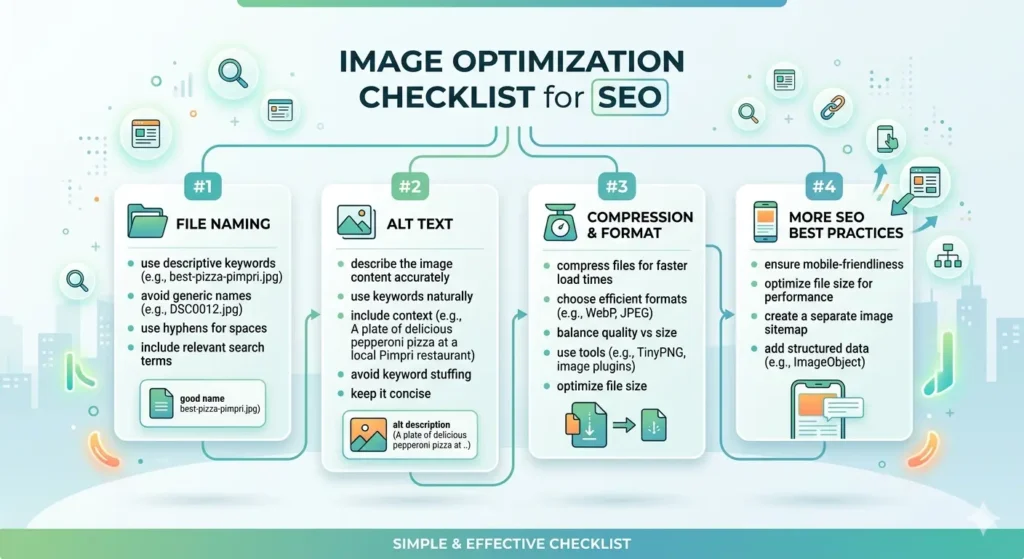
Image SEO checklist:
- Compress images using TinyPNG or WebP format
- Use descriptive, keyword-rich file names (e.g.,
seo-checklist-2026.png, notimg001.png) - Write descriptive alt text for every image (benefits accessibility + SEO)
- Use responsive images (
srcset) for different screen sizes - Implement lazy loading for images below the fold
- Serve images from a CDN where possible
Internal Linking Strategies
Internal links distribute “link equity” (PageRank) throughout your site and signal topical relevance to Google’s crawlers.
Best practices:
- Link from high-authority pages to pages you want to boost
- Use descriptive, keyword-rich anchor text (not “click here” or “read more”)
- Aim for 3–5 internal links per 1,000 words
- Create content clusters: one pillar page linked to by multiple supporting posts on related subtopics
- Audit internal links regularly — broken internal links waste crawl budget
5. Technical SEO Essentials
Technical SEO ensures that search engine crawlers can find, access, and understand your content. Without a solid technical foundation, even the best content can fail to rank.
Site Speed and Performance
Page speed is a confirmed Google ranking factor for both desktop and mobile. More critically, it directly impacts bounce rate and conversion rate.
According to Google’s research, as page load time goes from 1s to 3s, the probability of bounce increases by 32%. From 1s to 10s, it increases by 123%.
Technical speed checklist:
- Achieve LCP (Largest Contentful Paint) < 2.5 seconds
- Achieve INP (Interaction to Next Paint) < 200ms
- Achieve CLS (Cumulative Layout Shift) < 0.1
- Minify CSS, JavaScript, and HTML
- Enable browser caching
- Use a CDN (Cloudflare, Fastly, or equivalent)
- Eliminate render-blocking resources
- Enable GZIP or Brotli compression
Tools: Google PageSpeed Insights, GTmetrix, WebPageTest
Mobile-Friendliness and Responsive Design
Google uses mobile-first indexing — meaning the mobile version of your site is the version Google crawls and ranks. If your mobile experience is broken, your rankings are broken.
Mobile SEO checklist:
- Use responsive design (CSS flexbox/grid, not separate mobile URLs)
- Tap targets (buttons, links) sized at minimum 48×48px
- No intrusive interstitials (pop-ups that block content on mobile)
- Text readable without zooming (minimum 16px font)
- Test with Google’s Mobile-Friendly Test
XML Sitemaps and Robots.txt
These two files are your site’s communication layer with search engine crawlers.
XML Sitemap:
- Include all indexable pages — exclude thin, duplicate, or noindex pages
- Submit your sitemap in Google Search Console
- Update dynamically when new pages are published
- Keep file size under 50MB / 50,000 URLs (split into multiple sitemaps if needed)
Robots.txt:
- Block crawlers from /wp-admin/, /thank-you/, staging environments, and internal search result pages
- Never accidentally block CSS or JS files that Google needs to render your page
- Validate with Google’s robots.txt tester
Example robots.txt:
User-agent: *
Disallow: /wp-admin/
Disallow: /staging/
Allow: /

Sitemap: https://yoursite.com/sitemap.xml
Structured Data and Schema Markup
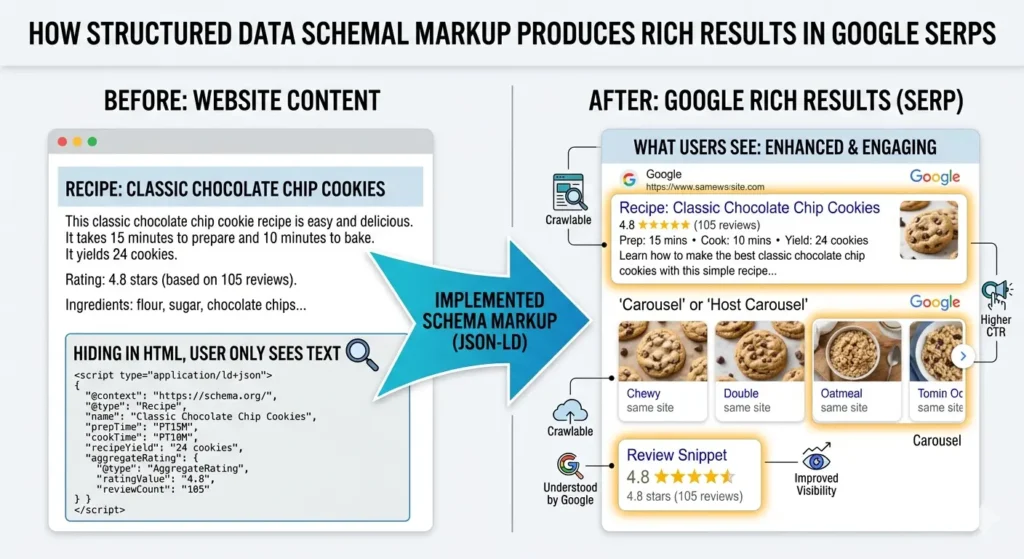
Schema markup is code (JSON-LD format) that tells search engines the type of content on your page. It powers rich results — star ratings, FAQs, breadcrumbs, recipes, events — which can dramatically increase CTR.
According to Search Engine Land, rich results can increase CTR by up to 30% compared to standard blue links.
High-impact schema types for 2026:
| Schema Type | Use Case | Benefit |
|---|---|---|
| Article | Blog posts, news | Timestamp, headline rich result |
| FAQ | FAQ sections | Expanded SERP with Q&A dropdown |
| HowTo | Step-by-step guides | Step-by-step rich result |
| Product | Ecommerce | Price, rating, availability |
| LocalBusiness | Local sites | Map pack, business info |
| BreadcrumbList | All pages | Breadcrumb trail in SERP |
| Organization | Brand pages | Knowledge panel entity |
6. Off-Page SEO Strategies
The Importance of Backlinks
Backlinks remain the most powerful off-page ranking signal in 2026. A study by Backlinko analyzing 11.8 million Google search results confirmed that the #1 result has an average of 3.8x more backlinks than positions #2–#10.
But quantity is dead. Quality and relevance are everything. One backlink from a topically relevant DA 70 site outperforms 100 backlinks from random DA 20 directories.
Building a Strong Backlink Profile
Tier 1 — High-Impact Tactics:
- Digital PR and data-driven content — Create original research, surveys, or statistics posts that journalists and bloggers cite. This is the backbone of passive link acquisition.
- Broken link building — Use Ahrefs or Screaming Frog to find broken links on authoritative sites in your niche. Pitch your content as a replacement.
- HARO / Connectively — Answer journalist queries in your niche to earn editorial mentions and links from high-authority news sites.
- Guest posting — Write high-quality articles for relevant industry publications. Focus on topical relevance over DA alone.
Tier 2 — Supporting Tactics:
- Tool and resource testimonials — Reach out to SaaS tools you use and offer a testimonial with a backlink request.
- Agency directory listings — Submit to Clutch, G2, DesignRush, and industry-specific directories.
- Podcast appearances — Podcasts frequently link to guests from show notes.
- Content partnerships — Co-author research or guides with complementary businesses.
Red flags to avoid:
- Buying links (violates Google’s link spam policies)
- PBNs (private blog networks)
- Footer/sidebar links in bulk
- Link exchanges (“I’ll link to you if you link to me”)
Social Media Influence on SEO
Social signals are not a direct ranking factor. But social media amplifies content distribution, which increases the probability of earning organic backlinks — making it an indirect SEO lever.
- Share every new piece of content across LinkedIn, X (Twitter), and relevant communities
- Repurpose long-form content into carousels, infographics, and short-form clips
- Build a following that accelerates content velocity and trust signals
Guest Blogging and Influencer Outreach
Guest blogging is still highly effective when done with selectivity. Target sites that:
- Are topically relevant to your niche (not just any high-DA site)
- Have real, engaged audiences (check comment sections and social shares)
- Allow do-follow links in the author bio or body (confirm before pitching)
- Publish content with editorial standards (avoiding link farms disguised as blogs)
Read more about Off Page SEO and Link building here – “Link Building Strategies“
7. Content Creation and Marketing
Why High-Quality Content Is Non-Negotiable
Google’s Helpful Content System has fundamentally changed the content game. Content that exists primarily to rank — but doesn’t genuinely help users — is now systematically suppressed.
High-quality content in 2026 means:
- Original insights (not rehashed information)
- First-hand experience or expertise (a core EEAT signal)
- Comprehensive coverage of the topic (topical depth)
- Correct, up-to-date information with proper citations
Content Types That Drive Traffic
| Content Type | Traffic Potential | Link Potential | Conversion Potential |
|---|---|---|---|
| Statistics roundups | High | Very High | Low–Medium |
| Ultimate guides / checklists | High | High | Medium |
| Product comparisons | Medium | Medium | Very High |
| Case studies | Medium | High | Very High |
| Tools / calculators | Medium–High | Very High | Medium |
| News / trend analysis | Burst traffic | Medium | Low |
For agencies and B2B businesses: Prioritize statistics posts, comparison pages, and ultimate guides. They generate passive backlinks and convert researchers into leads.
Content Promotion Strategies
Publishing is 20% of the work. Promotion is 80%.
Content promotion checklist:
- Share on all owned social channels within 24 hours of publishing
- Email your subscriber list with a teaser and link
- Submit to relevant Slack communities, Reddit threads, and forums (where appropriate)
- Reach out to anyone cited, linked, or mentioned in the article — they often reshare
- Repurpose into a LinkedIn carousel or X thread
- Add to your email signature temporarily
- Pitch to newsletter curators in your niche
Updating and Repurposing Existing Content
Content decay is real. According to HubSpot, updating old blog posts can increase organic traffic by up to 106%.
Content refresh process:
- Identify pages with declining traffic in Google Search Console
- Check for outdated statistics, broken links, or missing coverage
- Add new sections, updated data, and internal links to newer content
- Update the publish date only if substantive changes were made
- Re-submit the URL to Google Search Console for recrawling
8. Local SEO Optimization
Why Local SEO Matters in 2026
For any business serving a specific geography, local SEO is mission-critical. According to Google, 76% of people who search for something nearby on their smartphone visit a business within a day.
Local SEO puts your business in front of high-intent buyers at the exact moment they’re looking.
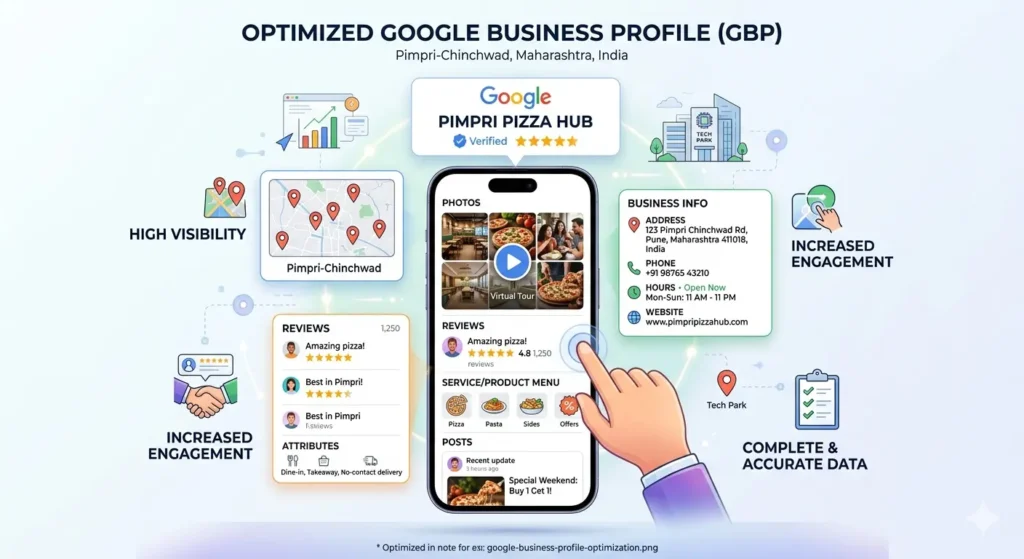
Google Business Profile (GBP) Optimization
Your Google Business Profile (formerly Google My Business) is the #1 local SEO asset. An optimized GBP dramatically improves your chances of appearing in the Local 3-Pack — the map results that appear above organic listings.
GBP optimization seo checklist:
- Claim and verify your business listing
- Complete every field: business name, address, phone, website, hours, category
- Add 10+ high-quality photos (exterior, interior, products, team)
- Write a keyword-rich business description (750 characters max)
- Enable messaging and Q&A features
- Post weekly updates (promotions, events, new content)
- Respond to all reviews within 24–48 hours (positive and negative)
Local Citations and Reviews
Citations are online mentions of your business NAP (Name, Address, Phone number). Consistency across directories signals legitimacy to Google.
Priority citation directories:
- Google Business Profile
- Bing Places
- Apple Maps
- Yelp
- Facebook Business
- Industry-specific directories (e.g., Houzz for contractors, Healthgrades for medical)
Reviews strategy:
- Ask satisfied customers directly (in-person, via email, or SMS)
- Make it easy — send a direct GBP review link
- Never offer incentives for reviews (violates Google’s policies)
- Address negative reviews professionally and specifically
Local Keyword Targeting
Local keyword strategy layers geographic intent on top of service-based keywords.
Formula:[Service] + [Location] → “SEO agency Pune” / “plumber in Chicago”
Implementation:
- Create location-specific landing pages for each city/area you serve
- Include NAP data in the footer of every page (schema-marked up)
- Embed a Google Map on your contact/location pages
- Use location-based keywords in title tags, H1s, and meta descriptions
9. Monitoring and Analytics
Tools for Tracking SEO Performance
You cannot improve what you don’t measure. These are the essential tools for a complete SEO monitoring stack:
| Tool | Purpose | Cost |
|---|---|---|
| Google Search Console | Impressions, clicks, crawl errors, indexing | Free |
| Google Analytics 4 | Traffic, engagement, conversions | Free |
| Ahrefs Site Explorer | Backlink monitoring, keyword tracking | From $99/mo |
| Screaming Frog | Technical audits, crawl analysis | Free/£259 p/a |
| SEMrush Position Tracking | SERP rank tracking | From $139/mo |
| BrightLocal | Local SEO tracking, citation audit | From $39/mo |
Key Metrics to Monitor
Monthly SEO KPI dashboard:
| Metric | What It Measures | Target Direction |
|---|---|---|
| Organic Sessions | Total search-driven visits | ↑ Increase |
| Keyword Rankings | Position for target keywords | ↑ Improve |
| Click-Through Rate (CTR) | SERP clicks / impressions | ↑ Increase |
| Core Web Vitals | Page experience scores | ↑ Pass all thresholds |
| Referring Domains | Unique domains linking to you | ↑ Grow |
| Pages Indexed | Pages in Google’s index | = Match target pages |
| Crawl Errors | Pages with access issues | ↓ Minimize |
| Bounce Rate | Single-page sessions | ↓ Reduce |
| Domain Rating / Authority | Overall site authority | ↑ Increase |
Adjusting Strategies Based on Data
Data without action is noise. Build a quarterly review cadence:
- Monthly: Review GSC for crawl errors, index issues, CTR drops
- Monthly: Check keyword position trends in Ahrefs/SEMrush
- Quarterly: Full technical audit with Screaming Frog
- Quarterly: Content performance review — identify candidates for refresh or consolidation
- Quarterly: Backlink audit — disavow toxic links if needed
- Annually: Full SEO strategy review aligned to business goals
The Importance of Regular Audits
An SEO audit is a diagnostic — it identifies what’s broken, what’s underperforming, and what opportunities you’re missing. Audits should cover:
- Technical: Crawlability, indexing, speed, schema, redirects
- On-page: Title tags, meta data, content quality, internal links
- Off-page: Backlink profile quality, toxic links, anchor text distribution
- Content: Thin content, duplicate content, keyword cannibalization
- Local (if applicable): GBP health, citation consistency, review velocity
Read more about the Website SEO Audits here – “Complete SEO Audit Guide“
10. Conclusion
SEO in 2026 rewards the disciplined. There are no shortcuts — but there is a clear path, and this seo checklist maps it out in full.
The core pillars, restated:
- Technical SEO is your foundation — get this right before anything else
- Keyword research determines whether you’re targeting the right traffic
- On-page optimization signals exactly what your page is about
- Content quality determines whether users (and AI systems) trust and cite you
- Backlinks validate your authority to search engines
- Local SEO captures high-intent buyers in your geography
- Analytics and audits ensure you’re improving, not just executing
Your next steps:
- Run a full technical audit using Screaming Frog or Ahrefs Site Audit
- Map your existing content to a keyword-intent framework
- Identify your top 10 link-building targets for the next quarter
- Set up a Google Search Console + GA4 monthly reporting workflow
- Create a content calendar anchored to your pillar topics
SEO is not a one-time project. It’s a compounding system — every technically sound page, every quality backlink, every content update adds to a growing asset that delivers traffic and leads without ongoing ad spend.