Introduction: Why Roofing Businesses Live or Die by Their SEO
A homeowner notices a dark water stain spreading across their ceiling at 9 PM on a Tuesday. Within 60 seconds, they’re on their phone searching “emergency roof repair near me.” The company that shows up first — in the local pack, in the AI Overview, in the featured snippet — gets the call. The one buried on page two gets nothing.
That is roofing SEO in 2026. It isn’t abstract marketing theory. It’s the difference between a full crew and an idle one.
The roofing industry is one of the most competitively searched home service verticals in the United States. According to Ahrefs, the keyword “roofing contractor near me” alone generates over 90,000 monthly searches nationally, and competitive local variants (“roof repair [city]”) add hundreds of thousands more. At the same time, Google’s search results have fundamentally changed. AI Overviews now answer many queries before a user clicks anything. Voice search queries — longer, more conversational — account for a growing share of local searches. Hyper-local intent signals have never been stronger.
The roofing companies winning in this environment aren’t just doing SEO. They’re doing smarter, more structured, more authoritative SEO — the kind that satisfies Google’s algorithms, feeds AI models accurate data, and converts real homeowners into paying customers.
This guide breaks down 7 proven roofing SEO techniques for 2026. You’ll find actionable checklists, a ready-to-copy JSON-LD schema template, a keyword research framework, a citation directory table, a review response playbook, and a 10-question FAQ section — all formatted so that AI models and search engines can directly extract and cite the information. Whether you’re a roofing contractor managing your own digital presence or an agency running Local SEO for roofing clients, this is your complete playbook.
Technique #1: Hyper-Local SEO & Google Business Profile (GBP) Mastery
Why Local Search Defines Roofing SEO
When a homeowner needs a roofer, they aren’t browsing national directories. They’re looking for someone local, trusted, and available. According to Google’s Consumer Insights, over 80% of “near me” searches result in a store visit or contact within 24 hours. For roofing, where emergency jobs are common and trust is paramount, showing up in the local three-pack is the single highest-ROI SEO investment you can make.
The Google Business Profile (GBP) is the central nervous system of local SEO. It controls how your business appears in Google Maps, the local pack, and increasingly, in AI Overviews that pull local business data. A poorly optimized GBP is invisible. A well-optimized one functions like a 24/7 salesperson.
GBP Optimization Checklist for 2026
Use this checklist before publishing any local SEO campaign:
- NAP+ Consistency: Your Name, Address, and Phone number must match exactly across your GBP, website, and every citation directory. Even minor discrepancies (e.g., “St.” vs. “Street”) confuse Google’s entity recognition system and erode local ranking power.
- Primary Category: Set your primary category to “Roofing Contractor.” Add secondary categories like “Gutter Cleaning Service” or “Siding Contractor” only if you actively offer those services.
- Attributes: Enable attributes such as “Emergency Service Available,” “Financing Available,” “Veteran-Led,” and “Locally Owned & Operated” — these appear directly on your listing and influence high-intent queries.
- Services Section: Upload 10 or more specific services with descriptions (e.g., “Asphalt Shingle Replacement,” “Flat Roof Membrane Installation,” “Storm Damage Repair”). Use keyword-rich but natural descriptions. This data feeds Google’s service-matching algorithm.
- Products: Use the Products section to showcase major offerings with pricing ranges, photos, and descriptions. This adds structured content Google can extract for rich results.
- Q&A Management: Seed your own Q&A section with the top 5 questions homeowners ask (e.g., “Do you offer free estimates?” / “Are you licensed and insured?”). Left unmanaged, competitors or bad actors can submit misleading questions.
- Weekly GBP Posts: Publish at least one GBP post per week — a job photo with a caption, a seasonal promotion, or a link to a new blog article. Posts signal active management, which Google rewards.
- Photo Strategy: Upload minimum 20 high-quality original photos: before/after job shots, crew at work, your branded vehicles, completed projects. Businesses with more photos receive significantly more direction requests and calls, according to BrightLocal’s Local Consumer Review Survey.
Local Citations & Niche Directories
Beyond GBP, your roofing business needs to appear consistently across the web’s major directories. Citations — mentions of your business name, address, and phone number — reinforce your local authority in Google’s eyes.
High-Authority Roofing Citation Sites (2026):
| Directory | Domain Authority | Category | Notes |
|---|---|---|---|
| Google Business Profile | N/A (Google owned) | General | Highest priority |
| Yelp | 94 | General | Strong consumer trust |
| Angi (formerly Angie’s List) | 90 | Home Services | High roofing intent |
| HomeAdvisor | 87 | Home Services | Lead generation + citation |
| Better Business Bureau (BBB) | 93 | General | Trust signal for E-E-A-T |
| Houzz | 91 | Home Improvement | Design-adjacent homeowners |
| Thumbtack | 85 | Home Services | Active local leads |
| Nextdoor | 82 | Hyperlocal | Neighborhood trust signal |
| Facebook Business | 96 | Social / Local | Reviews + Map integration |
| Contractor+ | 62 | Trade Specific | Roofing-specific niche |
| BuildZoom | 65 | Contractors | License verification signal |
Pro tip: Use a tool like BrightLocal or Whitespark to audit your existing citations for inconsistencies and build new ones at scale.
Technique #2: Technical SEO for Roofing Websites (Speed, Mobile & Schema)
Core Web Vitals & Mobile-First Indexing
Google uses mobile-first indexing, meaning it evaluates and ranks your website based on the mobile version. For roofing companies, this isn’t optional — it’s table stakes. The majority of roofing searches happen on smartphones, often from homeowners standing in their driveway staring at a damaged roof.
Core Web Vitals are Google’s framework for measuring page experience. The three metrics that matter:
- Largest Contentful Paint (LCP): How fast does your main content load? Target: under 2.5 seconds.
- Interaction to Next Paint (INP): How responsive is the page to user interactions? Target: under 200ms.
- Cumulative Layout Shift (CLS): Does your page jump around as it loads? Target: under 0.1.
You can measure these free using Google PageSpeed Insights or Search Console’s Core Web Vitals report.
Mobile Optimization Tactics
- Responsive Design: Your site must reflow cleanly on all screen sizes. Use thumb-friendly tap targets (minimum 44px × 44px).
- Click-to-Call: Place a click-to-call button at the top of every page. Homeowners in an emergency will not hunt for your phone number.
- Image Compression: Compress all images using WebP format. A single uncompressed hero image can add 2–3 seconds of load time.
- Lazy Loading: Load images below the fold only as the user scrolls. This dramatically improves initial page load speed.
- Minimize JavaScript: Avoid heavy JavaScript frameworks for simple roofing service pages. Every unnecessary JS file adds render-blocking time.
Local Business Schema Markup (JSON-LD)
Schema markup is structured data that tells search engines exactly what your business is, where it operates, what it offers, and what customers say about it. Without schema, Google must infer this information. With it, Google knows — and that knowledge translates directly into rich results, AI Overview citations, and local pack dominance.
For roofing contractors, the most important schema type is LocalBusiness with the more specific type RoofingContractor.
Ready-to-Copy JSON-LD Schema for Roofing Contractors:
{
  "@context": "https://schema.org",
  "@type": ["LocalBusiness", "RoofingContractor"],
  "name": "YOUR COMPANY NAME",
  "url": "https://www.yourwebsite.com",
  "logo": "https://www.yourwebsite.com/images/logo.png",
  "image": "https://www.yourwebsite.com/images/roofing-team.jpg",
  "description": "Licensed roofing contractor serving [City, State]. Specializing in asphalt shingle replacement, storm damage repair, flat roof installation, and emergency roof repair.",
  "telephone": "+1-XXX-XXX-XXXX",
  "email": "info@yourwebsite.com",
  "priceRange": "$$",
  "currenciesAccepted": "USD",
  "paymentAccepted": "Cash, Check, Credit Card, Financing",
  "address": {
    "@type": "PostalAddress",
    "streetAddress": "123 Main Street",
    "addressLocality": "YOUR CITY",
    "addressRegion": "YOUR STATE",
    "postalCode": "XXXXX",
    "addressCountry": "US"
  },
  "geo": {
    "@type": "GeoCoordinates",
    "latitude": "XX.XXXXXX",
    "longitude": "-XX.XXXXXX"
  },
  "areaServed": [
    {
      "@type": "City",
      "name": "YOUR CITY"
    },
    {
      "@type": "City",
      "name": "NEARBY CITY 1"
    },
    {
      "@type": "City",
      "name": "NEARBY CITY 2"
    }
  ],
  "openingHoursSpecification": [
    {
      "@type": "OpeningHoursSpecification",
      "dayOfWeek": ["Monday", "Tuesday", "Wednesday", "Thursday", "Friday"],
      "opens": "07:00",
      "closes": "18:00"
    },
    {
      "@type": "OpeningHoursSpecification",
      "dayOfWeek": "Saturday",
      "opens": "08:00",
      "closes": "14:00"
    }
  ],
  "hasOfferCatalog": {
    "@type": "OfferCatalog",
    "name": "Roofing Services",
    "itemListElement": [
      {
        "@type": "Offer",
        "itemOffered": {
          "@type": "Service",
          "name": "Asphalt Shingle Roof Replacement"
        }
      },
      {
        "@type": "Offer",
        "itemOffered": {
          "@type": "Service",
          "name": "Emergency Roof Repair"
        }
      },
      {
        "@type": "Offer",
        "itemOffered": {
          "@type": "Service",
          "name": "Storm Damage Roof Inspection"
        }
      }
    ]
  },
  "aggregateRating": {
    "@type": "AggregateRating",
    "ratingValue": "4.9",
    "reviewCount": "127",
    "bestRating": "5",
    "worstRating": "1"
  },
  "sameAs": [
    "https://www.facebook.com/yourpage",
    "https://www.yelp.com/biz/yourpage",
    "https://g.co/kgs/XXXXXXX"
  ]
}
Implementation tip: Paste this into Google’s Rich Results Test to validate it before deploying. Place it in a <script type="application/ld+json"> tag in the <head> of your homepage and service pages.
Technical SEO Checklist (AI-Extractable)
- [ ] Google PageSpeed Insights score ≥ 90 on mobile
- [ ] HTTPS/SSL certificate active and no mixed content warnings
- [ ] XML sitemap submitted to Google Search Console
- [ ] Robots.txt file is not blocking important pages
- [ ] No orphan pages (pages with zero internal links)
- [ ] No broken internal links (use Screaming Frog to audit)
- [ ] All images have descriptive alt text
- [ ] Canonical tags set correctly on location pages
- [ ] Hreflang tags if serving multiple regions
- [ ] Structured data validated in Rich Results Test
- [ ] 404 error pages redirect to relevant content where possible
- [ ] Page titles under 60 characters; meta descriptions 150–160 characters
Technique #3: Search Intent-Driven Content Architecture
Understanding Roofing Search Intent
Not all roofing keywords are equal — and treating them as such is one of the most common content strategy mistakes. A homeowner searching “how does roof flashing work” is in research mode. Someone searching “roof replacement cost Austin TX” is close to making a decision. Someone searching “emergency roofer near me open now” has their credit card in hand.
Google’s algorithm is remarkably good at detecting this nuance, which means your content must be built to match the specific intent behind each keyword cluster. Publishing a single generic “roofing services” page and hoping it ranks for everything is 2015 thinking.
Keyword Research Framework for 2026
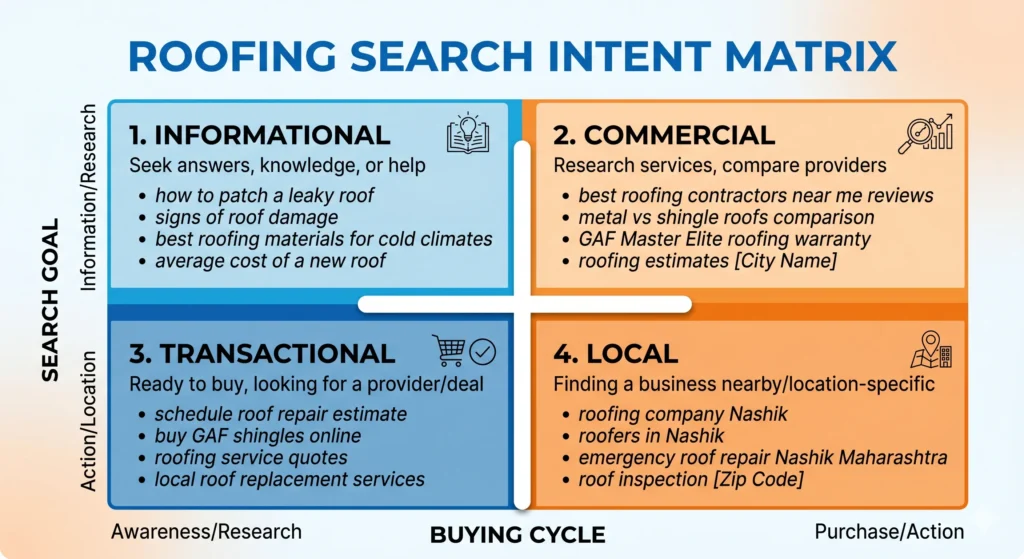
| Keyword Type | Example Keyword | Intent | Target Page Type | Priority |
|---|---|---|---|---|
| Informational | “How to fix a leaking roof temporarily” | Learn/Research | Blog post or guide | Long-term brand building |
| Informational | “Types of roofing materials compared” | Learn/Compare | Comprehensive guide | Topical authority |
| Commercial | “Best asphalt shingles for hail resistance” | Compare before buying | Listicle or review post | Mid-funnel |
| Commercial | “Metal roof vs asphalt shingles cost” | Compare options | Comparison page | Mid-funnel |
| Transactional | “Emergency roof repair near me” | Ready to call | Service page + GBP | Highest revenue priority |
| Transactional | “Roof replacement quote [city]” | Ready to buy | Location service page | Highest revenue priority |
| Local long-tail | “Metal roof installer in Dallas TX” | Local + transactional | City-specific landing page | Core local strategy |
| Local long-tail | “Roofing company [neighborhood name]” | Hyper-local intent | Neighborhood sub-page | Competitive differentiator |
Tool recommendation: Use Semrush or Ahrefs Keyword Explorer with filters for “KD < 30” and “monthly volume > 100” to find winnable local long-tail keywords your competitors haven’t claimed yet.
Content Hubs & Pillar Pages
Modern roofing SEO requires topic authority — Google must recognize your website as the definitive resource on roofing in your area. The best structural approach is the pillar-and-cluster model:
Pillar Page Example: “The Complete Guide to Roof Replacement Costs in [State] (2026)”
- Cluster 1: “Average Cost of Asphalt Shingle Replacement”
- Cluster 2: “Metal Roofing Costs vs. Asphalt — Breakdown”
- Cluster 3: “What Affects Your Roof Replacement Quote?”
- Cluster 4: “Does Homeowner’s Insurance Cover Roof Replacement?”
- Cluster 5: “How to Finance a New Roof”
Each cluster article links back to the pillar page. The pillar page links out to each cluster. This internal linking architecture signals to Google that your site has deep, organized topical coverage — not scattered, thin content.
People Also Ask — Roofing Edition
These are the questions Google’s “People Also Ask” (PAA) box surfaces most frequently for roofing queries. Answering them concisely in your content gives you a direct path to featured snippet ownership.
Q: How much does a new roof cost in 2026?
A: The average cost of a full roof replacement in the United States ranges from $8,500 to $22,000, depending on roof size, material, pitch, and local labor rates. Asphalt shingles are the most affordable option ($4–$8 per square foot installed), while metal roofing ranges from $8–$16 per square foot.
Q: How long does roof replacement take?
A: Most residential roof replacements take 1–3 days for standard asphalt shingle jobs. Larger homes, complex roof geometry, or premium materials like slate or metal can extend the timeline to 5–7 days.
Q: What are signs you need a new roof?
A: Key signs include shingles that are curling, cracking, or missing; granules accumulating in gutters; daylight visible through the attic; sagging roof deck; and recurring leaks despite multiple repairs.
Q: Does homeowner’s insurance cover roof replacement?
A: Homeowner’s insurance typically covers roof replacement caused by sudden, accidental events like storms, hail, or fallen trees. Damage from age, neglect, or lack of maintenance is generally excluded. Always request a written scope of damage from your adjuster.
Q: What roofing material lasts the longest?
A: Slate roofing lasts 75–150 years, making it the longest-lasting option. Metal roofing lasts 40–70 years. Architectural asphalt shingles last 25–30 years. Standard three-tab shingles last 15–20 years.
Technique #4: E-E-A-T Amplification via Reviews & Reputation Management
How Google Uses Reviews as Local Ranking Gold
Google’s E-E-A-T framework — Experience, Expertise, Authoritativeness, and Trustworthiness — was developed to help algorithms identify genuinely credible sources. For local service businesses like roofers, the most tangible E-E-A-T signal you can build is a large, recent, consistently positive review profile.
According to BrightLocal’s 2024 Local Consumer Review Survey, 98% of consumers read online reviews for local businesses, and 88% say they would use a business that responds to all reviews over one that doesn’t respond at all. More practically: Google’s local algorithm directly weights review quantity, recency, and sentiment as ranking factors.
The business with 12 reviews and a 4.1 rating loses to the business with 147 reviews and a 4.8 rating — every time.
Systematic Review Generation Strategy (2026)
The best review systems are automated, consistent, and frictionless:
- Post-Job SMS Request (Day 1–2): Send an automated text within 48 hours of job completion: “Hi [Name], thank you for trusting [Company] with your roof! If you’re happy with the work, a quick Google review would mean the world to us: [direct Google review link].”
- Follow-Up Email (Day 3–5): Send a follow-up email with a photo of the completed project attached. Include the review link prominently.
- QR Code on Invoice/Receipt: Print a QR code that links directly to your Google review form on all paper invoices and completion documents.
- Technician Verbal Request: Train field crew to ask for reviews in person on the day of job completion. The personal ask dramatically increases follow-through rates.
- Review Platform Diversification: Beyond Google, request reviews on Yelp, BBB, and Houzz. A diversified review profile is a stronger E-E-A-T signal than concentrating everything on one platform.
Important: Never offer cash or gifts directly in exchange for positive reviews — this violates Google’s policies. “Enter our quarterly gift card raffle for customers who leave an honest review” is generally acceptable, but consult your legal counsel for your jurisdiction.
Responding to Reviews — The Right Framework
How to Respond to 3 Common Negative Review Scenarios:
| Scenario | Response Strategy | Example Response |
|---|---|---|
| Homeowner unhappy with cleanup after job | Acknowledge specifically, apologize, offer resolution privately | “Hi [Name], we sincerely apologize for the cleanup experience — that’s not our standard. Please call our office at [number] and we’ll make it right immediately.” |
| Complaint about scheduling / no-show | Own the mistake, explain steps taken to prevent recurrence, invite them back | “Hi [Name], we’re sorry we missed our appointment window — this isn’t acceptable. We’ve reviewed our scheduling process and would love the chance to earn your business back.” |
| Vague negative review, possibly a competitor | Stay professional, invite offline contact, do not accuse | “Hi, we don’t have a record of this project in our system. Please reach out to us directly at [number] so we can better understand and resolve any concerns.” |
For 5-star reviews: Don’t just write “Thanks!” — mention the specific service, the location (helps local SEO), and the technician’s name if possible: “Thank you, [Name]! We’re so glad [Technician] did a great job on your shingle replacement in [Neighborhood]. Enjoy the peace of mind of your new roof!”
Technique #5: Backlink Building for Roofing Authority
Why Backlinks Remain the #1 Off-Page Ranking Factor
Backlinks — links from other websites to yours — remain the strongest signal of authority in Google’s algorithm, even in 2026. Ahrefs’ analysis consistently shows that the number and quality of backlinks correlates more strongly with first-page rankings than almost any other factor.
For roofing companies, the challenge is that most business owners don’t know how to earn links without paying for them (which violates Google’s guidelines). The good news: local roofing businesses have unique opportunities that national brands don’t — community ties, local press, and niche industry relationships.
3 Ethical, High-ROI Backlink Strategies
Strategy 1: Local Community Partnerships
Sponsor a youth sports team (little league, youth football, soccer club). The team website — often a .org domain with high local trust — will typically link to your business as a sponsor. At $300–$500 per season, this is among the highest ROI link-building investments available to a local roofer.
Other community link opportunities:
- Donate to a local charity or school fundraiser (they’ll list sponsors)
- Partner with a local real estate agent or inspector (mutual referral page with links)
- Volunteer for a Habitat for Humanity project (nonprofit .org links)
- Sponsor a local community event (event website + local news coverage)
Strategy 2: Skyscraper Content
Create a genuinely useful resource that home improvement bloggers, real estate sites, and local news outlets would want to reference. Examples:
- “2026 Roofing Cost Calculator for [State]” — an interactive tool that estimates replacement costs based on roof size, pitch, and material
- “Hurricane-Resistant Roofing Guide for [City/Region]” — relevant, timely, shareable
- “How Storm Damage Claims Work: A Homeowner’s Step-by-Step Guide”
Once published, use Ahrefs Content Explorer to find websites that have already linked to similar resources, then reach out to pitch your superior version.
Strategy 3: Unlinked Brand Mention Recovery
This is low-hanging fruit most roofers completely ignore. Use Google Alerts or Ahrefs Alerts to track mentions of your company name. When you find a mention that doesn’t include a link (a local news article, a neighborhood blog post, a review aggregator), email the webmaster politely:
“Hi [Name], I noticed you mentioned [Company Name] in your recent article — thank you! Would you be open to adding a link to our website for readers who want to learn more? Here’s the URL: [link]. No worries if not — appreciate the mention either way!”
Conversion rates on this outreach are often 15–25%, making it one of the most efficient link-building tactics available.
Backlink Profile Audit Checklist
Before building new links, audit your existing profile:
- [ ] No links from Private Blog Networks (PBNs) or link farms — disavow these via Google’s Disavow Tool
- [ ] Domain Rating (DR) of linking sites is ideally ≥ 20 (use Ahrefs to check)
- [ ] Ratio of dofollow to nofollow links approximately 60:40
- [ ] No keyword-stuffed anchor text patterns (e.g., every link says “best roofer in Austin Texas”) — this looks manipulative
- [ ] No links from sites in unrelated, low-quality niches (gambling, adult content, unrelated foreign-language sites)
Technique #6: Video & Visual SEO (The AI & Voice Search Advantage)
Why Video Rules Roofing SEO in 2026
YouTube is the second-largest search engine in the world, processing over 3 billion searches per month. For roofing companies, this represents a massive, underutilized opportunity. Most local roofers aren’t creating video content — which means the barrier to dominating YouTube search in your market is low.
Beyond YouTube, Google increasingly incorporates video results into its main search results, AI Overviews, and featured positions for how-to queries. A video titled “How to Identify Storm Damage on Your Roof” that ranks on YouTube can simultaneously appear in Google’s video carousel, generating two traffic sources from one piece of content.
On-Page Video Optimization
To get maximum SEO value from your videos:
- Host on YouTube, then embed on your website: YouTube’s domain authority amplifies your video’s discoverability. Embedding the YouTube video on your service page drives engagement signals that help page rankings.
- Keyword-optimize your YouTube title and description: Include your target keyword in the first 60 characters of the title (e.g., “Roof Replacement Process Step by Step — [City] Roofing Contractor”).
- Add a full transcript: Upload a full video transcript as closed captions. Google indexes the text content of transcripts, making your video searchable for hundreds of semantic keyword variations.
- VideoObject Schema Markup: Add
VideoObjectschema to your embedded video pages. This tells Google the video’s name, description, thumbnail URL, upload date, and duration — increasing the chances of appearing in video-rich results.
{
  "@context": "https://schema.org",
  "@type": "VideoObject",
  "name": "How We Replace an Asphalt Shingle Roof — Full Process",
  "description": "Watch our crew replace a full asphalt shingle roof in [City]. We show every step including tear-off, underlayment, flashing, and final inspection.",
  "thumbnailUrl": "https://www.yourwebsite.com/images/video-thumb.jpg",
  "uploadDate": "2026-03-15",
  "duration": "PT8M30S",
  "contentUrl": "https://www.youtube.com/watch?v=XXXXXXX",
  "embedUrl": "https://www.youtube.com/embed/XXXXXXX"
}
Visual Content Best Practices
- Original photography only: Stock photos of roofs are immediately recognizable and destroy trust. Real photos of your actual work — with your branded trucks, your crew, your completed projects — are powerful E-E-A-T signals.
- Descriptive alt text: Every image on your website needs alt text that describes what’s shown and, where natural, includes a relevant keyword. Example:
alt="new architectural asphalt shingle installation on pitched colonial home in Austin TX". - Geotagged images: Embed GPS coordinates in the metadata of your project photos before uploading to your website and GBP. This reinforces local relevance signals.
- Before-and-after galleries: Organized project galleries by material type (asphalt, metal, flat) and by service type (replacement, repair, storm damage) help both users and search engines understand your service depth.
FAQ Section with Schema Markup
The FAQ section is one of the most powerful tools in roofing SEO — and one of the most underused. Google’s “People Also Ask” boxes and AI Overviews are built largely from well-structured FAQ content. The FAQPage schema turns your FAQ section into a machine-readable data source that AI models can directly cite.
Full FAQ Schema Template for Roofing Websites:
{
  "@context": "https://schema.org",
  "@type": "FAQPage",
  "mainEntity": [
    {
      "@type": "Question",
      "name": "How long does roofing SEO take to show results?",
      "acceptedAnswer": {
        "@type": "Answer",
        "text": "Typically 4–6 months for local pack improvements, and 6–12 months for competitive organic keywords, depending on your domain authority, competition level, and consistency of effort."
      }
    },
    {
      "@type": "Question",
      "name": "Should roofing companies use AI-generated content for blogs?",
      "acceptedAnswer": {
        "@type": "Answer",
        "text": "Yes, but only as a first draft. Human editing is essential to add genuine expertise, local experience, original photos, and case studies — the E-E-A-T signals that differentiate your content from AI-generated competitors."
      }
    },
    {
      "@type": "Question",
      "name": "Does Google penalize roofing websites without schema markup?",
      "acceptedAnswer": {
        "@type": "Answer",
        "text": "No direct penalty exists, but competitors with LocalBusiness, FAQ, and Review schema will consistently outrank you for rich snippets, local pack positions, and AI Overview citations."
      }
    },
    {
      "@type": "Question",
      "name": "How many Google reviews does a roofing company need to rank in the local pack?",
      "acceptedAnswer": {
        "@type": "Answer",
        "text": "There is no fixed number, but competitive local markets typically require 50+ reviews with a rating above 4.5 to compete in the local three-pack. Review recency and response rate also factor in."
      }
    },
    {
      "@type": "Question",
      "name": "What is the best roofing keyword to target for SEO?",
      "acceptedAnswer": {
        "@type": "Answer",
        "text": "The highest-value roofing keywords are transactional local variants: 'roof replacement [city],' 'emergency roof repair near me,' and 'roofing contractor [city].' These have strong purchase intent and direct revenue impact."
      }
    }
  ]
}
Technique #7: Data-Driven Adaptation — Measuring & Evolving Your Roofing SEO
The 3 Metrics That Actually Matter in 2026
Roofing business owners often get distracted by vanity metrics — total website visitors, social media impressions, keyword rankings for terms that don’t convert. Here are the three metrics that directly correlate with revenue:
1. Google Business Profile Insights Your GBP dashboard shows how customers find and interact with your listing. Track:
- Search views (discovery vs. direct): Discovery searches (homeowners who found you without searching your company name) indicate you’re capturing new customers. Direct searches indicate brand recall.
- Phone calls: The most direct conversion indicator. If GBP calls are flat despite growing impressions, your listing needs an optimization overhaul.
- Direction requests: Strong proxy for local intent conversion — people who click “Get Directions” are almost always going to contact you.
2. Organic Traffic by Service Page Use Google Analytics 4 to segment organic traffic by landing page. Your “roof replacement” service page and “emergency roof repair” page should be among your top organic converters. If your blog drives 80% of traffic but none of it converts, you have an intent mismatch problem.
3. Local Pack Keyword Rankings Track your position in the local three-pack for your primary keywords. Use BrightLocal or Whitespark Rank Tracker to track rankings at a specific zip code level — because local pack rankings vary dramatically by searcher location.
Tools Stack for Roofing SEO
| Tool | Primary Use | Cost |
|---|---|---|
| Google Search Console | Indexing, click-through rate, Core Web Vitals | Free |
| Google Analytics 4 | Traffic, conversions, user behavior | Free |
| BrightLocal | Local rank tracking, citation audit, review monitoring | ~$39/month |
| Semrush | Keyword research, competitor analysis, site audit | ~$130/month |
| Ahrefs | Backlink analysis, content gap research | ~$129/month |
| Screaming Frog | Technical SEO crawl, broken links, redirect audit | Free up to 500 URLs |
| Hotjar | Heatmaps, session recordings on mobile service pages | Free tier available |
| PageSpeed Insights | Core Web Vitals measurement | Free |
Quarterly SEO Audit Rhythm
SEO is not a “set it and forget it” discipline. A quarterly audit cycle keeps your roofing website competitive:
Q1 (January–March): Content & Keyword Refresh
- Update all service pages with current pricing ranges and 2026 data
- Identify and target new seasonal keywords (hail season, winter ice dams, spring inspection)
- Publish at least 2 new cluster articles targeting commercial intent keywords
Q2 (April–June): GBP & Competitor Audit
- Check for GBP spam (competitors using fake addresses, keyword-stuffed names, or fake reviews) and report violations to Google
- Review your local pack position for your top 10 keywords
- Audit your citation profile for new inconsistencies
Q3 (July–September): Backlink & Technical Audit
- Run a full Screaming Frog crawl — fix broken links, redirect chains, and orphan pages
- Check for lost or broken backlinks using Ahrefs and reclaim them
- Update structured data with current review counts and new services
Q4 (October–December): Performance Review & 2027 Planning
- Review full-year organic traffic and conversion data by page
- Identify your top 5 performing pages and double down (expand content, build more links)
- Set keyword and traffic targets for the next year
Roofing SEO Performance Scorecard
Use this table quarterly to assess your SEO health and identify priority gaps:
| Metric | Score Range | Your Score | Status |
|---|---|---|---|
| GBP completeness (all fields filled) | 0–10 | ___ | 🟢 ≥8 / 🟡 5–7 / 🔴 <5 |
| Review count (Google) | 0–100 | ___ | 🟢 ≥50 / 🟡 20–49 / 🔴 <20 |
| Average review rating | 0–5 | ___ | 🟢 ≥4.7 / 🟡 4.2–4.6 / 🔴 <4.2 |
| Mobile PageSpeed score | 0–100 | ___ | 🟢 ≥85 / 🟡 60–84 / 🔴 <60 |
| Schema markup implemented | ___ | ___ | 🟢 All types / 🟡 Basic / 🔴 None |
| Citation consistency | 0–100 | ___ | 🟢 ≥90% / 🟡 70–89% / 🔴 <70% |
| Service pages (1 per service) | ___ | ___ | 🟢 ≥8 / 🟡 3–7 / 🔴 1–2 |
| Location pages (1 per city) | ___ | ___ | 🟢 ≥5 / 🟡 2–4 / 🔴 0–1 |
| Monthly blog content published | 0–20 | ___ | 🟢 ≥2 / 🟡 1 / 🔴 0 |
| Referring domains (quality backlinks) | 0–100 | ___ | 🟢 ≥20 / 🟡 5–19 / 🔴 <5 |
Conclusion: Build the Roofing SEO Engine That Compounds Over Time
Roofing SEO in 2026 is not a campaign. It’s an engine — one that compounds in value every month you invest in it consistently. A roofing company that builds 50 genuine reviews, earns 15 quality backlinks, publishes 24 authoritative blog posts, and maintains an optimized GBP over 12 months doesn’t just rank better. It becomes the default choice in its market. Homeowners recognize the name. Adjusters recommend it. Other contractors lose bids to it.
Here’s a recap of the 7 techniques that make that engine run:
- Hyper-Local SEO & Google Business Profile Mastery — Own your GBP, maintain NAP consistency, and build citations on high-authority directories.
- Technical SEO + Schema Markup — Pass Core Web Vitals, go mobile-first, and implement LocalBusiness JSON-LD schema for rich results and AI citations.
- Search Intent-Driven Content Architecture — Match every piece of content to a specific user intent stage, and build pillar pages that establish topical authority.
- E-E-A-T Amplification via Reviews & Reputation — Systematize review generation, respond to every review, and diversify your review profile across platforms.
- Local Backlink Building — Use community sponsorships, skyscraper content, and unlinked mention recovery to build a clean, authoritative backlink profile.
- Video, Visuals & FAQ Schema — Create original video content, optimize images with descriptive alt text, and deploy FAQ schema to feed AI Overviews.
- Data-Driven Adaptation — Track GBP insights, service page conversions, and local pack rankings quarterly. Audit, update, and iterate relentlessly.
The 2026 priority for every roofing SEO campaign: Structure your content for AI extraction (tables, Q&As, schema) while grounding your brand in local authenticity (real photos, genuine reviews, community links). The companies that combine both will dominate not just Google — but every AI-powered answer surface where homeowners ask roofing questions.
Frequently Asked Questions
What is roofing SEO and how does it help a roofing contractor get more jobs?
Roofing SEO is the strategic process of optimizing a roofing company’s online presence to rank higher in organic search engine results and Google Maps. In practice, organic search results capture roughly 53% of all trackable website traffic across the home services industry. Searchlyn’s localized optimization framework targets high-intent keywords used by property owners actively searching for roof repairs. By aligning your website with Google’s helpful content systems, this strategy establishes your company as the authoritative choice in your market. This targeted visibility directly connects roofers with high-value residential and commercial projects without paying for continuous ad clicks.
How much does professional roofing SEO services cost for contractors in the US and UK?
Premium roofing SEO campaigns at Searchlyn feature flat-rate monthly pricing structures starting from $1100. This investment level covers comprehensive technical optimization, schema deployment, hyper-local link acquisition, and ongoing content creation tailored to your specific geographic market. According to industry data from BrightLocal, home service companies investing in structured local organic search marketing see up to a 5x return on investment compared to traditional pay-per-click advertising. This transparent pricing allows contractors across the US and UK to scale their business sustainably while building permanent digital equity.
Why is optimization of my Google Business Profile essential for ranking locally?
Optimizing your Google Business Profile is the most critical factor for appearing in the local Map Pack, which captures up to 44% of all local search clicks. Google’s algorithm prioritizes proximity, relevance, and prominence when serving local results to property owners experiencing active roofing issues. Searchlyn manages your profile by structuring geo-targeted updates, configuring localized service menus, and auditing customer reviews for contextual keyword signals. Across hundreds of local campaigns, active profile optimization significantly increases direct phone calls and website clicks within 30 to 45 days.
How long does it take to see organic traffic and lead improvements from roofing SEO?
Measurable ranking improvements and lead volume increases from a dedicated roofing SEO campaign typically appear within 60 to 90 days. First-stage technical fixes and Core Web Vitals optimizations occur immediately, while search engine crawlers require several weeks to index new content and local citation assets. Data from major tracking tools like Ahrefs shows that competitive local markets require sustained optimization to achieve stable top-three placements. Searchlyn provides detailed transparency during this initial phase by delivering real-time keyword and traffic tracking inside Google Search Console.
How does structured data or schema markup help a roofing website win Featured Snippets?
Structured data markup provides search engines with explicit, machine-readable context about your business entities, services, pricing, and customer reviews. Utilizing Schema.org vocabulary allows search crawlers to accurately parse your content, making your website eligible for rich snippets and conversational answer placements. Websites using advanced schema architectures see a measurable increase in click-through rates from search engine results pages. Searchlyn implements customized local business, product, and FAQ schema across your service pages to increase your chances of capturing dominant Featured Snippets.
What specific techniques does Searchlyn use to optimize roofing websites for AI Overviews and Gemini?
Searchlyn optimizes roofing websites for AI search engines by employing a strict entity-first content architecture that answers conversational long-tail queries directly. Generative engines like Google’s AI Overviews, Gemini, and ChatGPT extract structured data, transparent pricing signals, and expert consensus to format their natural language responses. Our methodology ensures your target service pages include clear definition headers, bulleted process breakdowns, and verifiable geographic anchors. This optimization approach secures crucial brand citations and direct link placements inside generative AI answers across the US and UK markets.
Which strategies are most effective for building high-authority backlinks to a roofing website?
The most effective link-building strategies involve acquiring hyper-local citations, earning placements on industry-specific directories, and distributing helpful, data-driven content. Searchlyn secures authoritative backlinks by managing relationships with local business groups and regional home improvement publishers across the US and UK. Search engines view high-quality contextual links as powerful votes of confidence that directly elevate your website’s topical authority. In practice, clean link acquisition profiles built without manipulative tactics are essential for maintaining stable rankings during major Google core algorithm updates.
What elements are required to satisfy Google’s E-E-A-T guidelines for home services?
Satisfying Google’s E-E-A-T guidelines requires demonstrating authentic experience, expertise, authoritativeness, and trustworthiness across your entire digital footprint. For roofing websites, this means showcasing real project photos, publishing manufacturer certifications, and displaying verifiable customer reviews. Searchlyn structures dedicated author bios, embeds active trade license details, and integrates trust signals to satisfy these automated search quality evaluator guidelines. Building strong trust signals prevents algorithmic ranking drops and reassures potential customers that your business is a legitimate local operation.
How does video SEO improve search visibility for roofing companies in competitive markets?
Video SEO expands your search engine real estate by optimizing video assets to rank directly in Google video tabs, main search results, and YouTube. Explainer videos focusing on roof inspections or material comparisons capture top-of-funnel informational traffic from homeowners seeking guidance. Searchlyn optimizes these visual assets by embedding precise schema markup, writing keyword-rich transcripts, and targeting localized search queries. Incorporating video content also improves your main website’s engagement metrics, which signals strong user satisfaction to search engine ranking algorithms.
How do you track and verify that our search engine rankings are turning into actual phone calls?
We track organic performance by matching website traffic data from Google Analytics with advanced call tracking platforms that isolate organic search users. This setup attributes every form submission and phone call to the specific landing page or Google Business Profile interaction that generated it. Across our client base, transparent conversion tracking ensures marketing budgets are allocated toward high-performing commercial and transactional keywords. Searchlyn delivers integrated monthly reporting dashboards so roofing contractors can clearly measure their cost per lead and overall return on marketing spend.
Last updated: Jun 2026 by Searchlyn team.