Introduction
Every month, tens of thousands of homeowners open Google and type “AC repair near me” — and within three seconds, they’re calling one of the first three businesses they see. If your HVAC company isn’t one of them, that call — and that revenue — belongs to a competitor.
HVAC is one of the most search-driven local service industries on the planet. According to BrightLocal’s 2024 Local Consumer Review Survey, 98% of consumers used the internet to find local businesses in the past year, and the home services sector consistently sees some of the highest “near me” search volumes of any vertical. Poor SEO in this space doesn’t just mean lower rankings — it means missed emergency calls, empty appointment slots, and stalled revenue growth.
This guide gives you a complete, actionable framework for HVAC SEO in 2026. Here’s exactly what you’ll walk away with:
- Rank in Google’s Local Pack (the map results that dominate click-through)
- Earn featured snippets by structuring content for direct answers
- Pass Core Web Vitals to meet Google’s mobile-first indexing standards
- Build E-E-A-T signals that establish your authority with both Google and AI engines
- Target high-intent keywords that drive calls, not just traffic
- Implement Local Business Schema for rich results and AI citation eligibility
- Earn quality backlinks without risking penalties
- Track the right metrics to prove ROI and make smarter decisions
This isn’t a generic SEO checklist recycled from 2018. Every tactic here is calibrated for the HVAC industry specifically — its seasonality, its urgency-driven search behavior, and its hyper-local competitive landscape.
E-E-A-T and Why It Matters for HVAC Companies
Google’s quality evaluator framework — Experience, Expertise, Authoritativeness, and Trustworthiness — isn’t abstract for HVAC businesses. It maps directly to what customers already look for: Are you licensed? Have you done this job before? Do real people in my area vouch for you?
- Experience: Real job photos, before/after videos, documented case studies
- Expertise: Technically accurate content reviewed by certified HVAC technicians
- Authoritativeness: Backlinks from trade associations, local news, home improvement publications
- Trustworthiness: SSL, consistent NAP data, verified Google Business Profile, transparent pricing
When your SEO strategy reinforces each of these four pillars, you’re not just optimizing for an algorithm — you’re building a digital presence that converts.
II. How Does HVAC SEO Differ From Traditional SEO?
HVAC SEO isn’t simply “regular SEO applied to an HVAC website.” The industry has unique dynamics that fundamentally shape keyword strategy, content architecture, and conversion priorities.
The 3 Types of HVAC SEO Search Intent
Understanding intent is the foundation of any effective content strategy. HVAC searches break into three clear categories:
1. Informational Intent Users researching a problem, not yet ready to book.
- “Why is my AC making a grinding noise?”
- “What SEER rating should I look for in a new heat pump?”
- “How long does an HVAC system last?”
These queries are best served by blog content, FAQ pages, and video guides. They build awareness and trust at the top of the funnel.
2. Navigational Intent Users looking for a specific company they already know.
- “John’s Heating and Cooling reviews”
- “ARS Rescue Rooter near me”
These queries reinforce the importance of brand consistency — your name, address, and phone number (NAP) must appear identically across every platform.
3. Transactional/Local Intent Users ready to call right now.
- “Emergency furnace repair near me”
- “Same-day AC installation [city]”
- “HVAC company open now”
These are the highest-value queries in the HVAC space. They demand optimized service pages, strong GBP signals, and click-to-call functionality.
The “Near Me” Imperative
BrightLocal data consistently shows that “near me” searches in home services have grown over 200% in the last five years. For HVAC companies, geographic modifiers aren’t a secondary concern — they’re the primary battlefield. Every service page should target a city + service combination: “furnace repair in Denver,” “AC installation Phoenix,” and so on.
Critically, Google’s local ranking algorithm weighs three core factors: proximity, relevance, and prominence. You cannot fully control proximity (where your business is located relative to the searcher), but you can aggressively optimize relevance (service keywords, categories, and content) and prominence (reviews, citations, backlinks).
Seasonality & Urgency: Optimizing for Demand Spikes
HVAC demand is not flat — it spikes dramatically with weather. A well-prepared HVAC SEO strategy anticipates these surges and has pages already ranking before the season hits.
| Month | Top Search Trend | Seasonal Opportunity |
|---|---|---|
| January | Furnace repair, frozen pipes | Heating emergency content |
| February | Boiler service, heating tune-up | Pre-spring maintenance push |
| March | HVAC inspection, spring tune-up | Transition content |
| April | AC installation, HVAC replacement | High-volume buying season |
| May | Air conditioner service, AC tune-up | Peak AC content month |
| June | Emergency AC repair, coolant recharge | Urgency pages critical |
| July | AC repair near me, central air install | Highest local pack competition |
| August | Air quality, duct cleaning, AC filter | Secondary service upsell |
| September | Furnace tune-up, heating check | Heating content ramp-up |
| October | Furnace repair, heat pump install | Transition to heating season |
| November | Emergency heating repair, boiler service | Urgency heating content |
| December | Furnace replacement, heating emergency | Holiday emergency content |
Key insight: Publish seasonal content at least 60–90 days before the season peaks. Google needs time to crawl, index, and rank new content. If you publish your “AC tune-up” page in June, you’ve already missed May — your highest opportunity window.
III. What Keywords Should HVAC Companies Target?
Keyword strategy for HVAC is a balance between volume and intent. Chasing high-volume terms with no local modifier and no conversion intent is a traffic trap — you get visitors who never call.
Core Keyword Categories
Service Keywords (people ready to hire):
- HVAC repair, AC installation, furnace replacement, duct cleaning, heat pump service
- Always add location modifiers: “[service] in [city]” or “[service] near me”
Problem-Based Keywords (diagnostic stage):
- No heat in house, AC not cooling, HVAC making noise, furnace won’t turn on
- These drive informational blog traffic that can be converted with strong CTAs
Comparison Keywords (consideration stage):
- Heat pump vs. furnace cost, HVAC brands comparison, central air vs. mini-split
- Use these for in-depth guides that build authority and attract links
Emergency Keywords (highest urgency, highest conversion):
- Emergency HVAC repair, 24/7 AC service, furnace broke overnight
- These demand dedicated landing pages with phone numbers above the fold
Keyword Research Tool Stack
| Tool | Best Use Case | Cost |
|---|---|---|
| Google Keyword Planner | Free volume data, local filtering | Free |
| Semrush | Competitor gap analysis, KD scoring | Paid |
| Ahrefs | Backlink data + keyword difficulty | Paid |
| AnswerThePublic | Question-based query discovery | Freemium |
| Google Search Console | Real impression/click data for existing pages | Free |
Long-Tail vs. Short-Tail Strategy
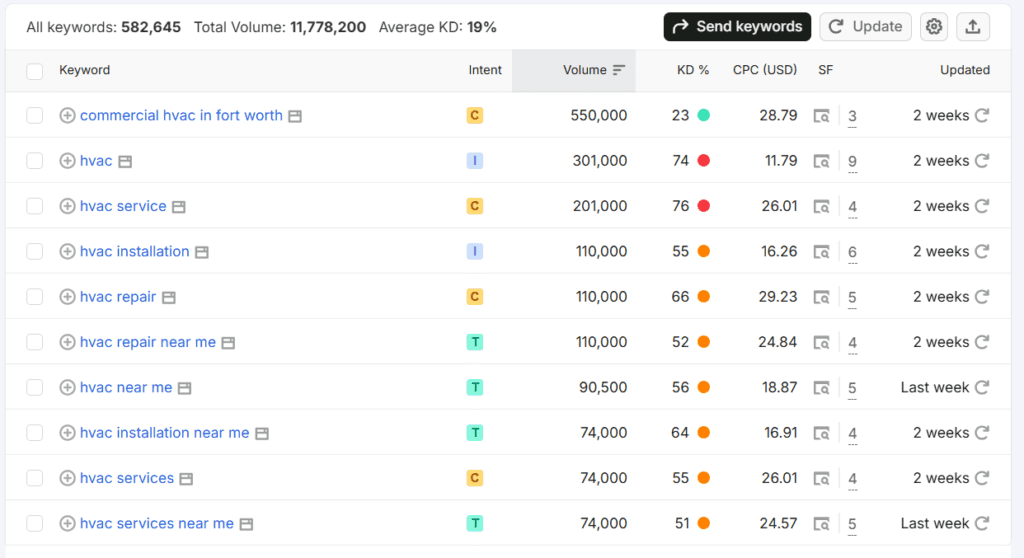
Short-tail keywords like “HVAC” get enormous search volume but are dominated by national aggregators (HomeAdvisor, Angi) and massive brands. An independent HVAC company targeting “HVAC” alone is a waste of budget and time.
Long-tail keywords are where local HVAC companies win: (Data from SEMRush)
| Keyword Type | Example | Avg. Monthly Searches | Competition | Conversion Potential |
|---|---|---|---|---|
| Short-tail | HVAC | 301,000 | Very High | Very Low |
| Long-tail | heat pump emergency repair | 110 | Low | Very High |
Keyword Vetting Checklist:
- ☐ Search volume ≥ 50 monthly (local long-tails are still valuable below this threshold if intent is high)
- ☐ Clear commercial or transactional intent
- ☐ Keyword difficulty (KD) under 40 on Semrush/Ahrefs for new domains
- ☐ Contains a geographic modifier or is a “near me” variant
- ☐ Maps to a specific page you can create or optimize
IV. How to Optimize On-Page HVAC Content for Featured Snippets
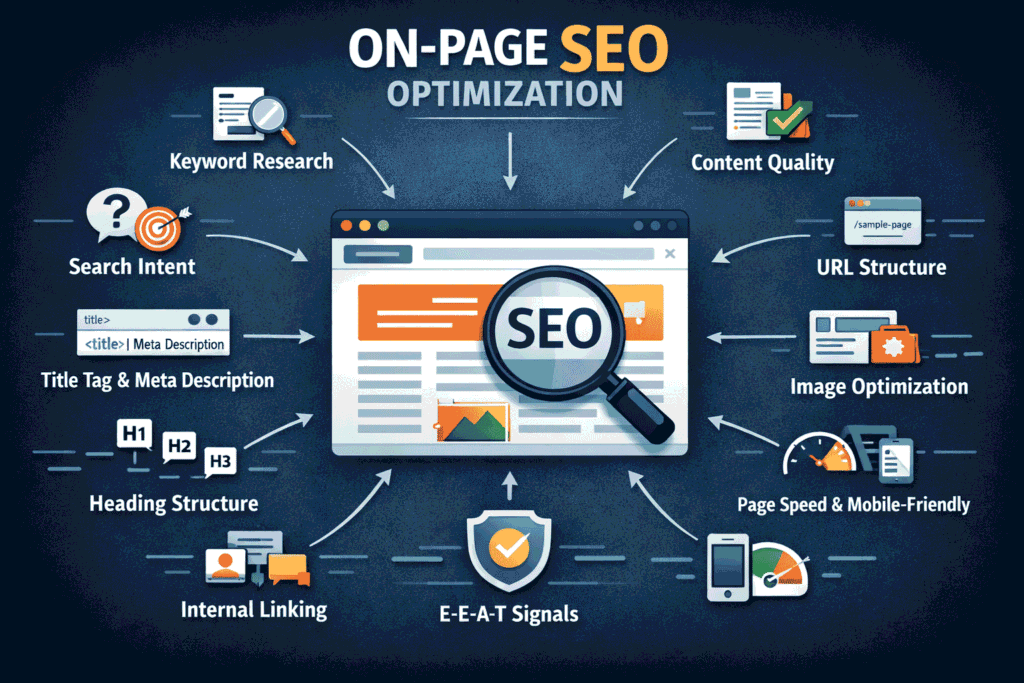
On-page optimization is where most HVAC websites leave enormous ranking opportunity on the table. The goal isn’t just to include keywords — it’s to structure your content so Google can extract and display it as a direct answer.
Title Tags & Meta Descriptions
Your title tag is the single most important on-page ranking signal outside of content quality. For HVAC service pages, the proven formula is:
[Service] + [City/Location] | [Urgency/USP]
Examples:
- “24/7 AC Repair Austin | Same-Day Service Available”
- “Furnace Installation Denver | Licensed & Insured HVAC Pros”
- “Emergency Heating Repair Chicago | Call Now, We Answer 24/7”
Rules:
- Keep title tags under 60 characters to avoid truncation in SERPs
- Meta descriptions: 150–160 characters, include primary keyword and a clear CTA
- Every service page needs a unique title tag — never duplicate across locations
Header Hierarchy (H2/H3 Structure)
Google’s featured snippet algorithm heavily favors content that directly answers questions within a clear header structure. Structure each service page to answer “who, what, where, when, why”:
H1: AC Repair in [City] — Same-Day Service
  H2: What Does AC Repair Include?
  H2: How Much Does AC Repair Cost in [City]?
    H3: Factors That Affect AC Repair Pricing
    H3: When Is It Better to Replace Than Repair?
  H2: How to Know If Your AC Needs Repair
  H2: Why Choose [Company Name] for AC Repair?
  H2: Frequently Asked Questions About AC Repair
This structure ensures your content competes for “People Also Ask” boxes, which now appear on the vast majority of local service queries.
Image & Video SEO
Images and video are underutilized ranking assets in HVAC SEO. Properly optimized, they drive both image search traffic and enhance your E-E-A-T signals.
Image SEO best practices:
- Use descriptive, keyword-rich filenames:
hvac-technician-replacing-air-filter-denver.jpg(notIMG_4521.jpg) - Write specific alt text that describes the action and includes relevant keywords
- Compress images to under 150KB without sacrificing quality (use tools like Squoosh)
- Use WebP format where possible — it reduces file size by 25–35% vs. JPEG
Proper alt text example (HTML):
<img
  src="hvac-technician-replacing-air-filter-denver.jpg"
  alt="Licensed HVAC technician replacing a clogged air filter in a Denver home HVAC unit"
  width="800"
  height="600"
  loading="lazy"
/>
Video SEO: Embed YouTube troubleshooting videos on relevant service and blog pages. A video titled “How to Tell If Your Furnace Heat Exchanger Is Cracked” embedded on your furnace repair page signals topical depth to Google and increases time-on-page — both positive quality indicators.
Internal Linking Strategy
Internal links distribute page authority across your site and help Google understand your content hierarchy. For HVAC websites, a strong internal linking structure looks like this:
- Service pages link to each other: “Furnace Repair” → “Thermostat Replacement” → “Duct Cleaning”
- Blog posts link to service pages: “Signs Your AC Needs Repair” → “AC Repair [City]” page
- Location pages link to service pages: “[City] HVAC Services” → “AC Installation [City]”
- Pillar pages link to cluster content: “Complete HVAC Maintenance Guide” → 10 related blog posts
Use descriptive anchor text — not “click here” or “learn more.” Instead: [INTERNAL LINK: “emergency furnace repair in Denver” → Furnace Repair Denver service page]
V. How to Dominate Local SEO & Google’s Local Pack (With Schema)
The Google Local Pack — those three businesses that appear with a map at the top of local search results — captures a disproportionate share of clicks. Studies by BrightLocal show the Local Pack receives 44% of all clicks on local service queries. Ranking here is the most impactful single improvement most HVAC companies can make.
Google Business Profile (GBP) Optimization
Your Google Business Profile is the command center of your local SEO. It’s free, it’s powerful, and most HVAC companies barely scratch its surface.
Category Selection:
- Primary category: “HVAC Contractor” (most important signal)
- Secondary categories: Add “Air Conditioning Repair Service,” “Furnace Repair Service,” “Heating Contractor” — as many as apply
Profile Completeness Checklist:
- ☐ Business name matches your website and all citations exactly
- ☐ Service area set to all cities/zip codes you serve (don’t hide your address if you have an office)
- ☐ Emergency phone number visible and verified
- ☐ Services list populated (include every service with descriptions)
- ☐ Q&A section seeded with 5–10 common customer questions (you can post these yourself)
- ☐ Google Posts published weekly (promotions, seasonal offers, new content)
- ☐ Photos updated monthly — minimum 20 photos including technicians, equipment, before/after work
Local Citations & NAP Consistency
A “citation” is any online mention of your business name, address, and phone number (NAP). Inconsistent NAP data across directories sends conflicting signals to Google and suppresses your local rankings.
Priority Citation Sources for HVAC:
| Directory | Domain Authority | HVAC Value |
|---|---|---|
| Yelp | 93 | High |
| Angi (formerly Angie’s List) | 91 | Very High |
| HomeAdvisor | 88 | Very High |
| BBB (Better Business Bureau) | 91 | High |
| Houzz | 85 | High |
| Thumbtack | 82 | High |
| Local Chamber of Commerce | Varies | High |
| ACCA (Air Conditioning Contractors of America) | 62 | Very High (industry authority) |
Use a tool like BrightLocal or Whitespark to audit your existing citations for NAP inconsistencies before building new ones.
Review Schema & Response Strategy
Reviews are the #1 trust signal for local service businesses. According to Moz’s Local Search Ranking Factors, review signals account for approximately 16% of local pack ranking factors.
How to ask for reviews (text message template):
“Hi [Name], this is [Tech Name] from [Company]. Thanks for letting us service your HVAC system today! We’d really appreciate a quick Google review — it only takes 60 seconds and helps our local business a lot. Here’s the direct link: [shortlink]. Thank you!”
Responding to negative reviews (framework):
- Thank them for the feedback (don’t be defensive)
- Acknowledge the specific issue
- Take the conversation offline: “Please call our manager at [number]”
- Never argue publicly — your response is for future readers, not just the reviewer
Local Business Schema (JSON-LD) — Copy-Paste Ready
This is one of the highest-value additions you can make to your HVAC website. Local Business Schema tells Google and AI engines exactly what your business does, where you operate, and how to contact you — in structured, machine-readable format.
Copy-paste this JSON-LD snippet into your website’s <head> section:
{
  "@context": "https://schema.org",
  "@type": "HVACBusiness",
  "name": "[Your Company Name]",
  "url": "https://www.yourcompany.com",
  "logo": "https://www.yourcompany.com/images/logo.png",
  "image": "https://www.yourcompany.com/images/hvac-team.jpg",
  "description": "Licensed HVAC contractor providing AC repair, furnace installation, and emergency heating and cooling services in [City] and surrounding areas.",
  "telephone": "+1-555-000-0000",
  "email": "info@yourcompany.com",
  "priceRange": "$$",
  "currenciesAccepted": "USD",
  "paymentAccepted": "Cash, Credit Card, Financing",
  "acceptsReservations": "True",
  "openingHoursSpecification": [
    {
      "@type": "OpeningHoursSpecification",
      "dayOfWeek": ["Monday","Tuesday","Wednesday","Thursday","Friday"],
      "opens": "07:00",
      "closes": "19:00"
    },
    {
      "@type": "OpeningHoursSpecification",
      "dayOfWeek": ["Saturday"],
      "opens": "08:00",
      "closes": "16:00"
    }
  ],
  "address": {
    "@type": "PostalAddress",
    "streetAddress": "123 Main Street",
    "addressLocality": "[City]",
    "addressRegion": "[State]",
    "postalCode": "[ZIP]",
    "addressCountry": "US"
  },
  "geo": {
    "@type": "GeoCoordinates",
    "latitude": "00.0000",
    "longitude": "-00.0000"
  },
  "areaServed": [
    {
      "@type": "City",
      "name": "[Primary City]"
    },
    {
      "@type": "City",
      "name": "[Secondary City]"
    }
  ],
  "sameAs": [
    "https://www.facebook.com/yourcompany",
    "https://www.yelp.com/biz/yourcompany",
    "https://www.google.com/maps?cid=XXXXXXXXX"
  ],
  "aggregateRating": {
    "@type": "AggregateRating",
    "ratingValue": "4.9",
    "reviewCount": "214"
  }
}
How to add this to your site:
- WordPress: Use the Schema Pro plugin or add via your theme’s
functions.php - Google Tag Manager: Create a Custom HTML tag, paste the
<script type="application/ld+json">block, and set it to fire on All Pages - HTML websites: Paste directly inside the
<head>tag of your homepage and key service pages
VI. What Type of Content Builds E-E-A-T for HVAC Websites?
E-E-A-T isn’t a single ranking factor — it’s a collection of signals that collectively tell Google your website deserves to rank for queries where the wrong answer could cost someone money or comfort. HVAC queries often involve significant purchase decisions ($2,000–$15,000+ for system replacements), which means Google’s quality standards are correspondingly high.
Pillar Pages & Topic Clusters
The most effective HVAC content architecture is the pillar-cluster model:
Pillar page: “The Complete Guide to HVAC Maintenance” (2,500–4,000 words)
Cluster content linking back to it:
- “How to Clean Your AC Coils Step by Step”
- “Signs Your Furnace Heat Exchanger Is Cracked”
- “How Often Should You Change Your HVAC Filter?”
- “What Is a SEER Rating and Why Does It Matter?”
- “How to Prepare Your HVAC System for Winter”
- “Common Reasons Your Air Conditioner Is Not Cooling”
Each cluster post is individually optimized for a long-tail keyword and internally links to the pillar. This structure signals topical authority to Google — you’re not just a company with a website, you’re a genuine resource on HVAC.
“Cost vs. Value” Content Tables
Transparent pricing content is one of the most powerful trust-building moves an HVAC company can make online. Homeowners desperately want to know if they’re being quoted fairly — and if your website answers that question, you earn their trust before they ever call.
Common HVAC Repair Cost Ranges (2025–2026 averages):
| Service / Repair | Low-End Cost | High-End Cost | Average Cost |
|---|---|---|---|
| AC Tune-Up | $75 | $200 | $130 |
| Refrigerant Recharge | $150 | $450 | $280 |
| Capacitor Replacement | $90 | $250 | $170 |
| Contactor Replacement | $150 | $350 | $220 |
| Blower Motor Replacement | $350 | $900 | $600 |
| Evaporator Coil Replacement | $650 | $1,200 | $900 |
| Condenser Coil Replacement | $900 | $2,500 | $1,600 |
| Compressor Replacement | $1,200 | $2,800 | $1,900 |
| Furnace Tune-Up | $80 | $200 | $130 |
| Heat Exchanger Replacement | $500 | $1,500 | $950 |
| New HVAC System (Central) | $5,500 | $12,000 | $8,000 |
| Heat Pump Installation | $4,500 | $10,000 | $7,000 |
| Duct Cleaning | $300 | $700 | $475 |
Note: Costs vary significantly by region, brand, and system age. Always get multiple quotes.
Pro tip: Add a cost guide to every major service page. Not only does it build trust, it targets informational intent queries like “how much does AC compressor replacement cost” — queries that drive massive organic traffic and frequently win featured snippets.
Video Case Studies
Nothing demonstrates real-world experience like documented job footage. A 90-second video showing a technician diagnosing a failed capacitor, explaining the issue in plain language, and showing the completed repair is worth more than a thousand words of marketing copy.
Video content ideas that build E-E-A-T:
- Before/after system replacements with homeowner testimonial
- “Day in the life of an HVAC technician” (humanizes your brand)
- Seasonal maintenance walkthroughs
- Animated explainer: “How a Heat Pump Works”
Upload to YouTube with keyword-optimized titles, descriptions, and tags. Then embed relevant videos on your service pages. Google surfaces video results prominently for instructional and diagnostic queries.
FAQ Page (Schema-Ready)
A dedicated FAQ page targeting 10–20 common customer questions serves three purposes:
- It captures long-tail informational traffic
- It competes for “People Also Ask” positions in Google
- It reduces pre-call friction by answering objections proactively
VII. How to Earn High-Quality Backlinks (Without Spam)
Backlinks remain one of Google’s top three ranking factors. But in 2026, quality vastly outweighs quantity. One link from a local news publication or a trade association is worth more than 500 links from low-quality directories.
Local Partnership Links
These are the most natural, most Google-approved links an HVAC company can earn:
- ACCA (Air Conditioning Contractors of America): Member listing at ACCA.org — high DA, industry-relevant
- Local hardware stores: Offer to write a maintenance tip article for their blog or newsletter in exchange for a link
- Real estate agencies: Position yourself as their “referred HVAC inspector” and get listed on their vendor resource page
- Property management companies: Similar to real estate — vendor relationship links
- Local news: A seasonal story pitch (“How to prepare your HVAC for a Denver winter”) often lands coverage with a link
- Home builders/contractors: Referral relationships often translate to website mentions
“Skyscraper” Content for Link Earning
The Skyscraper Technique, popularized by Backlinko, involves:
- Finding content in your niche that already has backlinks (e.g., “HVAC emergency checklist” with 40 linking domains)
- Creating a definitively better version (more comprehensive, better formatted, more up-to-date)
- Reaching out to every site that links to the inferior piece and offering yours as a superior replacement
HVAC content types with high link-earning potential:
- “The Ultimate HVAC Emergency Checklist (Printable)”
- “HVAC Lifespan Guide: How Long Does Every Component Last?”
- “Complete HVAC Glossary: 80 Terms Every Homeowner Should Know”
- “HVAC Energy Efficiency Guide: How to Cut Cooling Costs by 30%”
Unlinked Brand Mentions
If your company has been in business for a few years, there’s a good chance local publications, Yelp reviews, or neighborhood forums have mentioned your brand name without linking to your website. Use Ahrefs Content Explorer or Google Alerts to find these, then email the site owner requesting a link — it’s one of the highest-conversion outreach emails in SEO.
Broken Link Building
Find broken resources on authoritative sites relevant to home improvement, energy efficiency, or local government. Tools like Ahrefs Site Explorer or the Check My Links Chrome extension make this systematic:
- Search
.govor.edusites for HVAC, energy, or home comfort topics - Find pages with broken outbound links
- Create a relevant, high-quality resource on your site
- Email the webmaster offering your resource as a replacement
This strategy earns the highest-authority links available to a local HVAC company — and most competitors have no idea it exists.
VIII. How to Use Schema Markup & Structured Data (Beyond Local Business)
Most HVAC companies implement basic Local Business Schema and stop there. But structured data is a multi-layer opportunity — each schema type unlocks different rich result formats in Google SERPs and increases your eligibility for AI engine citations.
FAQ Schema
FAQ Schema wraps your question-and-answer content in JSON-LD, making it eligible to appear as expandable questions directly in Google’s search results.
Example FAQ Schema for “How often should I service my HVAC?”:
{
  "@context": "https://schema.org",
  "@type": "FAQPage",
  "mainEntity": [
    {
      "@type": "Question",
      "name": "How often should I service my HVAC system?",
      "acceptedAnswer": {
        "@type": "Answer",
        "text": "HVAC systems should be serviced twice per year — once in spring before cooling season and once in fall before heating season. Annual minimum maintenance includes replacing filters, cleaning coils, checking refrigerant levels, and inspecting electrical connections."
      }
    },
    {
      "@type": "Question",
      "name": "How long does an HVAC system last?",
      "acceptedAnswer": {
        "@type": "Answer",
        "text": "A well-maintained central HVAC system lasts 15–20 years. Heat pumps typically last 12–15 years. Regular maintenance and prompt repairs significantly extend system lifespan."
      }
    }
  ]
}
HowTo Schema
For step-by-step content like “How to Change Your HVAC Filter,” HowTo Schema can generate a rich result showing numbered steps directly in Google — dramatically increasing your click-through rate.
Best HowTo content candidates for HVAC:
- How to change an HVAC filter
- How to check if your AC is low on refrigerant
- How to reset a tripped furnace breaker
- How to clean an outdoor AC condenser unit
Service & Product Schema
Mark up individual services with offers and aggregate review data. This tells Google not just that you’re an HVAC company, but specifically that you offer duct cleaning with a 4.9-star rating from 214 customers. That level of granularity improves both ranking relevance and click-through rate.
Video Schema
If you’ve embedded YouTube tutorials on your service or blog pages, add VideoObject Schema to help Google surface them as video rich results. Key fields: name, description, thumbnailUrl, uploadDate, duration, and embedUrl.
IX. What Metrics Should HVAC Companies Track? (Beyond Rankings)
Tracking keyword rankings is table stakes. The metrics below tell you whether your SEO is actually generating revenue — which is the only number that matters.
1. Local Pack Impressions
Track how often your GBP appears in map results using GBP Insights. Watch for trends — if impressions drop after a GBP update or a competitor earns new reviews, you’ll see it here first.
2. GBP Insights (Click-Through Breakdown)
GBP Insights breaks down how users interact with your listing:
- Direction requests: How many people got directions to your location
- Phone call clicks: Direct calls from the GBP listing
- Website clicks: Traffic routed to your site
- Search queries: The exact terms people used to find your listing
This data is uniquely local-intent-rich — it’s all from people who were already in “local search” mode.
3. Call Tracking
Install a call tracking solution like CallRail or CallTrackingMetrics to attribute phone calls to specific keywords and pages. This closes the loop between SEO activity and actual revenue — you’ll know exactly which blog post or service page generated a booked job.
4. Core Web Vitals & Mobile-First Indexing
Google uses Core Web Vitals as a ranking signal. For HVAC websites, the most common failures are:
| Metric | What It Measures | Target |
|---|---|---|
| LCP (Largest Contentful Paint) | How fast the main content loads | Under 2.5 seconds |
| FID / INP (Interaction to Next Paint) | Responsiveness to user input | Under 200ms |
| CLS (Cumulative Layout Shift) | Visual stability during load | Under 0.1 |
Use Google PageSpeed Insights to audit your site. Common fixes: compress images, eliminate render-blocking JavaScript, and use a fast hosting provider.
5. Google Search Console
Google Search Console is your ground-truth SEO dashboard. Monitor:
- Average position: Are your target keywords climbing or falling?
- Click-through rate (CTR): If impressions are high but CTR is low, your title tag needs work
- Coverage errors: Crawl errors or pages marked “Excluded” indicate indexing problems
Printable Monthly HVAC SEO Dashboard Checklist:
- ☐ Review GBP Insights — impressions, calls, direction requests
- ☐ Check Google Search Console for new coverage errors
- ☐ Log top 5 keyword position changes in tracking sheet
- ☐ Review CallRail report — which pages drove calls this month?
- ☐ Run PageSpeed Insights on homepage and top service page
- ☐ Check review count and average rating (did anything change?)
- ☐ Verify NAP consistency on your top 5 citation sources
X. Conclusion & Next Steps
The 8 HVAC SEO Tips — Quick Recap
- Understand HVAC search intent — optimize separately for informational, navigational, and transactional queries
- Target long-tail, high-intent keywords — city + service combinations with urgency modifiers
- Optimize on-page content for featured snippets — clear H2/H3 hierarchy, structured answers, optimized alt text
- Dominate your Google Business Profile — categories, service areas, photos, Q&A, weekly posts
- Build NAP consistency — audit and fix all citation sources before building new ones
- Create E-E-A-T content — pillar pages, cost guides, video case studies, FAQ pages with schema
- Earn quality backlinks — trade associations, local partnerships, skyscraper content, broken link building
- Implement multi-layer schema — Local Business, FAQ, HowTo, Video, and Service schema
The Actionable HVAC SEO Checklist
Foundation (Month 1):
- ☐ Claim and fully optimize Google Business Profile
- ☐ Add LocalBusiness / HVACBusiness JSON-LD schema to website
- ☐ Audit NAP consistency across top 10 citation sources
- ☐ Install Google Search Console and Google Analytics 4
- ☐ Run Core Web Vitals audit on homepage and top service pages
- ☐ Set up call tracking (CallRail or similar)
Content (Month 1–3):
- ☐ Create city-specific service pages for each location you serve
- ☐ Build a pillar page for your primary service (AC or heating)
- ☐ Publish 2 blog posts targeting informational HVAC queries
- ☐ Add pricing/cost guide content to at least 3 service pages
- ☐ Add FAQ section with schema to homepage and service pages
Authority (Month 3–6):
- ☐ Submit to ACCA, Angi, Houzz, BBB, and local Chamber of Commerce
- ☐ Launch review acquisition process (text or email template post-job)
- ☐ Publish one “skyscraper” linkable asset (printable guide or checklist)
- ☐ Identify and pursue 5 local link-building opportunities
- ☐ Implement HowTo or VideoObject schema on at least one page
Ongoing:
- ☐ Publish 1–2 new blog posts per month
- ☐ Update seasonal service pages before each peak season
- ☐ Review monthly GBP Insights and Search Console data
- ☐ Respond to every new Google review within 48 hours
The HVAC companies winning in local search aren’t doing anything mysterious — they’re executing fundamentals with more consistency and more depth than their competitors. The framework above gives you everything you need to build a Local Pack-ready, AI-cited, backlink-earning digital presence.
Start today: Pull up your Google Business Profile and complete any missing fields. Then implement the LocalBusiness Schema snippet from Section V — it takes under 30 minutes and immediately improves how Google and AI engines understand your business.
If you want a professional audit of where your HVAC website currently stands, request a Free SEO Audit — we’ll identify your highest-impact opportunities and build a prioritized roadmap.
Frequently Asked Questions
What is HVAC SEO and how does it help a heating and cooling business get more customers?
HVAC SEO is the strategic process of optimizing a heating, ventilation, and air conditioning website to rank higher in organic search engine results. By targeting high-intent keywords like emergency AC repair, search engines can easily crawl, understand, and index your services. In practice, organic search results deliver up to a 5x higher return on investment compared to traditional print advertising. Across competitive markets in both the US and the UK, optimizing your technical infrastructure turns your website into a 24/7 lead generation asset that captures homeowners the exact moment their climate control systems fail.
Why do residential heating and cooling companies need specialized HVAC SEO instead of standard digital marketing?
Specialized HVAC SEO targets the precise, hyper-local search behavior of homeowners experiencing immediate, high-stress property emergencies. Standard digital marketing often overlooks critical local entities and proximity signals that search engine algorithms rely on to rank local trade services. Data shows that over 60% of emergency home service searches are conducted on mobile devices by users needing immediate assistance. By implementing advanced Schema.org structured data structured for local trades, specialized optimization connects your trucks directly to the neighborhoods you serve. This targeted approach ensures your business appears in front of ready-to-buy homeowners rather than casual web browsers.
How do you optimize a Google Business Profile to win more local HVAC service calls?
Optimizing a Google Business Profile requires claiming your local entity, maintaining absolute name-address-phone consistency, and selecting precise service categories. The Google Map Pack captures up to 44% of all clicks on local search results pages, making this your most valuable online real estate. Our methodology drives proximity and trust signals by regularly publishing geo-targeted updates and setting up automated review systems. Across major metropolitan markets in the US and UK, active profile management establishes your business as a verified local authority. This process converts casual local searchers into scheduled service appointments without paying for costly third-party lead brokers.
What are the most important local search ranking factors for HVAC contractors in competitive markets?
The most critical ranking factors for local service providers are proximity, prominent customer reviews, and comprehensive local entity citations. Google’s local algorithm heavily prioritizes businesses that actively maintain accurate data across verified directories like BrightLocal. Furthermore, aligning your on-page location pages with localized Local Service Ads creates a powerful, dual-visibility effect in search results. In highly competitive US and UK territories, historical search data confirms that businesses with structured local signals consistently outrank larger, non-local competitors. Building a dense network of hyper-local citations ensures your business remains dominant across your entire physical service radius.
How long does it take to see organic search ranking improvements and phone calls from an HVAC SEO campaign?
Initial organic ranking improvements and increases in phone calls typically appear within 60 to 90 days of campaign deployment. Technical adjustments, such as fixing crawl errors via Google Search Console and updating metadata, yield rapid indexing updates from search engine bots. However, establishing deep topical authority and outranking long-standing local competitors is a cumulative process that matures over three to six months. In competitive US regional markets, our data shows that the most sustainable, high-volume lead growth kicks in after structural optimizations take full effect. This realistic timeline ensures your digital infrastructure builds permanent asset value rather than temporary, artificial spikes.
How much does professional HVAC SEO cost and what is included in a baseline marketing budget?
Professional campaigns at Searchlyn feature structured, comprehensive optimization packages that start from an investment of $1100 per month. This baseline budget covers comprehensive technical audits, Google Business Profile management, local citation building, and dedicated landing page creation. Investing in organic optimization provides a highly cost-effective alternative to pay-per-click ads, which stop generating leads the moment your budget runs out. Across hundreds of home service campaigns in the US and UK, this price tier allows for aggressive local asset building that scales as your business grows. Our transparent pricing model ensures every dollar spent directly finances measurable keyword movement and verifiable phone calls.
Which areas of a website must be optimized to rank an HVAC business in the Google Map Pack?
To rank consistently in the Google Map Pack, an HVAC website must optimize its local schema markup, mobile responsiveness, and location-specific service pages. Search engines reward websites that pass strict Core Web Vitals tests, which measure real-world loading speed and visual stability for mobile users. Your core digital assets must also feature clear geographic signals embedded naturally within headings, image alt text, and footer data. In practice, connecting these on-page optimization signals with an active Google Business Profile creates a cohesive entity loop. This technical alignment proves to search algorithms that your business is legitimate, local, and ready to serve nearby customers.
How does Searchlyn ensure a heating and cooling website stays ahead of traditional search algorithm updates?
Searchlyn protects your digital visibility by deploying an advanced, evergreen content architecture built on strict technical search guidelines. Instead of chasing short-term loopholes, our team focuses on building comprehensive topical authority around core service hubs like energy-efficient heat pump installations. We utilize advanced diagnostics via tools like Screaming Frog to eliminate structural errors before they can negatively impact your organic rankings. This preventative, high-standard approach ensures that your website maintains stable search engine real estate even during volatile core algorithm rollouts. Our specialized framework treats your website as a premium corporate asset designed to dominate your local market for years.
How do generative AI search engines change the way homeowners search for local HVAC repair services?
Generative AI search engines use advanced natural language processing to answer complex, highly conversational queries like find an affordable technician to fix an air conditioner tonight. To capture traffic from AI Overviews, Gemini, and ChatGPT, business content must transition from simple keywords to clear, conversational answers. These advanced engines rely heavily on extracting structured data, explicit geographic entities, and verifiable brand facts to cite their answers. Our specialized AI Search Optimization ensures your business data is structured perfectly for extraction by modern generative answer models in the US and UK markets. This proactive strategy captures premium, high-intent traffic before users ever click through to a traditional search results page.
What proof can an elite agency provide to show that their HVAC search marketing strategies actually work?
Elite agencies demonstrate capability by showcasing verified search engine ranking gains, increased call volumes, and strict adherence to Google’s E-E-A-T guidelines. Trustworthiness is earned by showing transparent, real-time dashboards that connect optimization work directly to new customer intake and business revenue. In practice, our home services frameworks have successfully scaled independent contractors into dominant regional market leaders across both the US and UK. We back our specialized methodologies with transparent case studies and verifiable performance metrics that eliminate guesswork from your marketing budget. This data-driven transparency guarantees that your digital growth strategy is guided by real market results rather than empty promises.
Last updated: Jun 2026 by Searchlyn team