- Introduction
- II. Understanding Off Page SEO
- III. Building a Strong Backlink Profile
- IV. Leveraging Social Media for Off-Page SEO
- V. Content Marketing and Guest Blogging
- VI. Online Reputation Management
- VII. Influencer Outreach
- VIII. Local SEO and Citations
- IX. Monitoring and Analyzing Off-Page SEO Efforts
- X. Conclusion
- Build Real Authority Before Your Competitors Do
- Frequently Asked Questions
Introduction
Most websites that fail to rank don’t have a content problem — they have an authority problem. You can publish the most technically perfect, brilliantly written page on the internet, and it will still sit on page five if no one trusts your domain. That’s the core problem off-page SEO solves.
Off-page SEO refers to every action taken outside your own website to improve its visibility, credibility, and ranking position in search engine results pages (SERPs). Unlike on-page SEO — which covers your content, metadata, and site architecture — off-page SEO is fundamentally about how the rest of the internet perceives and references your website.
In this guide, you’ll get a comprehensive, actionable off page SEO checklist covering every lever that matters in 2026: link building, social signals, content marketing, local citations, online reputation, influencer outreach, and performance monitoring. Each section includes specific steps, real-world examples, and the data behind why each tactic works.
Whether you’re an SEO professional, a business owner, or a digital marketing strategist, this off page SEO checklist will give you a systematic framework for building domain authority and sustainable organic growth.
II. Understanding Off Page SEO
What Is Off-Page SEO?
Off-page SEO is the collective set of strategies and activities performed outside the boundaries of your own website that influence how search engines evaluate your site’s authority, relevance, and trustworthiness.
At its core, off-page SEO is about building signals that tell Google, Bing, and AI-driven search engines like Perplexity and ChatGPT Search: “This website is credible, referenced by others, and worthy of appearing at the top of results.”
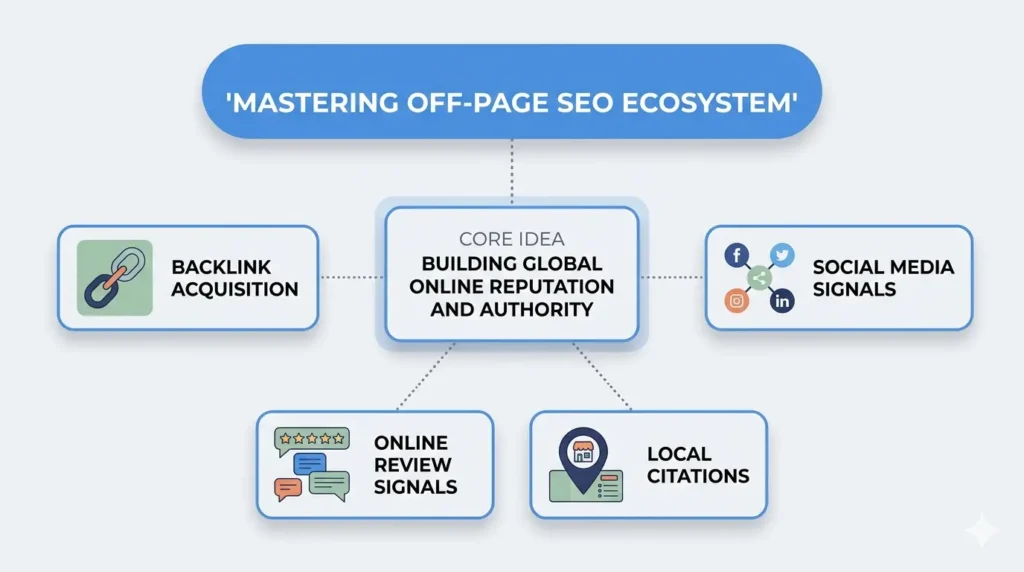
The primary components of off-page SEO include:
- Backlink acquisition — earning links from other domains pointing to yours
- Brand mentions — citations of your brand name, with or without hyperlinks
- Social signals — engagement, shares, and visibility on social platforms
- Local citations — consistent NAP (Name, Address, Phone) mentions across directories
- Online reputation — reviews, ratings, and public perception across platforms
- Content syndication — republishing or distributing content to third-party channels
- Influencer relationships — strategic collaborations that extend brand reach
On-Page SEO vs. Off-Page SEO: Key Differences
Understanding the distinction is essential for resource allocation and strategy building.
| Factor | On-Page SEO | Off-Page SEO |
|---|---|---|
| Location of activity | Within your website | External to your website |
| Primary signals | Content, meta tags, schema, site speed | Backlinks, mentions, authority |
| Control level | Full control | Partial to indirect control |
| Primary goal | Relevance and crawlability | Authority and trustworthiness |
| Time to impact | Days to weeks | Weeks to months |
| Key tools | Google Search Console, Screaming Frog | Ahrefs, Majestic, Moz |
| Influenced by | Site owner decisions | Third-party behaviors |
Both dimensions are non-negotiable. On-page SEO ensures your content is relevant and technically sound; off-page SEO ensures it’s considered authoritative enough to rank for competitive keywords.
Key Metrics Influenced by Off-Page SEO
Off-page efforts directly move the following measurable indicators:
- Domain Rating (DR) / Domain Authority (DA) — composite scores by Ahrefs and Moz respectively, reflecting the strength of your backlink profile
- Page Authority (PA) — the link equity pointing to a specific page
- Trust Flow and Citation Flow — Majestic’s metrics measuring link quality and volume
- Referring Domains — the number of unique domains linking to your site (more impactful than total backlinks)
- Organic traffic — long-term outcome of improved authority and ranking positions
- Branded search volume — an indirect indicator of brand awareness driven by off-page exposure
- SERP feature appearances — brand prominence in knowledge panels, AI overviews, and featured snippets
According to Backlinko’s study, pages that rank #1 on Google have an average of 3.8x more backlinks than those ranking in positions #2–#10. Off-page SEO is not a secondary concern — it is one of the primary determinants of competitive ranking.
III. Building a Strong Backlink Profile
Why Backlinks Remain the Cornerstone of Off-Page SEO
Despite decades of algorithm evolution, backlinks remain the single most powerful off-page ranking signal. Google’s original PageRank algorithm was built on the concept of links as votes of confidence — and while that algorithm has grown exponentially more sophisticated, its foundational logic endures.
According to Backlinko’s analysis of 11.8 million Google search results, the number of domains linking to a page has a stronger correlation with first-page rankings than any other factor studied.
What has changed is quality weighting. A single link from a trusted, topically relevant, high-authority domain now outweighs hundreds of links from low-quality directories. Google’s Penguin algorithm update and its subsequent integration into core algorithms permanently shifted the game from link quantity to link quality.
Types of Backlinks: Dofollow vs. Nofollow
Dofollow links pass PageRank (link equity) from the linking page to the linked page. They are the standard type of hyperlink and directly influence ranking signals.
Nofollow links contain the rel="nofollow" attribute, originally introduced by Google in 2005 to combat comment spam. They were historically considered to pass no link equity. However, Google updated its treatment in 2019, reclassifying nofollow as a hint rather than a directive — meaning some nofollow links may still influence rankings.
Additional link attributes introduced in 2019:
| Attribute | Use Case | Link Equity |
|---|---|---|
rel="dofollow" (default) | Standard editorial links | Full equity passed |
rel="nofollow" | User-generated content, untrusted links | Partial/no equity (hint) |
rel="sponsored" | Paid placements or affiliate links | No equity (must disclose) |
rel="ugc" | Forum posts, comment sections | Minimal equity |
Practical guidance: Pursue dofollow links from authoritative editorial sources as your primary goal. Don’t disregard nofollow links — a nofollow link from The New York Times or Forbes still builds brand visibility and drives referral traffic, and may carry indirect ranking benefit.
The Backlink Quality Framework
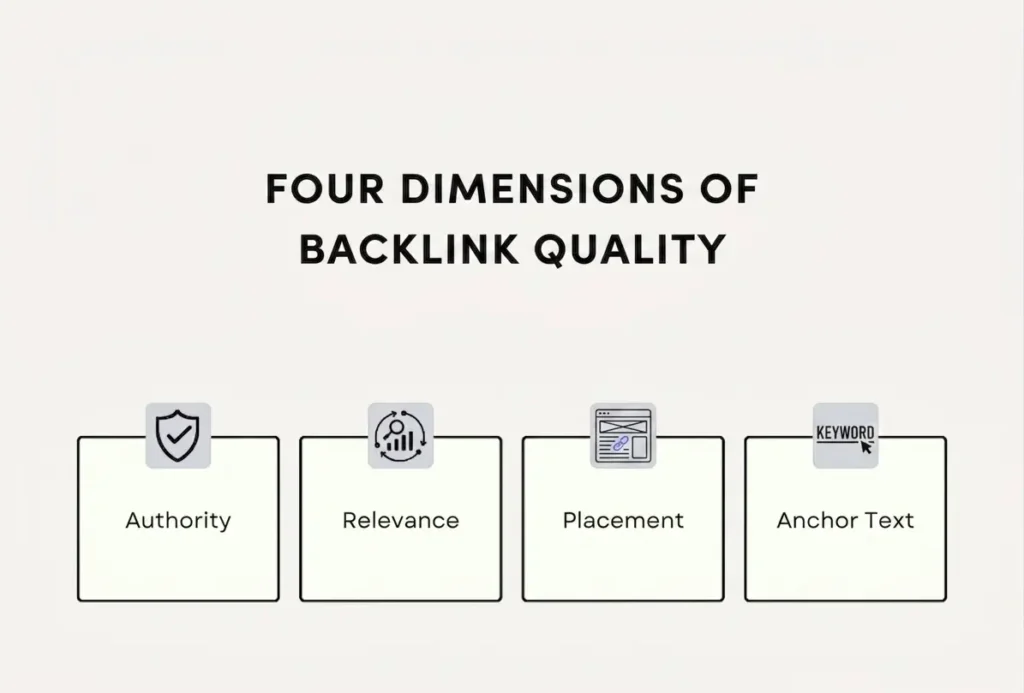
Not all backlinks are equal. Before pursuing any link, evaluate it across these four dimensions:
1. Domain Authority / Domain Rating
Links from high-DA domains (60+) carry significantly more weight than those from low-DA domains (below 20). Check DR using Ahrefs’ free backlink checker or Moz’s Link Explorer.
2. Topical Relevance
A link from a cybersecurity blog to a cybersecurity SaaS company is exponentially more valuable than a link from a food blog to that same company. Google’s Helpful Content and topic authority signals make relevance a critical dimension.
3. Link Placement
Links embedded within the main body content of a page (contextual links) carry far more weight than footer links, sidebar links, or navigational links.
4. Anchor Text
The clickable text of a hyperlink (anchor text) signals relevance. A mix of anchor types is ideal:
- Exact match (“off page SEO checklist”) — use sparingly
- Partial match (“off page SEO strategies”) — moderate use
- Branded (“Searchlyn”) — safe and natural
- Generic (“click here,” “read more”) — lowest signal value but natural
12 Proven Strategies for Acquiring High-Quality Backlinks
1. The Skyscraper Technique
Identify high-ranking content in your niche with significant backlinks. Create a demonstrably superior version (more data, better design, more depth). Then outreach to sites linking to the original, showing them why yours is a better resource. This technique, popularized by Brian Dean at Backlinko, remains one of the highest-ROI link building methods available.
2. Original Research and Data Studies
Publishing original survey data, industry benchmarks, or proprietary research generates natural, editorial backlinks at scale. When your data is the source, others must link to you to cite it. This is the strategy behind most “statistics” roundup pages — a piece like “50 SEO statistics for 2026” can accumulate hundreds of links passively over time.
3. Digital PR and Newsjacking
Identify breaking stories or trending topics in your industry. Create rapid, expert-level commentary or data pieces around them and distribute to journalists. Tools like HARO (Help a Reporter Out), Qwoted, and Connectively connect you with journalists actively seeking expert sources.
4. Broken Link Building
Use tools like Ahrefs’ broken link checker or Check My Links Chrome extension to identify 404 errors on authoritative pages. Contact the webmaster, flag the broken link, and offer your relevant content as a replacement. This provides genuine value and has a high acceptance rate.
5. Resource Page Link Building
Many authoritative websites maintain “resources” or “links” pages curating helpful external content. Search for pages using queries like:
"[your keyword]" + "useful resources""[your topic]" + intitle:"resources""[your industry]" + "recommended reading"
Contact the curator and pitch your content as a valuable addition.
6. Guest Posting on High-Authority Publications
Write substantive, original articles for established publications in your niche. Focus on topical relevance and editorial quality. A single guest post on a DA 70+ site with a contextual link can move rankings more than twenty links from low-authority blogs. (Covered in depth in Section V.)
7. Link Reclamation
Use tools like Ahrefs Alerts or Google Alerts to find unlinked brand mentions. When someone references your company, product, or content without linking to you, contact them and politely request that they add a link. These are among the easiest wins in link building — the publisher already values your brand enough to mention it.
8. The Content Asset / “Linkable Asset” Strategy
Create content specifically engineered to attract links: comprehensive guides, free tools, calculators, interactive data visualizations, or original research reports. The more utility the asset provides, the more organic link acquisition it generates over time.
9. Testimonials and Case Studies
Write genuine testimonials for tools, software, or services you use. Many vendors publish these testimonials on their website with a link back to your domain. One hour of effort can yield links from high-authority SaaS websites.
10. Podcast Appearances
Industry podcasts routinely link to guest websites in show notes. A single episode appearance on a respected podcast can yield a dofollow link, referral traffic, brand exposure, and topic authority — simultaneously.
11. Scholarship Link Building
Create a scholarship program relevant to your industry and offer it to university students. Universities and .edu domains typically link to scholarship pages. Academic links carry significant authority due to their institutional trust level.
12. Strategic Partnerships and Co-Marketing
Partner with complementary (non-competing) businesses in your niche for co-authored content, joint webinars, or shared research. Partners naturally link to collaborative content on their own domains.
Backlink Profile Health: What to Avoid
Building a strong backlink profile is only half the equation. Protecting it from toxic links is equally important.
Avoid:
- Private Blog Networks (PBNs) — Google actively devalues and penalizes these
- Link farms and mass directory submissions
- Paid links without proper
rel="sponsored"attribution - Irrelevant niche links (a casino site linking to your SaaS product)
- Exact-match anchor text over-optimization (more than 5–10% of your link profile)
Regular maintenance checklist:
- Monthly Ahrefs / SEMrush toxic link audit
- Review new referring domains for relevance and authority
- Disavow genuinely toxic links via Google Search Console Disavow Tool
- Monitor anchor text distribution for over-optimization signals
- Track lost backlinks and attempt to recover high-value ones
IV. Leveraging Social Media for Off-Page SEO
The Relationship Between Social Media and SEO
Social media does not directly influence Google’s ranking algorithm — Google has confirmed that social signals (likes, shares, followers) are not used as direct ranking factors. However, the indirect relationship between social media and SEO is substantial and well-documented.
Here’s the causal chain: Strong social media presence → wider content distribution → more people read your content → more people link to it, mention it, and share it further → backlinks and brand signals increase → rankings improve.
Additionally, social profiles themselves frequently rank in branded SERPs. Your LinkedIn company page, Twitter/X profile, Facebook page, and YouTube channel can occupy multiple positions on the first page for branded searches — a critical reputation management advantage.
According to HubSpot’s State of Marketing Report, businesses that consistently share content on social media see 3.5x more inbound links than those that don’t maintain an active presence.
Platform-Specific Best Practices
- Ideal for B2B brands, professional services, SaaS, and agencies
- Publish long-form articles directly on LinkedIn (LinkedIn Articles) — these rank in Google
- Share blog posts as native posts with key takeaways, not just bare links
- Engage with comments within the first hour of posting (boosts algorithmic distribution)
- Use LinkedIn newsletters to build a direct subscriber base
Twitter / X
- High-velocity content distribution for tech, marketing, and media industries
- Tweet threads break down complex topics and encourage engagement
- Tag relevant journalists, analysts, and creators when sharing original research
- Use Spaces for audio content that reinforces topical authority
YouTube
- YouTube is the world’s second-largest search engine (Statista)
- Video content ranks in both YouTube and Google SERPs simultaneously
- Include full website URL and specific page URLs in video descriptions
- Transcripts and closed captions improve discoverability
Reddit and Niche Forums
- Reddit posts and Quora answers frequently appear in Google results for informational queries
- Participate authentically — spam is rapidly identified and penalized by communities
- A single well-written answer in a high-traffic subreddit can generate significant referral traffic and brand exposure
- High-authority domain with nofollow links, but excellent for visual industries (food, fashion, home décor, design)
- Pins generate long-tail referral traffic for months or years after posting
Social Media Off Page SEO Checklist
- Optimize all social profiles with consistent NAP, branded description, and website URL
- Publish content on social platforms within 24 hours of it going live on your website
- Cross-promote across all active platforms (adapted format per platform)
- Engage with comments and replies within 60 minutes of posting
- Tag and mention relevant industry accounts to expand reach
- Use platform-native formats (carousels, reels, threads) — they receive algorithmic preference
- Monitor branded hashtags and mentions using Mention.com or Brand24
- Repurpose high-performing blog content into short-form social assets (infographics, quote cards, video clips)
- Build relationships with active community members who can amplify future content
V. Content Marketing and Guest Blogging
Why High-Quality Content Is the Foundation of Off-Page SEO
You cannot build strong off-page SEO without content worth linking to. Content is the asset; off-page SEO is the distribution and amplification mechanism. The two are inseparable.
“Linkable assets” — content that earns backlinks passively without ongoing outreach — share common characteristics:
- They provide original data not available elsewhere
- They offer comprehensive coverage of a topic that makes them reference-worthy
- They are visually compelling (custom charts, infographics, interactive tools)
- They solve a specific problem better than any existing resource
- They are regularly updated to maintain accuracy and relevance
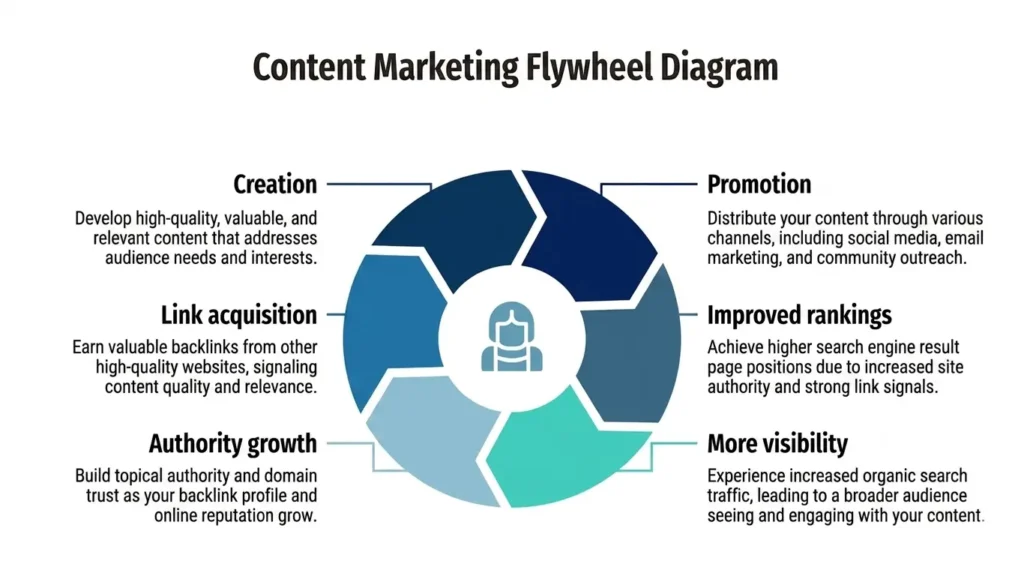
The content marketing → backlink flywheel works like this:
- Publish original, deeply researched content
- Promote through outreach, social, email, and paid amplification
- Content earns organic citations and backlinks
- Higher authority improves future content rankings
- More ranking content generates more backlinks → cycle accelerates
Guest Blogging: The Right Way in 2026
Guest blogging remains one of the most effective and legitimate link building strategies when executed with editorial integrity. The practice has evolved significantly since Google’s 2014 warning against low-quality guest post spam — today, what matters is genuine value delivery to the host publication’s audience.
Step-by-Step Guest Blogging Process:
Step 1: Target Identification
Build a prospecting list of publications with:
- Domain Rating 50+ (Ahrefs)
- Genuine editorial standards (not “write for us” pages that accept anyone)
- Topical relevance to your niche
- Active readership (check social engagement on their published posts)
Search operators for finding guest post opportunities:
"[your niche]" + "write for us""[your niche]" + "guest post guidelines""[your niche]" + "contributor""[your niche]" + "submit an article"
Step 2: Pitch Crafting
An effective guest post pitch includes:
- A personalized opener referencing specific content from their site
- 2–3 concrete topic ideas with 1-sentence descriptions
- Evidence of your expertise (your best published work)
- Brief bio and credentials
- Total length: under 200 words
Step 3: Content Creation
Write to the host publication’s editorial standards, not your own. Research their best-performing content to understand what their audience responds to. Your guest post should be as good as — or better than — anything already on their site.
Step 4: Strategic Link Placement
Include 1–2 contextual links back to relevant pages on your site. The anchor text should be natural and the linked page should genuinely add value to the reader. Avoid linking to your homepage repeatedly — link to specific, highly relevant resources.
Step 5: Post-Publication Amplification
Once published, share the guest post across all your social channels, include it in your newsletter, and notify anyone mentioned in the article. This helps the host publication see the value of your contribution and builds the relationship for future collaborations.
Guest Blogging Quality Checklist
- Site has genuine editorial standards (not all “write for us” submissions accepted)
- DR 50+ and topically relevant
- Content is original (not repurposed from your own blog)
- Meets or exceeds the publication’s typical content quality
- Contextual links are genuinely useful to readers, not forced
- Author bio is professional and includes a natural link to your site
- Published under your real name with authentic credentials
Additional Content Promotion Channels
Beyond guest blogging, distribute and amplify content through:
| Channel | Strategy | Expected Outcome |
|---|---|---|
| Email newsletter | Send to subscriber list with key takeaways | Direct traffic + social shares |
| Content syndication | Republish on Medium, LinkedIn, Substack (with canonical tag) | Extended reach, potential backlinks |
| Podcast pitching | Offer to discuss your research on relevant podcasts | Backlink in show notes + brand exposure |
| Journalist outreach | Pitch data from your research as a story angle | Editorial backlinks from major publications |
| Community sharing | Share in relevant Slack groups, Discord servers, forums | Targeted referral traffic |
| Paid amplification | Promote top content via LinkedIn/Twitter ads | Accelerated link-earning velocity |
VI. Online Reputation Management
How Online Reputation Affects SEO Rankings
Online reputation management (ORM) and SEO are more deeply intertwined than most practitioners realize. Google’s Quality Rater Guidelines explicitly instruct human quality raters to evaluate websites based on their real-world reputation — and this assessment informs algorithmic updates.
The EEAT framework (Experience, Expertise, Authoritativeness, Trustworthiness) is directly influenced by:
- Reviews and ratings on Google, Trustpilot, G2, Capterra, Yelp
- Third-party editorial coverage in trade publications and news media
- Forum discussions and community sentiment about your brand
- Wikipedia presence (a strong indicator of notability)
- Author reputation for content-producing brands
A poor online reputation doesn’t just hurt conversions — it signals to Google that your brand lacks the trust necessary to rank prominently, particularly in YMYL (Your Money, Your Life) categories.
Online Reputation Management Checklist
Monitoring:
- Set up Google Alerts for your brand name, key executives, and product names
- Monitor review platforms: Google Business Profile, Trustpilot, G2, Glassdoor
- Track social mentions using Brand24, Mention, or Sprout Social
- Monitor industry forums and communities (Reddit, Quora, niche platforms)
Response Strategy:
- Respond to all Google reviews within 48 hours (positive and negative)
- Maintain a professional, empathetic tone in all public responses to negative reviews
- Never argue publicly — acknowledge the concern and offer to resolve offline
- Thank reviewers for positive feedback specifically (not a generic “thanks for your review”)
Proactive Reputation Building:
- Build a structured process for requesting reviews from satisfied customers
- Create case studies and testimonials pages on your website
- Publish thought leadership content that establishes credibility in your field
- Build a Wikipedia presence or Wikidata entity if brand notability qualifies
- Pursue press coverage in reputable industry publications
The Power of Reviews in Off-Page SEO
Reviews influence SEO through multiple pathways:
Direct signals: Google Business Profile review count and rating directly affect local pack rankings. According to BrightLocal’s Local Consumer Review Survey, 97% of consumers read online reviews for local businesses and reviews are cited as the second most important factor in local pack ranking after proximity.
Indirect signals: Review platforms like Trustpilot, G2, and Capterra are high-authority domains. A strong presence on these platforms generates both backlinks and branded SERP real estate.
Schema integration: Review schema markup enables star ratings to appear in SERPs as rich snippets, improving click-through rates significantly. Search Engine Land reports CTR improvements of 10–35% when rich snippets appear.
VII. Influencer Outreach
The Role of Influencers in Off-Page SEO
Influencer outreach is frequently mischaracterized as a purely social media or brand awareness tactic. In the context of off-page SEO, its value lies in the backlinks, brand mentions, and content amplification that well-executed collaborations generate.
A single collaboration with a niche influencer who has a high-authority blog can produce:
- Editorial backlinks from their website
- Social amplification to an engaged, relevant audience
- Increased branded search volume (a relevance signal)
- Content co-creation that earns third-party links to the joint piece
The key distinction in SEO-focused influencer outreach is authority over audience size. A blogger with 5,000 monthly readers and a Domain Rating of 65 in your exact niche is far more valuable than a social media influencer with 500,000 followers and no website authority.
Identifying the Right Influencers
For link building purposes, prioritize:
- Niche bloggers with high DR — Use Ahrefs Content Explorer to find high-performing content in your space and identify who creates it
- Podcast hosts — Episode guests typically receive a backlink from the show’s website
- Industry journalists and analysts — Coverage in their publications generates high-authority editorial links
- Association and organization leaders — .org and .edu adjacent links carry exceptional authority
Tools for influencer identification:
- BuzzSumo — identifies top content creators and sharers in any niche
- SparkToro — audience intelligence showing where your audience follows and reads
- Ahrefs Content Explorer — finds top-performing content and its authors
- Hunter.io — email discovery for outreach
- LinkedIn Sales Navigator — B2B influencer identification
Influencer Collaboration Strategies for SEO
| Strategy | Description | Primary SEO Benefit |
|---|---|---|
| Co-authored research | Joint data study or industry report | Links from both audiences citing the research |
| Expert roundups | Quote collection featuring 15–30 industry experts | Participants share and link to the roundup |
| Podcast guest appearance | You as a guest on their podcast | Show notes backlink + referral traffic |
| Product review collaboration | Send product for honest review | Editorial link from their blog |
| Webinar co-hosting | Joint webinar promoted to both audiences | Mutual linking, email list growth |
| Social media takeover | Guest curator of their social content | Brand exposure, potential link from profile |
Outreach template principles:
- Lead with their value proposition, not yours
- Demonstrate genuine familiarity with their work
- Make the ask specific and easy to evaluate
- Follow up once (and only once) if no response after 7–10 days
- Build a relationship before making the ask whenever possible
VIII. Local SEO and Citations
Why Local SEO Is a Critical Off-Page Component
For businesses serving specific geographic areas — retail, healthcare, legal, hospitality, home services, and countless others — local SEO is not a subset of off-page SEO, it is off-page SEO. Local pack rankings and map visibility depend heavily on factors that are entirely off-page in nature.
According to Google’s own research, 76% of people who conduct a local search visit a business within one day, and 28% of those searches result in a purchase. The stakes of local SEO are immediate and commercial.
Building and Managing Local Citations
A local citation is any online mention of your business’s NAP (Name, Address, Phone Number). Consistent citations across the web signal to Google that your business is legitimate, established, and geographically anchored.
Primary citation sources (Tier 1 — highest priority):
- Google Business Profile
- Apple Maps
- Bing Places
- Yelp
- Facebook Business
- BBB (Better Business Bureau)
- Yellow Pages (YP.com)
Secondary citations (Tier 2 — industry and niche specific):
- Healthgrades / Zocdoc (healthcare)
- Avvo / FindLaw (legal)
- Houzz / HomeAdvisor (home services)
- TripAdvisor / OpenTable (hospitality)
- G2 / Capterra / Clutch (software/agencies)
Citation consistency rules:
- Use identical business name formatting across ALL platforms (no abbreviations on some, full name on others)
- Use the same phone number format (+1 555-555-5555 vs. (555) 555-5555 — pick one and stick with it)
- Address must match exactly what appears on your website and Google Business Profile
- Any change to NAP information must be updated across all citation sources simultaneously
Tools for citation management:
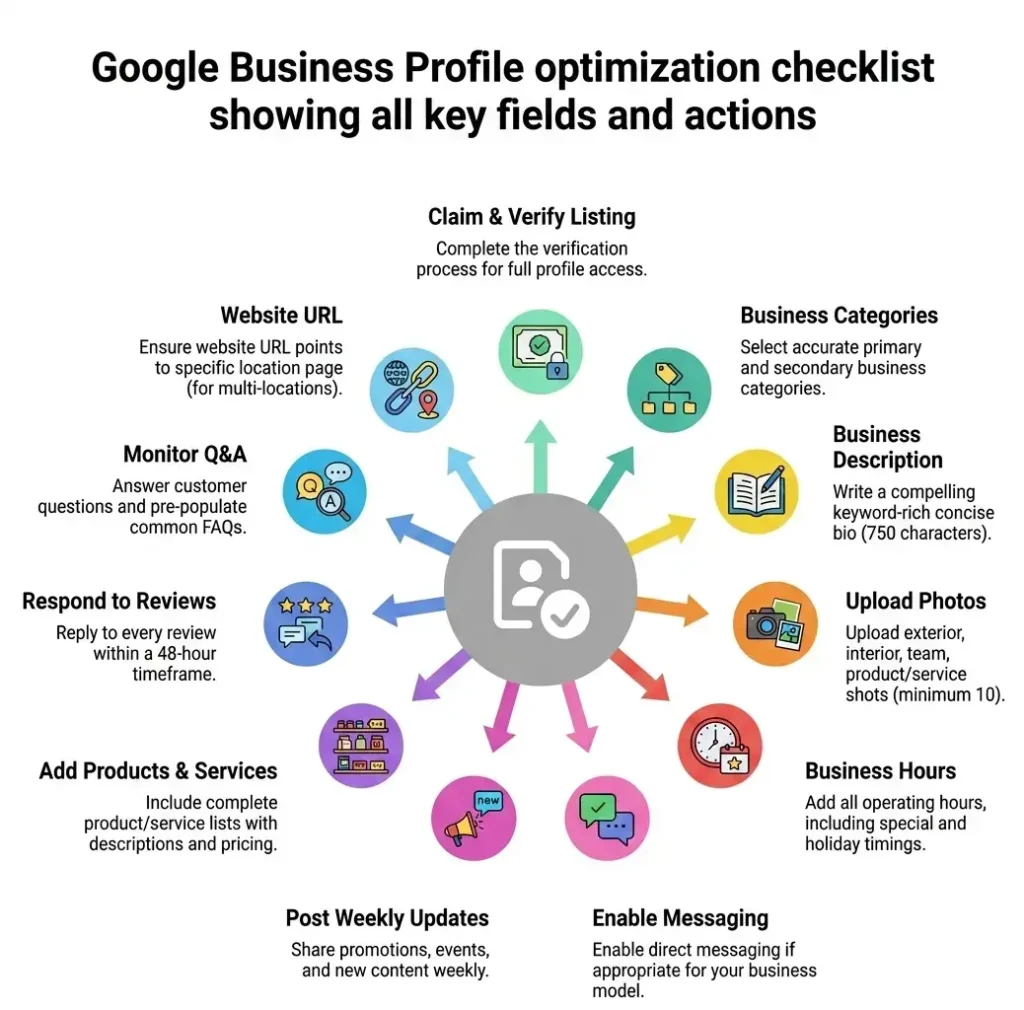
Google Business Profile Optimization Checklist
Google Business Profile (GBP) is the single most important asset in local SEO. Optimizing it is not a one-time task — it requires ongoing maintenance.
- Claim and verify your GBP listing
- Select the most accurate primary and secondary business categories
- Write a compelling 750-character business description with natural keyword inclusion
- Upload high-quality photos: exterior, interior, team, products/services (minimum 10 photos)
- Add all business hours including special/holiday hours
- Enable messaging if appropriate for your business type
- Post weekly GBP updates (promotions, events, new content)
- Add all products or services with descriptions and pricing
- Respond to every review within 48 hours
- Monitor Q&A section and pre-populate with common questions/answers
- Ensure website URL points to the correct location page (not just the homepage for multi-location businesses)
Local Link Building Strategies
Local backlinks — links from geographically relevant sources — carry disproportionate weight in local pack rankings.
High-value local link sources:
- Local chamber of commerce websites
- City and county government websites
- Local newspaper and news station websites
- University and college local business partnerships
- Local business association directories
- Sponsorships of local events (the event website links to sponsors)
- Local charities and nonprofits your business supports
- Local awards and recognition programs (best of city lists)
IX. Monitoring and Analyzing Off-Page SEO Efforts
The Measurement Imperative
Off-page SEO without measurement is a resource drain. Every tactic in this off page seo checklist must be tied to measurable outcomes — otherwise, you cannot distinguish what’s working from what’s wasting your time and budget.
The core principle: establish baselines before launching campaigns, then measure directional movement at regular intervals (weekly for fast metrics like rankings, monthly for slower metrics like DR and referring domains).
Essential Tools for Off-Page SEO Monitoring
| Tool | Primary Use | Pricing |
|---|---|---|
| Ahrefs | Backlink analysis, DR tracking, link prospecting | From $129/month |
| SEMrush | Backlink audit, competitor analysis, brand monitoring | From $139.95/month |
| Moz Pro | DA tracking, link building, local SEO | From $99/month |
| Majestic | Trust Flow, Citation Flow, link mapping | From $49.99/month |
| Google Search Console | Organic performance, impressions, click data | Free |
| BrightLocal | Local SEO, citation tracking, review management | From $39/month |
| Brand24 | Brand mention monitoring | From $99/month |
| Google Analytics 4 | Traffic source analysis, referral tracking | Free |
Key Metrics to Track Monthly
Backlink Profile Metrics:
- Total referring domains (target: steady month-over-month growth)
- New vs. lost backlinks (net gain should be positive)
- Domain Rating / Domain Authority trend
- Average DR of new referring domains (quality indicator)
- Anchor text distribution (check for over-optimization)
Ranking and Traffic Metrics:
- Organic keyword rankings for target terms (Google Search Console)
- Organic traffic trend (Google Analytics 4)
- Branded search volume trend (brand awareness indicator)
- Referral traffic from backlinks (GA4 > Acquisition > Referral)
Local SEO Metrics:
- Google Business Profile views, clicks, and calls
- Local pack ranking positions (BrightLocal rank tracker)
- Citation consistency score (Yext or Moz Local)
- Review count and average rating trends
Reputation Metrics:
- Total reviews across key platforms
- Average star rating
- Review response rate
- Branded sentiment in social monitoring tools
Building a Monthly Off-Page SEO Reporting Framework
A simple but effective reporting cadence:
Weekly: Quick check of new referring domains, review responses, social engagement metrics
Monthly:
- Pull Ahrefs site overview — record DR, referring domains, new links, lost links
- Export Google Search Console performance data — rankings, impressions, CTR trends
- Audit Google Business Profile performance report
- Check review status across all platforms
- Identify top-performing content by referral traffic (potential for amplification)
- Competitive benchmark — compare DR and referring domain growth against 3 key competitors
Quarterly:
- Full backlink audit (identify toxic links for disavowal)
- Content gap analysis (identify content assets you need to compete)
- Link velocity analysis (are you building links faster or slower than competitors?)
- Strategy review and adjustment based on performance data
Adjusting Strategies Based on Data
Data should drive decisions, not confirm existing biases. Common off-page SEO adjustment triggers:
| Signal | Likely Cause | Recommended Action |
|---|---|---|
| DR plateauing despite link building | Links from low-authority domains | Shift focus to DR 60+ target sites |
| High link count but poor rankings | Low topical relevance in link profile | Prioritize niche-relevant link sources |
| Rankings improving but no traffic increase | Ranking for low-volume keywords | Target higher-volume terms in link anchor strategy |
| Local rankings declining | Citation inconsistencies or new competitor | Audit and clean NAP data |
| Referring domains dropping | Toxic link penalties or natural attrition | Disavow audit + active link replacement |
X. Conclusion
Recap: Your Off-Page SEO Action Plan
Off-page SEO is not a one-time project — it is an ongoing discipline that compounds over time. Sites that consistently execute the fundamentals covered in this guide build domain authority that eventually becomes a competitive moat, making it progressively harder for competitors to displace them regardless of how much they spend on content.
The most important principles to carry forward:
Authority comes from consistency. The agencies and brands that dominate competitive SERPs aren’t doing anything exotic — they are executing the basics (backlink acquisition, local citations, reputation management, content amplification) better and more consistently than their competitors.
Quality beats quantity at every level. One link from a relevant, authoritative publication will outperform fifty links from marginal sources. One well-placed guest post will outperform twenty submissions to low-quality blogs. Invest your time where the signal-to-effort ratio is highest.
Measure relentlessly. Off-page SEO without measurement is guesswork. Establish your baseline metrics today and track them monthly. When something works, amplify it. When something doesn’t move the needle after three months, replace it with something else.
Your 30-Day Quick Start Off Page SEO Checklist
Use this as your immediate action plan:
Week 1 — Baseline and Foundation:
- Audit current backlink profile with Ahrefs or SEMrush
- Claim and fully optimize Google Business Profile
- Set up Google Alerts for brand mentions
- Submit NAP to top 10 citation sources
- Identify 20 link-building prospects for outreach
Week 2 — Content and Outreach:
- Identify or create your top linkable asset
- Draft and send 10 guest post pitches to relevant publications
- Set up broken link prospecting workflow
- Reach out to 5 sites with unlinked brand mentions
Week 3 — Reputation and Social:
- Implement review request workflow with existing customers
- Optimize all social media profiles for SEO
- Create first social media content calendar focused on content amplification
- Respond to any outstanding reviews on Google, Trustpilot, G2
Week 4 — Measurement and Optimization:
- Set up monthly reporting dashboard in GA4 and GSC
- Baseline DR, referring domains, and local rankings
- Identify top 3 competitors and benchmark their off-page profiles
- Prioritize next month’s activities based on gaps identified
Final Thought
The brands that win in search are the brands that the internet trusts. Trust is not built in a week through a batch of bulk link submissions — it is earned through a consistent track record of producing valuable content, building genuine relationships, managing your reputation with care, and treating your audience as people worth serving well.
This off page SEO checklist is not a shortcut. It is a systematic framework for building the kind of digital authority that lasts — through algorithm updates, AI Search disruption, and every other shift the search landscape throws at you.
Start with your highest-priority gaps. Execute consistently. Measure and adjust. The compounding returns of disciplined off-page SEO are among the most durable competitive advantages a business can build.
Frequently Asked Questions
Last updated: April 2026 by Searchlyn team