
Introduction: Why Garage Door SEO Can’t Be an Afterthought
A homeowner’s garage spring snaps at 7 a.m. on a Tuesday. Before they call a neighbor, they pull out their phone and type “garage door spring repair near me.” If your business doesn’t appear in the top three local results — or inside Google’s AI Overview — you just lost a high-intent customer to a competitor who did the SEO work you didn’t.
That’s the brutal, simple reality of running a garage door business in 2026. The local search landscape has never been more competitive, and the rise of AI-powered answer engines — ChatGPT, Perplexity, Gemini, and Bing Copilot — means your visibility now extends beyond the traditional blue links into a new layer of AI-generated summaries that pull from structured, authoritative content.
This guide delivers 8 battle-tested garage door SEO tips specifically engineered for service-area businesses. You will learn how to research and use local keywords that actually drive calls, how to structure your on-page content for featured snippets, how to implement Local Business Schema that powers Google’s knowledge panel, and how to build the kind of content and backlink profile that earns citations inside AI-generated answers. Each tip includes tables, checklists, code snippets, and real-world examples you can apply this week.
Whether you run a single-location operation in Austin or a multi-city garage door company spanning Dallas and Houston, these strategies give you a clear, actionable playbook to outrank competitors and capture more of the calls your market generates every day.
Tip 1: Master Local Keyword Research (With a Usable Table)
Why Local Intent Beats Generic Keywords
There is a common trap that derails garage door companies before they even start: targeting keywords that are technically relevant but commercially useless. “Garage door” is searched thousands of times per month — but by whom? Product researchers in other countries, people watching YouTube installation videos, and DIYers looking for tutorials. Almost none of them are homeowners in your city ready to pay $250 for a spring replacement.
Local intent keywords are a fundamentally different asset. When someone in Phoenix types “garage door repair Phoenix,” they have already resolved the what, where, and nearly the when. According to Google’s own Search data, 76% of people who conduct a local search on their smartphone visit a business within 24 hours, and 28% of those searches result in a purchase. That conversion trajectory is why “garage door repair Phoenix” is worth 100x more to your business than generic head terms with high volume but no local modifier.
The strategic framework is simple: pair a service keyword with a city, neighborhood, or “near me” modifier and layer in specificity wherever possible. “Garage door opener repair” is decent. “LiftMaster garage door opener repair [City]” is outstanding — it filters for customers who already know what they have and are ready to pay a specialist.
local SEO for Contractors → local-seo
Categorized Local Keyword Table
The following table is designed to be directly actionable. Use these keyword structures as your content and page-title templates, substituting your target city into every [City] placeholder.
| Keyword Type | Garage Door Example | Search Intent | Local Modifier Strategy |
|---|---|---|---|
| Short-tail (head term) | garage door repair | Informational / Broad | Low priority — too generic |
| Long-tail (service + brand) | LiftMaster opener installation [City] | Transactional | City + brand + service |
| Long-tail (service + issue) | garage door off track repair [City] | Transactional | City + service + problem |
| Question-based | How much does garage door spring repair cost? | Informational | Use in FAQ, blog, H2 headings |
| Location-based (city) | garage door repair Austin TX | Transactional | Primary city page keyword |
| Location-based (neighborhood) | garage door repair North Phoenix | Transactional | Hyperlocal service page |
| Near-me intent | emergency garage door repair near me | High urgency / Transactional | GBP, H1, meta description |
| Comparison/decision | repair vs replace garage door [City] | Decisional / Commercial | Blog post, landing page |
| Service-specific | garage door spring replacement cost Denver | Transactional / Informational | Cost page + FAQ schema |
| Seasonal/contextual | garage door weatherstripping winter [City] | Informational / Seasonal | Blog content calendar |
Best Free & Paid Tools for Garage Door Keyword Research
You do not need a $500/month tool suite to identify the right keywords. Here is a tiered toolkit:
Free Tools:
- Google Keyword Planner (ads.google.com) — The baseline. Filter by location to get city-level search volume.
- Google Search Console — Shows you what queries are already bringing traffic to your site. Mine this before spending on paid tools.
- AlsoAsked.com (alsoasked.com) — Extracts “People Also Ask” questions for any topic. Critical for question-based keyword discovery and FAQ section creation.
- Google Autocomplete & Related Searches — Type “garage door repair [your city]” and let Google complete it. Every suggestion is real demand.
Paid Tools:
- Ahrefs (ahrefs.com) — Best for competitor keyword gap analysis. See exactly what’s driving traffic to the garage door companies outranking you.
- SEMrush (semrush.com) — Excellent for local keyword tracking, position monitoring by city, and on-page optimization scoring.
- BrightLocal (brightlocal.com) — Purpose-built for local SEO. Tracks rankings in your specific service cities and audits your citation consistency.
Workflow Recommendation: Start with Google Keyword Planner for volume, then use AlsoAsked for question mining, then validate competition levels with a free Ahrefs or SEMrush trial. Build a master spreadsheet mapping one primary keyword to each page on your website before writing a single word.
Tip 2: Optimize On-Page SEO for Both Users and AI Crawlers
Title Tags & Meta Descriptions That Earn Clicks
Your title tag is the single most influential on-page ranking factor for any given keyword. It tells Google and your prospect exactly what the page is about — and it is the headline displayed in every search result, AI-generated overview, and social share.
Formula for garage door service page title tags: [Primary Keyword] in [City] | [Company Name]
Examples:
Garage Door Repair in Austin, TX | [Company Name]24/7 Garage Door Spring Replacement Dallas | [Company Name]Emergency Garage Door Repair Phoenix | [Company Name]
Keep titles between 50–60 characters to avoid truncation in Google SERPs. Your primary keyword should appear at or near the start — Google weights words that appear earlier in the title more heavily.
Meta descriptions do not directly influence rankings, but they dramatically influence click-through rate, and click-through rate sends engagement signals that do influence rankings. Write meta descriptions as a two-sentence pitch:
Sentence 1: State the problem and your solution. Sentence 2: Include a call to action with a differentiator.
Example: Garage door spring snapped? Our Austin technicians arrive in 60 minutes or less. Call now for same-day repair — no hidden fees.
Keep meta descriptions between 150–160 characters.
Heading Hierarchy: H1, H2, H3 Done Right
Think of your heading structure as a table of contents for Google’s crawler and for AI models extracting information from your page. Every service page and blog post should follow this hierarchy:
- H1 (one per page): Your primary keyword + local modifier. Example:
Garage Door Repair in Dallas, TX — Fast, Same-Day Service - H2 (major sections): Sub-services, benefits, FAQs, or process steps. Example:
Our Garage Door Repair Services,How Much Does Garage Door Repair Cost in Dallas? - H3 (supporting details): Specific issues, individual FAQs, or step breakdowns. Example:
Broken Spring Repair,Snapped Cable Replacement
Never skip heading levels. An H3 should always appear within an H2 section. This semantic structure is what allows AI models to parse and cite specific sections of your content independently.
Image Optimization: File Names, Alt Text, and Compression
Every image on your garage door website is an opportunity you are probably leaving on the table. Google Images drives meaningful traffic for visual searches like “garage door styles” or “garage door before after,” but only if your images are properly named and tagged.
Three-step image optimization:
- Rename the file descriptively before uploading:
DSC_4891.jpgtells Google nothing.garage-door-spring-replacement-austin-tx.jpgtells Google everything. - Write descriptive alt text: Alt text is read by screen readers (accessibility), crawled by Google (SEO), and increasingly used by AI models to understand visual content. Write it as a sentence:
Alt: Technician replacing a torsion spring on a residential garage door in Austin, TX - Compress before uploading: Uncompressed images are one of the top causes of slow page load times. Use TinyPNG or Squoosh to reduce file size by 60–80% without visible quality loss.
Internal Linking Checklist
Internal linking distributes page authority throughout your site and helps both Google and AI crawlers understand the hierarchical relationship between your pages. Use this checklist as a quarterly audit:
- [ ] Every service page links to your main Contact / Book Now page
- [ ] Every blog post links to at least one relevant service page (anchor text = service keyword)
- [ ] All interior pages include a link back to the homepage
- [ ] Your homepage links to every top-level service page
- [ ] Location pages for different cities link to the main service hub page
- [ ] FAQ pages and blog posts cross-link to each other where topics overlap
- [ ] No page on your site is an orphan page (zero internal links pointing to it)
- [ ] Anchor text is descriptive and keyword-rich — avoid “click here” or “read more”
Pro tip: Run your site through Ahrefs’ free Webmaster Tools and filter for “Orphan pages” to immediately identify pages with zero internal links.
Tip 3: Add Local Business Schema Markup (Dedicated JSON-LD Section)
What Is Local Business Schema?
Schema markup is structured data — a vocabulary of tags you add to your website’s HTML that helps search engines understand your business’s identity, offerings, location, and credibility. It is not visible to website visitors; it lives in the page’s code and speaks directly to Google’s Knowledge Graph.
For garage door companies, Local Business Schema is the most important structured data you can implement. It tells Google your exact business name, address, phone number, service hours, price range, service area, and even aggregated review ratings — all in a format Google can parse with certainty rather than inference.
According to Google’s documentation on structured data, pages with properly implemented schema markup are significantly more likely to earn rich results in Google Search — including star ratings, business hours, and direct call buttons in mobile results. For a garage door business, that call button alone can be worth hundreds of dollars per month in incremental leads.
Why Local Business Schema Is Critical for Garage Door SEO
Three direct benefits for your business:
- Knowledge Panel Activation: Schema data powers Google’s business knowledge panel — the box that appears on the right side of the search results showing your name, address, phone, hours, and reviews. Without schema, Google guesses; with schema, Google knows.
- E-E-A-T Signal: Structured data that includes reviews, address verification, and service details communicates trust and authority to Google’s ranking systems.
- AI Overview Eligibility: AI models pull structured, verifiable facts from schema-marked pages to populate overview answers. A business with schema markup is far more likely to be cited in an AI-generated answer than a competitor without it.
Copy-Paste Local Business JSON-LD Snippet
The following JSON-LD block is annotated and ready to adapt for your garage door business. Paste it between <script> tags in the <head> section of your homepage and every key service page.
{
  "@context": "https://schema.org",
  "@type": "LocalBusiness",
  "name": "Your Garage Door Company Name",
  "image": "https://yourwebsite.com/images/logo.jpg",
  "@id": "https://yourwebsite.com",
  "url": "https://yourwebsite.com",
  "telephone": "+1-555-000-0000",
  "priceRange": "$$",
  "address": {
    "@type": "PostalAddress",
    "streetAddress": "123 Main Street",
    "addressLocality": "Austin",
    "addressRegion": "TX",
    "postalCode": "78701",
    "addressCountry": "US"
  },
  "geo": {
    "@type": "GeoCoordinates",
    "latitude": 30.2672,
    "longitude": -97.7431
  },
  "openingHoursSpecification": [
    {
      "@type": "OpeningHoursSpecification",
      "dayOfWeek": ["Monday","Tuesday","Wednesday","Thursday","Friday"],
      "opens": "07:00",
      "closes": "19:00"
    },
    {
      "@type": "OpeningHoursSpecification",
      "dayOfWeek": ["Saturday"],
      "opens": "08:00",
      "closes": "16:00"
    }
  ],
  "areaServed": [
    {
      "@type": "City",
      "name": "Austin"
    },
    {
      "@type": "City",
      "name": "Round Rock"
    },
    {
      "@type": "City",
      "name": "Cedar Park"
    }
  ],
  "serviceArea": {
    "@type": "GeoCircle",
    "geoMidpoint": {
      "@type": "GeoCoordinates",
      "latitude": 30.2672,
      "longitude": -97.7431
    },
    "geoRadius": "30000"
  },
  "hasOfferCatalog": {
    "@type": "OfferCatalog",
    "name": "Garage Door Services",
    "itemListElement": [
      {
        "@type": "Offer",
        "itemOffered": {
          "@type": "Service",
          "name": "Garage Door Spring Replacement"
        }
      },
      {
        "@type": "Offer",
        "itemOffered": {
          "@type": "Service",
          "name": "Garage Door Opener Installation"
        }
      },
      {
        "@type": "Offer",
        "itemOffered": {
          "@type": "Service",
          "name": "Emergency Garage Door Repair"
        }
      }
    ]
  },
  "aggregateRating": {
    "@type": "AggregateRating",
    "ratingValue": "4.9",
    "reviewCount": "127"
  },
  "sameAs": [
    "https://www.google.com/maps/place/your-listing",
    "https://www.yelp.com/biz/your-business",
    "https://www.facebook.com/yourpage"
  ]
}
Key fields to customize:
name,telephone,url— Your exact NAP data (must match your GBP exactly)areaServed— List every city in your service area (not just your business address city)priceRange— Use$,$$,$$$, or$$$$based on your market positioningaggregateRating— Only populate if you have verified reviews; do not fabricate numberssameAs— Link to every verified profile where your business is listed
How to Test and Deploy Schema Markup
- Test before you publish: Paste your JSON-LD into Google’s Rich Results Test. If it passes, deploy. If it shows errors, fix the flagged fields.
- Validate with Schema.org Validator: validator.schema.org provides a secondary check with more detailed property validation.
- Deployment options:
- WordPress + Yoast/RankMath: Both plugins have built-in Local Business schema fields. Populate them in the plugin settings and they generate the JSON-LD automatically.
- Manual in
<head>: Paste the raw JSON-LD block inside a<script type="application/ld+json">tag in your site’sheader.phpor equivalent. - Google Tag Manager: Create a Custom HTML tag, paste the script block, and fire it on the relevant pages.
- Re-test after any business information change — a new phone number, updated hours, or additional service cities requires a schema update.
Read more about this in the Complete local SEO checklist guide → Local SEO Checklist
Tip 4: Create High-Quality, Locally Focused Content (E-E-A-T Power)
Content That Resonates with Homeowners
Google’s E-E-A-T guidelines — Experience, Expertise, Authoritativeness, Trustworthiness — are not abstract concepts. They are a practical framework for what separates useful content from filler. For a garage door company, E-E-A-T signals are embedded in the details: real cost ranges with your city’s labor rates, troubleshooting steps that reflect actual field experience, before-and-after photo documentation, and content that a homeowner could genuinely use to solve a problem or make an informed decision.
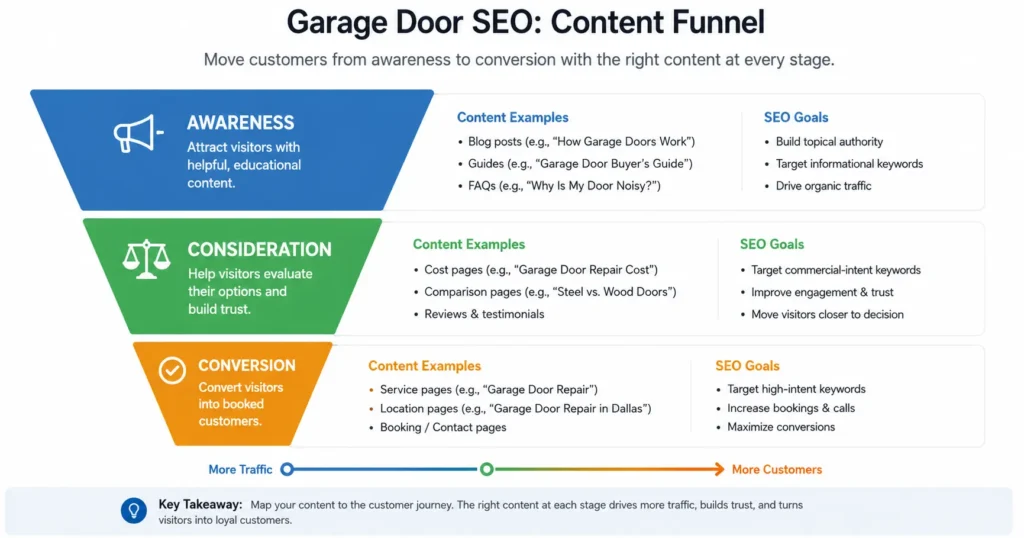
The content types that consistently drive both rankings and conversions for garage door companies:
- FAQ-style troubleshooting content: “Why is my garage door making a grinding noise?” earns featured snippet placement and serves homeowners mid-problem — the exact moment they are considering calling a professional.
- Cost breakdown guides: “How Much Does Garage Door Spring Replacement Cost in [City]?” is one of the highest-converting content formats because it speaks to the single biggest hesitation before booking.
- Service-specific long-form pages: A dedicated 1,500-word page for “Garage Door Off-Track Repair” dramatically outperforms a generic “services” page that lists everything without depth.
- Case studies / before-and-after posts: “We Replaced This San Antonio Customer’s 20-Year-Old Door in 4 Hours” — this format embeds Experience (you did the work) and Trust (real job, real photos) directly into your content.
According to HubSpot’s 2024 State of Marketing Report, businesses that blog consistently generate 67% more leads per month than those that don’t. For a garage door company, that gap is entirely capturable with a 12-post annual content calendar built around local keywords.
The Garage Door Content Matrix
| Content Type | Example Topic | Target Keyword | Schema Opportunity | Business Goal |
|---|---|---|---|---|
| Service Page | Garage Door Spring Replacement | garage door spring repair [City] | LocalBusiness + Service | Rank for commercial intent |
| Cost Guide | Garage Door Repair Cost in Houston | garage door repair cost Houston | FAQPage + Article | Capture decision-stage searchers |
| Troubleshooting Blog | Why Is My Garage Door Noisy? | garage door making noise fix | FAQPage + HowTo | Featured snippet + trust building |
| Brand-specific Page | LiftMaster Opener Installation | LiftMaster installer [City] | LocalBusiness + Product | Capture branded searches |
| FAQ Page | Garage Door FAQ | garage door questions | FAQPage | AI Overview eligibility |
| Comparison Post | Repair vs Replace Garage Door | repair or replace garage door | Article | Commercial intent, late funnel |
| Hyperlocal Service Page | Garage Door Repair North Phoenix | garage door repair [neighborhood] | LocalBusiness | Rank for neighborhood searches |
| Before/After Case Study | Spring Replacement in 2 Hours | [City] garage door spring repair | Article + Review | E-E-A-T signal, trust building |
| Seasonal Guide | Winterizing Your Garage Door | winter garage door maintenance | HowTo | Evergreen + seasonal traffic |
Naturally Integrating Keywords Without Keyword Stuffing
Keyword stuffing — cramming the same phrase into every sentence — is a 2010 tactic that now actively harms rankings. Google’s natural language processing systems, and the AI models that cite your content, evaluate semantic richness: how many related concepts, entities, and synonyms appear in your content alongside your primary keyword.
For a page targeting “garage door repair Austin,” naturally integrate semantically related terms:
- Torsion spring, extension spring, broken spring
- Garage door opener, LiftMaster, Chamberlain, Genie
- Off-track door, cable replacement, panel replacement
- Same-day service, emergency repair, 24-hour service
- Residential, commercial, multi-unit
These terms appear naturally in high-quality content written by an expert. If you find yourself reading your content and noticing the primary keyword every third sentence, rewrite it.
The Power of Hyperlocal Pages: “Garage Door Spring Replacement Cost in [City]”
One of the highest-leverage tactics available to garage door businesses is creating city-specific cost pages for each major service. These pages intercept buyers at the exact moment of cost research — right before they call for a quote.
Template structure for a hyperlocal cost page:
- H1: Garage Door Spring Replacement Cost in [City] — 2026 Pricing Guide
- Price table: Average costs by spring type (torsion vs extension), single vs double car garage
- What affects the price (H2): Brand, wire gauge, labor rate, emergency vs standard service
- Repair vs replace breakdown (H2)
- FAQ schema section with 5 cost-related questions
- CTA: “Get a free, no-obligation quote from our [City] team →”
Create one of these pages for each city in your service area and update the pricing data annually. These pages tend to earn both organic rankings and featured snippet placement because they answer a high-intent question with specific, structured data.
Tip 5: Build a Local SEO & Citation Ecosystem
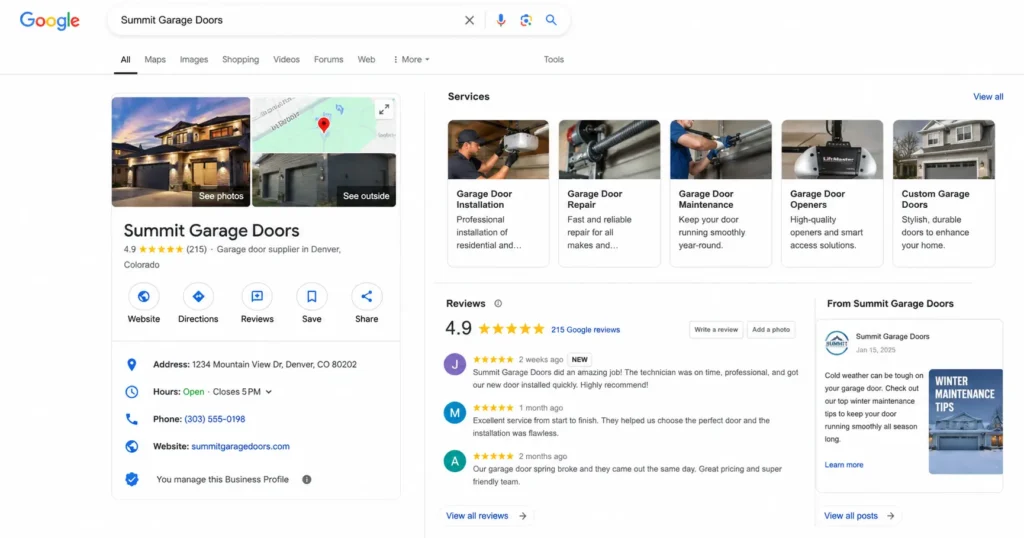
Google Business Profile: Your Most Powerful Free SEO Asset
Google Business Profile (GBP) is, by a significant margin, the most important local SEO asset for a garage door company. When someone searches “garage door repair near me” on mobile, the three businesses displayed in the Local 3-Pack capture the overwhelming majority of clicks — and Local 3-Pack placement is driven primarily by GBP optimization, not website SEO.
Complete GBP optimization checklist for garage door companies:
- Business Name: Use your exact legal business name. Do not stuff keywords into the name field — this violates Google’s guidelines and risks suspension.
- Primary Category:
Garage Door SupplierorGarage Door Repair Service— choose the most specific match. - Secondary Categories: Add
Home Improvement Contractor,Door Supplier,Locksmithwhere applicable. - Business Description: Write 750 characters that naturally include your primary service keywords and city. Mention your differentiators (24/7, licensed, insured, same-day).
- Services: List every service you offer. Be granular: “Torsion Spring Replacement,” “Broken Cable Repair,” “Panel Replacement” — not just “Garage Door Repair.”
- Attributes: Enable all relevant attributes — “Serves customers at their location,” “Online estimates,” “Emergency service.”
- Photos: Upload a minimum of 20 high-quality photos. Include technician at work, completed jobs, your vehicle, team photos, and before/after images. Businesses with photos receive 42% more requests for directions and 35% more clicks to their website.
- GBP Posts: Publish at least two posts per month. Service promotions, seasonal tips, and completed job showcases all work well.
- Q&A Section: Proactively add your own questions and answers. “Do you offer 24/7 emergency service?” answered by your own team is better than leaving it blank for customers to answer incorrectly.
Citation Audit Checklist
NAP consistency — the exact matching of your Name, Address, and Phone number across every online directory — is a foundational local SEO signal. Any discrepancy (abbreviated street name on one site, old phone number on another) dilutes the trust signal Google uses to verify your business is legitimate.
Use this checklist to audit your citation ecosystem quarterly:
Tier 1 — Core Platforms (must be 100% accurate):
- [ ] Google Business Profile
- [ ] Bing Places for Business (bingplaces.com)
- [ ] Apple Maps (mapsconnect.apple.com)
- [ ] Yelp (biz.yelp.com)
- [ ] Facebook Business Page
Tier 2 — Home Services Directories:
- [ ] Angi (formerly Angie’s List) (angi.com)
- [ ] HomeAdvisor
- [ ] Thumbtack (thumbtack.com)
- [ ] Houzz (houzz.com)
- [ ] Nextdoor Business (nextdoor.com)
Tier 3 — General & Local:
- [ ] Better Business Bureau (BBB)
- [ ] Yellow Pages
- [ ] Local Chamber of Commerce website
- [ ] Local city or neighborhood business directory
- [ ] Foursquare / Swarm
Audit tool recommendation: BrightLocal’s Citation Tracker or Moz Local can scan hundreds of directories and flag NAP inconsistencies automatically.
Reviews as Trust Signals: How to Earn, Respond to, and Schema-Markup 5-Star Reviews
Reviews are the closest thing to word-of-mouth at scale, and Google treats them as a significant local ranking factor. A garage door company with 100+ reviews averaging 4.8 stars occupies a different local trust tier than a competitor with 12 reviews at 4.1 stars.
Earning reviews systematically:
- Send a post-job text message with a direct Google review link within 2 hours of completing service — this is when satisfaction is highest.
- Train technicians to mention reviews at job completion: “If you were happy with today’s service, a quick Google review helps us more than you know.”
- Use a service like Podium or NiceJob to automate review request sequences.
Responding to reviews (both positive and negative):
- Respond to every review within 48 hours. Responses demonstrate that a human being is managing the business — a trust signal for both Google and prospective customers.
- For negative reviews: acknowledge, apologize, and offer to resolve offline. Never be defensive — your response is read by future customers more than the complaint itself.
Schema-marking your reviews: Your Local Business JSON-LD (see Tip 3) should include aggregateRating with your current average and review count. Update this field quarterly. This data can appear directly in Google’s search results as star ratings.
Tip 6: Earn Quality Backlinks (Authority & Trust)
Why Backlinks Still Matter for Garage Door SEO
Despite years of speculation about backlinks becoming less important, they remain one of Google’s top three ranking signals. A backlink is a vote of confidence from another website — and the more authoritative the referring site, the more weight that vote carries in Google’s ranking algorithm.
For garage door companies, the goal is not thousands of backlinks. It is a smaller number of high-quality, locally relevant links that tell Google your business is a trusted part of the community it serves. According to Ahrefs’ analysis of 1 billion pages, 91% of pages get zero organic traffic from Google, and the primary differentiator between pages that rank and those that don’t is the quantity and quality of backlinks.
One authoritative local backlink — from a city’s Chamber of Commerce website, a regional news outlet, or a .edu institution — can do more for your garage door company’s search visibility than 50 low-quality directory links.
Practical Tactics for Local Link Building
1. Sponsor a Local Sports Team or Community Event Contact your city’s Little League, soccer club, youth football league, or school booster club. A $150–$500 annual sponsorship typically earns a link from a .org domain with genuine community trust. These links carry high local relevance because they explicitly connect your business to a geographic community.
2. Partner with Complementary Local Businesses Real estate agents, property management companies, general contractors, and moving companies all have clients who need garage door services. Establish referral partnerships and ask for a “Preferred Partners” page link on their website. These links are highly relevant (home services context) and come from local businesses with real traffic.
3. Guest Post for Home Improvement Blogs and Local Publications Pitch locally-focused content to city lifestyle blogs, home improvement sites, or neighborhood news publications. A guest post titled “5 Signs Your Garage Door Needs Replacing Before Winter” on a Dallas home improvement blog earns a contextual backlink and exposes your brand to qualified local readers.
4. Create Linkable Assets Data-driven, research-backed content naturally attracts backlinks. A study like “Garage Door Repair Cost Survey: 500 Jobs Across 10 Cities” or an infographic showing “Average Garage Door Lifespan by Door Type” gives journalists, bloggers, and local websites something worth citing.
5. HARO / Journalist Outreach (Help a Reporter Out) Monitor HARO (now Connectively) for queries about home improvement, real estate, or home security. When journalists need expert commentary, a quote from your garage door business can earn a mention and backlink in regional or national publications.
Backlink building for home service companies → Link Building and Off Page SEO
Backlink Quality Score Table
Not all backlinks are created equal. Use this table to evaluate the relative value of any link opportunity before investing time in pursuing it.
| Link Source Type | Authority Level | Local Relevance | Example | Pursue? |
|---|---|---|---|---|
| Government website (.gov) | Very High | Varies | City economic development directory | Yes — always |
| University / College (.edu) | Very High | Medium | Campus housing maintenance partner | Yes — if relevant |
| Regional news outlet | High | Very High | Local newspaper home section feature | Yes — top priority |
| Chamber of Commerce | High | Very High | City Chamber business directory | Yes — easy win |
| Home improvement blog (DA 40+) | Medium-High | High | Guest post on regional home blog | Yes |
| Industry association | Medium-High | Medium | Door & Access Systems Mfrs. Association | Yes |
| Garage door forum / community | Medium | High | DIY home repair forums | Yes — with caution |
| Complementary local business | Medium | Very High | Realtor “preferred vendors” page | Yes |
| General directories (Yelp, etc.) | Low-Medium | Medium | Yelp, YellowPages | Yes — for citations |
| Paid link / link farm | Negative | None | Any site selling links | Never |
| Irrelevant foreign site | Negative | None | Off-topic overseas blogs | Never |
Tip 7: Ensure Technical SEO & Mobile-First Indexing
Page Speed & Core Web Vitals: The Floor of User Experience
Google’s Core Web Vitals are a set of measurable user experience metrics that became a confirmed ranking factor in May 2021. For garage door companies — whose customers are often searching from a cracked driveway on a phone — these metrics are not academic. A slow website loses real calls.
The three Core Web Vitals metrics:
| Metric | What It Measures | Good Score | Common Cause of Failure |
|---|---|---|---|
| LCP (Largest Contentful Paint) | How fast main content loads | Under 2.5 seconds | Uncompressed hero images |
| FID / INP (Interaction to Next Paint) | How responsive the page is to input | Under 200ms | Excessive JavaScript |
| CLS (Cumulative Layout Shift) | Visual stability during load | Under 0.1 | Missing image dimensions, late-loading ads |
Quick wins for garage door websites:
- Compress all images using WebP format (use a WordPress plugin like ShortPixel or Imagify)
- Enable server-side caching (WP Rocket or W3 Total Cache for WordPress)
- Defer non-critical JavaScript — most phone-call tracking scripts can load after the main page content
- Use a CDN (Content Delivery Network) if you serve multiple cities across a large geographic area
Test your current scores at Google PageSpeed Insights. Aim for a score above 80 on mobile. If you are below 60, page speed is actively costing you rankings and calls.
Mobile Optimization: Non-Negotiable for Garage Door Companies
According to Google’s mobile-first indexing announcement, Google now predominantly uses the mobile version of your website for indexing and ranking. If your desktop site is polished but your mobile experience is broken, your rankings reflect the broken version.
The majority of “garage door broken” searches happen on mobile devices — often in real time, from the driveway, by a frustrated homeowner who needs help immediately. Your mobile site needs to:
- Load the main content in under 3 seconds on a 4G connection
- Display a tap-to-call button prominently above the fold on every page
- Have font sizes no smaller than 16px (minimum comfortable reading on mobile)
- Have touch targets (buttons, links) at least 48×48 pixels apart to prevent mis-taps
- Never require horizontal scrolling — all content should reflow to a single column
Test your mobile usability at Google’s Mobile-Friendly Test.
Fix Broken Links & Redirect Chains
Every 404 error (broken link) on your website is a dead end for both users and search engine crawlers. Every unnecessary redirect chain (URL A → URL B → URL C) wastes crawl budget and dilutes link equity.
How to find and fix broken links:
- Set up a free account at Ahrefs Webmaster Tools and run a site audit.
- Filter for HTTP status codes: look for all 404s (broken pages) and 301 chains (multi-hop redirects).
- Fix 404s by either restoring the content, redirecting the URL to the most relevant existing page (301 redirect), or removing internal links pointing to the dead URL.
- Flatten redirect chains: if A→B→C, update the original URL to redirect directly to C.
Technical SEO Runbook
This numbered runbook is structured for direct AI extraction. Run through these steps quarterly for every garage door company website you own or manage.
- Run a full site crawl using Screaming Frog (free for up to 500 URLs) or Ahrefs Webmaster Tools. Export all URLs and filter by status code — resolve all 4xx errors first.
- Check mobile tap targets using Chrome DevTools (Ctrl+Shift+I → Lighthouse → Mobile audit). Flag any interactive elements (buttons, phone links, forms) that are smaller than 48px × 48px.
- Validate robots.txt at
https://yourwebsite.com/robots.txt. Confirm your service pages and blog are not accidentally blocked from crawling. - Submit an updated sitemap.xml in Google Search Console after any significant content additions. Confirm all important pages are included and status is “Submitted and indexed.”
- Test Core Web Vitals on mobile via Google PageSpeed Insights. Document your LCP, INP, and CLS scores. Set a quarterly improvement target.
- Check for duplicate content — if you have location pages for 10 cities with near-identical content, each one needs enough unique, location-specific text to differentiate it from the others. Use canonical tags where intentional duplication is unavoidable.
- Audit your HTTPS implementation — all pages should load via
https://and automatically redirect fromhttp://. Mixed content warnings (HTTPS page loading HTTP resources) erode trust signals. - Review schema markup validity using Google’s Rich Results Test on your homepage and key service pages.
Tip 8: Add a Dedicated FAQ Schema Section (AI Overview Gold)
Why FAQ Schema Is Your Most Direct Path to AI Overviews
FAQ Schema is not just an SEO tactic — it is the primary bridge between your website and AI-generated answer engines. When ChatGPT, Perplexity, Gemini, or Google’s AI Overviews generate an answer to a query like “how much does garage door repair cost,” they pull from pages that have:
- A clear question clearly stated (ideally in a heading)
- A direct, concise answer (40–80 words)
- Structured FAQ schema telling the AI exactly which content is a Q&A pair
Google’s documentation on FAQPage structured data confirms that qualifying FAQ pages can have their questions and answers displayed directly in search results as rich results — expanding your organic real estate without requiring a position-one ranking.
For garage door companies, FAQ schema converts casual searchers (still in information mode) into warm leads by answering their questions so thoroughly that the next logical step is calling you.
Five Garage Door FAQ Schema-Ready Questions Examples
Below are five complete, schema-ready Q&A pairs written to target People Also Ask queries and AI extraction. Adapt the pricing to your market.
Q1: How much does a garage door spring replacement cost? A: Garage door spring replacement typically costs between $150 and $350, depending on the type of spring (torsion or extension), the spring size, and your location. Torsion springs are more durable and cost more ($200–$350 per pair), while extension springs run $150–$250. Labor is usually included in most quotes. Emergency or after-hours service adds $50–$100 to the base rate.
Q2: How long does a garage door opener last? A: A well-maintained garage door opener lasts 10 to 15 years on average. Factors that shorten lifespan include frequency of use (openers in homes with 4+ daily cycles wear faster), power surges, and lack of lubrication on the drive system. Belt-drive openers tend to outlast chain-drive models. Most manufacturers offer a 1- to 5-year warranty, with professional-grade units carrying longer coverage.
Q3: Do you offer 24/7 emergency garage door repair? A: Yes. Most professional garage door companies offer 24/7 emergency repair for situations like a door that won’t close (leaving your home unsecured), a snapped spring that has trapped your vehicle, or a garage door off its tracks after a collision. Emergency service calls typically carry a surcharge over standard pricing, usually between $75 and $150 depending on the time of day and market.
Q4: Should I repair or replace my garage door? A: Repair is generally the right choice if your door is less than 10 years old, structurally sound, and the issue is isolated to a single component (spring, cable, opener, or one panel). Replace if the door is over 15 years old, has significant structural damage across multiple panels, has been hit by a vehicle, or would cost more than 50% of a replacement door to repair. A new insulated steel door costs $800–$1,500 installed; full repairs on an aging door may run $400–$700 with no guarantee against further issues.
Q5: How often should a garage door be serviced? A: Garage doors should be professionally serviced once per year, with a DIY visual inspection and lubrication every 3–6 months. Annual service includes spring tension testing, cable inspection, roller and hinge lubrication, balance testing, and reversal safety sensor calibration. Regular maintenance extends the life of your door by 3–5 years and catches spring or cable wear before catastrophic failure — the most expensive emergency call you can make.
Complete FAQ Schema JSON-LD Block
{
  "@context": "https://schema.org",
  "@type": "FAQPage",
  "mainEntity": [
    {
      "@type": "Question",
      "name": "How much does a garage door spring replacement cost?",
      "acceptedAnswer": {
        "@type": "Answer",
        "text": "Garage door spring replacement typically costs between $150 and $350, depending on the type of spring (torsion or extension), the spring size, and your location. Torsion springs are more durable and cost more ($200–$350 per pair), while extension springs run $150–$250. Labor is usually included in most quotes. Emergency or after-hours service adds $50–$100 to the base rate."
      }
    },
    {
      "@type": "Question",
      "name": "How long does a garage door opener last?",
      "acceptedAnswer": {
        "@type": "Answer",
        "text": "A well-maintained garage door opener lasts 10 to 15 years on average. Factors that shorten lifespan include frequency of use, power surges, and lack of lubrication on the drive system. Belt-drive openers tend to outlast chain-drive models. Most manufacturers offer a 1- to 5-year warranty."
      }
    },
    {
      "@type": "Question",
      "name": "Do you offer 24/7 emergency garage door repair?",
      "acceptedAnswer": {
        "@type": "Answer",
        "text": "Yes. Most professional garage door companies offer 24/7 emergency repair for situations like a door that won't close, a snapped spring, or a door off its tracks. Emergency service calls typically carry a surcharge of $75–$150 depending on the time of day."
      }
    },
    {
      "@type": "Question",
      "name": "Should I repair or replace my garage door?",
      "acceptedAnswer": {
        "@type": "Answer",
        "text": "Repair is generally the right choice if your door is less than 10 years old and the issue is isolated to a single component. Replace if the door is over 15 years old, has significant structural damage, or would cost more than 50% of a replacement to repair."
      }
    },
    {
      "@type": "Question",
      "name": "How often should a garage door be serviced?",
      "acceptedAnswer": {
        "@type": "Answer",
        "text": "Garage doors should be professionally serviced once per year, with a DIY visual inspection and lubrication every 3–6 months. Regular maintenance extends the life of your door by 3–5 years and catches spring or cable wear before catastrophic failure."
      }
    }
  ]
}
How to Implement FAQ Schema
Three methods, in order of ease:
- WordPress Plugin (Easiest): Both Yoast SEO Premium and RankMath Pro allow you to add FAQ blocks visually in the WordPress editor. The plugin generates the JSON-LD automatically.
- Manual JSON-LD (Most Control): Paste the complete JSON-LD block above into a
<script type="application/ld+json">tag in the<head>of the page. Place a separate block for Local Business schema (Tip 3) and FAQ schema on the same page — they do not conflict. - Schema Markup Generator: Use Merkle’s Schema Markup Generator to build FAQ schema from a form without writing code, then paste the output into your site.
After implementation, test every page at Google’s Rich Results Test and monitor in Google Search Console under the “Enhancements → FAQ” report.
Conclusion: Your 8-Step Garage Door SEO Game Plan
Garage door SEO in 2026 rewards businesses that combine local relevance with technical precision and genuine content depth. The eight tips in this guide are not theoretical — each one is a lever your competitors are either pulling or ignoring, and the gap between those two groups is widening every month as AI-powered search surfaces increasingly redefine how homeowners find service providers.
Quick-reference recap of all 8 tips:
- Tip 1: Build a local keyword strategy around service + city + intent — prioritize transactional and location-specific terms over broad head keywords.
- Tip 2: Optimize every page’s title tag, meta description, heading hierarchy, and internal links — both for users and for AI crawlers.
- Tip 3: Implement Local Business JSON-LD schema on your homepage and service pages — this is the single most direct signal you can send to Google and AI models.
- Tip 4: Create locally focused, E-E-A-T-rich content — cost guides, troubleshooting posts, hyperlocal service pages, and before/after case studies.
- Tip 5: Optimize your Google Business Profile fully and audit your citation consistency across every major directory.
- Tip 6: Build quality backlinks through local sponsorships, partnerships, guest posts, and linkable content assets.
- Tip 7: Fix technical SEO issues — Core Web Vitals, mobile usability, broken links, crawlability — before adding more content.
- Tip 8: Add FAQ schema to every service page and blog post — this is your most direct path to AI Overviews and featured snippet placement.
Where to start: If you implement only one tip this week, make it Tip 3 — Local Business Schema markup. It costs nothing to add, takes under an hour with the JSON-LD block provided above, and sends an immediate, clear signal to Google about your business’s identity and trustworthiness. Layer in GBP optimization (Tip 5) in week two, and use the content matrix (Tip 4) to plan your first three blog posts in week three.
SEO is not a one-time project. Algorithm updates, seasonal shifts, new competitors entering your market, and evolving AI search patterns require ongoing attention. Schedule a monthly review of your Google Search Console data, a quarterly citation audit, and an annual content refresh for your top-ranking pages.
The garage door companies winning in search right now are not necessarily the biggest or the oldest. They are the ones that made the decision to build SEO infrastructure systematically — and kept going when results took longer than expected. Start today. One tip. One page. One schema block.
Frequently Asked Questions About Garage Door SEO
What is garage door SEO?
Garage door SEO is the practice of optimizing a garage door company’s online presence — website, Google Business Profile, citations, and content — to rank higher in local search results on Google and AI-generated answer engines, driving more qualified leads and booked jobs from homeowners in the company’s service area.
How long does it take to see results from garage door SEO?
Most garage door companies see initial movement in local rankings within 60–90 days of implementing foundational changes (GBP optimization, citation cleanup, on-page optimization). Significant organic traffic growth typically takes 4–6 months. Competitive markets (Phoenix, Dallas, Los Angeles) may require 6–12 months for top-three local rankings. SEO compounds over time — the longer you invest, the stronger the returns.
How much does garage door SEO cost?
Garage door SEO services range from $500/month for basic local SEO packages to $3,500+/month for comprehensive campaigns covering technical SEO, content production, link building, and AI search optimization. The right investment level depends on your market size, competitive intensity, and growth goals. In most mid-sized cities, a $1,200–$2,500/month investment generates a positive ROI within 6 months.
What is the difference between local SEO and traditional SEO for garage door companies?
Traditional SEO focuses on ranking in organic search results nationally or broadly. Local SEO specifically optimizes for the Local Pack (the map results with three business listings) and location-specific organic results. For garage door companies — which serve a defined geographic area — local SEO is almost always more valuable than traditional SEO because it targets buyers in the exact cities you serve.
Can I do garage door SEO myself?
Yes, to a degree. Business owners can implement GBP optimization, citation building, on-page changes, and content creation with time and learning investment. Technical SEO, link building, and advanced schema implementation typically benefit from professional expertise. A hybrid approach — handling content internally while outsourcing technical and link building work — is a practical starting point for smaller operations.
Does social media help garage door SEO?
Social media does not directly influence Google rankings. However, an active social presence (Facebook, Instagram, Nextdoor) drives brand awareness, generates social proof, and can funnel traffic to your website — indirectly supporting SEO. Additionally, social profiles often rank in Google’s search results for branded queries, helping you control more of your first-page real estate.
What makes garage door SEO different from other home services SEO?
Garage door SEO operates in a high-urgency, high-competition local market. Most search queries signal immediate service need (“repair,” “broken,” “emergency”), making conversion optimization as important as traffic generation. The service also has extremely high seasonality — spring and fall see spikes in spring-replacement queries, and winter drives demand in cold climates. Seasonal content calendars and flexible local ad budgets matter more here than in lower-urgency verticals.
Published by Searchlyn in June 26 — The SEO agency built exclusively for home service contractors. Explore our garage door SEO services → /services/garage-door-seo