Introduction: The Electrician Who’s Never Found Is the Electrician Who Never Gets Hired
When a homeowner smells burning plastic near their breaker panel at 9 PM, they’re not flipping through a phonebook. They’re opening Google and typing “emergency electrician near me.” Within seconds, three businesses appear in the Local Pack — and yours better be one of them. If it isn’t, that panicked homeowner will call a competitor before they even know your name exists.
This is the fundamental reality of running an electrical contracting business in 2026: Google is your most powerful business development tool, and most electricians are using it wrong — or not at all.
According to BrightLocal’s Local Consumer Review Survey, 85% of consumers use the internet to find local service providers, with Google being the dominant platform by a significant margin. Meanwhile, nearly half of all Google searches have local intent, according to Google’s own search behavior data. For electricians, this means the battle for new business is overwhelmingly fought and won on search engine results pages.
This guide breaks down 8 data-driven electrician SEO strategies you can implement immediately, including:
- Service-area keyword research with long-tail targeting
- On-page optimization for local service pages (not just generic blog posts)
- Local Business schema markup with a copy-paste JSON-LD template
- Google Business Profile optimization and review schema
- “AI-Bait” content designed to appear in ChatGPT, Perplexity, and Google AI Overviews
- Backlink and citation building for trust and authority
- Mobile-first and Core Web Vitals improvements
- Performance tracking with a monthly SEO scorecard
Whether you’re running a solo operation out of your truck or managing a team of licensed electricians across multiple service areas, these strategies apply directly to your situation — and they work.
What is electrician SEO? Electrician SEO (Search Engine Optimization) is the process of optimizing your website, Google Business Profile, and online presence so your electrical contracting business appears prominently in Google search results when local homeowners and businesses search for electrical services in your area.
Tip #1: Conduct “Service Area” Keyword Research With a Long-Tail Focus
Most electricians who attempt SEO make the same mistake: they optimize for “electrician” and nothing else. That’s a race against thousands of competitors for a single, brutally contested keyword. The smarter play is to go long-tail — targeting specific, high-intent phrases that your competitors have ignored.
Why Long-Tail Keywords Win More Jobs
Long-tail keywords (phrases with three or more words) convert at dramatically higher rates than short-tail terms. According to Ahrefs’ keyword research data, long-tail keywords account for 70% of all search traffic, and they attract users who are further along in the buying decision. “Emergency rewiring service in Phoenix” is typed by someone who needs work done today — not someone casually browsing.
Here’s the keyword taxonomy every electrician should understand:
| Keyword Type | Example | Search Intent | Commercial Value |
|---|---|---|---|
| Short-tail | electrician near me | Transactional | High |
| Long-tail (service) | panel upgrade cost in Austin | Commercial investigation | Very High |
| Long-tail (emergency) | 24/7 emergency rewiring service in [City] | Urgent/Transactional | Very High |
| Question-based | why does my breaker keep tripping | Informational | Medium (lead gen) |
| Comparison | licensed vs unlicensed electrician cost | Commercial investigation | Medium-High |
| Neighborhood | electrician in [Neighborhood Name] | Local/Transactional | High |
| Service + City | EV charger installation Denver | Transactional | Very High |
Tools for Electrician Keyword Research
You don’t need an enterprise-level SEO budget to find winning keywords. These four tools cover everything:
- Google Autocomplete & People Also Ask — Type your core service into Google and note every suggestion. These are real searches happening right now in your market. Free, and updated in real time.
- Google Search Console — If your site is already indexed, GSC shows you which queries are already sending you impressions. This is your fastest path to low-hanging optimization wins.
- Ahrefs or Semrush — Both tools let you enter a competitor’s URL and see exactly which keywords they rank for. Plug in the top-ranking electrician in your city and steal their keyword strategy. Semrush offers a free tier; Ahrefs starts at a modest monthly cost.
- AnswerThePublic — This tool visualizes all the questions people are asking around a topic. For “electrician,” it surfaces queries like “how much does an electrician charge per hour” and “can an electrician fix a tripped breaker” — all prime content opportunities.
5 Local Long-Tail Keywords to Target This Month
Use this as a starting framework, substituting your city and service area:
licensed electrician [City Name]circuit breaker replacement cost [City]24/7 emergency electrician [City or Neighborhood]EV charger installation [City]electrical panel upgrade [City] permit
Pro tip: Don’t just optimize for city-level searches. Neighborhoods, suburbs, and ZIP codes are less competitive and often convert better. A plumber ranking for “electrician in Bucktown Chicago” faces far less competition than one optimizing for “Chicago electrician.”
Learn more about local keyword strategy → Keyword Research
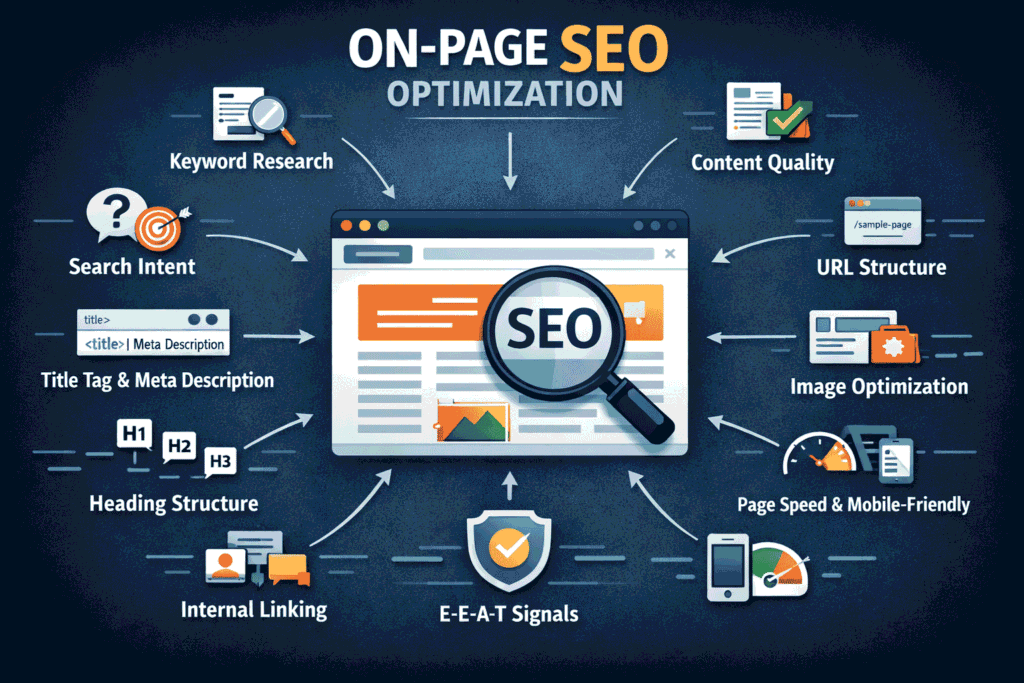
Tip #2: On-Page SEO — Optimize for Local Service Pages, Not Just Blogs
Blogging is valuable, but the pages that drive phone calls and contact form submissions are service pages. Most electrical contractor websites have a single “Services” page that lists every offering in bullet points. That’s a missed opportunity worth thousands of dollars per month in lost leads.
Build Dedicated Pages for Each Service in Each Location
Every core service you offer — panel upgrades, EV charger installation, whole-home rewiring, emergency electrical repair — deserves its own dedicated, deeply optimized page. And if you serve multiple cities or neighborhoods, each combination deserves separate treatment.
URL structure examples:
/emergency-electrician-austin/panel-upgrade-dallas-tx/ev-charger-installation-phoenix
These URLs are descriptive, keyword-rich, and signal to Google exactly what the page is about and where you operate.
Page-Level Optimization Fundamentals
For each service page, optimize these elements:
Title Tag (55–60 characters):
Licensed Emergency Electrician in Austin, TX | [Company Name]
Meta Description (150–160 characters):
Need a licensed emergency electrician in Austin? [Company Name] offers 24/7 service, upfront pricing, and same-day response. Call (512) XXX-XXXX.
H1 Tag: Should match or closely mirror the title tag — one per page, prominently near the top.
H2/H3 Hierarchy Example:
H2: 24/7 Emergency Electrician in [Neighborhood], Austin
  H3: Same-Day Circuit Breaker Repair
  H3: Licensed Electrical Panel Inspection
  H3: After-Hours Surge Protection Installation
H2: Why Austin Homeowners Choose [Company Name]
H2: Emergency Electrician Pricing in Austin
This hierarchy does two things simultaneously: it helps Google understand the page’s topic structure, and it helps scanning users (who read headings, not body text) quickly find what they need.
Image Optimization With Geotagged Alt Text
Every image on your service pages should have descriptive, geo-specific alt text. Don’t write “electrician photo” — write “licensed electrician replacing fuse box in Brooklyn Heights.” This reinforces local relevance for image search and contributes a small but meaningful signal to overall page relevance.
Additionally, compress all images before uploading. Tools like Squoosh or TinyPNG reduce file size without sacrificing quality — a direct improvement to page load speed.
Internal Linking Architecture
A well-linked site distributes authority efficiently and helps Google discover and index all your pages. Follow this linking pattern:
Service Page → Neighborhood Page → Supporting Blog Post → Contact/Quote Page
For example:
- “Panel Upgrade Austin” service page links to “Electrician in South Congress Austin” neighborhood page
- That neighborhood page links to “How Much Does an Electrical Panel Upgrade Cost?” blog post
- That blog post links back to the service page and to the contact page
On-page SEO checklist for home service contractors → On Page SEO Audit Checklist
Tip #3: Local Business Schema Markup — The #1 Missing Ingredient
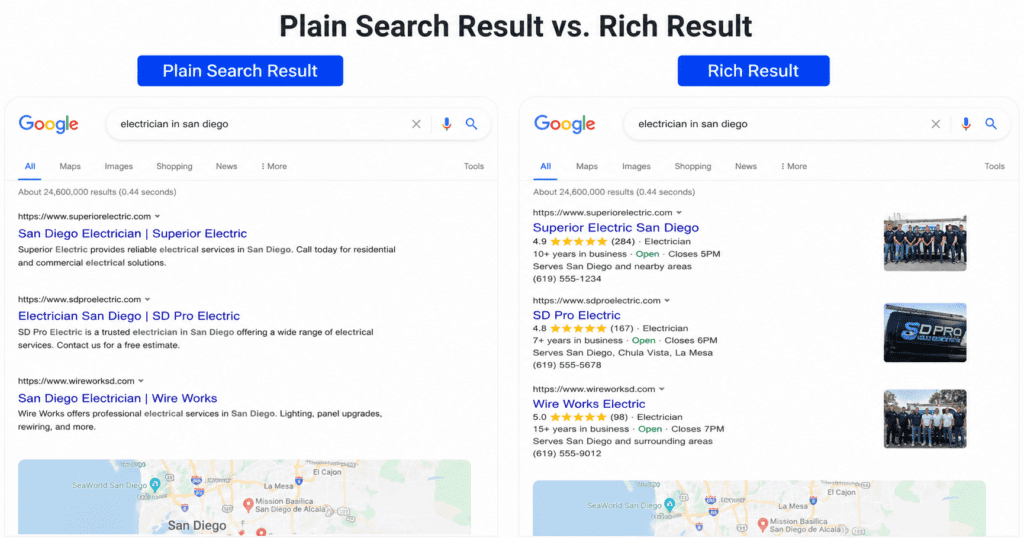
If there’s one technical SEO tactic that separates electricians with strong local visibility from those who struggle to rank, it’s schema markup. Specifically, LocalBusiness schema — and more precisely, the Electrician sub-type — tells Google exactly what your business is, where it operates, and what it offers. In return, Google rewards you with rich results: star ratings, hours, and service information displayed directly in search results before anyone clicks.
Why Schema Markup Is Non-Negotiable in 2026
Google’s AI-powered search features — including AI Overviews — rely heavily on structured data to understand and surface business information. According to Search Engine Land, websites with properly implemented structured data are significantly more likely to appear in featured snippets and knowledge panels. For local businesses, this translates directly to phone calls.
Without schema, Google has to guess your business type, hours, and service area. With schema, you tell it directly — and Google trusts direct statements more than inferred ones.
Copy-Paste JSON-LD Template for Electricians
Implement this in the <head> section of your website, or use your CMS’s schema plugin to add it to your homepage and key service pages. Replace all bracketed placeholders with your real business information:
{
  "@context": "https://schema.org",
  "@type": "Electrician",
  "name": "[Your Business Name]",
  "image": "https://yourdomain.com/images/team-photo.jpg",
  "url": "https://yourdomain.com",
  "telephone": "[+1-XXX-XXX-XXXX]",
  "priceRange": "$$",
  "address": {
    "@type": "PostalAddress",
    "streetAddress": "[Your Street Address or 'Service Area Business']",
    "addressLocality": "[Your City]",
    "addressRegion": "[State Abbreviation]",
    "postalCode": "[ZIP Code]",
    "addressCountry": "US"
  },
  "geo": {
    "@type": "GeoCoordinates",
    "latitude": "[Your Latitude]",
    "longitude": "[Your Longitude]"
  },
  "areaServed": [
    {
      "@type": "City",
      "name": "[Primary City]"
    },
    {
      "@type": "City",
      "name": "[Secondary City]"
    }
  ],
  "openingHoursSpecification": [
    {
      "@type": "OpeningHoursSpecification",
      "dayOfWeek": ["Monday", "Tuesday", "Wednesday", "Thursday", "Friday"],
      "opens": "07:00",
      "closes": "18:00"
    },
    {
      "@type": "OpeningHoursSpecification",
      "dayOfWeek": ["Saturday"],
      "opens": "08:00",
      "closes": "14:00"
    }
  ],
  "aggregateRating": {
    "@type": "AggregateRating",
    "ratingValue": "4.9",
    "reviewCount": "87"
  },
  "sameAs": [
    "https://www.facebook.com/yourbusiness",
    "https://www.yelp.com/biz/yourbusiness"
  ]
}
Important: Keep your
aggregateRatingvalues updated as your review count grows. Outdated data is worse than no data — Google cross-references schema claims against your actual review platforms.
How to Implement Schema Without Coding
If you use RankMath (WordPress), navigate to SEO → Local SEO and fill in your business details — RankMath generates schema automatically. Yoast SEO Premium offers similar functionality under Local SEO settings.
For those comfortable with HTML, add the JSON-LD block directly before the closing </head> tag in your website’s header.php or equivalent template file.
Testing Your Schema
After implementation, verify it with two free tools:
- Schema Markup Validator — Checks for syntax errors and missing required properties
- Google Rich Results Test — Shows exactly how Google reads your schema and which rich result features you’re eligible for
Tip #4: Google Business Profile Optimization + Review Schema
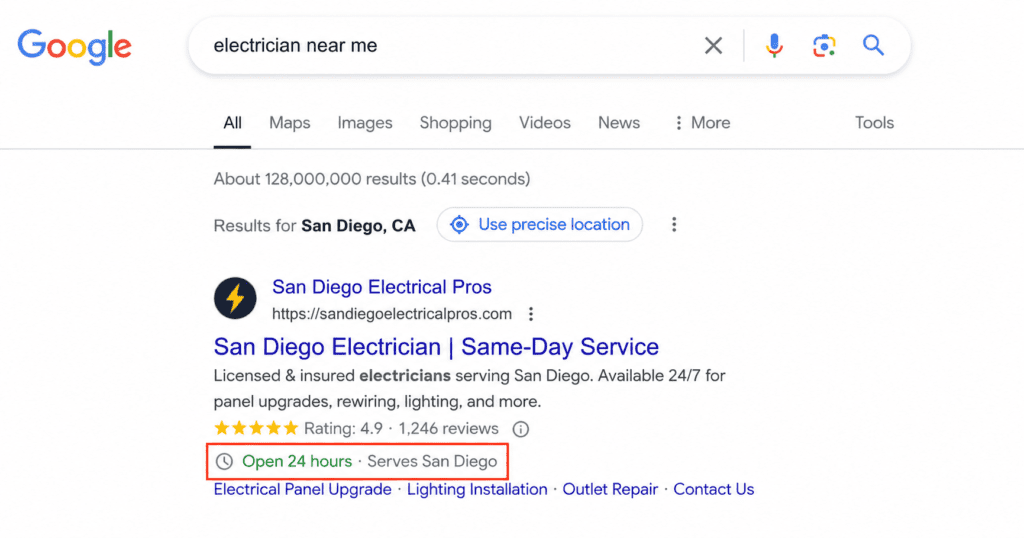
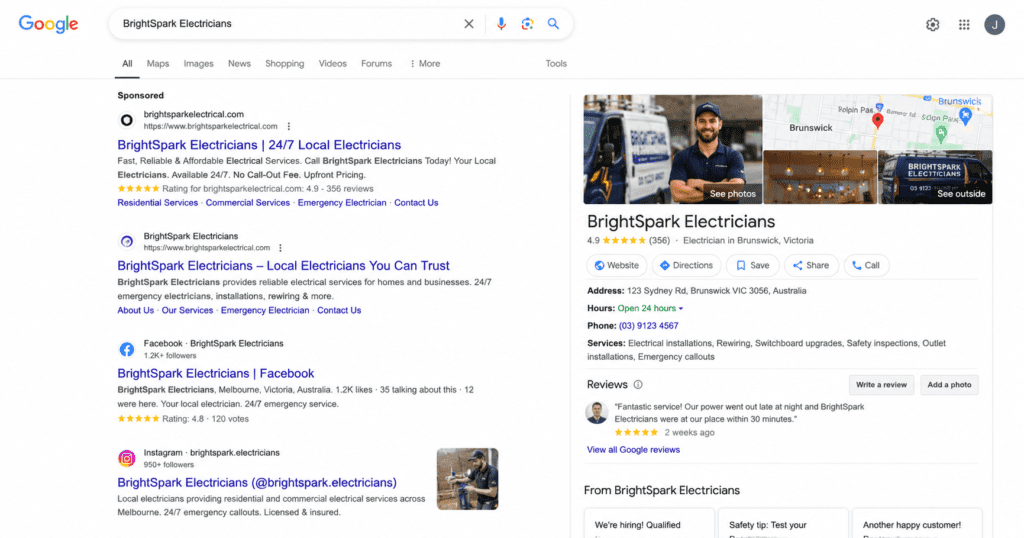
Your Google Business Profile (formerly Google My Business) is arguably the highest-ROI asset in your entire digital marketing stack. It’s free, it drives calls and direction requests directly from Google Maps, and it’s the primary driver of Local Pack rankings — those three businesses that appear above organic results for “near me” searches.
Most electricians set up their GBP once and never touch it again. That’s a mistake. Google’s algorithm rewards freshness, completeness, and engagement. Here’s how to use your GBP as an active business development tool.
The Complete GMB Setup Checklist
Before worrying about optimization, make sure your profile is fully complete:
- ✅ Business name — Exactly as it appears on your license and website (no keyword stuffing)
- ✅ Primary category: “Electrician” — Add secondary categories: “Emergency Electrician,” “Lighting Contractor,” “Solar Energy Contractor” if applicable
- ✅ Service area — List every city, neighborhood, and ZIP code you actively serve
- ✅ Phone number — Use a local area code; toll-free numbers underperform in local search
- ✅ Website URL — Link directly to your homepage or a dedicated landing page
- ✅ Business hours — Including holiday hours and 24/7 availability if applicable
- ✅ Services list — Add every service with descriptions: Panel Upgrades, EV Charger Installation, Whole-Home Rewiring, GFCI Outlet Installation, etc.
- ✅ Photo library — Minimum 20 photos covering team, vehicles, work-in-progress, and completed jobs
- ✅ Business description — 750 characters, keyword-rich but conversational
Weekly GBP Freshness Checklist
Treat your Google Business Profile like a social media account that drives real revenue. Run through this every week:
- 📸 Add 3–5 new photos — Work in progress shots, branded van at job site, team photos, before-and-after panels. Businesses that post photos regularly receive 42% more direction requests than those that don’t.
- 💬 Respond to every new review within 24 hours — Both positive and negative. For negative reviews, acknowledge the concern, apologize sincerely, and offer to resolve offline.
- 📝 Publish a GBP post — These appear in your Knowledge Panel and signal activity to Google. Topics: seasonal electrical tips, completed projects, promotions, or answers to common questions (e.g., “Why your GFCI outlet keeps tripping”).
- ❓ Answer new Q&A submissions — Google allows anyone to ask questions publicly on your profile. Monitor and answer these promptly to prevent misinformation and to own the narrative.
Implementing Review Schema (AggregateRating)
Review schema is the piece of the puzzle that brings your star ratings from Google Maps into organic search results. The aggregateRating property within your LocalBusiness schema (shown in Tip #3 above) handles this — but it requires you to keep the ratingValue and reviewCount fields current.
If your business consistently earns 5-star reviews but your schema shows 12 reviews when you actually have 147, you’re leaving rich result potential on the table. Build a monthly reminder into your workflow to update these values.
The Business Case for Reviews
Reviews are not just a trust signal for potential customers — they’re a ranking factor. According to Whitespark’s Local Search Ranking Factors study, review signals (quantity, velocity, diversity, and keyword presence in review text) account for a meaningful portion of local pack ranking factors.
A separate BrightLocal survey found that 78% of consumers trust online reviews as much as personal recommendations from friends or family. For a high-stakes service like electrical work — where homeowners are allowing a stranger into their home — that trust is existential.
Action step: Build a review request system. After every completed job, send a two-message text sequence: the first thanks the customer, the second (sent 24 hours later) asks for a Google review with a direct link. Tools like GatherUp or even a simple Google Review link shortened with Bitly can automate this.
Tip #5: Create “AI-Bait” Content — FAQ, How-To, and Troubleshooting Guides
The most overlooked growth lever in electrician SEO is content that answers questions before the phone rings. Not because you want to give away free advice — but because content that answers specific electrical questions earns Google’s trust, appears in AI-generated answers, and brings in homeowners who are one step away from hiring someone.
This is what the industry calls “AI-Bait” content: articles, FAQs, and guides structured in ways that make them easy for large language models and AI answer engines (ChatGPT, Perplexity, Google AI Overviews) to extract, summarize, and cite.
The Dedicated FAQ Section (With Schema-Ready Q&A)
Every service page should contain a dedicated FAQ section targeting the questions your customers actually ask. These don’t need to be long — 2–4 sentences per answer is ideal for featured snippet capture and AI extraction.
High-value FAQ questions for electrician websites:
Q: How much does it cost to hire a licensed electrician per hour? A: Licensed electricians typically charge between $50 and $130 per hour in most US markets, with emergency and after-hours rates running 25–50% higher. The exact rate depends on your location, the complexity of the work, and whether permits are required.
Q: What are the signs of an overloaded circuit? A: An overloaded circuit typically shows these warning signs: frequently tripping breakers, flickering or dimming lights when appliances run, outlets or switches that feel warm to the touch, and a burning or plastic smell near the electrical panel. Any of these symptoms warrants an immediate inspection by a licensed electrician.
Q: Do electricians need to be licensed in [State]? A: In most US states, electricians performing work on residential or commercial properties are required to hold a valid state license. Requirements vary — some states require a master electrician license for independent work, while others allow journeyman licensees to operate under supervision. Always ask to see your electrician’s license number before authorizing any work.
Q: How long does an electrical panel upgrade take? A: A standard 200-amp panel upgrade typically takes 4–8 hours for an experienced electrician. Projects involving permit inspections, service entrance upgrades, or older homes with aluminum wiring may extend over multiple days.
How-To Guides With Numbered Steps (+ Safety Disclaimers)
Step-by-step how-to content earns featured snippets at higher rates than any other format. Google explicitly rewards HowTo schema-marked content with expanded rich results. Focus on tasks homeowners can safely attempt themselves — and be honest about when to call a professional.
Example: How to Reset a Tripped Circuit Breaker
⚠️ Safety Disclaimer: If your breaker trips repeatedly, smells of burning, or trips immediately after resetting, do not continue resetting it. This indicates an underlying fault that requires a licensed electrician. The steps below apply only to a single-occurrence trip with no associated symptoms.
- Locate your electrical panel — Usually in the basement, garage, utility room, or hallway.
- Identify the tripped breaker — It will be in the middle position or turned slightly toward “off,” visually distinct from the fully “on” breakers.
- Turn the breaker fully off — Push it firmly toward the “off” position until it clicks.
- Wait 30 seconds — This allows the internal mechanism to fully reset.
- Flip the breaker firmly to “on” — You should feel a distinct click. The breaker should stay in the “on” position.
- Test the circuit — Turn on a light or plug in a device to confirm power is restored.
- Identify the cause — Reduce the load on that circuit by unplugging devices before running multiple high-draw appliances simultaneously.
The DIY vs. Call an Electrician Comparison Table
This table is designed to capture featured snippets for “can I do X myself” queries — one of the highest-volume question formats in the home improvement space:
| Electrical Issue | DIY Safe? | When to Call an Electrician |
|---|---|---|
| Replace a standard light switch | ✅ Yes (with breaker off + voltage tester) | ⚠️ If wiring looks burned, melted, or unusual |
| Replace an outlet | ✅ Yes (same-circuit only, with breaker off) | ⚠️ If GFCI-protected or circuit not identified |
| Reset a tripped breaker | ✅ Yes (single occurrence only) | ✅ If it trips repeatedly or immediately |
| Buzzing or humming breaker panel | ❌ No | ✅ Immediately — possible arcing or overload |
| Install an EV charger (Level 2) | ❌ No (permit required in all 50 states) | ✅ Licensed electrician only |
| Add a new electrical circuit | ❌ No (requires panel work) | ✅ Licensed electrician with permit |
| Replace a standard light fixture | ✅ Yes (with breaker off) | ⚠️ If junction box or wiring appears faulty |
| Diagnose intermittent power loss | ❌ No | ✅ Diagnostic tools required |
Video Transcripts Embedded as Text
If you produce YouTube videos — job walkthroughs, safety explainers, before-and-after reveals — embed the full transcript as text below each embedded video on your website. This does three things:
- Boosts accessibility for hearing-impaired visitors
- Provides indexable text that search engine bots can crawl (video content alone is not indexed)
- Improves AI extractability — AI engines can pull verbatim answers from text transcripts
Tip #6: Local Backlinks & Citations — Authority + NAP Consistency
Every time another website links to yours, it signals to Google that your business is legitimate, relevant, and trustworthy. For local businesses, two types of authority building matter most: citations (consistent business listings across the web) and backlinks (inbound links from relevant, authoritative websites).
Citation Audit: The Foundation of Local Authority
Before building new links, audit your existing citations for accuracy. NAP consistency — identical Name, Address, and Phone number across every online listing — is a foundational local SEO requirement. A single discrepancy (e.g., “Suite 100” on your website but “Ste. 100” on Yelp) can dilute your local authority signals.
Priority citation platforms for electricians:
| Platform | Domain Authority | Type |
|---|---|---|
| Google Business Profile | Very High | Primary |
| Yelp | Very High | General business |
| Better Business Bureau (BBB) | Very High | Trust/Authority |
| Angi (formerly Angie’s List) | High | Home services |
| HomeAdvisor | High | Home services |
| Houzz | High | Home improvement |
| Nextdoor | Medium-High | Hyperlocal |
| Thumbtack | Medium | Home services |
| Local Chamber of Commerce | Medium-High | Local authority |
| City/County business directory | High (.gov) | Authoritative |
Use a tool like BrightLocal or Whitespark to run a citation audit, identify inconsistencies, and push corrections to dozens of platforms simultaneously.
Citation Audit Checklist
Run through this quarterly:
- [ ] Business name identical across all platforms (no abbreviations, no “&” vs. “and” inconsistencies)
- [ ] Phone number consistent (same format: XXX-XXX-XXXX vs. (XXX) XXX-XXXX — pick one)
- [ ] Address consistent (if SAB/Service Area Business, ensure physical address is hidden on all platforms)
- [ ] Website URL consistent (always use the same version: with or without “www”)
- [ ] Business categories consistent across platforms
- [ ] Business description updated and keyword-rich
- [ ] Hours consistent across all platforms (update for holidays immediately)
Backlink Strategies That Actually Work for Electricians
Forget link schemes and paid directories. The backlinks that move the needle are earned through genuine relevance and community involvement:
1. Local Community Sponsorships Sponsor a local little league team, youth soccer club, or school fundraiser. Most local sports organizations maintain a website with a “Sponsors” page — and those pages typically sit on .org domains with meaningful local authority. The backlink you receive is genuine, relevant, and durable.
2. Guest Posts on Real Estate and Home Improvement Blogs Homebuyers are asking their real estate agents about electrical inspections. Write a genuinely useful guest post — “Electrical Inspection Checklist Before Buying a Home” — for a local real estate agent’s blog or a regional home improvement publication. This earns a contextually relevant backlink and puts your expertise in front of an audience that will need an electrician soon.
3. Local Media and Press Local news sites, neighborhood blogs, and community publications are always looking for expert sources. Reach out to your local newspaper or city magazine offering to comment on electrical safety topics — especially ahead of summer (air conditioning season) or winter (space heater fire risk season). A single mention in a local news outlet can yield a high-DA backlink and brand awareness simultaneously.
4. “Best Electrician in [City]” Roundup Articles Search for list-style articles ranking the best electricians in your market. When you find them, reach out to the publisher directly and ask to be included. Explain your credentials, review count, and specialties. These roundup pages often carry significant authority and rank for competitive terms.
5. Supplier and Manufacturer Partnerships If you’re a certified installer for products like Tesla Powerwall, Leviton, or Square D panels, those manufacturers often maintain contractor directories on their websites. Reach out and get listed — these are high-authority, industry-relevant backlinks that also validate your expertise.
A Note on Disavowal
If your site has accumulated low-quality links from spammy directories or link farms (common if previous contractors used black-hat tactics), clean house. Use Google’s Disavow Tool to instruct Google to ignore those links. A clean link profile is more valuable than a large but questionable one.
Tip #7: Mobile-First & Core Web Vitals — Because Google Indexes Mobile Only
Google switched to mobile-first indexing permanently in 2023, meaning the mobile version of your website is the primary version Google crawls, indexes, and ranks. If your desktop site is polished but your mobile experience is clunky, slow, or hard to navigate, you’re penalizing your own rankings.
For electricians, this matters acutely. Homeowners in an electrical emergency are almost always reaching for their phone first. A slow, hard-to-navigate mobile site loses those leads before the first impression is even made.
The Speed Problem
According to Google’s own research published on Think with Google, 53% of mobile users abandon a website that takes longer than 3 seconds to load. For a $2,000 panel upgrade job, that’s a lot of money walking out the door because a page took four seconds.
Core Web Vitals — Google’s framework for measuring page experience — sets specific benchmarks:
| Core Web Vital | What It Measures | Target Score |
|---|---|---|
| Largest Contentful Paint (LCP) | How fast the main content loads | < 2.5 seconds |
| First Contentful Paint (FCP) | How fast the first element appears | < 1.5 seconds |
| Interaction to Next Paint (INP) | Responsiveness to user input | < 200ms |
| Cumulative Layout Shift (CLS) | Visual stability (no jumping elements) | < 0.1 |
Mobile UX Checklist for Electrician Websites
Beyond raw speed, the user experience on mobile must be engineered around the specific behavior of someone looking for emergency electrical help:
- Tap-to-call button on every page — Your phone number should be a tappable link (
tel:+1XXXXXXXXXX) visible without scrolling, ideally pinned to a sticky header or footer bar - No intrusive pop-ups — Google penalizes interstitials that cover page content on mobile. Remove any pop-ups that appear on page load
- Minimum 16px font size — Text smaller than this forces users to pinch-zoom, which Google reads as a poor mobile experienceButtons minimum 44×44 pixels — Anything smaller is difficult to tap accurately on a touchscreen
- Simplified mobile navigation — A hamburger menu with 5–7 items maximum; multi-level dropdowns are nearly unusable on mobile
- Short contact forms — Mobile form abandonment is high. For initial contact, ask only for name, phone, and service needed. Collect additional information by phone
- Embedded Google Map — Make it easy for users to get directions with a single tap
Tools to Test and Improve Mobile Performance
Run all three of these tests on your homepage and each primary service page:
- Google PageSpeed Insights — Provides both mobile and desktop scores, plus specific recommendations ranked by impact. Start with the highest-impact items.
- Google Lighthouse — A more detailed audit tool built into Chrome DevTools. Covers performance, accessibility, SEO, and best practices.
- Mobile-Friendly Test — Google’s simple pass/fail test for mobile compatibility. If you fail this, fix it before anything else.
Quick win: The single fastest way to improve load time on most contractor websites is image compression. If your site uses uncompressed photos from a smartphone camera, you may have 4–8 MB images where 200 KB would serve just as well visually. Run every image through Squoosh before uploading.
Tip #8: Track What Matters — AI-Compatible Performance Dashboard
SEO without measurement is guesswork. The challenge for electricians is knowing which metrics actually correlate with more booked jobs — and which are vanity numbers that feel good but don’t pay the bills. This tip cuts through that noise with a focused performance dashboard built around business outcomes.
The Metrics That Actually Matter
Forget obsessing over domain authority scores or keyword rankings in isolation. These are the metrics that connect directly to revenue:
Local Pack Impressions and Actions (GMB Insights) How many times did your business appear in local search results? More importantly, how many of those impressions converted into direction requests, website clicks, or — most importantly — phone calls? GMB Insights provides all of this data, broken down by time period, search type, and platform.
Click-to-Call Conversions (Google Analytics 4) Set up an event in Google Analytics 4 that fires when a user clicks your phone number on mobile. This is your most direct measure of leads generated from SEO. Without this event, you have no idea how many calls your website is actually driving.
Organic Traffic to Service Pages (Google Search Console) Total traffic means little. What matters is whether the people landing on your “Panel Upgrade Austin” page are actually from Austin and actually searching for panel upgrades. Use Search Console’s performance report, filtered by page, to see which queries drive clicks to your service pages.
Review Growth Rate Month-over-month review count is a leading indicator of both business activity and local ranking potential. Set a target — even 4–6 new reviews per month makes a measurable difference to your Local Pack performance over a 12-month period.
Organic Phone Calls (CallRail or Similar) If you use a call tracking platform like CallRail, you can assign unique phone numbers to organic search, GBP, and paid channels separately. This lets you calculate a true cost-per-lead for SEO — invaluable when justifying continued investment.
Monthly SEO Scorecard for Electricians
Use this as a literal document you update at the start of each month:
| Metric | Target | Tracking Tool | Current Status |
|---|---|---|---|
| Avg. local pack position | Top 3 for primary keywords | GMB Insights + STAT | |
| Mobile page speed (FCP) | < 1.5 seconds | PageSpeed Insights | |
| New backlinks acquired | 5–10 per month | Ahrefs / Semrush | |
| Review response rate | 100% within 24 hours | Manual GBP tracking | |
| GBP profile views | Month-over-month growth | GMB Insights | |
| Click-to-call events | Month-over-month growth | Google Analytics 4 | |
| Organic traffic (service pages) | Month-over-month growth | Google Search Console | |
| New Google reviews | 4–6 minimum | GBP dashboard | |
| Avg. response time (website) | < 200ms | Pingdom / GTmetrix |
How to Act on the Data
Numbers without decisions are just numbers. Here’s how to translate common findings into action:
- “Emergency electrician” page has high traffic but high bounce rate → Add an emergency availability badge (“Available Tonight — Call Now”), a simplified contact form visible above the fold, and pricing transparency (even a range helps)
- Low click-through rate on Local Pack despite good position → Your GBP title, photos, or review count need work. Add new photos, refresh your description, and push a review generation campaign
- Service pages ranking on page 2 → Audit their word count, internal links, and schema. Pages on page 2 typically need more depth, better internal linking, or additional supporting content
- Phone calls spiking in spring → Double down on seasonal content (“Spring Electrical Safety Checklist”) to capture intent during your busiest period
Conclusion: Your Electrical Business Is Invisible Without SEO — Here’s How to Change That
Search engine optimization for electricians isn’t a “nice to have” in 2026. It’s the difference between a phone that rings and a business that struggles to grow. The 8 strategies in this guide aren’t theoretical — they’re the specific levers that move the needle for local electrical contractors competing in real markets.
Here’s what you’ve learned to implement:
- Keyword Research — Go long-tail and service-area specific; stop competing for “electrician” alone
- On-Page Optimization — Build dedicated service pages with proper URL slugs, heading hierarchies, and internal linking
- Local Business Schema — Add the JSON-LD template from Tip #3 to your homepage this week
- Google Business Profile — Treat it as an active channel: weekly posts, photo uploads, and review responses
- AI-Bait Content — Build FAQ pages, how-to guides, and comparison tables that AI engines extract and cite
- Backlinks and Citations — Audit your NAP consistency, then build local links through community involvement and guest content
- Mobile-First Experience — Test your site on a real phone; if it’s slow or hard to navigate, fix it before anything else
- Performance Tracking — Use the monthly scorecard to connect SEO activities to actual calls and revenue
6 Things to Implement Today
If you do nothing else after reading this, do these six things:
- [ ] Claim and complete your Google Business Profile if it isn’t already 100% filled out
- [ ] Add the JSON-LD LocalBusiness schema from Tip #3 to your homepage
- [ ] Run your site through PageSpeed Insights and address the top two recommendations
- [ ] Send three review requests to recent satisfied customers using a direct Google review link
- [ ] Identify five long-tail keywords using the table in Tip #1 and create a content plan around them
- [ ] Check NAP consistency on Yelp, BBB, and Angi — fix any discrepancies today
SEO for electricians compounds. The authority you build through reviews, backlinks, and consistent content production in 2026 will be working for you in 2028 without additional ad spend. It’s not a one-time fix — it’s a reputation asset that grows with your business.
Frequently Asked Questions About Electrician SEO
These questions reflect the most common electrician SEO queries appearing in People Also Ask boxes, AI answer engines, and search autocomplete. Each answer is structured for direct extraction by AI systems and featured snippet capture.
Q: How long does SEO take for a local electrician?
A: Most local electricians begin seeing meaningful improvements in Google Business Profile visibility and citation-driven rankings within 45–60 days of foundational optimization. Organic service page rankings typically take 4–6 months for competitive markets and less for smaller cities. Review velocity and consistent GBP activity can accelerate timelines significantly.
Q: Do electricians really need a blog?
A: Yes — but with a specific purpose. A blog supports your service pages by establishing topical authority around electrical topics. Posts answering “why does my breaker keep tripping” or “how much does an electrical panel upgrade cost” attract homeowners early in their decision process and route them toward your service pages and contact form. Without supporting content, standalone service pages are harder to rank.
Q: What’s the single best ROI SEO tactic for electricians?
A: A fully optimized Google Business Profile combined with Local Business and Review schema markup. This combination costs nothing but time to implement, directly influences Local Pack rankings (where most high-intent searches convert), and provides rich result display — star ratings, hours, and service information — without requiring a paid ad.
Q: Can I do electrician SEO myself, or do I need an agency?
A: The foundational work — GBP optimization, citation cleanup, schema markup, and basic on-page optimization — is learnable and executable without an agency. The work that requires scale and specialized expertise — technical SEO audits, link building campaigns, and ongoing content production — is where a specialist agency typically earns its fees. Many electricians start DIY and bring in professional help once they see the initial results.
Q: How does electrician SEO differ from general SEO?
A: Electrician SEO is almost entirely local-focused. Unlike national e-commerce SEO, electrician SEO centers on the Local Pack, Google Business Profile, service-area pages, NAP citation consistency, and review acquisition. The keyword universe is geographically constrained but commercially high-value — most searches with local intent are from people ready to hire immediately.
Q: How many Google reviews does an electrician need to rank in the Local Pack?
A: There’s no hard threshold, but competitive markets typically see Local Pack leaders with 50–200+ reviews and strong review velocity (4–8 new reviews per month). Review score matters too — a 4.8 rating with 80 reviews typically outperforms a 3.9 rating with 200 reviews. Focus on quality, consistency, and response rate, not just raw count.
Q: What’s the difference between Local SEO and regular SEO for electricians?
A: Regular (organic) SEO targets positions in the standard blue-link search results through keywords, content, and backlinks. Local SEO targets the Map Pack (the three businesses shown with map pins above organic results) through Google Business Profile signals, proximity, review quality, and citation consistency. Both matter for electricians — Local SEO drives immediate calls; organic SEO builds long-term authority and inbound traffic.
Q: Should I use AI-generated content for my electrician website?
A: AI-generated content alone does not meet Google’s E-E-A-T (Experience, Expertise, Authority, Trust) requirements for electrician websites. Content that demonstrates real-world experience — your license number, photos of completed work, specific job case studies, permit histories — cannot be generated by AI because it requires actual business records. AI can assist with research, outlines, and drafts, but all published content must be fact-checked, enriched with original details, and reviewed by someone with electrical expertise.
Last updated by Searchlyn team in June 2026