Introduction: Why Plumbing SEO Is the Most Valuable Investment You’re Not Making
When a pipe bursts at 11 PM, homeowners don’t flip through a directory. They grab their phone, type “emergency plumber near me,” and call whoever appears first. If your business isn’t ranking at the top of those results, a competitor is collecting that revenue — every single night.
Plumbing SEO (Search Engine Optimization) is the practice of optimizing your online presence so that Google surfaces your business ahead of competitors when local customers search for plumbing services. It’s not a luxury reserved for large companies. For independent plumbers and regional plumbing businesses, Plumbing SEO is arguably the highest-ROI marketing channel available — because it puts you in front of customers at the exact moment they’re ready to spend money.
The numbers confirm this urgency. According to BrightLocal, 75% of users never scroll past the first page of search results. That means if you’re sitting on page two or three, you’re effectively invisible to three-quarters of your potential customers.
In this guide, you’ll learn seven data-driven plumbing SEO tips — from keyword research and on-page optimization to Google Business Profile management, backlink building, and page speed — that will meaningfully increase your local search visibility and drive more inbound service calls.
Quick Stats: Why Local SEO Is Non-Negotiable for Plumbers
| Statistic | Source | Implication for Plumbers |
|---|---|---|
| 78% of local mobile searches result in an offline purchase or call | Google/Ipsos | Optimizing for “near me” queries directly drives revenue |
| 46% of all Google searches have local intent | HubSpot | A massive share of your target audience is already searching |
| 88% of consumers trust online reviews as much as personal recommendations | BrightLocal | Review generation must be a systematic daily habit |
| The top 3 Google map pack results capture 44% of all local clicks | Search Engine Land | Winning the map pack is a revenue-critical objective |
| Businesses with complete GBP listings get 7x more clicks | Google Business | An incomplete profile is leaving calls on the table |
Tip #1 — Conduct Plumbing-Specific Keyword Research with Local Intent
Why Generic Keywords Will Always Disappoint You
Let’s be direct: ranking for the keyword “plumber” is not a realistic goal, and even if it were, it would barely move the needle on your revenue.
“Plumber” is searched by people comparing prices, doing research, or possibly looking for plumbing supplies. It has no geographic boundary and no urgency signal. Competing for it means going head-to-head against national directories like Angi, Yelp, and HomeAdvisor — companies with domain authorities and content budgets that dwarf any local plumbing business.
The customers who actually call and book jobs type phrases like “emergency plumber in [city]”, “water heater replacement [neighborhood]”, or “sewer line repair near me.” These are high-intent, location-specific searches — and they are winnable by a well-optimized local plumbing business.
The Right Tools for Plumbing Keyword Discovery
You don’t need to guess which terms your customers use. These tools give you real search volume, competition data, and keyword ideas:
- Google Keyword Planner — Free. Enter broad terms like “plumber” or “drain cleaning” and filter by your city or service area. Great starting point.
- Semrush — Paid. Shows keyword difficulty, local SERP features, and competitor keyword gaps. The Keyword Magic Tool is particularly useful for discovering long-tail local variations.
- Ahrefs — Paid. Best-in-class for analyzing what keywords competitors are already ranking for. Enter a competitor’s URL into Site Explorer and filter for local terms. There is also a free version available!
- Google Autocomplete & “People Also Ask” — Free and criminally underused. Type “plumber [your city]” into Google and let autocomplete reveal what real customers are searching for.
What keywords should plumbers target for SEO? Plumbers should prioritize long-tail, location-specific keywords that signal urgency or a specific service — such as “emergency plumber in [city]” or “water heater repair [neighborhood].” These terms have lower competition than broad keywords and attract customers who are ready to book immediately.
Mapping Keywords to the Right Pages
One of the most common plumbing SEO mistakes is trying to rank one page for every service. Instead, create a dedicated page for each service-location combination: E.g. –
/drain-cleaning-austin-txtargets “drain cleaning Austin”/water-heater-repair-dallastargets “water heater repair Dallas”/sewer-line-replacement-houstontargets “sewer line replacement Houston”/emergency-plumber-san-antoniotargets “emergency plumber San Antonio”
Blog posts, meanwhile, should target problem-based and informational queries — like “why does my water heater smell like sulfur” or “how to unclog a slow drain.” These posts educate readers, demonstrate expertise, and funnel readers toward your service pages.
Tip #2 — Implement On-Page SEO and Structured Data (LocalBusiness + FAQ Schema)
Optimizing Title Tags and Meta Descriptions
Your title tag is the single most visible on-page SEO element. It appears as the blue clickable headline in Google’s search results. For plumbing pages, effective title tags follow a simple but powerful formula:
Formula: [Primary Service] in [City] | [Brand Name] | [Differentiator]
Examples:
Emergency Plumber in Austin, TX | Fast & Licensed | ABC PlumbingWater Heater Repair Dallas | Same-Day Service | XYZ PlumbingDrain Cleaning Chicago | Affordable & Guaranteed | Smith Plumbing Co.
Title tags should stay between 50–60 characters to avoid truncation in search results. Include your city name and, where natural, a urgency or trust signal (“licensed,” “same-day,” “24/7”).
Meta descriptions don’t directly influence rankings, but they dramatically affect click-through rates. Write them as a compelling pitch — 150 to 160 characters — that gives the searcher a reason to click your result over the one below it.
Example: “Burst pipe? Clogged drain? Our licensed Austin plumbers respond in under an hour. Call now for same-day emergency service. No hidden fees.”
Header Hierarchy That Answers User Questions
Search engines — and readers — use your H1, H2, and H3 tags to understand page structure and extract direct answers. Structure your plumbing service pages like this:
- H1: One per page, contains primary keyword. Example: “Emergency Plumber in Austin, TX”
- H2: Section headers for each major topic. Example: “Our Austin Emergency Plumbing Services,” “How Fast Can You Arrive?”, “Emergency Plumbing Rates”
- H3: Subsections within H2s. Example: “Burst Pipe Repair,” “Water Heater Failures,” “Gas Leak Emergencies”
Questions make excellent H2 and H3 headers because they match how users search and how AI systems extract answers for featured snippets.
LocalBusiness Schema Markup — The Technical Edge Most Plumbers Skip
Schema markup is structured data you add to your website’s code that explicitly tells search engines what your business is, where it’s located, what it does, and how to contact it. It enables rich results — star ratings, phone numbers, business hours — directly in the search results page, before users even click.
For plumbing businesses, implement LocalBusiness schema (or more specifically Plumber schema) on your homepage and key service pages.
Example JSON-LD — Copy-Paste Ready:
{
  "@context": "https://schema.org",
  "@type": "Plumber",
  "name": "ABC Plumbing Co.",
  "url": "https://www.abcplumbing.com",
  "logo": "https://www.abcplumbing.com/images/logo.png",
  "image": "https://www.abcplumbing.com/images/team-photo.jpg",
  "description": "Licensed and insured plumbing company serving Austin, TX. Specializing in emergency plumbing, drain cleaning, water heater repair, and sewer line replacement.",
  "telephone": "+1-512-555-0100",
  "address": {
    "@type": "PostalAddress",
    "streetAddress": "123 Main Street",
    "addressLocality": "Austin",
    "addressRegion": "TX",
    "postalCode": "78701",
    "addressCountry": "US"
  },
  "geo": {
    "@type": "GeoCoordinates",
    "latitude": 30.2672,
    "longitude": -97.7431
  },
  "openingHoursSpecification": [
    {
      "@type": "OpeningHoursSpecification",
      "dayOfWeek": ["Monday","Tuesday","Wednesday","Thursday","Friday"],
      "opens": "07:00",
      "closes": "19:00"
    },
    {
      "@type": "OpeningHoursSpecification",
      "dayOfWeek": ["Saturday","Sunday"],
      "opens": "08:00",
      "closes": "17:00"
    }
  ],
  "areaServed": {
    "@type": "GeoCircle",
    "geoMidpoint": {
      "@type": "GeoCoordinates",
      "latitude": 30.2672,
      "longitude": -97.7431
    },
    "geoRadius": "30000"
  },
  "priceRange": "$$",
  "aggregateRating": {
    "@type": "AggregateRating",
    "ratingValue": "4.9",
    "reviewCount": "214"
  }
}
Test your schema using Google’s Rich Results Test before publishing.
FAQ Schema — Winning “People Also Ask” Boxes
FAQ schema marks up your Q&A content so Google can display it as an expandable accordion directly in search results, often in the “People Also Ask” section. This earns you additional SERP real estate without requiring a higher ranking position.
Common FAQs to mark up on plumbing service pages:
- “Do you offer emergency plumbing on weekends?”
- “How much does drain cleaning cost?”
- “Are your plumbers licensed and insured?”
- “Do you provide free estimates?”
Each answer should be 40–80 words — concise enough for a featured snippet but substantive enough to be genuinely useful.
Internal Linking Strategy
Internal links pass authority between pages and guide users through your site. For plumbing websites, use this hierarchy:
- Homepage → links to all primary service pages
- Service pages → link to related service pages and location pages
- Blog posts → link to the most relevant service page (with keyword-rich anchor text)
- Location pages → link back to service pages with local modifiers
Example: A blog post on “how to prevent frozen pipes” should internally link to your “emergency pipe repair [city]” service page.
Tip #3 — Optimize Your Google Business Profile for Maximum Local Visibility
[IMAGE: google-business-profile-plumbing-optimization.png | Alt: Fully optimized Google Business Profile for a plumbing company showing photos, reviews, services, and business hours]
Your Google Business Profile (GBP) is the single most impactful local SEO asset for plumbers. It determines whether you appear in the local map pack — the three-business block that appears above organic results for local queries — and it’s often the first impression potential customers have of your business.
According to Google, businesses with complete and accurate GBP listings are twice as likely to earn customer trust. Those with 10 or more photos see 35% more website clicks and 42% more direction requests.
Complete Every Single Field — No Exceptions
Most plumbing businesses leave their GBP partially filled out. That’s a direct competitive disadvantage. Google rewards profile completeness with higher visibility.
Fields to complete in full:
- Business name — Use your exact legal/operating name. No keyword stuffing (this violates Google’s guidelines).
- Primary category — “Plumber.” Add secondary categories like “Drainage service,” “Water heater repair service,” or “HVAC contractor” if applicable.
- Hours — Include regular hours, holiday hours, and special hours. Mark 24/7 availability if you offer it.
- Attributes — Enable “emergency service available,” “women-led,” “veteran-owned,” or any other applicable attributes. These surface in filtered searches.
- Service area — Define your service radius or specific zip codes/cities. This is especially important for service-area businesses without a public-facing office.
- Description — Write a 250-word business description that naturally includes your primary services and city. Don’t keyword stuff; write for the customer.
- Services section — List every service individually with a name, description, and price range where applicable.
Post Weekly Updates — Consistency Signals Activity
Google’s algorithm favors active, engaged businesses. Posting weekly updates to your GBP signals to Google that your business is current and customer-focused. Effective post types for plumbers include:
- Offers — “10% off water heater installation this month”
- What’s New — New service announcements or service area expansions
- Events — If you sponsor local events or host community days
- Before/After photos — Nothing builds trust faster than visual proof of quality work
Proactive Q&A Management
The Q&A section of your GBP is public — meaning anyone can ask questions, and anyone can answer them, including competitors. Take ownership of this section by preemptively posting and answering your own FAQs:
- Q: “Do you offer same-day service?” → A: “Yes, we offer same-day and emergency plumbing service 7 days a week.”
- Q: “Are you licensed and insured?” → A: “Yes, we are fully licensed, bonded, and insured in [State].”
Regularly monitor this section for new questions. Unanswered questions create uncertainty and lost bookings.
Local SEO Audit Checklist for Your GBP
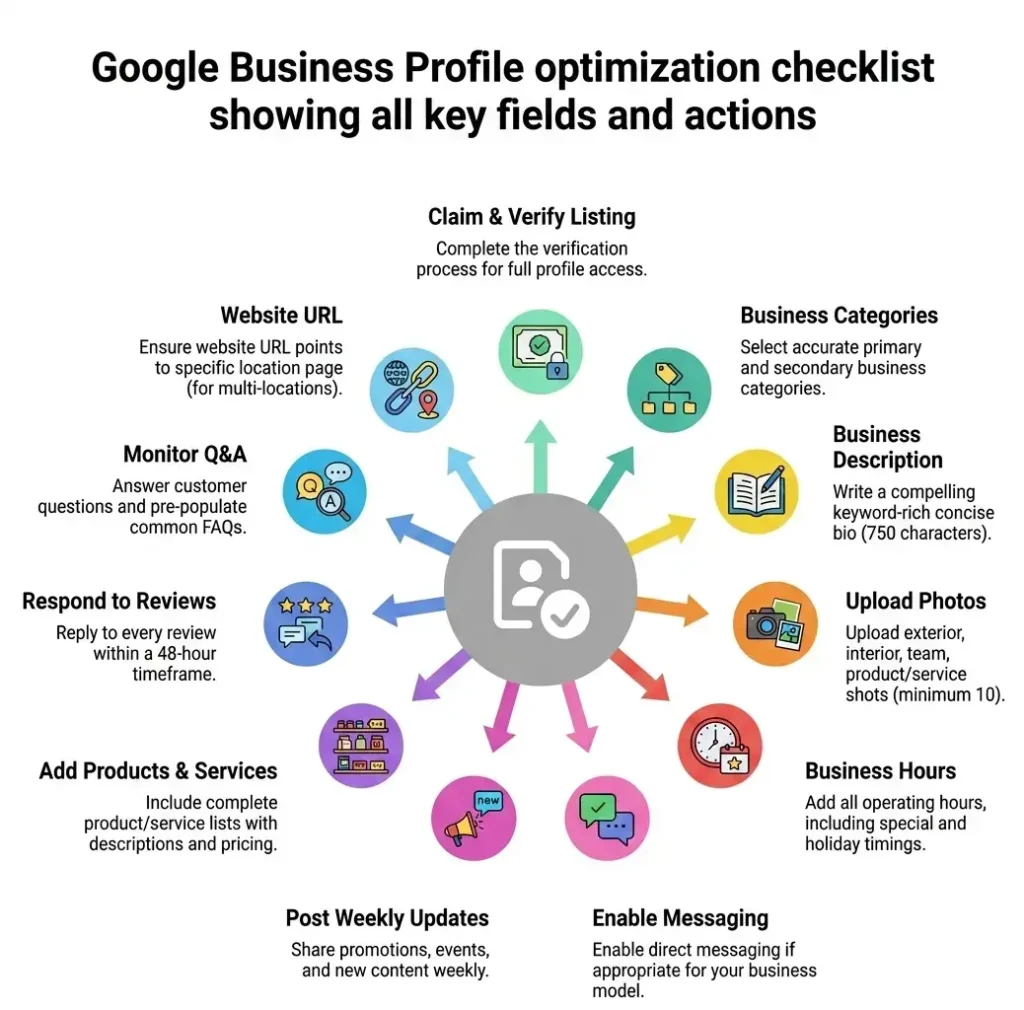
Use this checklist to verify your profile is fully optimized:
- ☐ NAP (Name, Address, Phone) is 100% consistent across your website, GBP, and all directories
- ☐ Business description is written and includes primary services + city
- ☐ At least 10 high-resolution photos (team, vehicles, job sites, before/after)
- ☐ All services listed individually with descriptions
- ☐ Emergency service attribute enabled
- ☐ Respond to every review — positive and negative — within 24 hours
- ☐ Messaging is enabled for instant customer inquiries
- ☐ Weekly posts are scheduled or published
- ☐ Q&A section has 5+ preemptive questions answered
- ☐ Website URL is correctly linked and points to a relevant landing page
How we optimize Google Business Profiles → Local SEO Services
Tip #4 — Build Local Citations and Generate a Steady Stream of Positive Reviews
What Are Local Citations and Why Do They Matter?
A local citation is any online mention of your business’s Name, Address, and Phone number (NAP) — whether on a directory, review site, local blog, or news outlet. Citations serve two critical functions:
- They confirm to Google that your business is real, established, and trustworthy.
- They create additional pathways for customers to find you.
Moz’s Local Search Ranking Factors consistently identifies citation signals as one of the top factors for local pack rankings. The more accurate, consistent citations you have across authoritative directories, the stronger your local SEO foundation.
Consistency Is the Cornerstone
The word “consistency” sounds simple, but inconsistent NAP data is one of the most common and damaging local SEO issues for plumbers. If your address appears as “123 Main St” on your website but “123 Main Street” on Yelp and “123 Main St. Suite A” on the BBB, Google treats these as different businesses — diluting your authority.
Use a citation management tool to audit and correct inconsistencies across the web:
- Moz Local — Scans and syncs your NAP across 15+ major directories automatically.
- BrightLocal — More granular control; excellent for agencies and multi-location plumbing businesses.
- Whitespark — Best for finding citation opportunities in niche and local directories.
Top Citation Sites for Plumbing Businesses
| Directory | Domain Authority | Why It Matters | Special Notes |
|---|---|---|---|
| Google Business Profile | 100 | #1 for local pack visibility | Must be claimed and fully optimized |
| Yelp | 93 | High consumer trust, used in Apple Maps | Respond to all reviews promptly |
| Angi (formerly Angie’s List) | 84 | Homeowner leads with service intent | Consider paid lead generation |
| Better Business Bureau | 91 | Trust signal, especially for older demographics | BBB accreditation adds credibility |
| HomeAdvisor | 81 | Large homeowner audience | Useful for early-stage businesses |
| Houzz | 89 | Strong for remodel-adjacent plumbing work | Add portfolio photos |
| Thumbtack | 78 | Lead generation + citation value | Competitive bidding model |
| Yellow Pages | 86 | Legacy authority, still indexed | Simple listing, good for NAP consistency |
| Nextdoor | 81 | Hyperlocal neighborhood recommendations | Excellent for residential plumbers |
Review Generation: Turning Happy Customers into SEO Assets
Reviews are not just trust signals for customers — they are a confirmed ranking factor for local SEO. According to BrightLocal, 88% of consumers trust online reviews as much as personal recommendations, and businesses with higher review counts and ratings consistently outrank competitors in the local map pack.
The most effective review generation system is simple and consistent:
Step-by-step review workflow:
- Complete the job — Ensure the customer is satisfied before leaving.
- Ask in person — A brief, natural request: “We’d really appreciate it if you could leave us a Google review. It only takes 30 seconds.”
- Send an SMS follow-up — Within 2 hours of job completion. Include a direct link to your Google review form (create a short link via Google’s review link generator).
- Send an email follow-up — 24 hours later for customers who didn’t respond to SMS.
- Add review badges to your website — Display your Google rating and Yelp rating prominently on your homepage and contact page.
SMS template:
“Hi [Name], thanks for choosing [Business Name]! If you’re happy with the service, we’d love a quick Google review — it means the world to small businesses like ours: [SHORT LINK]. Thanks, [Plumber Name]”
Handling Negative Reviews Like a Professional
Negative reviews will happen. How you respond publicly to them is often more important than the review itself. A professional, empathetic response demonstrates accountability and frequently converts skeptical prospects into customers.
Response framework for negative reviews:
- Acknowledge the experience without being defensive
- Apologize sincerely (even if the complaint is exaggerated)
- Take responsibility or explain context briefly
- Offer to resolve it (phone number or email)
- Keep it under 100 words
Example response:
“Hi [Name], we’re sorry to hear this wasn’t the experience we pride ourselves on delivering. We’d love the opportunity to make it right. Please call us directly at [phone] — we’ll get this resolved promptly. Thank you for the feedback.”
Never argue, never blame the customer, and never offer a refund publicly.
Tip #5 — Create High-Value, Problem-Solving Content That Earns Traffic and Trust
Why Content Is the Foundation of Plumbing E-E-A-T
Google’s quality guidelines emphasize E-E-A-T: Experience, Expertise, Authoritativeness, and Trustworthiness. For plumbing businesses, demonstrating these qualities through content is the most sustainable path to long-term organic growth.
A plumber with 20 years of experience has an enormous amount of knowledge that homeowners genuinely want access to. That knowledge — translated into blog posts, FAQs, how-to guides, and case studies — creates content that earns trust, attracts backlinks, and keeps your website growing in authority over time.
According to HubSpot’s State of Marketing Report, companies that blog consistently generate 55% more website visitors and 67% more leads than those that don’t.
Content Pillars for Plumbing Businesses
Structure your content around three core pillars:
1. How-To Guides (Informational) These attract high search volume, demonstrate expertise, and generate backlinks.
- “How to Winterize Your Home’s Plumbing System”
- “How to Locate Your Main Water Shutoff Valve”
- “How to Fix a Running Toilet in 6 Steps”
- “How to Unclog a Drain Without Chemicals”
2. Seasonal Maintenance Content Timely content peaks during high-demand periods and captures searchers before emergencies occur.
- “Spring Plumbing Checklist: 10 Things to Inspect Before Summer” (publish in March)
- “Frozen Pipe Prevention Guide for Homeowners” (publish in October)
- “Fall Plumbing Prep: Get Your Home Winter-Ready” (publish in September)
3. Case Studies and Before/After Stories These are the highest-trust content format and are almost never produced by competing plumbers — giving you a genuine competitive edge.
- Document a complex sewer line replacement with photos, the diagnosis process, timeline, and outcome
- Write a “Project Spotlight” for a water heater upgrade that saved a customer $40/month on energy bills
- Share a testimonial-driven story from a customer who called during a flood emergency
Service Pages vs. Blog Posts: Understanding the Difference
This distinction matters enormously for your SEO architecture:
| Content Type | Purpose | Primary Keyword | CTA Focus |
|---|---|---|---|
| Service page | Convert visitors into customers | “drain cleaning [city]” | Book now, Call us |
| Blog post | Attract informational searchers | “how to unclog a slow drain” | Read more, Contact us |
| FAQ page | Capture “People Also Ask” traffic | “how much does a plumber cost” | Get a free quote |
| Location page | Target service-area cities | “plumber in [suburb]” | Call today |
Never try to make a blog post do the job of a service page. Searchers with commercial intent want to land on a service page immediately — not wade through an article.
Embedding Video to Extend Time-on-Page
According to Wistia’s State of Video Report, pages with embedded video see 88% more time spent on average compared to pages without video. For plumbing content, even a simple 2-minute “how-to” video — filmed with a smartphone — adds credibility and keeps visitors engaged longer.
Effective video formats for plumbing businesses:
- “How to shut off your main water valve” (evergreen, high-search)
- Time-lapse of a major pipe replacement project
- “Meet the team” introduction video for your about page
- Before/after reveals of restoration or remodel work
Host videos on YouTube (for discoverability) and embed them in relevant blog posts.
Tip #6 — Earn Quality Local Backlinks Through Partnerships and Community Engagement
Why Backlinks Remain One of Google’s Most Powerful Ranking Signals
A backlink is a link from another website pointing to yours. In Google’s view, a backlink from a credible site is a “vote of confidence” — an endorsement of your expertise and authority. According to Ahrefs, the number of unique referring domains pointing to a page is one of the strongest correlates with search ranking, consistently across industries and keyword types.
For local plumbing businesses, the goal is not to acquire thousands of links, but to earn highly relevant, geographically targeted links from trusted local and industry sources.
Local Link-Building Tactics That Actually Work for Plumbers
1. Sponsor Local Events and Organizations
Little League teams, food banks, school fundraisers, charity 5Ks — these organizations almost always publish a “sponsors” page on their website with a link back to each sponsor. These links are locally relevant, editorially placed, and come from domains with genuine community trust.
How to execute:
- Search
"[your city] little league sponsors"or"[your city] charity event sponsors"to find active opportunities - Reach out with a sponsorship offer ($250–$1,000 depending on the organization)
- Request a link to your website from their sponsors page
2. Join the Local Chamber of Commerce
Most chambers of commerce maintain an online business directory with links to member websites. Annual membership typically costs $200–$600 — a small price for a high-authority local backlink combined with the networking and credibility benefits.
3. Guest Post on Real Estate and Home Improvement Blogs
Real estate agents, home improvement bloggers, and renovation influencers serve the same homeowner audience as plumbers — without competing directly. A guest post like “5 Plumbing Inspections Every Home Buyer Should Request” earns you a dofollow link, positions you as an expert, and often drives direct referral traffic.
4. Get Listed as a Recommended Contractor by Suppliers
Plumbing suppliers like Ferguson, Hajoca, and local wholesale distributors often maintain contractor referral pages or partner directories on their websites. Contact your supplier’s sales rep and ask to be listed.
5. Offer Expert Commentary to Local News Outlets
When a water main breaks or a local neighborhood experiences flooding, local news reporters need expert quotes. Build a relationship with local journalists by making yourself available as a plumbing expert. Services like HARO (Help a Reporter Out) or direct email outreach to local news desks can get you quoted — and linked.
Link Prospect Prioritization Template
| Source Type | Example | Link Quality | Outreach Difficulty | Notes |
|---|---|---|---|---|
| Local .gov or .edu domain | City emergency preparedness page | Very High | Hard | Pitch a winter pipe safety guide or resource |
| Local news outlet | City newspaper or neighborhood blog | High | Medium | Offer expert commentary on plumbing topics |
| Chamber of Commerce | Local chamber member directory | High | Easy | Join and request listing |
| Real estate blog | “Best plumbers in [city]” roundup | Medium-High | Medium | Pitch a Q&A or informational article |
| Home improvement blog | DIY or renovation site | Medium | Medium | Guest post with a byline and link |
| Plumbing supplier | Contractor referral page | Medium | Easy | Ask your sales rep |
| Local event organization | Sponsor page | Medium | Easy | Make a small sponsorship donation |
What to Avoid: Toxic Backlinks
Not all links help you. Certain types of links — from link farms, spammy directories, irrelevant foreign websites, or private blog networks — can actively harm your rankings. Google penalizes manipulative link schemes.
Use Google Search Console to monitor your backlink profile. If you identify patterns of toxic links, use Google’s Disavow Tool to instruct Google to ignore them.
Tip #7 — Ensure Mobile-First Design and Lightning-Fast Page Speed
Google’s Mobile-First Indexing — What It Means for Plumbers
Since 2023, Google has operated exclusively on a mobile-first indexing model, meaning it primarily uses the mobile version of your website to evaluate your content, structure, and performance for ranking purposes. Your desktop site is secondary.
For plumbing businesses, this has profound implications: the majority of your customers are searching from smartphones, often in urgent situations. A slow, poorly structured mobile site doesn’t just frustrate users — it directly suppresses your search rankings.
According to Google’s Page Speed research, 53% of mobile users abandon a site that takes longer than 3 seconds to load. In plumbing — where speed and urgency are core to the customer relationship — a slow website is a direct revenue leak.
Core Web Vitals: The Technical Metrics That Determine Your Rankings
Google evaluates page experience through three Core Web Vitals metrics. Understanding them empowers you to have an informed conversation with any developer you hire:
| Metric | What It Measures | Target Threshold | Common Causes of Failure |
|---|---|---|---|
| LCP (Largest Contentful Paint) | Load time of the largest visible element | Under 2.5 seconds | Unoptimized hero images, slow hosting |
| FID (First Input Delay) | Responsiveness to first user interaction | Under 100ms | Heavy JavaScript, third-party scripts |
| CLS (Cumulative Layout Shift) | Visual stability during loading | Under 0.1 | Images without dimensions, late-loading ads |
Measure your current performance using Google PageSpeed Insights — it’s free and gives actionable recommendations specific to your site.
Actionable Page Speed Fixes for Plumbing Websites
Most plumbing websites run on WordPress, which is both an advantage and a vulnerability — properly configured, it’s fast; poorly configured, it’s painfully slow.
Fixes ranked by impact:
- Convert images to WebP format — WebP files are 25–35% smaller than JPEG/PNG with no visible quality loss. Use a plugin like ShortPixel or Smush to automate this.
- Implement lazy loading — Images below the fold shouldn’t load until a user scrolls to them. This dramatically improves LCP. WordPress supports lazy loading natively since version 5.5.
- Eliminate render-blocking JavaScript — Scripts that load before your page content delay rendering. Use a plugin like WP Rocket or NitroPack to defer non-critical JavaScript.
- Use a Content Delivery Network (CDN) — A CDN delivers your site’s static assets from servers geographically close to each visitor. Cloudflare offers a free tier that works excellently for local business websites.
- Choose quality hosting — Shared hosting on budget providers (GoDaddy, Bluehost) is often the root cause of poor Core Web Vitals scores for small business sites. Upgrade to managed WordPress hosting providers like Kinsta, WP Engine, or SiteGround.
- Enable browser caching — Tells returning visitors’ browsers to store your site’s files locally, making repeat visits load almost instantly.
- Minimize external scripts — Live chat widgets, third-party tracking pixels, review badge widgets — every external script adds latency. Audit and remove any you don’t actively use.
Click-to-Call Buttons — The Most Direct Revenue Impact
For plumbing businesses, the phone is still the primary conversion mechanism. Make calling you frictionless:
- Sticky header with phone number — A header that remains visible as users scroll, with a tappable phone number at all times.
- Click-to-call CTA above the fold — On mobile, the first screen should include your phone number as a clickable
tel:link. - Floating call button — A persistent button in the bottom corner of the screen on mobile.
- Phone number in hero section, footer, and contact page — Never make a visitor hunt for your number.
Mobile Usability Checklist
Run this checklist against your current website on an actual smartphone:
- ✅ Text is readable without zooming (minimum 16px base font size)
- ✅ Buttons are at least 44x44px with adequate spacing between tap targets
- ✅ No horizontal scrolling on any page
- ✅ Forms use appropriate input types (tel, email) so mobile keyboards auto-adapt
- ✅ Navigation is accessible via a hamburger menu or similar mobile pattern
- ✅ Phone number in the header is a tappable
tel:link - ✅ Images don’t overflow their containers on small screens
- ✅ Page loads in under 3 seconds on a 4G connection (test with PageSpeed Insights)
Conclusion: Plumbing SEO Is a Long-Term Investment with Compounding Returns
Local search dominance doesn’t happen overnight — but it also doesn’t require a miracle. It requires consistency, strategic execution, and patience. The seven plumbing SEO tips covered in this guide are not theoretical; they are the same strategies that separate the plumbing businesses appearing in every “near me” search from those invisible on page three.
Recap: 7 Plumbing SEO Tips
| # | Tip | Core Action |
|---|---|---|
| 1 | Keyword Research with Local Intent | Target long-tail, location-specific keywords with high conversion potential |
| 2 | On-Page SEO + Structured Data | Optimize titles, headers, and implement LocalBusiness + FAQ schema |
| 3 | Google Business Profile Optimization | Complete every field, post weekly, manage reviews proactively |
| 4 | Local Citations + Reviews | Build consistent NAP citations and systematize review collection after every job |
| 5 | Problem-Solving Content | Publish 2–4 blog posts monthly targeting informational and seasonal queries |
| 6 | Local Backlink Building | Earn links through sponsorships, Chamber of Commerce, and supplier partnerships |
| 7 | Mobile-First Speed Optimization | Fix Core Web Vitals, convert to WebP, and make every phone number clickable |
The Compounding Nature of Plumbing SEO
SEO is not a switch you flip. It’s an investment that compounds. The content you publish today will continue generating traffic for years. The reviews you collect this month strengthen your map pack ranking next quarter. The backlinks you earn from a local sponsorship will still be passing authority to your domain three years from now.
Most plumbing businesses begin seeing meaningful movement — GBP impressions increasing, keywords entering the top 10, call volume growing — within 3 to 6 months of consistent, quality execution. Those who commit for 12+ months typically find themselves in a position where inbound leads exceed their capacity to fulfill them.
Your Next Step
The most common reason plumbing businesses fail at SEO is not lack of knowledge — it’s lack of consistent execution. If managing all seven of these strategies internally is unrealistic given your workload, partnering with a specialist SEO agency that understands the home services industry is the highest-leverage decision you can make.
FAQ Section
What is plumbing SEO and how does it help a contractor get more service calls?
Plumbing SEO is the process of optimizing a contractor’s website and online presence to rank higher on search engines like Google for local service queries. In practice, ranking in the top three positions of Google Maps captures up to 44% of all local search clicks. Searchlyn implements an advanced schema-first architecture that translates your technical services into clear data entities that search engines trust. This targeted visibility directly connects your business with homeowners actively looking to hire a professional, accelerating your inbound phone calls within 90 days.
Why is my plumbing business not showing up in the Google Map Pack?
A plumbing business usually fails to appear in the Google Map Pack due to a lack of local prominence, incomplete data, or missing geo-targeted schema markup. Google’s local algorithm heavily prioritizes proximity, relevance, and prominence when serving map results to users. Across the US and UK, mobile searches account for over 60% of urgent emergency plumbing queries, making map visibility critical. Searchlyn resolves this by executing hyper-local citation building across 40 plus authoritative directories while optimizing your Google Business Profile to outrank local competitors.
How long does it take to see organic traffic results from a plumbing SEO campaign?
Measurable improvements in keyword rankings and organic traffic typically appear within 60 to 90 days of initiating a campaign. Initial technical fixes, such as resolving crawling errors via Google Search Console and improving Core Web Vitals, yield the fastest indexing updates. For highly competitive plumbing keywords across major US markets, establishing dominant topical authority requires sustained content publishing and backlink acquisition over four to six months. Searchlyn accelerates this timeline by targeting high-intent, long-tail commercial phrases that face lower initial competition.
How much does professional plumbing SEO cost for a local contractor?
Professional plumbing SEO campaigns at Searchlyn start at $1100 per month, depending on market competition and geographic target areas. This transparent investment covers full-scale technical optimization, monthly localized content production, and continuous Google Business Profile management. Data demonstrates that comprehensive local SEO delivers a five times higher return on investment compared to traditional print or pay-per-click advertising. Our methodology avoids rigid long-term contracts, focusing instead on delivering measurable phone call growth that justifies your marketing budget month over month.
Which specific optimization strategies help a plumbing website win Google Featured Snippets?
Winning Google Featured Snippets requires structuring plumbing content to answer conversational user questions using explicit paragraph headers, bulleted lists, or clean data tables. Search engines extract these concise blocks of text when they directly satisfy a user’s informational search intent. In practice, embedding structural Schema.org code into your service pages gives search bots clear, structured definitions of your expertise. Searchlyn’s dedicated content architecture isolates high-volume troubleshooting questions, allowing your business to capture zero-click positions above standard organic results.
How can a local plumber optimize their business for AI Overviews and GEO search?
Optimizing for AI Overviews and Generative Engine Optimization requires building undeniable topical authority through deep, entity-rich answers and verifiable third-party citations. Generative AI models like Gemini, ChatGPT, and Perplexity synthesize data from highly authoritative sources rather than just tracking simple keywords. Searchlyn utilizes a proprietary AI Search Optimization framework designed to format your business data for easy machine extraction. Ensuring your brand is consistently mentioned across platforms like BrightLocal and premium industry blogs makes your business highly citable by modern AI search engines.
What does a complete technical SEO audit cover for a plumbing website?
A technical SEO audit evaluates a website’s underlying code, mobile responsiveness, page speed, and overall crawlability to eliminate hidden indexing bottlenecks. Utilizing advanced diagnostic tools like Screaming Frog allows optimization specialists to pinpoint duplicate content, broken links, and broken redirect chains. Rectifying these underlying structural flaws ensures that search engine bots can easily navigate and index your high-value service landing pages. Based on how Google’s systems work, a clean technical foundation is mandatory before any on-page content or backlink strategy can successfully rank.
How do homeowners in the US and UK use voice search to find local emergency plumbers?
Homeowners use voice search by speaking natural, conversational long-tail sentences into mobile devices and smart speakers instead of typing short keywords. Voice queries heavily utilize explicit question structures starting with who, what, where, and how to find immediate solutions. To capture this traffic, plumbing websites must naturally integrate these exact conversational phrases into their landing page headers and FAQ sections. Searchlyn optimizes your local footprint so that voice assistants pull your business data directly from the Google Map Pack during hands-free searches.
Why should a plumbing contractor prioritize building high-quality localized backlinks?
High-quality localized backlinks act as digital votes of confidence that prove your plumbing business is an active, trusted entity within your specific community. Search engine algorithms analyze your backlink profile to evaluate your website’s fundamental Experience, Expertise, Authoritativeness, and Trustworthiness. Acquiring links from local business associations, regional news sites, and home improvement blogs signals geographic relevance that national competitors cannot replicate. Searchlyn builds these clean authority signals to solidify your rankings in competitive metropolitan territories across the US and UK.
What makes Searchlyn’s home services SEO framework more effective than standard digital marketing?
Searchlyn’s framework is specifically engineered for home service businesses, shifting away from generic digital marketing toward an advanced, multi-engine visibility system. While traditional agencies focus exclusively on standard Google desktop search, our methodology simultaneously optimizes your brand for Local SEO, AEO, and GEO. We combine deep technical schema deployment with automated citation syncing to capture homeowners across traditional search, map applications, and generative AI engines. This comprehensive approach guarantees your plumbing brand remains highly visible, trusted, and citable across all evolving search environments.
Last updated: Jun 2026 by Searchlyn team