Introduction: Why SEO Is the Best Investment a Plumber Can Make
When a pipe bursts at 11 PM or a homeowner spots damp patches on the ceiling, they don’t flip through a phonebook. They grab their phone and search “emergency plumber near me.” The business that appears at the top of those results gets the call. The one buried on page two doesn’t.
That’s the real power of SEO for plumbers — it puts your business in front of people who are actively, urgently looking for exactly what you offer. Unlike paid ads that stop the moment you pause your budget, a well-executed SEO strategy builds compounding visibility over time. It’s the difference between renting attention and owning it.
This guide covers every layer of plumbing SEO: keyword research, local rankings, technical structure, content strategy, backlinks, and performance tracking. Whether you’re a solo plumber or running a team of ten, you’ll walk away with a clear playbook to outrank competitors and win more jobs in your service area.
II. Understanding Plumbing SEO
What SEO Actually Means for a Plumbing Business
Search Engine Optimization (SEO) is the practice of making your website and online presence more visible in unpaid (organic) search results on Google, Bing, and AI-powered platforms like Perplexity and Google Gemini.
For a plumbing business, SEO means appearing when potential customers search for:
- Service queries: “boiler repair Manchester”, “drain unblocking Chicago”
- Emergency queries: “emergency plumber near me open now”
- Comparison queries: “best plumber in [city]”
- Problem queries: “why is my water pressure low”
Direct Answer: SEO for plumbers is the process of optimizing a plumbing business’s website and local listings so it ranks prominently in search results when nearby customers search for plumbing services — turning online visibility into booked jobs.
Why Local SEO Is the Core of Plumbing Search Visibility
Plumbing is an inherently local business. You don’t serve customers 500 miles away. This means local SEO — optimizing for geographically relevant searches — is far more important than broad national rankings.
According to Google, 76% of people who conduct a local search on their smartphone visit a business within 24 hours, and 28% of those searches result in a purchase. For emergency service businesses like plumbing, that conversion window is even tighter.
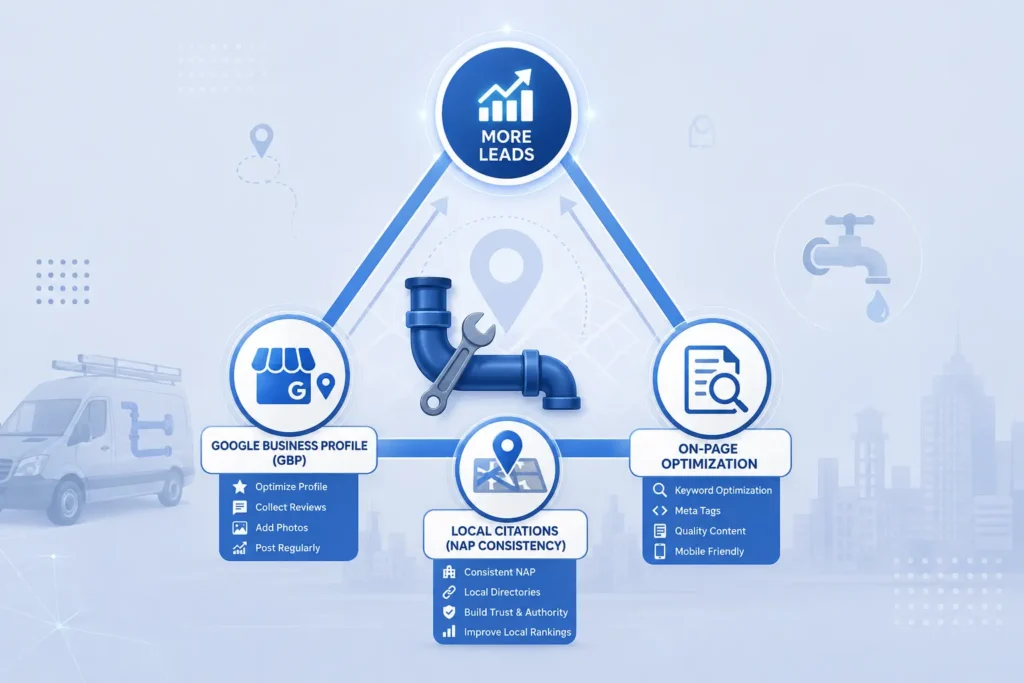
Local SEO for plumbers focuses on three core pillars:
- Google Business Profile (GBP) — the local listing that appears in Google Maps and the “Local Pack” (the top 3 results with a map)
- On-page local optimization — city, suburb, and neighborhood mentions woven naturally into your website
- Local citations and backlinks — consistent mentions of your business name, address, and phone number (NAP) across directories and local sites
III. Keyword Research for Plumbing Services
Identifying the Right Keywords for Your Plumbing Business
Keyword research is the foundation of any effective SEO campaign. It tells you exactly what language your potential customers use — and where the search volume actually lives.
For plumbing businesses, keywords fall into four categories:
| Keyword Type | Example | Search Intent | Priority |
|---|---|---|---|
| Core service | “plumber [city]” | Transactional | Very High |
| Emergency service | “emergency plumber near me” | Urgent/Transactional | Very High |
| Specific service | “water heater installation [city]” | Transactional | High |
| Problem-based | “why is my toilet constantly running” | Informational | Medium |
| Long-tail local | “boiler repair [suburb] [city]” | Transactional | High |
| Comparison | “best plumber in [city]” | Commercial | High |
Start by listing every service you offer — drain cleaning, leak detection, pipe replacement, boiler servicing, bathroom installations — and pair each with your geographic service area (city, suburb, borough).
Tools for Effective Plumbing Keyword Research
You don’t need an enterprise budget to do solid keyword research. These tools cover the full spectrum:
Free Tools:
- Google Keyword Planner — direct volume data from Google
- Google Search Console — shows queries your site already ranks for
- Google’s “People Also Ask” and autocomplete — goldmine for long-tail variations
Paid Tools:
- Ahrefs — best for competitor keyword gap analysis and keyword difficulty scores
- SEMrush — strong for local keyword tracking and position monitoring
- Moz Pro — solid for local SEO insights
Step-by-Step Keyword Research Process for Plumbers:
- Open Ahrefs (or SEMrush) and enter your top competitor’s domain
- Go to “Top Pages” to see which pages drive the most traffic
- Click through to see the keywords those pages rank for
- Filter by keywords with transactional intent and local modifiers
- Export the list and group by service type
- Run the same process for 3–5 competitors
- Merge results, remove duplicates, and prioritize by search volume + keyword difficulty
Long-Tail Keywords: High Intent, Low Competition
Long-tail keywords are longer, more specific phrases that typically have lower search volume but significantly higher conversion rates. A homeowner searching “tankless water heater installation cost [city]” is far closer to booking a job than someone searching “water heater.”
According to Backlinko, long-tail keywords make up 70% of all web searches. For plumbers, they represent the clearest path to ranking quickly in a competitive local market.
High-value long-tail examples for plumbing:
- “How much does drain unblocking cost in [city]”
- “24/7 emergency plumber [neighbourhood]”
- “Boiler service before winter [city]”
- “Trenchless pipe repair vs traditional plumbing [city]”
- “Licensed plumber for bathroom renovation [city]”
Build dedicated landing pages or blog posts around these phrases. Each one is an additional entry point from Google into your business.
IV. Optimizing Your Website Structure
Why Website Structure Matters for Plumbing SEO
Google’s crawlers need to understand what your site is about and how its pages relate to each other. A poorly structured website — one where content is buried, navigation is confusing, or key pages don’t exist — will underperform regardless of how good the content is.
Key Elements of a Strong Plumbing Website Structure
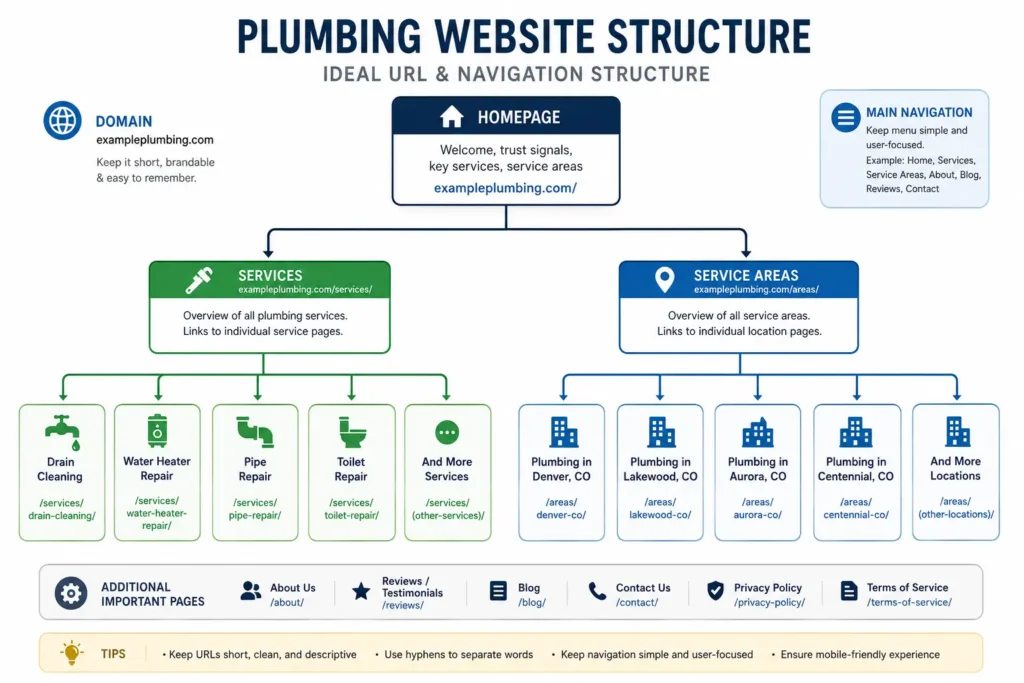
1. Clear, Hierarchical Navigation
Your main navigation should immediately tell visitors (and Google) what you do:
Home → Services → [Individual Service Pages] → Service Area → Blog → Contact
Avoid dumping everything into one mega-menu. Flat, logical structures perform better.
2. Dedicated Service Pages
Each service deserves its own page — not a paragraph buried on a generic “Services” page. This means:
/drain-cleaning-[city]//boiler-repair-[city]//emergency-plumber-[city]//bathroom-installation-[city]/
Each page should target a specific keyword, contain at least 600–800 words, and include a clear call-to-action.
3. Location Pages for Service Areas
If you serve multiple cities or suburbs, build individual location pages:
/plumber-[city-1]//plumber-[city-2]/
These pages should be genuinely unique — not copy-pasted versions of each other with the city name swapped. Include local landmarks, service-area maps, and neighborhood-specific details.
4. Mobile-First Design
According to Statista, over 60% of global web traffic comes from mobile devices in 2025. For local emergency searches, that number skews even higher. If your site isn’t fast and easy to use on a smartphone, you’re losing customers before they even read your offer.
Key mobile checks:
- Page loads under 3 seconds (test with Google PageSpeed Insights)
- Tap targets (buttons, links) at least 48px in size
- No horizontal scrolling
- Phone number clickable to call directly
5. Core Web Vitals
Google’s Core Web Vitals — Largest Contentful Paint (LCP), Interaction to Next Paint (INP), and Cumulative Layout Shift (CLS) — are confirmed ranking signals. A plumbing site that loads slowly or jumps around during load loses both rankings and customers.
| Core Web Vital | What It Measures | Target Score |
|---|---|---|
| LCP (Largest Contentful Paint) | Page load speed | Under 2.5 seconds |
| INP (Interaction to Next Paint) | Interactivity | Under 200ms |
| CLS (Cumulative Layout Shift) | Visual stability | Under 0.1 |
Schema Markup for Plumbing Services
Schema markup is structured data you add to your website’s code that helps search engines understand exactly what your page is about — and display rich results (star ratings, hours, FAQs) in search results.
For plumbers, the most valuable schema types are:
- LocalBusiness / Plumber schema — tells Google your business name, address, phone, hours, and service area
- Service schema — defines each plumbing service with descriptions and pricing
- FAQPage schema — enables FAQ dropdowns directly in Google search results
- HowTo schema — for DIY guides that demonstrate expertise
- Review/AggregateRating schema — displays star ratings in search results
Here’s a basic LocalBusiness schema example for a plumbing company:
{
  "@context": "https://schema.org",
  "@type": "Plumber",
  "name": "City Pro Plumbing",
  "image": "https://www.citypro.com/logo.jpg",
  "telephone": "+1-555-000-1234",
  "address": {
    "@type": "PostalAddress",
    "streetAddress": "123 Main Street",
    "addressLocality": "Chicago",
    "addressRegion": "IL",
    "postalCode": "60601",
    "addressCountry": "US"
  },
  "openingHoursSpecification": [
    {
      "@type": "OpeningHoursSpecification",
      "dayOfWeek": ["Monday","Tuesday","Wednesday","Thursday","Friday"],
      "opens": "07:00",
      "closes": "19:00"
    }
  ],
  "areaServed": ["Chicago", "Evanston", "Oak Park"],
  "priceRange": "$$"
}
V. Creating High-Quality Content for Plumbing SEO
Types of Content That Actually Win Plumbing Customers
Content is how you prove expertise, answer questions before customers even pick up the phone, and earn the backlinks that push your domain authority higher. For plumbing businesses, the most effective content formats are:
1. Service Pages (Commercial Intent) The core of your site. These pages target high-value keywords like “boiler installation [city]” and convert traffic into enquiries. They should include service descriptions, pricing indicators, benefits, process breakdowns, and a strong CTA.
2. Location Pages (Local Intent) As mentioned above — unique pages for each geographic area you serve.
3. FAQs (Informational + AEO) Frequently asked questions about plumbing services address the “People Also Ask” queries Google displays prominently in search results. They also make your content more likely to be cited by AI answer engines.
4. How-To Guides (Informational + Authority) Content like “How to Know When to Replace vs. Repair Your Boiler” positions you as a trusted expert, earns organic backlinks, and captures customers earlier in their decision process.
5. Cost Guides (Commercial Investigation) Pages like “How Much Does Drain Cleaning Cost in [City]?” capture high-intent customers researching before booking. These are among the highest-converting informational pages a plumber can publish.
6. Emergency Guides (Urgent Intent) “What to Do If a Pipe Bursts” or “Signs You Have a Gas Leak” — these attract panicked searchers and build trust under pressure.
| Content Type | Primary Intent | Conversion Potential | Time to Rank |
|---|---|---|---|
| Service Pages | Transactional | Very High | 3–6 months |
| Location Pages | Local/Transactional | Very High | 2–5 months |
| Cost Guides | Commercial Investigation | High | 3–6 months |
| Emergency Guides | Urgent/Informational | High | 1–4 months |
| How-To Guides | Informational | Medium | 4–8 months |
| FAQs | Informational | Medium | 1–3 months |
Addressing Customer Pain Points in Every Piece of Content
The best plumbing content doesn’t lead with features — it leads with problems. Customers don’t search for “highly skilled plumber with 20 years experience.” They search for “why does my shower drain keep blocking” or “emergency plumber no call-out fee.”
Structure your content around the pain points your customers experience:
- Fear of high costs → Publish transparent pricing guides and cost estimators
- Uncertainty about urgency → Create guides that help customers diagnose whether a problem needs immediate attention
- Lack of trust → Feature reviews, credentials, photos of completed jobs, and guarantee statements prominently
- Disruption to daily life → Emphasize fast response times, same-day service, and minimal mess
Keyword Integration: Natural, Not Mechanical
The goal isn’t to repeat “SEO for plumbers” or “plumber [city]” as many times as possible. It’s to write content that naturally covers the full semantic field of your topic. Google’s algorithms have evolved well beyond keyword counting — they understand entity relationships and topical depth.
Practical guidelines:
- Include the primary keyword in the H1, first paragraph, one H2, and the meta title
- Use semantic variants throughout (e.g., “plumbing services,” “local plumber,” “drain specialist”)
- Write for a Flesch-Kincaid reading level of 8th–10th grade — clear enough for a homeowner in a stressful moment to scan quickly
- Keep paragraphs to 2–4 lines maximum
- Use subheadings every 200–300 words
VI. Local SEO for Plumbers
Google Business Profile: Your Most Important Local Asset
Your Google Business Profile (GBP) is the single highest-impact local SEO asset available to a plumbing business. It’s what populates Google Maps results and the coveted Local Pack — the three businesses shown with a map at the top of local search results.
According to BrightLocal’s 2024 Local Consumer Review Survey, 98% of consumers used the internet to find information about a local business in the past year. Your GBP is often the first thing they see.
Complete GBP Optimization Checklist:
- [ ] Claim and verify your listing at business.google.com
- [ ] Select the correct primary category (“Plumber”) and add relevant secondary categories
- [ ] Write a keyword-rich business description (750 characters)
- [ ] Add all services with individual descriptions
- [ ] Upload at least 15–20 high-quality photos (team, vans, completed jobs, office)
- [ ] Set precise service areas for every neighbourhood you cover
- [ ] Add accurate, consistent NAP (Name, Address, Phone)
- [ ] Enable messaging and respond promptly
- [ ] Post weekly Google Business updates (offers, tips, new services)
- [ ] Add your booking/contact link
Building Local Citations for Plumbing Businesses
A local citation is any online mention of your business’s Name, Address, and Phone number (NAP). Consistent citations across authoritative directories signal to Google that your business is legitimate and geographically established.
Priority Citation Sources for Plumbers (US & UK):
| Directory | Market | DA | Priority |
|---|---|---|---|
| Google Business Profile | US/UK | — | Critical |
| Yelp | US | 93 | Very High |
| Houzz | US/UK | 89 | Very High |
| Angi (formerly Angie’s List) | US | 84 | Very High |
| HomeAdvisor | US | 81 | High |
| Checkatrade | UK | 59 | Very High (UK) |
| Trustpilot | US/UK | 93 | High |
| Yell.com | UK | 71 | High (UK) |
| BBB (Better Business Bureau) | US | 91 | High |
| Facebook Business | US/UK | 96 | Very High |
Critical rule: Your NAP must be identical across every directory. A mismatch as minor as “St.” vs “Street” can dilute your local authority signals.
Use a tool like BrightLocal or Whitespark to audit existing citations and identify gaps.
Building Local Backlinks
Backlinks from locally relevant websites carry significant weight in local search rankings. For plumbers, the most achievable local link sources include:
- Local Chamber of Commerce — most offer a member directory with a link
- Local trade associations — PHIA (UK), PHCC (US), and similar bodies
- Local news sites — pitch a story about a community project or charitable work
- Home improvement blogs in your city — offer a guest post or expert quote
- Local real estate agents — a referral partnership page with links to each other
- Supplier websites — manufacturers and wholesalers you work with may feature contractors
- Sponsorships — sponsor a local sports team or event in exchange for a website mention
Full guide to local link building for home service businesses → Link Building Strategies
Generating and Managing Customer Reviews
Reviews are a direct ranking factor for Google’s Local Pack. More importantly, 93% of consumers say online reviews influence their purchasing decisions, according to Podium’s 2024 State of Reviews.
Review Generation Strategy:
- Timing is everything — ask immediately after job completion, while satisfaction is highest
- Make it frictionless — send a direct link to your GBP review page via SMS or email (use Whitespark’s free GBP link generator)
- Train your team — every plumber on your team should verbally request a review at job end
- Automate follow-ups — use a CRM or tool like Jobber to send automated review request messages 2 hours after job completion
- Respond to every review — both positive and negative, professionally and promptly
Sample Review Request SMS:
“Hi [Name], it was great helping you today! If you’re happy with the work, it would mean a lot if you could leave us a quick review here: [GBP link]. Takes less than 60 seconds. – [Plumber Name], [Company]”
VII. Social Media’s Role in Plumbing SEO
Does Social Media Directly Impact SEO Rankings?
The honest answer: social media signals are not a direct Google ranking factor. However, the indirect benefits are real and measurable.
Social media amplifies content reach, which drives more people to your website. More visits from relevant audiences signal relevance to Google. Social profiles also appear in branded search results, which strengthens your overall SERP presence and brand authority.
Best Platforms and Practices for Plumbing Businesses
Not all platforms are equal for plumbers. Focus where your potential customers actually spend time and where visual content works:
Facebook:
- Best for community engagement and local groups
- Share before/after photos of completed jobs
- Run local awareness ads targeting homeowners in your service area
- Post time-sensitive offers (“10% off boiler servicing this week”)
Instagram:
- Highly visual — ideal for before/after transformations
- Use location tags on every post to appear in local searches
- Instagram Reels of quick plumbing tips build trust and reach
YouTube:
- Second-largest search engine in the world
- Short explainer videos (“How to Fix a Dripping Tap”) rank in both YouTube and Google search
- Builds authority and earns backlinks when other sites embed your videos
Nextdoor:
- Underused by most plumbers, but highly effective
- Neighborhood-specific platform where homeowners actively ask for local tradesperson recommendations
LinkedIn:
- More useful for B2B plumbing (commercial contracts, property management companies)
- Position yourself as an expert in commercial plumbing
Content Ideas That Work for Plumbing Businesses on Social
- Before/after photos of drain unblocking, pipe replacement, bathroom fits
- “Did you know?” tips about water pressure, boiler maintenance, or pipe age
- Behind-the-scenes videos of your team and vans
- Seasonal reminders (“Get your boiler serviced before winter hits”)
- Customer testimonial videos
- Quick polls (“How often do you get your drains cleared?”)
VIII. Monitoring and Analyzing SEO Performance
Essential Tools for Tracking Your Plumbing SEO
You cannot improve what you don’t measure. These tools give you the data to make smart decisions:
| Tool | What It Tracks | Cost |
|---|---|---|
| Google Search Console | Rankings, impressions, clicks, crawl errors | Free |
| Google Analytics 4 | Traffic, conversions, user behaviour | Free |
| Google Business Insights | GBP views, calls, direction requests | Free |
| Ahrefs / SEMrush | Keyword rankings, backlinks, competitors | Paid |
| BrightLocal | Local rankings, citation tracking, reviews | Paid |
| PageSpeed Insights | Core Web Vitals, page speed | Free |
Key Performance Indicators for Plumbing SEO
Track these KPIs monthly:
Traffic Metrics:
- Organic sessions (total and by landing page)
- Local organic sessions (filtered by service area geography)
- Mobile vs. desktop split
Ranking Metrics:
- Position for primary service keywords in target cities
- Local Pack appearances (tracked via BrightLocal or SEMrush Local)
- Featured snippet captures
Conversion Metrics:
- Phone calls from organic traffic (use call tracking via CallRail or similar)
- Contact form submissions from organic
- GBP calls and direction requests
- Organic traffic to booking/quote pages
Authority Metrics:
- Domain Rating / Domain Authority growth
- Number of referring domains
- New backlinks acquired per month
Adjusting Strategy Based on Data
SEO data tells a story — you have to know how to read it.
If rankings are stagnant: Audit competitor pages ranking above you. Are they longer? Do they have more backlinks? Better schema? More reviews?
If traffic is high but conversions are low: Your landing pages may lack urgency, trust signals, or a clear CTA. Test different headlines, add more reviews, and simplify your contact form.
If GBP views are low: Add more photos, post weekly updates, and actively acquire more reviews.
If crawl errors are appearing in Search Console: Fix them immediately — broken pages lose link equity and confuse Google’s crawlers.
IX. Staying Updated with SEO Trends in 2026
Why SEO Is Never “Set and Forget”
Google updates its core algorithm hundreds of times per year. In 2023 and 2024, major updates significantly reshuffled local search results — with businesses that relied on thin content or manipulative tactics losing rankings overnight. In 2025 and 2026, the rise of AI-generated answers in Google, ChatGPT, and Perplexity has added a new dimension: your content needs to be optimized for generative engines, not just traditional search.
The Most Important SEO Shifts for Plumbers Right Now
1. AI Overview Optimization (GEO) Google’s AI Overviews now appear at the top of many local and informational queries. To get cited in these answers, your content needs to be structured, factual, and self-contained. Concise, direct answers (the kind you’d find in an FAQ section) are most likely to be pulled into AI summaries.
2. Voice Search Smart speakers and phone assistants respond to queries like “Hey Google, find me a plumber near me.” Optimizing for conversational, question-based queries positions you for this channel.
3. E-E-A-T (Experience, Expertise, Authoritativeness, Trustworthiness) Google’s quality guidelines have increasingly emphasised first-hand experience. For plumbing content, this means:
- Author bios with real credentials (Gas Safe registration, licensed plumber certifications)
- Case studies and real job photos
- Specific, experience-based insights rather than generic advice
4. Hyperlocal SEO Ranking for “plumber [city]” is increasingly competitive. The next battleground is suburb and neighbourhood-level keywords: “plumber [specific suburb]”, “drain cleaning [postcode]”. Start building this hyperlocal content now.
Resources for Ongoing SEO Education
- Google Search Central Blog — official algorithm updates
- Backlinko — in-depth SEO research and case studies
- Ahrefs Blog — practical, data-driven SEO guides
- Search Engine Journal — daily SEO news
- BrightLocal Blog — local SEO specific research
- Moz Blog — foundational and advanced SEO strategy
X. Conclusion: Your Plumbing Business Deserves to Be Found
The homeowner with a burst pipe at midnight isn’t going to scroll through five pages of Google results. They’ll call the first business that shows up and looks trustworthy. That business should be yours.
The seven core pillars of plumbing SEO covered in this guide are:
- Keyword research — understand exactly what your customers are searching for
- Website structure — build a fast, mobile-friendly, logically organized site with dedicated service and location pages
- High-quality content — publish content that answers real questions and demonstrates genuine expertise
- Google Business Profile — optimize it fully and keep it active with photos, posts, and reviews
- Local citations and backlinks — build consistent NAP citations and earn links from locally relevant sources
- Review strategy — systematically generate and respond to customer reviews
- Monitoring and adaptation — track your KPIs monthly and evolve your strategy as search behavior changes
None of these steps require a massive budget. They require consistency, attention to detail, and a willingness to treat your online presence with the same professionalism you bring to every job on-site.
Start this week: Claim your Google Business Profile if you haven’t, add your services, upload 10 photos, and send a review request to your last five happy customers. That alone will move the needle.
Frequently Asked Questions
What is SEO for plumbers and why does my plumbing business need it?
SEO for plumbers is the strategic process of optimizing your website and online presence to rank higher in search engine results when local homeowners look for plumbing services. Because over 70% of property owners click on organic listings or the Google Map Pack when facing a plumbing emergency, missing from these placements means losing high-value jobs directly to your local competitors. Implementation of Local Business schema markup on your service pages ensures search engines accurately crawl your exact location and availability. Implementing these technical optimizations directly increases online visibility and secures steady call volumes without relying on expensive pay-per-click ads.
How long does it take to see organic lead results from a plumbing SEO campaign?
Plumbing companies typically experience measurable improvements in keyword rankings and inbound phone calls within 60 to 90 days of launching a campaign. Technical fixes like resolving crawl errors in Google Search Console yield immediate stability, while authoritative local link building takes slightly longer to mature. Data shows that comprehensive optimization strategies establish permanent authority, allowing contractors to capture long-term search traffic. Searchlyn accelerates this timeline by executing simultaneous technical audits and hyper-local citation building across relevant plumbing directories. Our structured sprint approach ensures your business builds sustainable equity and outranks local competitors in major service areas.
How much does professional SEO for plumbers cost on average?
Professional SEO campaigns for plumbing contractors generally range from $1,500 to $5,000 per month depending on market competition and geographic scope. This investment directly finances continuous technical monitoring, authoritative content creation, and aggressive local citation cleanups required to dominate regional search results. Studies indicate that local SEO delivers up to 5x higher ROI compared to traditional print advertising or standard shared-lead networks. Investing in a dedicated monthly strategy ensures your digital assets remain compliant with shifting algorithm requirements. Searchlyn provides transparent, fixed-price growth packages tailored specifically to the competitive dynamics of the US and UK plumbing markets.
Why is a Google Business Profile critical for securing local emergency plumbing jobs?
A Google Business Profile is the foundational component of local search success because it directly powers your appearance in local map results. Research reveals that businesses appearing in the prominent Google Map Pack secure up to 44% of total user clicks for localized commercial queries. Optimizing this profile with real-time business hours, accurate service areas, and authentic customer reviews signals immediate trust to nearby searchers. Ensuring your primary categories match common voice search patterns maximizes visibility during high-intent search moments. Searchlyn actively manages and protects these profiles to ensure plumbing clients consistently capture urgent, high-value emergency dispatches.
How does Searchlyn optimize plumbing websites to get cited in Google AI Overviews?
Searchlyn optimizes plumbing websites for generative search engines by restructuring content using an advanced, schema-first content architecture. Artificial intelligence models like Gemini, ChatGPT, and Perplexity rely on clear, structured data to extract direct factual answers for conversational user queries. By embedding explicit question-and-answer pairs into your service pages, your business becomes the preferred factual source for complex, multi-intent local searches. This optimization strategy directly qualifies your business assets for valuable citations within generative summaries. Utilizing this framework guarantees your brand maintains dominant search visibility as traditional search engines transition into modern answer engines.
Which plumbing website pages drive the highest volume of qualified commercial leads?
Dedicated city-specific landing pages and individual service pages for high-margin jobs like water heater replacement drive the most qualified commercial leads. Generic websites that group all offerings onto a single page fail to satisfy user intent and struggle to rank for specific regional searches. Crafting distinct, optimized pages for each core service allows you to target explicit long-tail keywords used by ready-to-hire property owners. Incorporating precise geo-coordinates and custom Schema.org code on these pages maximizes local relevance for search algorithms. This targeted architecture converts casual organic traffic into booked service calls across all your target operating regions.
How important are Google reviews for plumbing SEO?
Extremely important. Reviews are a confirmed Local Pack ranking factor. Beyond rankings, they directly influence whether potential customers choose to call you. A plumbing business with 4.8 stars and 150 reviews will consistently outperform a competitor with 4.2 stars and 20 reviews — even if the competitor ranks slightly higher.
How do website loading speeds and Core Web Vitals impact organic rankings for plumbers?
Website loading speed and compliance with Core Web Vitals operate as direct algorithmic ranking signals within Google’s core evaluation systems. Because mobile searches account for over 60% of emergency plumbing queries, slow-loading pages cause frustrated users to quickly bounce back to the search results. A slow website directly degrades user experience and signals to search engines that your platform provides poor utility. Optimizing media assets, leveraging modern browser caching, and streamlining code ensures your site loads seamlessly on all mobile networks. Maintaining optimal performance metrics prevents ranking degradation and maximizes the conversion rate of your inbound organic traffic.
How can a plumbing business build strong E-E-A-T signals to satisfy Google search guidelines?
Plumbing brands build strong Experience, Expertise, Authoritativeness, and Trustworthiness signals by showcasing verifiable credentials, active trade licenses, and real customer outcomes. Authoring detailed case studies regarding complex commercial plumbing projects provides concrete evidence of your practical field experience. Linking your digital profiles to verified industry associations and local chambers of commerce builds undeniable institutional trust. Displaying real, unedited project photos alongside positive customer reviews confirms authentic local operation to human users and search evaluators alike. Searchlyn systematically embeds these authoritative trust signals across your entire digital presence to ensure permanent compliance with Google’s quality guidelines.
What is the difference between standard SEO and the specialized Local SEO required for plumbers?
Standard SEO focuses on ranking informational content on a national level, whereas Local SEO optimizes your business to capture immediate transactional intent within specific geographic boundaries. For plumbing contractors, standard rankings provide little value if the traffic originates outside of your physical service dispatch zones. Local optimization prioritizes the Google Map Pack, localized review generation, and geographic citations to capture nearby customers in real-time. Implementing hyper-local optimization ensures your marketing assets target users actively searching for immediate professional assistance. Searchlyn specializes in these localized frameworks to ensure plumbing businesses capture dominant market share throughout the US and UK.
Last updated: May 2026 by Searchlyn team


Pingback: Tankless Water Heater SEO: Strategic Guide to Rank (2026)