- 1. Why Understanding Local Search Intent Is Your Starting Point {#intent}
- 2. How to Optimize Google Business Profile for Maximum Visibility (2026 Updates) {#gbp}
- 3. What Local Keywords Actually Drive Conversions? Research & Intent Mapping {#keywords}
- 4. On-Page SEO & Local Business Schema: The #1 AI Citation Hook {#on-page}
- 5. Why Local Citations Still Matter (And How to Build Them Flawlessly) {#citations}
- 6. How to Turn Online Reviews Into a Lead Generation Machine {#reviews}
- 7. Local Link Building: The Missing Piece in Most Local SEO Checklist {#links}
- 8. Mobile Optimization & Core Web Vitals: Google's Mobile-First Indexing Demands It {#mobile}
- 9. How to Create Localized Content That Earns AI Overviews & Featured Snippets {#content}
- Conclusion: Your Local SEO Action Plan for 2026 {#conclusion}
- Turn Search Visibility Into Sustainable Business Growth through our SEO Services
- Frequently Asked Questions About Local SEO
- What is local SEO and how is it different from regular SEO?
- What is the most important local SEO ranking factor in 2026?
- How long does it take to see results from local SEO?
- Can I do local SEO myself without hiring an agency?
- How many reviews do I need to rank in the Local Pack?
- What is NAP consistency and why does it matter?
- Is local SEO still worth it in 2026 with AI search growing?
- What tools should every local business be using for SEO?
46% of all Google searches carry local intent. That means nearly half the people searching on Google right now are looking for something near them — a plumber, a roofer, an electrician, a pest control company. If your business isn’t showing up in those results, you’re handing leads to your competitors every single day.
Local SEO in 2026 is not the same game it was three years ago. Google’s local ranking systems have grown more sophisticated, AI-powered answer engines (Perplexity, ChatGPT, Gemini) now surface local businesses in conversational responses, and proximity alone no longer guarantees a spot in the Local Pack. You need a systematic, multi-layered strategy — not a checklist of surface-level tips you can find anywhere.
This guide is that strategy.
Below, you’ll find local SEO checklist with 9 deeply actionable local SEO strategies built around what actually drives rankings, leads, and revenue in 2026. Whether you’re a home services contractor managing your own online presence or an agency building a local SEO program for clients, this local seo checklist gives you everything you need:
- A complete Google Business Profile optimization checklist
- A local keyword research framework with copy-paste templates
- A copy-paste JSON-LD schema for local businesses
- A citation priority table with the top directories
- Review response templates for positive, negative, and neutral reviews
- A mobile audit checklist tied to Core Web Vitals
- FAQ Schema markup ready for implementation
Let’s build your local search dominance from the ground up.
1. Why Understanding Local Search Intent Is Your Starting Point {#intent}
Before you touch a single meta title or citation listing, you need to understand why people are searching — not just what they’re searching. Local search intent is the foundation every other item on this local seo checklist is built on. Get it wrong, and you’ll optimize for traffic that never converts. Get it right, and every piece of content you create will pull in customers who are ready to buy.
The Three Types of Local Search Queries
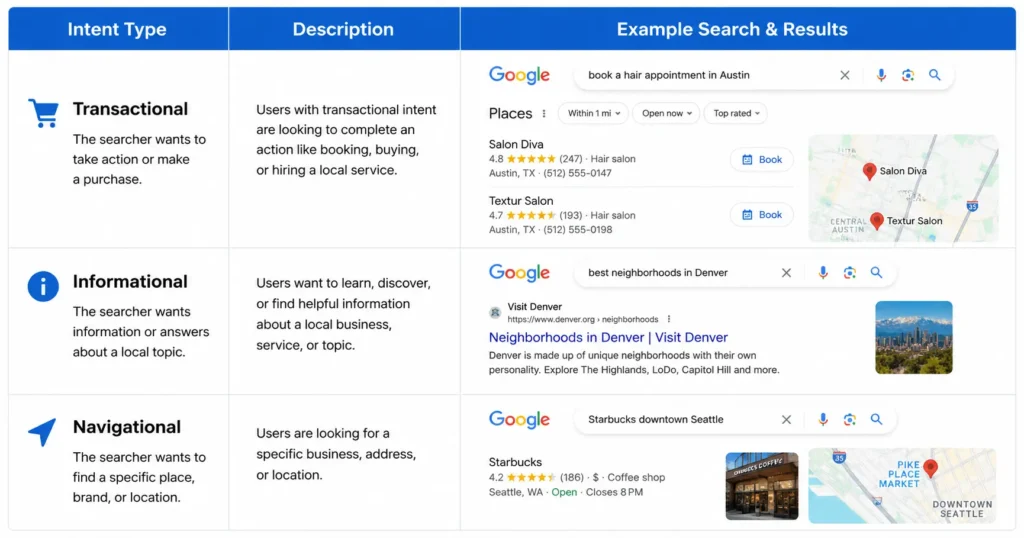
Local searches fall into three intent buckets, each requiring a different content and optimization response:
| Intent Type | Example Keyword | Best Content Format |
|---|---|---|
| Transactional | “emergency plumber near me” | Google Business Profile + location landing page |
| Informational | “how to fix a leaky faucet” | Long-form blog post with embedded video |
| Navigational | “Mike’s Plumbing Austin” | NAP-optimized contact/about page |
| Commercial Investigation | “best HVAC company in Phoenix reviews” | Service area page with review schema |
| Voice/Conversational | “who fixes air conditioners near me open now” | GBP + FAQ schema on landing page |
Transactional queries are your highest-priority targets. These are people with an immediate problem and money ready to spend. A homeowner typing “emergency plumber Brooklyn” at 11 PM isn’t browsing — they want a phone number and a fast response time.
Informational queries build brand awareness and topical authority. A blog post answering “how long does a roof replacement take” captures a homeowner in the research phase. If your answer is authoritative and helpful, you’re the company they call when they’re ready to get quotes.
Navigational queries mean someone already knows your brand. These are warm leads — optimize your contact page and GBP for them.
Tools to Diagnose Local Intent
Use these free tools before any keyword research session:
- Google Search Console → Filter by queries with “near me,” city names, or zip codes to see what’s already driving impressions
- Google’s “People Also Ask” → Shows what questions surround a given local search topic; each PAA box is a featured snippet opportunity
- AnswerThePublic (answerth epublic.com) → Generates question, preposition, and comparison queries around any seed keyword
- Google Keyword Planner → Filter by location to see local search volumes; free with a Google Ads account
Local keyword research guide → Keyword Research]
2. How to Optimize Google Business Profile for Maximum Visibility (2026 Updates) {#gbp}
Your Google Business Profile (GBP) — formerly Google My Business — is the single most important local SEO asset you control. It feeds the Local Pack (the map results that appear above organic listings), Google Maps, and increasingly, AI-generated answer responses. A fully optimized, actively managed GBP can be the difference between consistently appearing for “best plumber in [city]” and being invisible to 80% of your potential customers.
According to BrightLocal’s 2025 Local Consumer Review Survey, 98% of consumers used the internet to find information about a local business in the past year — and Google Maps is the first place most of them looked.
Step-by-Step GBP Optimization
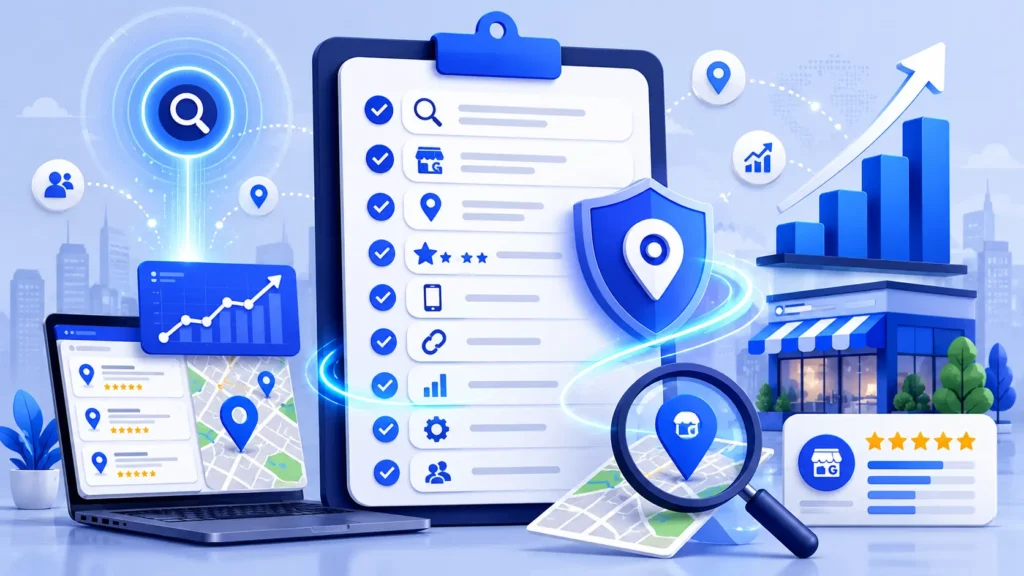
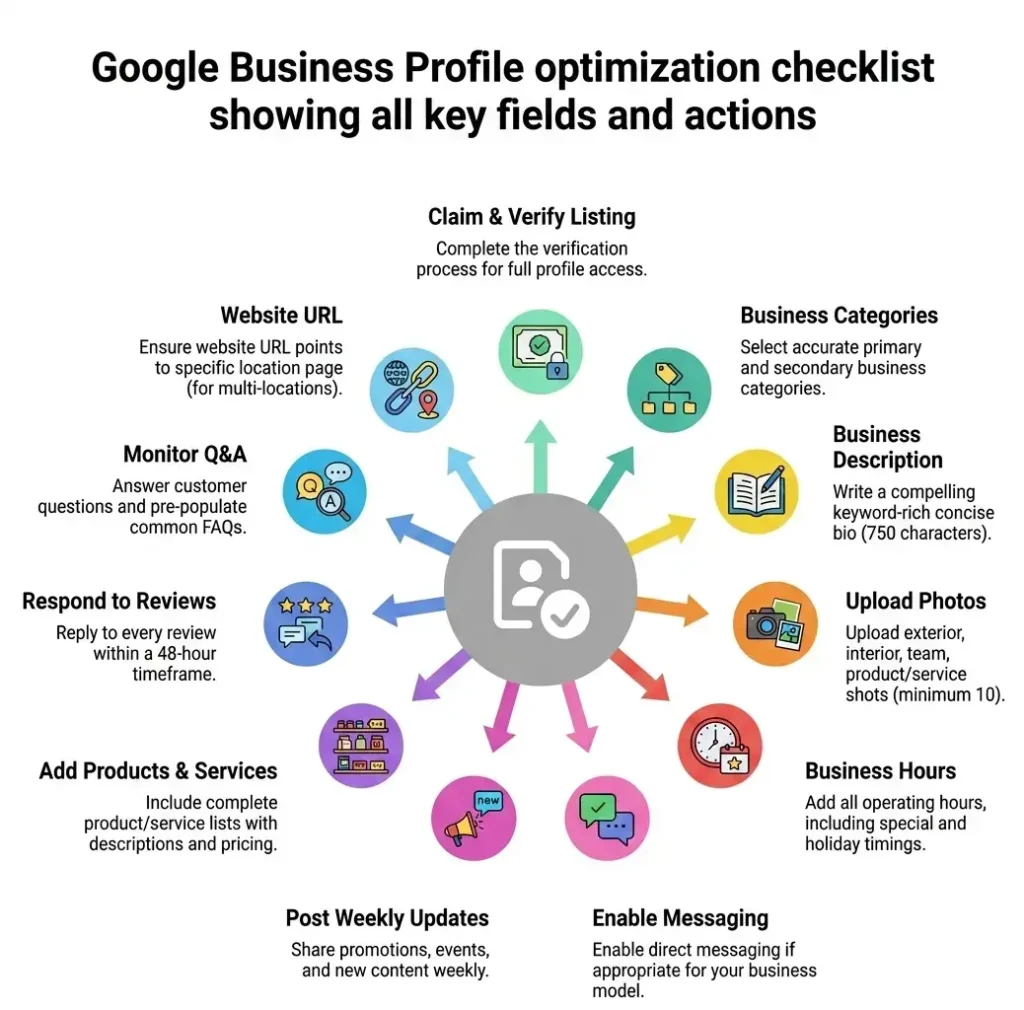
A. Claim, Verify, and Complete Every Field
This sounds basic, yet a significant percentage of local business profiles remain incomplete. Every unfilled field is a missed signal. Complete:
- Business name (must match your legal/NAP name exactly)
- Primary and secondary categories (be specific: “Roofing Contractor” not just “Contractor”)
- Service areas (list every city/neighborhood you serve)
- Business attributes (“Free estimates,” “Veteran-led,” “Women-owned,” “24/7 availability”)
- Products/services with descriptions, prices, and landing page links
- Business hours including holiday hours
- Business description (750 characters; lead with your primary service + city)
B. NAP Consistency: The Non-Negotiable Foundation
NAP stands for Name, Address, Phone number. These three data points must be identical — character by character — everywhere they appear online: your website, GBP, directories, and social profiles. Even minor discrepancies (“St.” vs. “Street,” or different phone number formats) can create conflicting signals that erode Google’s confidence in your listing.
C. Advanced GBP Features to Leverage in 2026
- GBP Posts: Publish at least one post per week — offers, seasonal promotions, completed project highlights. Posts that include a keyword + city in the first sentence get more traction. According to Whitespark’s 2024 Local Search Ranking Factors, GBP engagement signals (including post clicks) are a growing ranking factor.
- Q&A Section: Don’t wait for customers to ask questions. Seed the Q&A with your three most common customer questions and answer them yourself, naturally including service keywords and your city. Example: “Do you offer same-day HVAC repair in Charlotte? Yes, we offer same-day and emergency HVAC repair across Charlotte and the surrounding areas.”
- Photos: Upload at minimum 10 geotagged, high-resolution photos. Include exterior shots, team photos, before-and-after project photos, and equipment. Listings with photos receive 42% more requests for directions and 35% more website clicks than those without.
GBP Optimization Checklist
- [ ] Profile claimed and verified via postcard, phone, or video
- [ ] Business name exactly matches NAP on website and all directories
- [ ] Primary category is the most specific match available
- [ ] 3–5 secondary categories added
- [ ] Service areas listed for every location you serve
- [ ] 10+ high-quality, geotagged photos uploaded
- [ ] All attributes filled in (services, amenities, accessibility, highlights)
- [ ] Business description written (750 chars; service + city in first sentence)
- [ ] Products and/or services added with descriptions and links
- [ ] Q&A seeded with 3–5 common customer questions
- [ ] GBP posts scheduled (minimum 1 per week)
- [ ] Appointment link or booking URL connected
- [ ] Messaging enabled (respond within 24 hours to maintain status)
3. What Local Keywords Actually Drive Conversions? Research & Intent Mapping {#keywords}
Keyword research for local SEO is fundamentally different from national SEO. You’re not trying to rank globally — you’re trying to dominate a specific geographic footprint. That means your keyword list should be built around location modifiers and commercial-intent phrases that map directly to pages you can optimize and conversions you can measure.
Building Your Local Keyword Architecture
Step 1: Start with Your Core Services
List every service you offer. For a plumbing company, this might be: drain cleaning, water heater installation, pipe repair, slab leak detection, emergency plumbing, bathroom remodeling.
Step 2: Layer in Geographic Modifiers
Combine each service with:
- Primary city: “drain cleaning Denver”
- Neighboring cities: “drain cleaning Aurora CO,” “drain cleaning Lakewood CO”
- Neighborhoods: “drain cleaning Capitol Hill Denver”
- Zip codes (for high-commercial-intent pages): “emergency plumber 80203”
- “Near me” modifier: still valuable as a phrase even in on-page copy
Step 3: Add Intent Modifiers
Transform generic service keywords into high-converting phrases:
- “affordable [service] in [city]”
- “best [service] [city] reviews”
- “emergency [service] [city] 24/7”
- “[service] cost in [city]”
- “licensed [service] [city]”
Step 4: Competitive Gap Analysis
Run your top 3 competitors through Semrush’s Keyword Gap tool or Ahrefs Site Explorer. Look for local keywords they rank for in positions 1–5 where you’re unranked or below position 10. These are your highest-priority targets.
Local Keyword Mapping Template
Use this table as your keyword-to-page mapping framework. Each primary keyword should be assigned to exactly one page to avoid cannibalization.
| Keyword | Est. Local Volume | Intent | Assigned Page |
|---|---|---|---|
| [service] + [primary city] | Research via GKP | Transactional | GBP + City landing page |
| “best [service] in [neighborhood]” | Research via GKP | Commercial | Service area page |
| “[service] cost [city]” | Research via GKP | Commercial Investigation | Cost/pricing page |
| “emergency [service] [city]” | Research via GKP | Transactional (urgent) | GBP + dedicated emergency page |
| “how to [DIY task related to service]” | Research via GKP | Informational | Blog post (with CTA to hire) |
| “[service] near me” | Research via GKP | Transactional | GBP optimization (on-page too) |
Pro tip: Long-tail local keywords with zip codes — like “affordable water heater repair Chicago 60601” — typically have lower volume but significantly higher conversion rates. A homeowner typing a zip code is narrowing their search to their immediate area. Build dedicated service-area landing pages for your highest-value zip code clusters.
4. On-Page SEO & Local Business Schema: The #1 AI Citation Hook {#on-page}
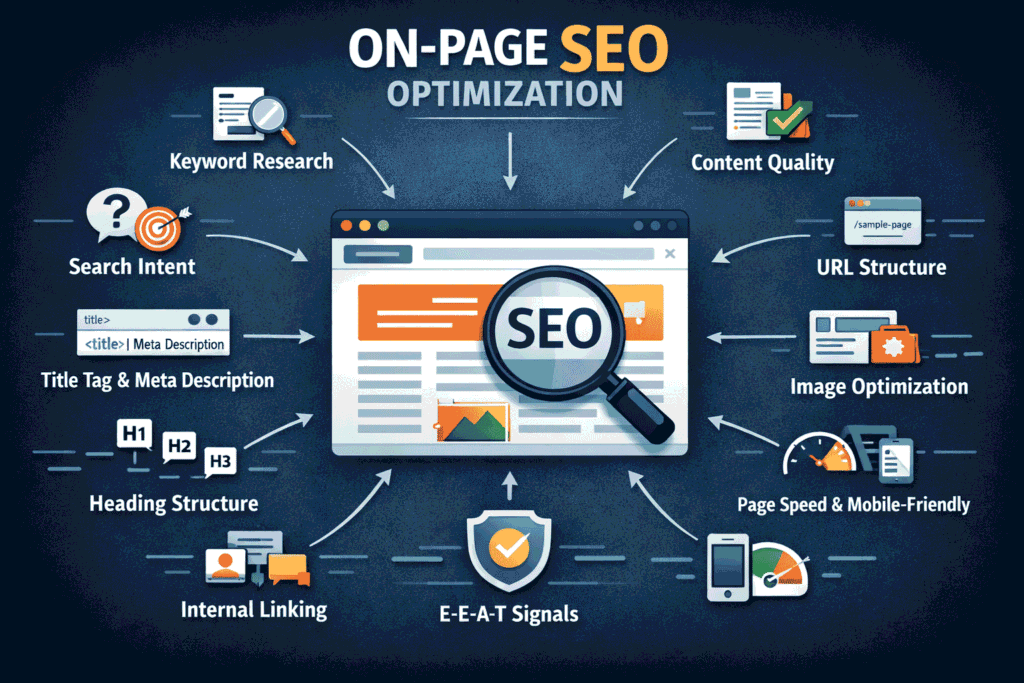
On-page SEO for local businesses has a clear hierarchy: get the technical fundamentals right, then layer in location signals throughout your content, then implement structured data so both Google and AI engines can accurately interpret and surface your business information.
Title Tags & Meta Descriptions
Every location-specific page needs a title tag that combines your primary service with your city. The format that works best:
[Primary Service] in [City] | [Brand Differentiator]
Examples:
- “Plumbing Services in Denver | 24/7 Licensed Plumbers”
- “HVAC Repair Atlanta | Same-Day AC & Heating Service”
- “Emergency Electricians in Houston | Licensed & Insured”
Keep title tags between 50–60 characters to avoid truncation. Your meta description (150–160 characters) should expand on the title, include a secondary keyword or city modifier, and contain a direct action phrase (“Call now,” “Book online,” “Get a free estimate”).
Header Hierarchy with Location Signals
Structure your page headers so location signals appear naturally at the H2 and H3 levels — not just stuffed into the body copy.
H1: Emergency Plumbing in Denver, CO — 24/7 Licensed Plumbers
  H2: Why Denver Homeowners Choose [Company Name]
  H2: Our Emergency Plumbing Services in the Denver Metro Area
    H3: Same-Day Drain Cleaning in Denver
    H3: Water Heater Repair & Replacement in Aurora and Lakewood
  H2: What to Do Before Our Plumber Arrives
  H2: Service Areas: Denver, Aurora, Lakewood, Englewood, and More
This structure tells Google’s crawlers exactly what the page is about and where you operate — and it gives AI language models a clear, parseable hierarchy when generating local search answers.
Local Business Schema (JSON-LD) — Complete Copy-Paste Template
Structured data is the single most important technical element for AI engine optimization. When ChatGPT, Perplexity, or Google’s AI Overview references a local business, it’s often extracting information from schema markup because it’s machine-readable, unambiguous, and structured exactly the way AI systems prefer to consume data.
Add the following JSON-LD to the <head> of every location-specific page, customized for your business:
{
  "@context": "https://schema.org",
  "@type": "LocalBusiness",
  "name": "Denver Pro Plumbing",
  "image": "https://www.denverproplumbing.com/images/logo.jpg",
  "@id": "https://www.denverproplumbing.com",
  "url": "https://www.denverproplumbing.com",
  "telephone": "+1-303-555-0100",
  "priceRange": "$$",
  "address": {
    "@type": "PostalAddress",
    "streetAddress": "1234 Main Street",
    "addressLocality": "Denver",
    "addressRegion": "CO",
    "postalCode": "80203",
    "addressCountry": "US"
  },
  "geo": {
    "@type": "GeoCoordinates",
    "latitude": 39.7392,
    "longitude": -104.9903
  },
  "openingHoursSpecification": [
    {
      "@type": "OpeningHoursSpecification",
      "dayOfWeek": ["Monday","Tuesday","Wednesday","Thursday","Friday"],
      "opens": "08:00",
      "closes": "18:00"
    },
    {
      "@type": "OpeningHoursSpecification",
      "dayOfWeek": "Saturday",
      "opens": "09:00",
      "closes": "14:00"
    }
  ],
  "sameAs": [
    "https://www.facebook.com/DenverProPlumbing",
    "https://www.yelp.com/biz/denver-pro-plumbing"
  ],
  "aggregateRating": {
    "@type": "AggregateRating",
    "ratingValue": "4.9",
    "reviewCount": "214"
  },
  "description": "Denver Pro Plumbing offers 24/7 emergency plumbing, drain cleaning, water heater installation, and pipe repair throughout Denver, Aurora, and Lakewood, CO.",
  "areaServed": [
    {"@type": "City", "name": "Denver"},
    {"@type": "City", "name": "Aurora"},
    {"@type": "City", "name": "Lakewood"}
  ],
  "hasOfferCatalog": {
    "@type": "OfferCatalog",
    "name": "Plumbing Services",
    "itemListElement": [
      {
        "@type": "Offer",
        "itemOffered": {
          "@type": "Service",
          "name": "Emergency Plumbing Repair"
        }
      },
      {
        "@type": "Offer",
        "itemOffered": {
          "@type": "Service",
          "name": "Water Heater Installation"
        }
      }
    ]
  }
}
Validate your schema using Google’s Rich Results Test before publishing. Errors in your JSON-LD can prevent rich results from appearing entirely.
Image Optimization with Location Context
Every image on a local landing page should work harder than decoration:
- File names: Use descriptive, keyword-rich names before uploading.
hvac-repair-phoenix-az.jpgsignals more thanIMG_3847.jpg - Alt text: Write a natural sentence that describes the image and includes location context:
alt="HVAC technician repairing air conditioner in Phoenix, AZ" - Geotag photos: Before uploading project photos, embed GPS coordinates using a tool like GeoImgr or your phone’s location tagging feature
- Image compression: Use Squoosh or ShortPixel to compress images without quality loss — large images tank Core Web Vitals
5. Why Local Citations Still Matter (And How to Build Them Flawlessly) {#citations}
A local citation is any online mention of your business’s Name, Address, and Phone number — even without a backlink. Citations are one of Google’s foundational local ranking signals because they function as third-party corroboration of your business’s existence, location, and legitimacy. The more high-quality, consistent citations you have, the stronger Google’s confidence in your listing.
According to Whitespark’s Local Search Ranking Factors study, citation signals (volume, consistency, and authority of listings) remain among the top 20 ranking factors for local pack results in 2026.
The Citation Priority Framework
Not all directories are created equal. Build your citation profile in tiers, starting with the highest-authority platforms:
| Priority | Platform | Domain | Why It Matters |
|---|---|---|---|
| Tier 1 | Google Business Profile | google.com/maps | Primary local ranking signal |
| Tier 1 | Apple Maps | maps.apple.com | iOS users; Siri queries |
| Tier 1 | Bing Places | bingplaces.com | Microsoft Bing, Cortana queries |
| Tier 1 | Facebook Business | facebook.com | High DA; social proof |
| Tier 2 | Yelp | yelp.com | High-trust consumer reviews |
| Tier 2 | Better Business Bureau | bbb.org | Trust signal for service businesses |
| Tier 2 | Angi (formerly Angie’s List) | angi.com | Home services specific |
| Tier 2 | Houzz | houzz.com | Home improvement; strong DA |
| Tier 3 | HomeAdvisor | homeadvisor.com | Lead generation + citation value |
| Tier 3 | Thumbtack | thumbtack.com | Local service directories |
| Tier 3 | Local Chamber of Commerce | varies | Local authority signal |
| Tier 3 | Industry associations | varies | Vertical-specific trust |
For home services specifically: Platforms like Angi, HomeAdvisor, Houzz, and your local Chamber of Commerce carry outsized weight because they’re industry-relevant. A citation from angi.com tells Google you’re a legitimate, active home services provider.
Citation Audit & Cleanup Process
- Audit existing citations using BrightLocal or Moz Local. Both tools scan hundreds of directories and flag inconsistencies.
- Identify the four most common citation errors:
- Old addresses (businesses that have moved)
- Phone number format inconsistencies (+1-303-555-0100 vs. 303.555.0100)
- Business name abbreviations (Pro Plumbing vs. Professional Plumbing Solutions)
- Missing categories or outdated business hours
- Correct errors directly by logging into each platform. For platforms that don’t allow direct edits, use data aggregators like Data Axle or Neustar Localeze to push corrected NAP data.
- Build new citations starting with Tier 1, then Tier 2, then Tier 3. Don’t create all citations at once — a natural citation-building pace is 5–10 new citations per month.
Citation Audit Checklist
- [ ] Run BrightLocal or Moz Local audit to identify existing citations
- [ ] List all inconsistencies found (NAP mismatches, duplicates, missing listings)
- [ ] Claim and correct all Tier 1 directory listings first
- [ ] Ensure business name is consistent (no abbreviations or variations)
- [ ] Verify phone number format is identical everywhere
- [ ] Address format matches exactly (Suite vs. Ste., abbreviation consistency)
- [ ] Add business to any industry-specific directories not yet listed
- [ ] Set a monthly task to monitor and respond to new directory listings
6. How to Turn Online Reviews Into a Lead Generation Machine {#reviews}
Reviews are among the most powerful forces in local SEO — and one of the most underutilized. Google’s local ranking algorithm explicitly factors in review quantity, recency, response rate, and keyword diversity. A business with 200 recent, detailed, keyword-rich reviews will almost always outrank a technically optimized competitor with 15 generic ones.
But the business case for reviews extends far beyond rankings. According to BrightLocal’s 2025 Consumer Survey, 91% of consumers say positive reviews make them more likely to use a business, and 79% trust online reviews as much as personal recommendations from people they know.
Reviews aren’t just an SEO checkbox. They’re your most scalable form of word-of-mouth marketing.
Ethical Review Acquisition Strategies
SMS/Email Follow-Up (Most Effective) Send a review request 24–48 hours after a job is completed, while the customer’s satisfaction is at its peak. Keep the message short:
“Hi [Name], thanks for letting us handle your [service] today! If we did a great job, we’d really appreciate a quick Google review — it takes less than a minute and helps our small business tremendously. [Direct GBP review link]”
Always use a direct review link that takes the customer straight to the review form. Generate yours at: https://search.google.com/local/writereview?placeid=[YOUR_PLACE_ID]
QR Codes on Physical Materials Print a QR code linking to your GBP review page on:
- Invoices and receipts
- Business cards
- Vehicle wraps
- Leave-behind door hangers after a completed job
In-Person Requests Train technicians to verbally ask for a review at job completion: “If everything looked good today, we’d really appreciate a Google review — it’s huge for our business.” A face-to-face ask backed by excellent service converts at a remarkably high rate.
What NOT to Do
- Never buy reviews. Google’s algorithms and manual reviewers actively detect and remove inauthentic reviews, and the penalty to your ranking can be severe.
- Don’t incentivize reviews with discounts or cash (violates Google’s policies).
- Don’t ask multiple customers to leave reviews from the same IP address or device.
Review Response Templates
Responding to every review — positive or negative — signals to Google and prospective customers that you’re an engaged, accountable business. Response rates are a GBP engagement signal.
| Review Type | Response Template |
|---|---|
| Positive (5-star) | “Thank you so much, {Customer Name}! We’re thrilled to hear that our {specific service} met your expectations. Your kind words mean the world to our team. We look forward to serving you again whenever you need us!” |
| Positive (specific detail) | “We really appreciate your detailed review, {Customer Name}. Knowing that {specific technician or detail they mentioned} made a difference is exactly why we do this work. Thank you for trusting {Company Name} with your home.” |
| Negative (calm, empathetic) | “Hi {Customer Name}, we’re truly sorry to hear your experience didn’t meet our standards. This is not the level of service we aim to provide. Please contact us directly at {phone/email} so we can understand what happened and make it right for you.” |
| Neutral (3-star) | “Thank you for your honest feedback, {Customer Name}. We’re glad some aspects of your experience were positive, and we take your comments about {specific issue} seriously. We’re always working to improve — please don’t hesitate to reach out directly.” |
| Fake/Fraudulent | [Do not respond publicly. Flag via Google Business Profile Manager → “Suggest an edit” → “Remove photo/video” or report via support.] |
Managing Negative Reviews: A Framework
- Respond within 24 hours — delayed responses to negative reviews signal indifference
- Never argue or be defensive — even if the complaint is unfair, your response is read by hundreds of prospective customers
- Acknowledge, apologize (for the experience, not necessarily the fault), and offer resolution
- Move the conversation offline — provide a direct phone number or email in your response
- After resolution, politely ask the reviewer to update their review — many customers will
7. Local Link Building: The Missing Piece in Most Local SEO Checklist {#links}
Most local SEO guides stop at citations and reviews. The businesses that dominate competitive local markets go further — they build local backlinks that increase their domain authority and send powerful topical relevance signals to Google.
A backlink from a local .edu, .gov, or .org domain is worth more than dozens of generic directory links. These links are hard to get, which is exactly why they move the needle.
Why Local Backlinks Outperform Generic Link Building
According to Ahrefs’ research on local ranking factors, websites with strong local link profiles — links from locally relevant, high-authority domains — consistently outperform competitors in the local pack even when their overall domain authority is lower. Locality and relevance beat raw volume.
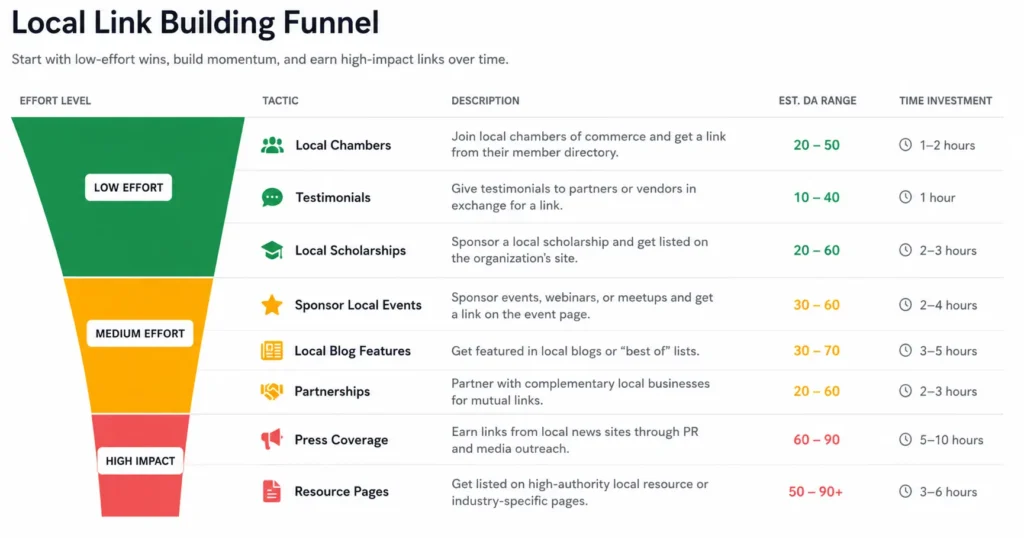
Actionable Local Link Building Tactics
1. Sponsor Local Events and Youth Organizations
Local 5K runs, youth sports leagues, school fundraisers, and community festivals typically publish a sponsor page with backlinks. The ROI is double: you get the link and local brand visibility.
- Outreach angle: Contact the event organizer directly. Offer a specific sponsorship amount in exchange for a logo and website link on the event page.
- Target:
.orgdomains, local school websites (.edu), community event pages
2. Supplier/Partner Testimonials
Every product or service supplier you use likely has a testimonials page. Write a genuine, detailed testimonial for your truck upfitter, your parts supplier, your software vendor — and many will link back to your site as the source.
3. “Best of [City]” Resource Pages
Create genuinely useful local resource guides:
- “Best Neighborhoods in Phoenix for Families: A Local Contractor’s Perspective”
- “Atlanta’s Most Common HVAC Problems (And How to Fix Them)”
These pages naturally attract citations and links from local bloggers, community forums, and news sites.
4. Local Press and News Coverage
Reach out to local news sites and hyperlocal platforms like Patch.com with genuinely newsworthy angles:
- Large charitable donation or community project
- Milestone business anniversary or expansion
- Hiring veterans or offering apprenticeships
5. Chamber of Commerce and Business Associations
Paying for chamber membership almost always includes a directory listing with a dofollow link. At $200–$500/year for most chambers, it’s one of the highest-ROI link building tactics available to local businesses.
Local Link Prospect Table
| Source Type | Example Target | Outreach Angle |
|---|---|---|
| Local Chamber of Commerce | [city]chamber.org | Member spotlight + directory listing |
| Local news/hyperlocal site | [city]patch.com | Community story pitch |
| Youth sports league | [city]soccer.org | Team sponsorship |
| Complementary local business | wedding planner, real estate agent | Cross-promotion partnership |
| Local university | [uni].edu/local-resources | Community resource contribution |
| Supplier/vendor | parts supplier, software vendor | Testimonial with backlink |
| Local charity/nonprofit | [nonprofit].org | Donation or volunteer spotlight |
8. Mobile Optimization & Core Web Vitals: Google’s Mobile-First Indexing Demands It {#mobile}
More than 60% of local searches now happen on mobile devices, and that number skews even higher for home services searches — people searching for an emergency plumber or a same-day AC repair are almost always on their phones. Google’s mobile-first indexing means the mobile version of your website is the primary version Google crawls and uses to determine rankings.
A slow, clunky mobile experience isn’t just frustrating for users — it’s a direct ranking penalty.
Core Web Vitals: Your 2026 Performance Benchmarks
Core Web Vitals are Google’s standardized set of user experience metrics. Meeting these thresholds is a prerequisite for competitive local rankings:
| Metric | What It Measures | Target Threshold |
|---|---|---|
| LCP (Largest Contentful Paint) | How long until the main content loads | < 2.5 seconds (Good) |
| FID / INP (Interaction to Next Paint) | Responsiveness to user interaction | < 200ms (Good) |
| CLS (Cumulative Layout Shift) | Visual stability (elements jumping around) | < 0.1 (Good) |
| TTFB (Time to First Byte) | Server response speed | < 800ms (Good) |
Check your scores in Google Search Console → Core Web Vitals report and PageSpeed Insights (free, instant analysis by URL).
The most common Core Web Vitals killers for local business sites:
- Uncompressed images (causes slow LCP)
- Render-blocking JavaScript (delays page paint)
- Unstable ad or cookie banner injections (causes CLS)
- Cheap shared hosting with slow TTFB
Mobile UX Requirements for Local Service Businesses
Beyond Core Web Vitals, your mobile experience should be optimized specifically for local conversion:
- Click-to-call button on every page — pinned to the bottom of the screen on mobile, not buried in a footer
- Tap-friendly form fields — inputs should be at least 44px tap target size; avoid small checkboxes
- No intrusive interstitials — Google penalizes popups that block main content on mobile within seconds of page load
- Local phone number (not toll-free) in the header — local area code builds geographic trust
- Google Maps embed on contact and landing pages — makes your location immediately clear and adds a relevance signal
- Booking/scheduling accessible in ≤2 taps — every additional step kills conversion rates
Mobile Audit Checklist
- [ ] PageSpeed Insights mobile score ≥ 75
- [ ] LCP < 2.5 seconds on mobile
- [ ] INP < 200ms
- [ ] CLS < 0.1
- [ ] All images compressed and served in WebP format
- [ ] Click-to-call button visible without scrolling on mobile
- [ ] No popups appearing within 3 seconds of mobile page load
- [ ] Forms have large, tap-friendly input fields
- [ ] Google Maps embedded on contact and key landing pages
- [ ] Font size ≥ 16px for body text (avoids “text too small to read” penalty)
- [ ] Booking/contact accessible in 2 taps or fewer
9. How to Create Localized Content That Earns AI Overviews & Featured Snippets {#content}
The final strategy in this local SEO checklist is where most businesses leave the most performance on the table. Localized content — blog posts, service-area pages, case studies, and FAQs built around your specific geography and services — is what separates businesses that appear in Google’s AI Overviews and featured snippets from those that don’t.
AI-generated search answers (Google’s AI Overview, Perplexity, ChatGPT search) pull from content that is structured, authoritative, and specifically answerable. Generic service pages don’t get cited. Deeply specific, locally relevant content does.
Content Types That Win Local Featured Snippets
“Best [Service] in [Neighborhood]” Guides
These comprehensive comparison guides target high-volume commercial investigation queries. A roofing company in Atlanta might publish: “Best Roofing Companies in Buckhead, Atlanta: What to Look for and Questions to Ask.”
This page doesn’t just rank — it positions you as the authoritative local voice, builds topical authority, and is exactly the kind of structured, comparative content that AI engines cite in their answers.
Local Case Studies and Project Pages
“How We Replaced a 23-Year-Old Roof on a Historic Home in Midtown Atlanta” is not just interesting content — it’s an E-E-A-T signal (Experience + Expertise), a natural backlink magnet, and a model of the specific, location-tagged content AI engines can extract and cite.
Structure each case study with:
- The Problem: What specific issue did the homeowner face?
- The Diagnosis: What did you find when you assessed the situation?
- The Solution: What did you do, and why did you choose that approach?
- The Result: Photos, measurements, or customer quote confirming success
- Location + Schema: Tag the city, neighborhood, and service in your structured data
Community Event Roundups and Local Resources
“Phoenix HVAC Rebate Programs: 2026 Guide for Homeowners” or “Charlotte’s Most Common Electrical Code Violations (And How to Fix Them)” — these informational pieces target the research phase, build brand authority, and attract natural links from local news sites and community blogs.
Voice Search Optimization
Voice queries are longer, more conversational, and often question-based: “What’s the best way to find a licensed plumber in my area?” Structure your FAQ sections and service page intro paragraphs to mirror this natural language. Pages that answer conversational queries with direct, concise answers (under 60 words) are prime candidates for voice search results and AI Overview citations.
Content Optimization Framework for AI Engines
| Content Signal | Why It Matters for AI Engines | How to Implement |
|---|---|---|
| Direct answer in first paragraph | AI engines extract first clear response | Lead every section with a 1–2 sentence answer |
| Question-based H2/H3 headers | Matches PAA and voice search queries | Use “How to,” “What is,” “Why does” in subheadings |
| FAQ section with schema | Primary source for AI-generated FAQs | Add FAQPage JSON-LD (see schema section below) |
| Specific data and statistics | AI cites specific, verifiable claims | Include numbers, percentages, sources |
| Location entities in copy | Helps AI understand geographic relevance | Naturally mention city, neighborhood, zip codes |
| Internal links with descriptive anchors | Builds content relationships for AI comprehension | “Learn how to [do X]” not “click here” |
Conclusion: Your Local SEO Action Plan for 2026 {#conclusion}
Local SEO in 2026 rewards businesses that treat it as a system, not a one-time task. The nine strategies in this local seo checklist compound on each other: a fully optimized GBP earns more visibility, more visibility drives more reviews, more reviews build more trust, and more trust converts searchers into customers who refer others.
Your 9-Strategy Recap
- Understand local search intent — map content to transactional, informational, and navigational queries
- Optimize your Google Business Profile — complete every field, post weekly, seed the Q&A
- Build a local keyword architecture — layer service + city + intent modifiers; map to specific pages
- Implement on-page SEO and schema — title tags with city, header hierarchy, LocalBusiness JSON-LD
- Build consistent, high-authority citations — Tier 1 first, then industry-specific directories
- Generate and manage reviews systematically — post-job SMS requests, direct links, response templates
- Build local backlinks — sponsorships, testimonials, press, chamber memberships
- Optimize for mobile and Core Web Vitals — LCP < 2.5s, INP < 200ms, CLS < 0.1
- Create localized content for AI engines — case studies, “best of” guides, structured FAQs
Continuous Optimization Schedule
| Frequency | Tasks |
|---|---|
| Weekly | Publish one GBP post; respond to all new reviews within 24 hours |
| Monthly | Add 5–10 new citations; review Search Console for new local keyword opportunities |
| Quarterly | Full GBP audit; Core Web Vitals check; citation inconsistency scan; content gap review |
| Annually | Full technical audit; competitor analysis; keyword architecture refresh |
Local SEO is iterative. The businesses at the top of your local market didn’t get there with a one-time optimization push — they stayed consistent when competitors got complacent.
Ready to build a local SEO system that actually generates leads?
[INTERNAL LINK: Get a free local SEO audit → /free-audit]
If you found this guide useful, bookmark it and share it with another local business owner who could use it. And if you want to see exactly how your current local SEO setup stacks up, start with a free audit of your Google Business Profile and website.
Frequently Asked Questions About Local SEO
What is local SEO and how is it different from regular SEO?
Local SEO is the practice of optimizing your online presence to rank in geographically relevant searches — particularly Google’s Local Pack (the map results), Google Maps, and location-based organic results. Unlike traditional SEO, which focuses on ranking for broad keywords at a national or global level, local SEO prioritizes location signals: your Google Business Profile, NAP consistency, local citations, and geographically targeted content.
What is the most important local SEO ranking factor in 2026?
According to Whitespark’s 2024 Local Search Ranking Factors study, Google Business Profile signals (completeness, category relevance, review signals, and engagement) are the strongest local pack ranking factors, followed by on-page local signals (NAP, location keywords, schema) and link authority. Review recency, quantity, and response rate are increasingly weighted in the ranking algorithm.
How long does it take to see results from local SEO?
Typically, GMB optimizations show movement within 2–4 weeks, particularly if your profile was previously incomplete or inactive. Citation and on-page improvements generally produce visible ranking changes within 3–6 months. Competitive markets (e.g., plumbers in Los Angeles or HVAC companies in Houston) may require 6–12 months of sustained effort to reach top-3 Local Pack positions.
Can I do local SEO myself without hiring an agency?
Yes. The full local SEO checklist in this guide is designed to be DIY-executable using free tools: Google Business Profile Manager, Google Search Console, Google Keyword Planner, and PageSpeed Insights. Where paid tools provide significant leverage are in citation auditing (BrightLocal or Moz Local) and competitive keyword research (Semrush or Ahrefs). That said, competitive markets often benefit from professional expertise to accelerate results.
How many reviews do I need to rank in the Local Pack?
There’s no fixed number. What matters more is review velocity (recency), diversity (different reviewer profiles), and keyword richness (reviews that mention your service and city). In lower-competition markets, 30–50 strong reviews can place you in the top 3. In competitive metros like Chicago or Houston, top-ranked service businesses often have 200–500+ reviews. Focus on consistent acquisition rather than trying to hit a target number.
What is NAP consistency and why does it matter?
NAP stands for Name, Address, Phone number. NAP consistency means these three data points are identical across your Google Business Profile, website, and every directory listing online. Even minor variations — “Street” vs. “St.” or a different phone format — can create conflicting signals that weaken Google’s confidence in your business data and suppress your local rankings.
Is local SEO still worth it in 2026 with AI search growing?
More than ever. As AI-powered search engines (Google’s AI Overview, Perplexity, ChatGPT) become the primary interface for information discovery, businesses with strong local SEO foundations are better positioned to be cited in AI-generated answers — not less. AI engines pull from authoritative, structured, locally relevant sources. A business with a fully optimized GBP, clean citation profile, strong reviews, and schema-marked website is exactly what AI engines are looking for when generating local recommendations.
What tools should every local business be using for SEO?
Free: Google Business Profile Manager, Google Search Console, Google Keyword Planner, PageSpeed Insights, Google’s Rich Results Test Paid (high ROI): BrightLocal (citation management + rank tracking), Semrush or Ahrefs (keyword research + competitor analysis), Screaming Frog (technical audits)
Last updated: June 2026 | Written by the Searchlyn team