- Introduction
- Tip #1: Master Modern Keyword Research (Tools + Techniques)
- Tip #2: Align Every Keyword with Search Intent (E-E-A-T Foundation)
- Tip #3: Conduct a Competitor Keyword Gap Analysis
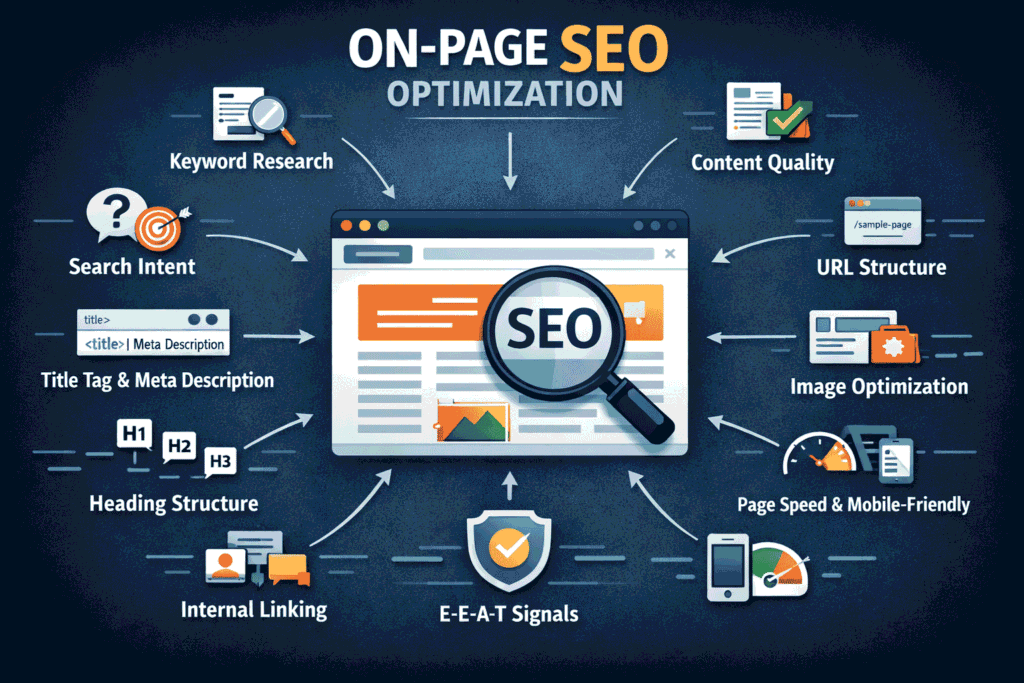
- Tip #4: On-Page SEO Optimization with Schema Markup
- Tip #5: Create Content Clusters (Keyword Mapping + Topic Authority)
- Tip #6: Track, Measure, and Adapt with Data-Driven KPIs
- Tip #7: Future-Proof Your Strategy for Voice Search, AI Overviews, and Beyond
- Conclusion
- Turn Search Visibility Into Sustainable Business Growth through our SEO Services
- Frequently Asked Questions: SEO Keyword Strategy
- What is the most important SEO ranking factor in 2026?
- How long does it take to see results from a seo keyword strategy?
- Can I use the same keywords on multiple pages?
- How often should I update my keyword list?
- Does AI-generated content affect keyword rankings?
- What is the difference between AEO and traditional SEO keyword strategy?
- How many keywords should I target per page?
- What is the best free tool for keyword research?
Key Takeaways
- Modern seo keyword research requires AI-assisted clustering and multi-tool triangulation, not just volume data
- Search intent alignment is the single highest-leverage on-page optimization you can make in 2026
- Content clusters built around a pillar-cluster model dominate competitive SERPs
- Schema markup (JSON-LD) directly increases visibility in rich snippets and AI Overviews
- Tracking average position, CTR, and keyword cannibalization monthly separates growing sites from stagnant ones
- Voice search and AI Overview optimization require conversational, question-based keyword targeting
Introduction
Most businesses treat keyword research like a box to check. They pull a list from a tool, drop it into a spreadsheet, and wonder why their rankings plateau six months later. The truth is uncomfortable: in 2026, SEO keyword strategy is not a step in your SEO workflow — it is the workflow.
Search has fundamentally changed. Google’s Search Generative Experience (SGE), now fully integrated into mainstream results as AI Overviews, means the traditional “rank #1 and collect traffic” model no longer tells the whole story. AI systems from Perplexity, ChatGPT Search, and Gemini now intercept enormous volumes of queries that used to flow directly to your content. To win visibility — both in blue links and in AI-generated summaries — your SEO keyword strategy must be architected differently than it was even two years ago.
This guide delivers a seven-part, actionable SEO keyword strategy framework built for 2026 realities. Whether you’re an SEO specialist, agency owner, or in-house marketer, you’ll walk away with:
- A clear method for conducting modern SEO keyword research using AI-assisted tools
- A systematic way to align every keyword with the correct search intent
- A step-by-step competitor keyword gap analysis process
- On-page optimization tactics including schema markup for rich result eligibility
- A content cluster model that builds topical authority at scale
- The KPIs that actually predict organic growth — and how to track them
- Future-proofing techniques for voice search, AI Overviews, and beyond
Let’s build a SEO keyword strategy that doesn’t just rank — one that gets cited.
Tip #1: Master Modern Keyword Research (Tools + Techniques)
Traditional vs. Modern Keyword Research
The gap between how SEOs conducted keyword research in 2018 and how high-performing teams do it today is significant. Traditional approaches relied on manual brainstorming, basic search volume data from a single tool, and a rough sense of competition. Modern keyword research in 2026 is a multi-signal, intent-layered process informed by AI prediction models, SERP feature analysis, and trend forecasting.
| Traditional Method (Pre-2022) | Modern Method (2026) |
|---|---|
| Manual brainstorming | AI-powered suggestion engines (ChatGPT, Gemini) |
| Basic monthly volume data | Intent prediction + real-time trend forecasting |
| Single-tool reliance (Google KP) | Multi-tool triangulation across 3–5 platforms |
| Exact-match keyword obsession | Semantic keyword clustering and topic modeling |
| Desktop-first query thinking | Voice and conversational query prioritization |
| Reactive research | Predictive trend identification 60–90 days out |
The shift from exact-match volume chasing to semantic intent clustering is the most important evolution a practitioner can make. According to Ahrefs’ 2025 keyword research study, over 92% of all keywords receive fewer than 10 searches per month, which means obsessing over head terms at the expense of long-tail clusters leaves enormous opportunity on the table.
The 2026 Keyword Research Toolkit
Use this checklist to build a complete research stack:
Keyword Research Toolkit — 2026
| Tool | Primary Use | Best For |
|---|---|---|
| Google Keyword Planner | Baseline search volume, CPC data | Budget-conscious entry-level research |
| SEMrush Keyword Magic Tool | Competitor gap analysis, SERP features | Agency-level research at scale |
| Ahrefs Keywords Explorer | Keyword Difficulty (KD), parent topic mapping | Authority site expansion |
| AnswerThePublic | Question-based and preposition keywords | FAQ content, AEO optimization |
| Google Search Console | Actual impression/click data on owned queries | Identifying quick-win opportunities |
| AlsoAsked.com | People Also Ask mapping | Featured snippet targeting |
| ChatGPT / Perplexity | AI-driven keyword clustering, semantic variants | Content brief enrichment |
| Google Trends | Seasonality and trend trajectory | Timing content publication |
- ☐ Google Keyword Planner (baseline volume + CPC context)
- ☐ SEMrush or Ahrefs (competitor gap + SERP feature analysis)
- ☐ AnswerThePublic or AlsoAsked (question-based keyword mining)
- ☐ ChatGPT or Perplexity (semantic clustering and variant generation)
- ☐ Google Search Console (owned query performance — highest accuracy)
- ☐ Google Trends (seasonality validation before content investment)
A keyword research toolkit for 2026 should include at minimum: Google Keyword Planner for volume baselines, SEMrush or Ahrefs for competitor gap analysis, AnswerThePublic for question-based keywords, Google Search Console for owned performance data, and an AI tool like ChatGPT for semantic clustering and content brief enrichment.
Long-Tail vs. Short-Tail Keywords: When to Use Each
Short-tail keywords (1–2 words, e.g., “plumber SEO”) have high volume, high competition, and diffuse intent. They rarely convert on their own but anchor brand authority when you rank for them. Realistically, competing for pure head terms requires significant domain authority (DA 40+) and sustained content investment.
Long-tail keywords (3–6+ words, e.g., “SEO for plumbers in Houston Texas”) have lower volume individually but convert at dramatically higher rates. According to Backlinko’s analysis of 306 million keywords, long-tail keywords account for 70% of all web searches and convert at rates 2.5× higher than head terms.
The practical approach in 2026: build content clusters where a pillar page targets the short-tail anchor and cluster posts collectively target hundreds of long-tail variants. You earn authority at both levels without diluting either.
Latent Semantic Indexing (LSI) Keywords — Why Context Still Matters
LSI keywords — semantically related terms that help search engines understand the topical context of your content — remain critical in 2026, even as the term itself has become somewhat outdated in technical SEO circles. What matters is semantic richness: a page about “keyword research” should naturally contain terms like search intent, SERP analysis, keyword clustering, search volume, keyword difficulty, and competitive analysis. Their absence signals a thin or narrow treatment of the topic.
Tools like SEMrush’s Keyword Magic Tool and Ahrefs’ “Also rank for” report surface these related terms automatically. The practical rule: before publishing any piece, scan the top 5 ranking pages and identify recurring semantic terms you haven’t used. Add them where they serve the reader — not as a mechanical checklist.
[IMAGE: lsi-keyword-semantic-cluster-example.png | Alt: Visual showing semantic keyword cluster for “SEO keyword research” with related entities]
Tip #2: Align Every Keyword with Search Intent (E-E-A-T Foundation)
The 4 Types of Search Intent
Search intent is the single most important signal Google uses to determine which pages deserve to rank. A technically perfect page targeting the wrong intent will not rank. This is not a ranking factor debate — it’s a fundamental architectural requirement.
| Intent Type | User Goal | Keyword Example | Optimal Content Format |
|---|---|---|---|
| Informational | Learn something, answer a question | “how to do keyword research for SEO” | Blog post, guide, how-to article, video |
| Navigational | Find a specific website or page | “Ahrefs login,” “Google Search Console” | Homepage, brand page, login page |
| Transactional | Make a purchase or sign up | “buy SEO audit tool,” “SEMrush free trial” | Product page, pricing page, landing page |
| Commercial Investigation | Compare options before deciding | “best SEO tools 2026,” “SEMrush vs Ahrefs” | Comparison post, review article, roundup |
The four types of search intent are: (1) Informational — users want to learn; (2) Navigational — users want to find a specific site; (3) Transactional — users want to buy or sign up; (4) Commercial Investigation — users are comparing options before a decision. Correctly identifying intent is the foundation of every on-page optimization decision.
How to Reverse-Engineer Intent from the Top 3 Google Results
Before assigning intent to a keyword, validate it empirically. Don’t guess — observe:
- Search the keyword in an incognito window to eliminate personalization
- Analyze the top 3 results: What content format dominates? (Articles vs. product pages vs. tools)
- Identify the content angle: Is the dominant result “best of,” “how to,” “definition,” or “comparison”?
- Check SERP features: Are there featured snippets? People Also Ask boxes? Local packs? These signal what Google believes the intent is
- Match your content to the dominant format and angle — not to what you want to publish
A common mistake: targeting “HVAC SEO” with a service page when the entire first page is occupied by informational guides. Google has already determined the intent. Work with that signal, not against it.
Search Intent Mapping Template
Use this template to systematically map keywords before building content briefs:
| Keyword | Intent Type | Validated? (Y/N) | Target Page URL | Content Format | Priority |
|---|---|---|---|---|---|
| “keyword research for plumbers” | Informational | Y | /blog/keyword-research-plumbers | How-to guide | High |
| “plumber SEO services” | Commercial | Y | /services/plumber-seo | Service landing page | High |
| “buy SEO audit for plumbing business” | Transactional | Y | /free-audit | Audit request form | Medium |
| “best SEO agency for plumbers” | Commercial Investigation | Y | /why-us | Comparison/positioning page | High |
Why Intent Alignment Signals E-E-A-T
Google’s Search Quality Rater Guidelines place significant emphasis on whether content satisfies user needs completely — what they call “Needs Met” scoring. When your content format precisely matches what a user expects for a given query, you signal Experience (you understand the user’s situation), Expertise (your content depth reflects mastery), and Trustworthiness (you’re not bait-and-switching with a sales page where a guide was expected).
Intent misalignment is one of the top reasons otherwise well-written content fails to rank. According to Google’s own Quality Rater Guidelines, the highest-quality pages are those that most completely and satisfyingly serve the need behind the query.
Tip #3: Conduct a Competitor Keyword Gap Analysis
Why Gap Analysis Outperforms Starting from Scratch
Building a SEO keyword strategy from a blank slate is inefficient. Your competitors — particularly those already ranking in positions 1–10 for commercial terms in your space — have done years of research implicitly through their rankings. A keyword gap analysis lets you reverse-engineer their success, identify uncontested opportunities, and prioritize content investment with confidence.
Step-by-Step Competitor Gap Analysis Process
Step 1: Identify Your Top 5 Competitors
Include both:
- Direct competitors (same business model, same service area)
- SERP competitors (sites outranking you for your target keywords — could be blogs, aggregators, or industry publications)
Use this method: search your 3–5 most important keywords and list every domain appearing in the top 5 results. The domains appearing most frequently across searches are your true SERP competitors.
Step 2: Extract Their Top-Ranking Keywords
In SEMrush: navigate to Competitive Research → Keyword Gap and input your domain alongside 2–4 competitor domains. In Ahrefs: use the Content Gap tool under Site Explorer.
Filter for:
- Keywords where competitors rank in positions 1–20 but you are not ranking at all (pure gaps)
- Keywords where competitors rank 1–10 but you rank 11–30 (opportunity keywords)
- Keywords with monthly search volume ≥ 100 (realistic traffic potential)
- Keyword Difficulty ≤ 40 for new content initiatives (attainable with targeted effort)
Step 3: Categorize and Prioritize
| Keyword | Our Rank | Competitor A Rank | Competitor B Rank | Opportunity Score | Priority |
|---|---|---|---|---|---|
| “plumbing SEO checklist” | Not ranking | #4 | #11 | Very High | 1 |
| “local SEO for HVAC companies” | #22 | #3 | #7 | High | 1 |
| “electrician website SEO tips” | #31 | #8 | Not ranking | High | 2 |
| “roofer keyword research guide” | Not ranking | Not ranking | Not ranking | Medium | 3 |
| “best keywords for pest control” | #14 | #2 | #5 | Medium-High | 2 |
Copy-paste blank template:
| Keyword | Our Rank | Competitor A Rank | Competitor B Rank | Opportunity Score | Priority |
|---|---|---|---|---|---|
Finding Untapped Content Gaps
Beyond keywords your competitors are targeting, look for keywords nobody in your space has addressed well. These are found by:
- Mining “People Also Ask” boxes for questions that return only vaguely relevant results
- Using AnswerThePublic to surface question-based queries with no strong content answer in the top 5
- Searching Reddit, Quora, and industry forums for recurring questions your audience asks but nobody ranks for well
- Analyzing zero-click queries in Google Search Console — high impression, near-zero click queries often indicate your meta description is failing to differentiate against weak competition
Tools for competitor research: SEMrush Keyword Gap, Ahrefs Content Gap, SpyFu (particularly strong for PPC/SEO overlap analysis)
Read more about Competitor Analysis in this guide – “Complete SEO Competitor Analysis Guide”
Tip #4: On-Page SEO Optimization with Schema Markup
Keyword Placement Best Practices
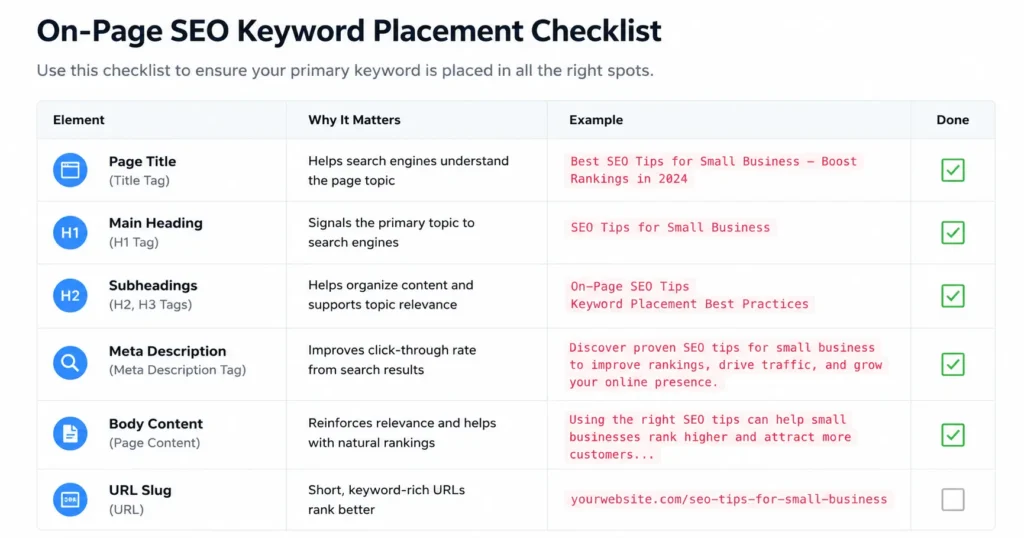
On-page optimization is where SEO keyword strategy converts into ranking signals. Placement matters — but so does proportionality. Here is the priority order for keyword integration:
- Title Tag (H1) — Exact-match or front-loaded primary keyword. Google weights title tag heavily for initial relevance assessment. Keep under 60 characters.
- First 100 Words — Establish the topic unambiguously within the opening paragraph. Don’t bury your keyword.
- H2 and H3 Subheadings — Use primary and secondary keywords as natural subheading labels. This aids crawlability and featured snippet extraction.
- Meta Description — Does not directly affect rankings but critically impacts CTR. Include the keyword and a value proposition within 155 characters.
- URL Slug — Concise, hyphenated, keyword-inclusive. Example:
/blog/seo-keyword-strategy-2026not/blog/article-1234 - Image Alt Text — Descriptive and keyword-inclusive where natural. Avoid stuffing; prioritize accessibility.
- Body Copy — Natural, contextual use throughout. Write for the reader first; keywords appear organically.
Keyword Density Guidelines
Target range: 0.5%–1.5% natural frequency.
At 1,500 words, that means your primary keyword appears approximately 8–22 times — naturally, not forced. The concept of “keyword density” as a mechanical metric is outdated; Google’s NLP systems evaluate topical relevance and semantic coverage, not raw repetition.
What matters more:
- Semantic completeness (are related entities and concepts present?)
- Topical depth (does the content go deeper than competing pages on key points?)
- Structural clarity (are H2s informative and specific, not generic?)
Local Business Schema Markup (JSON-LD)
Schema markup is the structured data layer that bridges your content and search engine understanding. For businesses with a local or service-area component, LocalBusiness schema is non-negotiable.
Why schema markup matters in 2026:
- Enables rich results (star ratings, operating hours, service areas in SERPs)
- Powers Knowledge Panel data when combined with GBP and entity consistency
- Directly feeds AI Overview citations — Google’s SGE pulls structured entity data preferentially
- Improves voice search answer eligibility (voice results disproportionately come from structured data sources)
Copy-Paste Local Business Schema (JSON-LD):
{
  "@context": "https://schema.org",
  "@type": "LocalBusiness",
  "name": "Your Business Name",
  "description": "Brief description of your services and service area",
  "url": "https://www.yourdomain.com",
  "telephone": "+1-XXX-XXX-XXXX",
  "priceRange": "$$",
  "address": {
    "@type": "PostalAddress",
    "streetAddress": "123 Main Street",
    "addressLocality": "Your City",
    "addressRegion": "State/Province",
    "postalCode": "XXXXX",
    "addressCountry": "US"
  },
  "geo": {
    "@type": "GeoCoordinates",
    "latitude": "XX.XXXX",
    "longitude": "-XX.XXXX"
  },
  "openingHoursSpecification": [
    {
      "@type": "OpeningHoursSpecification",
      "dayOfWeek": ["Monday", "Tuesday", "Wednesday", "Thursday", "Friday"],
      "opens": "08:00",
      "closes": "18:00"
    }
  ],
  "sameAs": [
    "https://www.google.com/maps/...",
    "https://www.facebook.com/yourbusiness",
    "https://www.linkedin.com/company/yourbusiness"
  ],
  "keywords": "your primary service keyword, local SEO, keyword strategy"
}
Additional Schema Types for Content Authority
Beyond LocalBusiness, content-heavy pages benefit from:
| Schema Type | When to Use | Benefit |
|---|---|---|
Article | Blog posts, guides, news content | Enables article rich results, author attribution |
HowTo | Step-by-step instructional content | Eligible for HowTo rich result in SERP |
FAQ | Pages with question-and-answer sections | FAQ accordion rich result (high CTR boost) |
BreadcrumbList | All pages with clear site hierarchy | Breadcrumb display in SERP snippet |
Organization | Homepage, About page | Entity establishment, Knowledge Panel eligibility |
WebPage + Speakable | Key content pages | Voice search answer eligibility |
Validate all schema markup using Google’s Rich Results Test before publishing.
Tip #5: Create Content Clusters (Keyword Mapping + Topic Authority)
What Is Keyword Mapping?
Keyword mapping is the discipline of assigning specific, non-overlapping keywords to specific URLs across your site. Its purpose is twofold: prevent keyword cannibalization (multiple pages competing for the same term, splitting your authority) and ensure every page has a clear, singular topical focus that Google can confidently index and rank.
Without keyword mapping, sites grow organically in ways that undermine their own rankings. According to SEMrush’s State of Content Marketing Report, cannibalization is one of the top five technical issues found in site audits of established domains.
Keyword mapping is the process of assigning specific target keywords to specific URLs on a website. It prevents keyword cannibalization, ensures clear page-level topical focus, and creates a logical internal linking architecture that distributes authority efficiently across the site.
The Pillar-Cluster Model
The pillar-cluster model is the dominant content architecture strategy for building topical authority in 2026. It works by grouping all content on a broad topic under a comprehensive pillar page, with satellite cluster posts covering subtopics and linking back to the pillar.
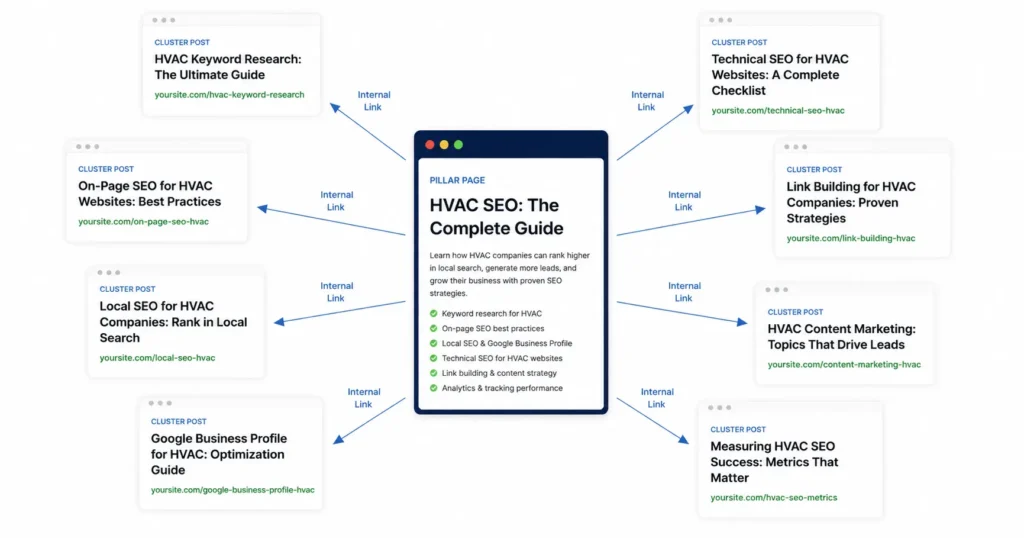
Example Pillar-Cluster Architecture for “Plumbing SEO”:
Pillar Page: "The Complete Guide to SEO for Plumbers" [/blog/plumber-seo]
    ├─ Cluster 1: "Keyword Research for Plumbers" [/blog/plumber-keyword-research]
    ├─ Cluster 2: "Local SEO Citations for Plumbing Companies" [/blog/plumbing-local-citations]
    ├─ Cluster 3: "Google Business Profile Optimization for Plumbers" [/blog/plumber-gbp-optimization]
    ├─ Cluster 4: "Plumbing Website Backlink Building Strategies" [/blog/plumbing-backlinks]
    ├─ Cluster 5: "On-Page SEO Checklist for Plumbing Websites" [/blog/plumbing-on-page-seo]
    └─ Cluster 6: "Schema Markup for Plumbing Businesses" [/blog/plumbing-schema-markup]
Each cluster post links to the pillar using descriptive anchor text. The pillar links back to each cluster. This bidirectional internal linking structure concentrates topical authority on the pillar while allowing cluster posts to rank independently for their target long-tail keywords.
Keyword Mapping Spreadsheet Template
Use this template as your master keyword-to-page mapping document:
| Keyword | Target URL | Search Intent | Monthly Volume | Keyword Difficulty | Priority Score | Status |
|---|---|---|---|---|---|---|
| “seo keyword strategy 2026” | /blog/seo-keyword-strategy | Informational | 1,200 | 38 | 9/10 | In Progress |
| “keyword research for plumbers” | /blog/plumber-keyword-research | Informational | 320 | 22 | 8/10 | Published |
| “local SEO for HVAC companies” | /blog/hvac-local-seo | Informational | 480 | 31 | 9/10 | Planned |
| “electrician SEO services” | /services/electrician-seo | Commercial | 590 | 44 | 8/10 | Published |
Checklist for Building a Keyword Map
- ☐ Export all target keywords into a master spreadsheet
- ☐ Group keywords by topic using clustering (Keyword Insights, SEMrush Topic Research, or manual review)
- ☐ Designate one pillar page per core topic (max 3–5 pillars for a focused site)
- ☐ Assign long-tail variants to specific cluster posts — no overlap between pages
- ☐ Audit existing content for cannibalization before creating new pages
- ☐ Create 5–10 cluster posts per pillar, published progressively over 2–4 months
- ☐ Use descriptive, keyword-rich anchor text for all internal links
- ☐ Review and update the keyword map quarterly as rankings evolve
The PIE Framework for Keyword Prioritization
When you have more keyword opportunities than content bandwidth, the PIE Framework (Protect, Improve, Expand) provides a principled prioritization method:
- Protect — Keywords where you currently rank 1–5 and risk displacement by competitors. Publish supporting cluster content to reinforce these positions.
- Improve — Keywords where you rank 6–20 (the “stuck in traffic” zone). These require targeted content improvements, CTR optimization, and link building to break through.
- Expand — New keyword opportunities identified through gap analysis. These have no current ranking and require fresh content creation.
Apply PIE in that order of urgency: protect existing value before chasing new ground.
Tip #6: Track, Measure, and Adapt with Data-Driven KPIs
Why Most SEO Teams Track the Wrong Things
Rankings without context are vanity. A site ranking #8 for a high-intent commercial keyword may be generating more revenue than one ranking #1 for an informational query with poor conversion architecture. The KPIs that matter connect keyword performance to business outcomes — not just SERP position.
Essential KPIs for SEO Keyword Strategy Success
| KPI | What It Actually Measures | Best Tool | Reporting Frequency |
|---|---|---|---|
| Average Position | Overall ranking trajectory for target keyword set | Google Search Console | Weekly |
| Click-Through Rate (CTR) | Appeal of title tag and meta description | GSC (by query) | Weekly |
| Organic Traffic | Total sessions from non-paid search | Google Analytics 4 | Daily (trend), Weekly (review) |
| Keyword-to-Conversion Rate | Revenue impact of specific keyword clusters | GA4 + CRM integration | Monthly |
| Impressions Growth | Topical coverage expansion over time | Google Search Console | Monthly |
| Pages Indexed vs. Crawled | Technical SEO health affecting keyword visibility | GSC Coverage Report | Monthly |
| Keyword Cannibalization Rate | Pages competing for same terms (self-competition) | SEMrush / Ahrefs | Monthly |
| AI Overview / Featured Snippet Capture Rate | Percentage of target keywords triggering your snippet | Manual SERP audit + SEMrush | Quarterly |
Setting Up Google Search Console and GA4 for Keyword Tracking
Google Search Console Setup:
- Verify your domain via DNS record (recommended) or HTML tag
- Submit your XML sitemap at
yourdomain.com/sitemap.xml - Navigate to Performance → Search Results and enable all four metrics: Total Clicks, Total Impressions, Average CTR, Average Position
- Filter by Country (separate your US from UK traffic), Device (mobile vs. desktop behaviors differ), and Search Type (Web, Image, Video, News)
- Use the Queries tab to identify your top 20 keywords by impression and your top opportunity keywords (positions 11–20)
Google Analytics 4 Setup for SEO:
- Create a custom Exploration report filtering by
Session source/medium = google / organic - Add dimensions: Landing Page + Query (connect via GSC → GA4 data integration)
- Set up a Conversion Event for your primary conversion goal (form submission, phone call, booking)
- Build an Audience of organic visitors who complete conversions for remarketing and lookalike targeting
Keyword Performance Dashboard Checklist
Build your monthly keyword performance review around these four zones:
- ☐ Top 20 keywords by impressions — Are impression volumes growing month-over-month? This indicates index expansion.
- ☐ Keywords with declining CTR — Identify titles/meta descriptions needing rewrite. A 0.5% CTR drop sustained over 4 weeks is a rewrite trigger.
- ☐ New ranking opportunities (positions 11–20) — These are your highest-ROI optimization targets. Small improvements (adding an FAQ, improving internal links) can move a #14 to a #7 with relatively low effort.
- ☐ High impressions, low CTR pages — These pages are visible but not compelling. Prioritize title and meta description testing.
- ☐ Cannibalization flags — Any keyword where 2+ of your URLs appear in top 20 results simultaneously. Consolidate via redirect or canonical tag.
- ☐ Content decay monitoring — Pages that ranked top 5 but have slipped to 6–15 over 90 days. These need a content freshness update.
Monthly Keyword Audit Checklist
Run this audit on the first Monday of every month:
- Pull GSC Performance data for the prior 28 days (compare to same period last month and last year)
- Identify keywords that dropped more than 5 positions — investigate for algorithm update impact, new competitor content, or technical issues
- Export all keywords ranking 11–20 — create a “quick win” content improvement list
- Check for cannibalization: search your top 10 target keywords in Google and confirm only one page per keyword is ranking
- Review conversion data in GA4: which landing pages are converting organic traffic, and which are leaking it?
- Assess new keyword opportunities: what queries appeared in your GSC impressions report this month that you haven’t yet targeted?
- Update your keyword mapping spreadsheet based on all findings above
- Set three keyword-focused action items for the coming month (not more than three — prioritization is discipline)
Adjusting Strategy: When to Double Down vs. When to Pivot
| Signal | Recommended Action |
|---|---|
| Ranking 6–15 for a high-value keyword | Double down: improve content depth, add internal links, build 2–3 relevant backlinks |
| Ranking 1–3 but CTR below 3% | Rewrite title/meta description; test question-format headlines |
| Ranking for a keyword that doesn’t convert | Reassess intent match; the keyword may be informational when your page is commercial |
| Ranking has plateaued at 15–25 for 6+ months | Consider a fresh page with a different angle, or build topical authority through cluster content first |
| New competitor page displaced your ranking | Conduct a content gap comparison; update your page to address topics the new page covers |
Tip #7: Future-Proof Your Strategy for Voice Search, AI Overviews, and Beyond
Voice Search Optimization
Voice search accounts for a substantial and growing share of queries — particularly for local, how-to, and quick-answer intent. According to Statista, voice-based digital assistants are in active use on over 8.4 billion devices globally, and voice searches are 3× more likely to be local-intent queries than text searches.
Voice-optimized SEO keyword strategy requires:
- Conversational phrasing: Target complete questions, not just keywords. “How do I choose the right HVAC contractor near me?” not “HVAC contractor near me”
- Featured snippet targeting: Voice assistants disproportionately read featured snippet content as their answer. To win voice results, first win the featured snippet.
- Schema
Speakablemarkup: Tells Google which sections of your page are appropriate for text-to-speech audio delivery
Conversational Keyword Examples for Home Services (2026):
Preparing for Google’s AI Overviews
Google’s AI Overviews (SGE) have fundamentally altered the top of the SERP for a growing percentage of queries. Early data from BrightEdge’s 2025 SGE Impact Research suggests AI Overviews appear for approximately 42% of all search queries — with higher frequency on informational, how-to, and “best of” queries.
What earns inclusion in AI Overviews:
- Rank in positions 1–5 — AI Overviews draw disproportionately from top-ranking pages. Existing authority is your single greatest leverage point.
- Use clear declarative sentences — AI systems extract content that directly answers a question. Structure answers as: “[Term] is [definition/explanation]. [Context sentence]. [Supporting detail].”
- Format with AI-scannable structure — Bullet points, numbered lists, tables, and short paragraphs are preferentially extracted by generative systems.
- Establish entity clarity — Your business name, services, location, and expertise signals should be explicit and consistent across your content, schema, and GBP.
- Write self-contained sections — Each H2 section should be comprehensible as a standalone answer without requiring the reader to have read the full page. AI systems extract sections, not full pages.
GEO Principle: Content optimized for generative engine citation must be quotable at the section level. Every H2 block should contain a direct, standalone answer to the implicit question posed by that heading.
Conversational Keyword Trends for 2026
The most important shift in keyword targeting for 2026 is the move from keyword → topic to topic → question → direct answer. Users increasingly phrase queries the way they’d ask a knowledgeable colleague, and AI search engines expect content that responds in kind.
High-value conversational keyword patterns to target:
- “How do I [achieve business outcome] with SEO” — e.g., “How do I get my plumbing company to show up in Google Maps”
- “What is the best [service/approach] for [specific situation]” — e.g., “What is the best keyword strategy for a new HVAC website”
- “Why does [problem] happen and how do I fix it” — diagnostic + solution format
- “[Location] + [service] + [qualifier]” — e.g., “affordable SEO agency for electricians in Dallas”
FAQ Section with Schema Markup
An FAQ section is one of the highest-ROI additions to any long-form content page in 2026. It serves four simultaneous purposes: (1) targets People Also Ask keywords, (2) earns FAQ accordion rich results in SERPs, (3) provides direct-answer content for AI Overview extraction, and (4) addresses buyer objections for commercial pages.
Conclusion
A best-in-class SEO keyword strategy in 2026 is not a one-time research exercise. It’s a living operational system that connects how your audience searches to how you create, structure, and measure content — then adapts based on what the data shows.
The 7-part framework this guide covers:
- Master modern keyword research — Use multi-tool triangulation, semantic clustering, and AI-assisted variant generation rather than single-tool volume chasing
- Align every keyword with search intent — Validate intent empirically by analyzing the top 3 results before writing a word
- Conduct competitor keyword gap analysis — Reverse-engineer your competitors’ rankings to find both shared battlegrounds and uncontested opportunities
- Optimize on-page with schema markup — Place keywords strategically, maintain natural density, and implement JSON-LD schema to earn rich result eligibility
- Build content clusters through keyword mapping — Use the pillar-cluster model to accumulate topical authority without cannibalization
- Track data-driven KPIs — Monitor average position, CTR, cannibalization, and conversion rate monthly, not just rankings
- Future-proof for voice search and AI Overviews — Write in conversational structures, target featured snippets, and ensure every section contains a self-contained, extractable answer
The competitive advantage in this environment belongs to whoever builds the most systematically. Sporadic content with good keywords will lose to consistent content with a disciplined architecture.
Keywords aren’t just about ranking — they’re about being the answer Google and AI choose to cite.
SEO Keyword Strategy Implementation Checklist –
Use this as your starting point for the next 90 days:
- ☐ Audit your current content for keyword cannibalization
- ☐ Build or update your keyword mapping spreadsheet
- ☐ Identify your top 5 SERP competitors and run a gap analysis
- ☐ Validate the search intent for your top 20 target keywords
- ☐ Implement
LocalBusinessandFAQschema on priority pages - ☐ Create or update your pillar page for your core topic
- ☐ Publish 2 cluster posts linking back to the pillar
- ☐ Set up a GSC Performance report filtered by your target keywords
- ☐ Conduct your first monthly keyword audit using the 8-step checklist above
- ☐ Identify 3 “position 11–20” quick wins and update those pages
Ready to build a SEO keyword strategy that earns rankings and AI citations? Contact the Searchlyn team for a personalized SEO audit.
Frequently Asked Questions: SEO Keyword Strategy
What is the most important SEO ranking factor in 2026?
Search intent alignment is the single most impactful factor you can control at the content level. If your content format and depth don’t match what Google has determined users want for a query, no amount of technical optimization will overcome that mismatch. Beyond content, authoritative backlinks and Core Web Vitals performance remain critical for competitive keywords.
How long does it take to see results from a seo keyword strategy?
For new content targeting low-competition long-tail keywords (KD under 25), initial rankings typically appear within 4–8 weeks. For competitive head terms (KD 40–70), expect a 6–12 month runway before significant ranking movement — assuming consistent content publication, internal linking, and backlink acquisition. Established pages optimized for quick-win keywords (positions 11–20) can see improvements in 2–4 weeks following targeted updates.
Can I use the same keywords on multiple pages?
No — using the same primary keyword on multiple pages creates keyword cannibalization, where your own pages compete against each other and split your authority. Assign each primary keyword exclusively to one URL. Related variations and semantic subtopics can appear across multiple pages, but the core target keyword should map to a single, authoritative page. Use canonical tags or 301 redirects to consolidate any existing cannibalization issues.
How often should I update my keyword list?
Conduct a full seo keyword strategy review quarterly. Keyword volumes, competition levels, and search intent signals shift — sometimes dramatically, especially following Google core updates or market events. A lighter monthly audit focusing on GSC performance data, new ranking opportunities, and content decay is recommended between quarterly reviews. Evergreen content should be refreshed annually at minimum.
Does AI-generated content affect keyword rankings?
Content quality matters more than production method — but AI-generated content that is generic, shallow, or factually inconsistent will underperform regardless of keyword optimization. Google’s Helpful Content guidelines (now integrated into core ranking systems) assess whether content demonstrates genuine expertise, original analysis, and utility for real users. AI-assisted content that is properly reviewed, fact-checked, enriched with original insights, and accurately represents E-E-A-T signals performs comparably to manually written content. The production method is not the risk; unreviewed, undifferentiated output is.
What is the difference between AEO and traditional SEO keyword strategy?
Traditional SEO keyword strategy optimizes for rankings in the ten blue links. AEO (Answer Engine Optimization) additionally optimizes for inclusion in featured snippets, AI Overviews, and AI assistant answers from ChatGPT, Perplexity, and Gemini. AEO requires structuring content with direct, self-contained answers to specific questions, using schema markup, and prioritizing clarity of entity and relationship in your content — because AI systems extract information, not pages.
How many keywords should I target per page?
Target one primary keyword per page, with 3–5 secondary keywords that share similar intent. Your primary keyword should appear in the title tag, H1, URL, and opening paragraph. Secondary keywords should appear naturally in H2/H3 subheadings and body copy. Using AI Overview-style tooling (Surfer SEO, Clearscope, or MarketMuse) to identify the semantic terms missing from your page will extend topical coverage more effectively than adding more primary keyword instances.
What is the best free tool for keyword research?
Google Search Console is the best free keyword tool for established sites — it shows actual query data for pages you already own, which is higher quality than estimated volume data from any third-party tool. For prospecting new content opportunities, Google Keyword Planner (free with a Google Ads account) and AnswerThePublic’s free tier (limited daily searches) provide solid starting points. Google Search itself — through autocomplete, People Also Ask, and Related Searches — remains an underutilized free research resource.
Last updated: by Searchlyn team in June 2026.