- I. Introduction
- II. How to Identify Your True SEO Competitors (Beyond Just "Business Rivals")
- III. Competitor Keyword Analysis: Finding Their Winning Terms
- IV. On-Page SEO & Content Strategy Evaluation
- V. Backlink Profile Examination (Off-Page SEO)
- VI. Technical SEO Evaluation (Crawl, Index, Render)
- VII. Social Media & Brand Presence Analysis
- VIII. Local SEO Competitor Analysis (If Applicable)
- IX. Tracking & Monitoring: Turning Analysis into Action
- X. Conclusion
- Turn Search Visibility Into Sustainable Business Growth through our SEO Services
- Dedicated FAQ Section
- How often should I do an SEO competitor analysis?
- What is the best free tool for competitor keyword research?
- Can I outrank a competitor with higher domain authority?
- Does competitor analysis work for local SEO only?
- Can I do a full competitor audit without paying for SEMrush or Ahrefs?
- What is the most important section of a competitor analysis?
- How do I know if my competitor's SEO strategy is working?
- Should I copy my competitor's SEO strategy exactly?
I. Introduction
Most SEO strategies fail not because of poor execution — but because they’re built in a vacuum.
You publish content, build links, and optimize pages without ever systematically studying the competitors who are already winning your target rankings. That’s not a strategy. That’s guessing.
SEO competitor analysis is the structured process of auditing your SERP rivals across nine critical dimensions — keywords, content, backlinks, technical infrastructure, local presence, and more — to extract actionable intelligence you can use to close ranking gaps and overtake them.
In 2026, this practice has evolved dramatically. With AI-generated answers from ChatGPT, Perplexity, and Google’s AI Overviews reshaping how searchers interact with results, competitor analysis now extends beyond traditional keyword rankings. You need to understand how your rivals are structured for AI citation, how they signal E-E-A-T (Experience, Expertise, Authority, Trust), and where their visibility strategy breaks down.
This checklist covers it all — and critically, the majority of it can be done using free Google SERP methods, with no paid SEMrush or Ahrefs subscription required.
Here’s what you’ll learn in this guide:
- How to identify your true SEO competitors (not just your business rivals)
- How to extract their winning keywords using free tools
- How to evaluate their on-page strategy, content depth, and E-E-A-T signals
- How to reverse-engineer their backlink profile
- How to benchmark their technical SEO setup
- How to outperform them in local search
- How to build a sustainable monitoring system
Whether you’re an in-house SEO, freelancer, or agency owner, this is the most complete, action-ready SEO competitor analysis checklist available in 2026.
II. How to Identify Your True SEO Competitors (Beyond Just “Business Rivals”)
Before you analyze any competitor, you need to identify the right ones. Many businesses make the mistake of only looking at their known business rivals. But your SEO competitors are the sites ranking on the same SERPs you want to own — and those aren’t always who you expect.
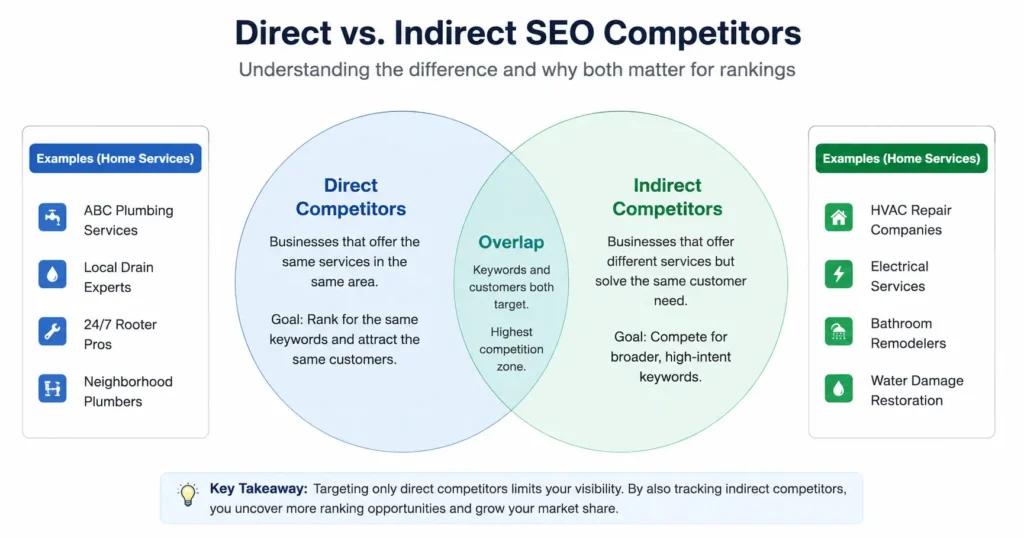
A. Direct vs. Indirect Competitors
Understanding the difference between these two categories is foundational.
Direct SEO competitors are businesses that offer the same services or products and are competing for the same commercial keywords. If you run an HVAC company in Phoenix and “HVAC repair Phoenix” returns three other HVAC companies in the top 5, those are direct competitors.
Indirect SEO competitors are sites that rank for your target keywords but aren’t in your industry. These could include:
- Industry blogs and news publications (e.g., a plumbing tips blog ranking for “how to fix a leaking pipe”)
- Directory sites like Angi, HomeAdvisor, or Thumbtack
- YouTube videos ranking in universal search
- Government or educational resources (.gov, .edu)
Identifying both types tells you two different things. Direct competitors reveal market-level strategy. Indirect competitors reveal content gaps you can exploit by publishing better, more targeted resources than aggregator sites.
Real-world example: A roofing company in Atlanta trying to rank for “roof replacement cost Atlanta” might find that the #1 result is a HomeAdvisor cost guide, #2 is a local roofing company, and #3 is a blog post from a building supplies brand. All three are your SEO competitors for that query — but your strategies to beat each one will differ entirely.
B. Free Google SERP Search Method (No Paid Tools Required)
You don’t need a $200/month subscription to identify your real SERP competitors. Google itself gives you everything you need.
Checklist: Manual SERP Analysis
- [ ] Search your main keyword on Google in a regular browser window
- [ ] Repeat the search in an incognito/private window (removes personalization bias)
- [ ] Record the top 10 organic results — these are your true SERP competitors
- [ ] Use
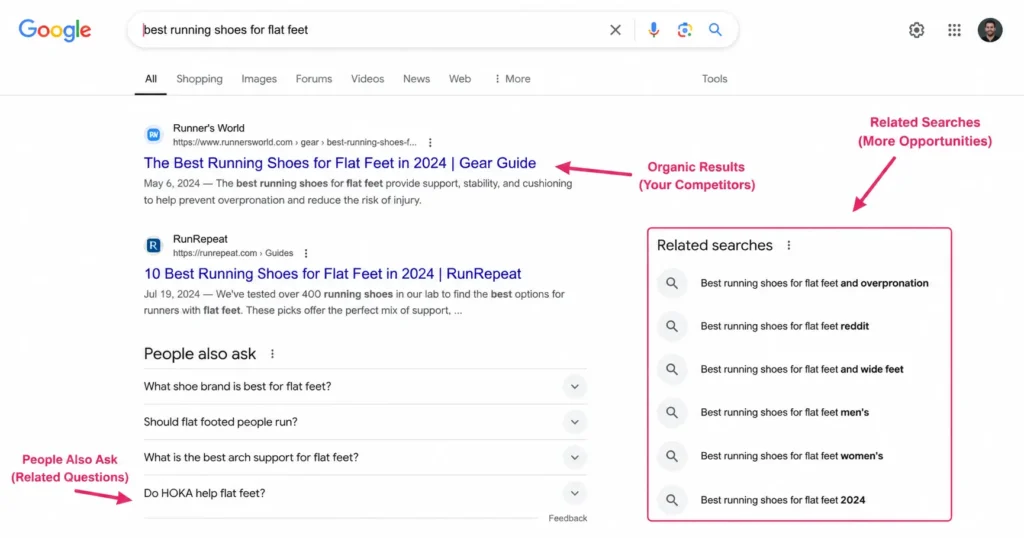
site:competitordomain.comto check how many pages Google has indexed for each rival - [ ] Click through the “People Also Ask” (PAA) boxes and expand each question — these reveal related topics your competitors are likely covering
- [ ] Scroll to the bottom and review “Related Searches” — these surface adjacent keyword clusters your competitors may be targeting
Pro tip: The incognito search is non-negotiable. Your regular browser is personalized to your browsing history. Incognito gives you the closest approximation to what an anonymous searcher in your target location would see.
Why “site:” matters: If site:competitor.com returns 800+ pages and you have 40, that’s a topical authority gap. If they have 80 pages and you have 60, you’re closer in scale and can compete more efficiently on content quality rather than volume alone.
C. Tools for Competitor Discovery
While free SERP methods are powerful, the right tools accelerate the process significantly. Here’s a comparison of the most effective options:
| Tool | Best For | Free/Paid | Free Limit |
|---|---|---|---|
| Google Search | Identifying SERP competitors manually | Free | Unlimited |
| Google Keyword Planner | Estimating search volumes | Free (Gmail) | Unlimited (ranges) |
| SEMrush | Full competitor analysis suite | Paid ($139/mo+) | 10 requests/day (free) |
| Ahrefs | Backlink profiles & keyword gaps | Paid ($99/mo+) | Free via Webmaster Tools |
| SpyFu | PPC + SEO competitor research | Freemium | 5 searches/day |
| SimilarWeb | Traffic estimation & audience overlap | Freemium | 5 results/month |
| Moz | DA scoring, link explorer | Freemium | 10 queries/month |
| Bing Webmaster Tools | Backlink data (underutilized, fully free) | Free | Unlimited with account |
Recommended starting stack (zero budget): Google Search + Google Keyword Planner + Ahrefs Webmaster Tools + Bing Webmaster Tools + MozBar Chrome extension.
D. Analyzing Competitor Market Share & Positioning
Once you’ve identified your top 5–10 SERP competitors, map their positioning to understand where you fit in the landscape.
Ask these questions about each competitor:
- Who is their primary audience? (DIY homeowners, commercial contractors, property managers?)
- What is their content tone? (Educational, sales-heavy, community-driven?)
- What content formats dominate their rankings? (Long-form guides, short FAQs, video transcripts?)
- Are they targeting national, regional, or hyper-local keywords?
This positioning map tells you where there are genuine gaps. If all four of your HVAC competitors are writing broadly about “air conditioning repair,” there may be an open lane for hyper-local content targeting specific neighborhoods or highly specific queries like “why is my HVAC blowing warm air but not cooling the house.”
III. Competitor Keyword Analysis: Finding Their Winning Terms
Knowing who your competitors are is one thing. Understanding exactly which keywords are driving their traffic — and which ones you’re invisible for — is where competitor analysis becomes genuinely powerful.
A. How to Identify Your Competitors’ Target Keywords
Your competitors’ keywords fall into two broad categories, and your strategy for each is different.
Short-tail (head) keywords are broad, high-volume terms like “HVAC repair” or “roofing company.” They’re competitive, slow to rank for, and often dominated by aggregator sites or high-DA brands. These keywords reveal your competitors’ primary service positioning.
Long-tail keywords are specific, lower-volume phrases like “how much does it cost to replace an HVAC system in Phoenix” or “emergency plumber open Sundays in Charlotte.” These are where most competitors leave ranking opportunity on the table — and where you can gain ground faster.
According to Ahrefs’ study on search demand, approximately 92% of all keywords get fewer than 10 searches per month. The collective volume of these long-tail queries, however, represents the majority of all search traffic. Your competitors are likely over-investing in short-tail terms and ignoring the long-tail goldmine.
B. Free Google SERP Keyword Tactics
You can surface competitor keyword strategies without spending a dollar. Here’s how:
1. Use advanced search operators
intitle:"HVAC repair Phoenix"— Shows you every competitor that has optimized their title tag for this exact phrase. High volume of results = high competition.inurl:plumber-near-me— Reveals which competitors have built keyword-rich URL slugs for a term, signaling deliberate SEO targeting.site:competitor.com "garage door repair"— Shows you all indexed pages on a competitor’s site that mention a specific keyword.
2. Mine Google Autocomplete for long-tail gaps
Type a competitor topic into Google and add a letter at the end: “HVAC repair a,” “HVAC repair b,” “HVAC repair c.” Each autosuggest result represents a real query with real search volume. This is free keyword research that most competitors completely ignore.
3. Expand every People Also Ask question manually
When you click to expand a PAA answer, Google dynamically loads new PAA questions below it. Keep clicking and you can uncover 20–30 related queries from a single seed question. Every one of these is a keyword your competitor may or may not be targeting.
C. Checklist: Key Metrics to Extract for Each Keyword
When building your competitor keyword list, extract these metrics for each term:
- [ ] Search Volume — Use Google Keyword Planner (free with a Google account). Note: GKP shows ranges rather than exact numbers on free accounts, but ranges are sufficient for prioritization.
- [ ] Keyword Difficulty (estimated) — Look at the SERP. Are the top 5 results from high-DA national sites (Forbes, HomeAdvisor, Wikipedia)? That signals high difficulty. Are results from local or mid-tier sites? Lower difficulty, more opportunity.
- [ ] Search Intent — Classify each keyword as Informational (how-to, what is), Navigational (brand + location), or Transactional (hire, near me, cost, quote).
- [ ] SERP Feature Presence — Note whether the SERP shows a featured snippet, local pack, image carousel, video results, or PAA box. Each feature represents a ranking opportunity beyond the standard blue links.
- [ ] Competitor URL ranking for the keyword — Record which page on their site ranks, not just the domain. This tells you what content type they used to win the position.
D. AI Citation Hook: Keyword Gap Analysis Table
A keyword gap is any term where your competitor ranks and you don’t. Here’s an example framework for mapping your gaps:
| Keyword | Monthly Volume | Your Rank | Competitor A Rank | Competitor B Rank | Gap Opportunity |
|---|---|---|---|---|---|
| HVAC repair Phoenix | 2,400 | Not ranking | #3 | #7 | High |
| AC not cooling house | 1,600 | Not ranking | #2 | Not ranking | High |
| HVAC maintenance cost | 880 | #14 | #5 | #8 | Medium |
| emergency HVAC Phoenix | 320 | #6 | #1 | Not ranking | Medium |
| how long does HVAC last | 590 | Not ranking | Not ranking | #4 | Low–Medium |
| HVAC inspection checklist | 480 | Not ranking | #6 | Not ranking | Low–Medium |
How to use this table: Prioritize “High” gap opportunities first — these are terms where competitors rank in positions 1–5 and you’re invisible. Use this table to directly inform your content calendar for the next quarter.
Read more about Keyword Research in this guide → keyword-research-for-home-services]
E. Using Keyword Gaps to Build Your Content Strategy
The output of your keyword gap analysis should directly feed your content calendar. Here’s how to operationalize it:
Step 1: List all keywords where your competitor ranks in positions 1–10 and you rank outside the top 30.
Step 2: Group these by topic cluster (e.g., all “HVAC cost” queries in one cluster, all “HVAC emergency” queries in another).
Step 3: For each cluster, determine if the gap is a missing page problem (you have no content on this topic) or a quality problem (you have a page but it’s thin or poorly optimized).
Step 4: Assign a content type to each gap — new blog post, service page expansion, FAQ section addition, or existing page optimization.
Step 5: Prioritize by search volume × intent match × estimated difficulty.
According to HubSpot’s 2025 State of Marketing Report, companies that blog consistently generate 67% more leads per month than those that don’t. For home services businesses, the majority of that blogging ROI comes from long-tail, intent-matched content — exactly the kind your competitor keyword analysis will surface.
IV. On-Page SEO & Content Strategy Evaluation
Once you know what keywords your competitors are targeting, the next step is understanding how well they’re executing on those targets. On-page analysis reveals the specific tactics — and the specific failures — in their content strategy.
A. Checklist: What to Audit on a Competitor’s Page
For each competitor page you’re analyzing, work through this checklist:
Title Tags & Meta Descriptions
- [ ] Right-click the page → “View Page Source” → Ctrl+F → search “title” and “meta name=description”
- [ ] Alternatively, install the free MozBar Chrome extension and read on-page elements without touching source code
- [ ] Note: Does the title tag include the primary keyword? Is it under 60 characters? Does the meta description include a value proposition and CTA?
Heading Structure
- [ ] Use MozBar or the free SEO Meta in 1 Click Chrome extension to see the full H1 → H2 → H3 hierarchy
- [ ] Does the H1 match or closely align with the title tag?
- [ ] Are H2s used to break out major topic sections (not decorative subheadings)?
- [ ] Do H3s appear under H2s, not standalone?
Internal Linking Logic
- [ ] Count how many internal links appear in the body content (vs. navigation/footer)
- [ ] Are the anchor texts descriptive and keyword-rich, or generic (“click here”)?
- [ ] Does the page link to supporting content (topic cluster model) or is it an isolated island?
Multimedia Usage
- [ ] Does the page include original images (not stock photos)?
- [ ] Is there embedded video content?
- [ ] Are images properly alt-tagged? (View source or use MozBar)
- [ ] Is there a structured infographic or data visualization?
- [ ] Does the page use schema markup? (Use Google’s Rich Results Test on any URL — free)
B. Content Quality Assessment (E-E-A-T Lens)
Google’s E-E-A-T framework — Experience, Expertise, Authority, Trust — has become the dominant quality signal for determining which content deserves to rank. When evaluating a competitor’s content quality, run it through each E-E-A-T dimension:
Experience
- Does the content demonstrate first-hand knowledge? (Specific job examples, real costs cited, named locations)
- Is there an author byline? Does the author have verifiable industry credentials?
- Are there photos of actual work, job sites, or equipment (not stock)?
Expertise
- Is the content written by someone with clear domain knowledge, or does it read like a general overview?
- Are technical terms used correctly and in context?
- Does the content go beyond surface-level advice to offer genuine depth?
Authority
- Does the content attract natural citations from other sites? (Check with Ahrefs free tier or Bing Webmaster Tools)
- Is the brand mentioned in industry publications, review platforms, or local directories?
- Does the domain have an established history, or is it relatively new?
Trust
- Is there a clear privacy policy, contact page, and physical address?
- Are customer reviews integrated on the page or linked to a verified profile?
- How fresh is the content? Look for a “Last Updated” date in the footer, byline, or page source. Chrome extensions like Chrome Dev Tools can also surface
Last-Modifiedheaders.
For estimating competitor traffic: Use the free tier of SimilarWeb or Semrush’s Traffic Analytics. Neither gives exact numbers for free, but they provide directional estimates that are sufficient for competitive benchmarking.
C. Identifying Content Gaps & Opportunities
Once you’ve audited your competitors’ on-page execution, the final step is identifying what they’re not covering — the white space where you can stake your claim.
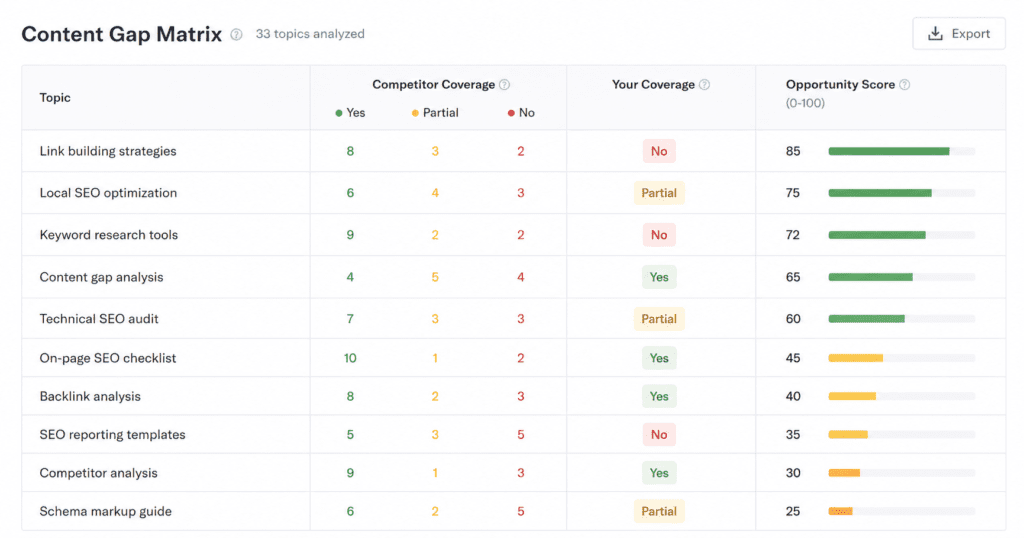
Three types of content gaps to look for:
1. Topical gaps: Your competitor covers “HVAC installation” but has no content on “HVAC financing options” or “HVAC brands compared.” These are entire topic clusters they’ve left unaddressed.
2. Depth gaps: They have a page on a topic but it’s shallow — 400 words, no data, no specifics. You can write a definitive, 2,500-word resource that makes their page look inadequate by comparison.
3. Format gaps: They’ve written about a topic but only in blog form. You could address the same topic with a comparison table, an interactive checklist, or a video — capturing SERP features they’re not positioned for.
V. Backlink Profile Examination (Off-Page SEO)
On-page optimization gets you in the game. Backlinks determine where you finish.
A. Why Backlinks Still Dominate in 2026
Despite years of predictions about backlinks becoming irrelevant, the data continues to tell a clear story. Ahrefs’ analysis of 1 billion web pages found that 91% of all pages get zero organic traffic from Google — and the primary differentiator between pages that rank and pages that don’t is the quantity and quality of their backlink profile.
In 2026, what’s changed is how backlinks are evaluated. Links from topically relevant, authoritative, and editorially curated sources carry disproportionate weight. A single link from a respected trade association in the plumbing industry is worth more than 50 links from generic directories. Google’s recent Helpful Content updates and the leaked Google API documentation have reinforced that the quality-over-quantity principle is being applied with increasing precision.
Understanding where your competitors get their links — and which of those links you can replicate or improve upon — is one of the highest-leverage SEO activities available.
B. Checklist: Backlink Audit Metrics
Use these tools to access competitor backlink data at no cost:
- Ahrefs Webmaster Tools (free after verifying your domain) — shows your own site’s backlink profile. Use the free “Link Intersect” alternative manually by comparing who links to your competitor vs. you.
- Bing Webmaster Tools (fully free, no site verification required for competitor lookup) — a severely underutilized resource that provides genuine backlink data.
- Google Search Console (free) — shows your own backlinks; use it as your baseline.
- MozBar Chrome extension (free tier) — shows Domain Authority on any site you visit.
For each competitor, evaluate these metrics:
- [ ] Domain Authority (DA) / Domain Rating (DR) — Read as a rough benchmark, not gospel. Use MozBar for DA, Ahrefs for DR. A competitor with DA 45 vs. your DA 20 has a meaningful authority gap that will require a deliberate link-building campaign to close.
- [ ] Number of Referring Domains — More impactful than total backlinks. 200 links from 200 unique domains > 1,000 links from 5 domains. Record this number for each competitor.
- [ ] Anchor Text Distribution — What text do sites use when linking to your competitor? A healthy profile includes a mix of branded anchors (company name), generic anchors (“click here,” “learn more”), keyword-rich anchors (used sparingly), and URL anchors (the raw URL itself). Heavy over-optimization on exact-match keyword anchors is a red flag signaling a link scheme.
- [ ] Link Type: Follow vs. Nofollow — Followed links pass link equity (“PageRank”). Nofollow links don’t pass equity directly but have indirect value via brand exposure and traffic. Check the link type by viewing source code and searching for
rel="nofollow"orrel="ugc". - [ ] Link Source Quality — Is the link from an editorial article, a directory listing, a guest post, a forum, or a comment? Editorial links (a journalist chose to link to them without being asked) carry the highest weight.
C. AI Citation Hook: Sample Backlink Source Table
Here’s an example of what a competitor backlink source analysis might look like for a roofing company:
| Competitor | Top Link Source | Link Type | DA of Source | Anchor Text |
|---|---|---|---|---|
| Competitor A | roofingcontractor.com | Editorial | 58 | “metal roofing specialists” |
| Competitor A | angieslist.com | Directory | 71 | Branded (company name) |
| Competitor A | houselogic.com | Editorial | 74 | “Atlanta roofing contractors” |
| Competitor B | houzz.com | Profile | 91 | URL anchor |
| Competitor B | localnewspaper.com | Editorial/PR | 47 | “local roofing company” |
| Competitor B | roofingindustry.org | Association | 52 | “member contractor” |
What this table reveals: Competitor A is earning editorial links from trade publications — a deliberate PR and outreach strategy. Competitor B has a strong directory and association presence. You need both.
D. Actionable Tactics to Replicate Their Best Backlinks
Once you’ve catalogued your competitors’ top links, reverse-engineer each one with these tactics:
1. Directory and profile links: If they have a profile on Houzz, HomeAdvisor, Angi, or a local chamber of commerce — get listed there immediately. These are replicable within days.
2. Association links: If they’re linked from an industry association, look up whether you’re eligible for membership. Trade association links are among the most trusted sources for contractor sites.
3. Editorial links from trade blogs: Look at which trade publications are linking to them. Find the content they linked to, then create a better, more comprehensive version of it. Then pitch that publication with your improved resource. This is the “skyscraper technique” outlined by Brian Dean at Backlinko.
4. Local press and news links: Search competitor name + "featured in" or competitor name + site:localnewspaper.com to find PR placements. These often come from press releases, sponsorships, or community events. Replicate the tactic, not just the link.
5. Broken link building: Use Ahrefs Webmaster Tools or a free broken link checker to find links pointing to competitor pages that no longer exist (404 errors). Then create content that fills that gap and pitch the linking sites to update their link to your resource.
VI. Technical SEO Evaluation (Crawl, Index, Render)
Content and backlinks win rankings. But technical SEO failures can prevent that content from being crawled, indexed, or rendered correctly — which means all your content and link-building work produces nothing. Evaluating your competitors’ technical setup tells you whether they have a structural advantage or vulnerability you can exploit.
A. Checklist: Technical Factors to Benchmark
Work through these technical checks for each competitor using 100% free tools:
Site Speed & Core Web Vitals
- [ ] Run the competitor’s homepage through Google PageSpeed Insights (free, no account needed)
- [ ] Note their LCP (Largest Contentful Paint — target: under 2.5s), CLS (Cumulative Layout Shift — target: under 0.1), and INP (Interaction to Next Paint — target: under 200ms)
- [ ] Also run their key landing page (e.g., their service page, not just the homepage) — performance often varies significantly by page
- [ ] For a second opinion, use GTmetrix free tier which shows waterfall loading charts for diagnosing specific bottlenecks
Mobile-Friendliness
- [ ] Test any competitor URL with Google’s Mobile-Friendly Test (being retired; use PageSpeed Insights mobile tab instead as of 2024)
- [ ] Scroll their site on your own phone — are buttons tappable, text readable, and forms functional without zooming?
Indexing & Crawlability
- [ ] Run
site:competitor.comin Google — how many pages are indexed? More than 1,000 pages for a local contractor is a signal of either a bloated site or an aggressive content strategy. Fewer than 20 pages for an established company may indicate crawl or index issues. - [ ] Check
competitor.com/robots.txtdirectly in your browser — are they accidentally blocking key sections from being crawled? (A common mistake that creates significant ranking loss) - [ ] Check
competitor.com/sitemap.xml— do they maintain a clean, regularly updated sitemap?
HTTPS & Security
- [ ] Confirm the site is loading on HTTPS (padlock icon in browser bar). HTTP sites are penalized in rankings and flagged as insecure by Chrome.
- [ ] Use SSL Labs’ free SSL checker to verify their certificate quality (Grade A = no issues; lower grades = potential trust problems).
Structured Data
- [ ] Run their homepage and service pages through Google’s Rich Results Test to see which schema types they’ve implemented.
- [ ] Note which schema types appear: LocalBusiness, FAQPage, Review, BreadcrumbList, Service. Each schema type represents a potential SERP feature opportunity.
B. Tools for Technical Analysis
| Tool | What It Reveals | Cost |
|---|---|---|
| Google PageSpeed Insights | LCP, CLS, INP scores; field data vs. lab data | Free |
| GTmetrix | Waterfall analysis, load time breakdown | Free (limited) |
| Screaming Frog SEO Spider | Full crawl: broken links, redirect chains, meta data, H-tags | Free up to 500 URLs |
| Google Rich Results Test | Schema markup detection and validation | Free |
| SSL Labs | SSL certificate quality and configuration | Free |
| Google Search Console | Crawl errors, coverage issues (your site only) | Free |
| Bing Webmaster Tools | Crawl reports and indexing data | Free |
Screaming Frog note for agencies: The free tier (500 URL limit) is sufficient to crawl a typical local contractor site. For sites with 1,000+ pages, you need the paid license ($259/year). But for most competitor sites in home services, the free tier gets the job done.
C. Local Business Schema Markup (High E-E-A-T Value)
One of the most underutilized technical advantages in local SEO is proper LocalBusiness schema markup. According to Search Engine Land, fewer than 35% of local business websites implement structured data correctly — meaning most of your competitors have this gap.
Implementing LocalBusiness schema sends explicit, machine-readable signals to Google about your business category, location, service area, hours, and contact information. It directly supports E-E-A-T by providing verifiable, structured Trust signals.
Here’s an example of a correctly implemented LocalBusiness schema for an HVAC company:
{
  "@context": "https://schema.org",
  "@type": "HVACBusiness",
  "name": "Phoenix Comfort HVAC",
  "url": "https://www.phoenixcomforthvac.com",
  "logo": "https://www.phoenixcomforthvac.com/images/logo.png",
  "image": "https://www.phoenixcomforthvac.com/images/team.jpg",
  "description": "Phoenix Comfort HVAC provides expert HVAC repair, installation, and maintenance services across Phoenix, Scottsdale, and Tempe, AZ.",
  "telephone": "+1-602-555-0192",
  "email": "info@phoenixcomforthvac.com",
  "address": {
    "@type": "PostalAddress",
    "streetAddress": "4500 N 7th Street",
    "addressLocality": "Phoenix",
    "addressRegion": "AZ",
    "postalCode": "85014",
    "addressCountry": "US"
  },
  "geo": {
    "@type": "GeoCoordinates",
    "latitude": 33.5085,
    "longitude": -112.0739
  },
  "areaServed": [
    {"@type": "City", "name": "Phoenix"},
    {"@type": "City", "name": "Scottsdale"},
    {"@type": "City", "name": "Tempe"}
  ],
  "openingHoursSpecification": [
    {
      "@type": "OpeningHoursSpecification",
      "dayOfWeek": ["Monday","Tuesday","Wednesday","Thursday","Friday"],
      "opens": "07:00",
      "closes": "18:00"
    },
    {
      "@type": "OpeningHoursSpecification",
      "dayOfWeek": "Saturday",
      "opens": "08:00",
      "closes": "14:00"
    }
  ],
  "priceRange": "$$",
  "sameAs": [
    "https://www.google.com/maps?cid=123456789",
    "https://www.yelp.com/biz/phoenix-comfort-hvac",
    "https://www.facebook.com/phoenixcomforthvac"
  ]
}
Why this matters competitively: If your competitor has no schema and you implement it correctly, your listing may gain rich snippet enhancements in search results — star ratings, service area callouts, and business hours — making your result visually dominant even if you rank below them.
VII. Social Media & Brand Presence Analysis
Social media doesn’t have a direct ranking factor in Google’s algorithm — but it has significant indirect effects that compound over time. Understanding your competitors’ social presence helps you identify where they’re building brand authority, what content resonates with your shared audience, and where their strategy has gaps.
A. Which Social Platforms Drive Their Traffic?
Different platforms matter differently for home services businesses. Here’s a benchmark framework:
| Platform | Relevance for Home Services | Best Content Type | Competitor Signal |
|---|---|---|---|
| High — local community groups, paid ads | Before/after photos, customer testimonials, local news | Check their page likes and post engagement rate | |
| Medium-High — visual project portfolio | Project transformations, time-lapses, team culture | Review follower count vs. engagement rate | |
| YouTube | High — search-driven, long-term asset | How-to videos, project walkthroughs, FAQs | Look for views on educational vs. promotional videos |
| Medium — B2B / commercial clients | Awards, company news, hiring | Less relevant for residential; high for commercial | |
| Nextdoor | High (underrated) — hyper-local word of mouth | Reviews, local offers, service availability posts | Search competitor name on Nextdoor publicly |
| TikTok | Growing — especially for Gen Z homeowners | Quick tips, satisfying transformations | Early movers in this space have minimal competition |
How to analyze competitor social engagement: On Facebook, every business page shows a “People Also Follow” section which surfaces direct competitors. For Instagram, note the ratio of likes + comments to follower count — this is engagement rate. A competitor with 5,000 followers and 20 likes per post has a dead audience. One with 800 followers and 150 likes has a highly engaged community that’s a real asset.
B. Analyzing Audience Interaction & Community Building
The most underrated social signal is community depth. Is your competitor’s audience commenting, tagging friends, sharing posts, and asking follow-up questions? That level of interaction signals genuine brand trust — which influences direct search (branded queries), branded link building, and referral traffic.
Look for:
- Are they responding to every comment and review promptly? (Trust signal)
- Do followers tag them in posts without being asked? (Brand advocacy)
- Do they run community-oriented content, like neighborhood spotlights or local partnerships?
- Are they leveraging seasonal content tied to local weather events? (For HVAC, pest control, and roofing, this is especially high-conversion)
C. How Social Signals Indirectly Influence SEO
While Google has stated that social media links don’t pass PageRank, the indirect effects are well-documented:
Brand search volume: When customers follow a competitor on Instagram and then later search for them directly, those branded searches signal to Google that this is a trusted, relevant entity in their niche. More brand searches = higher entity authority.
Content distribution: Viral or widely shared content attracts natural backlinks from bloggers and journalists who discovered it through social channels. This is organic link acquisition at scale.
Click-through rate signals: Content that earns social engagement tends to also earn higher CTR when it appears in SERPs — because users already have brand familiarity. Higher CTR can influence rankings for those queries.
Referral traffic: Even if social links are nofollowed, referral traffic from social platforms signals to Google that a URL is valuable and worth returning to users in search results.
VIII. Local SEO Competitor Analysis (If Applicable)
For home services businesses, local SEO is not a subcategory of SEO — it’s the primary battlefield. When a homeowner in Charlotte types “electrician near me,” the three businesses appearing in the Google Local Pack capture the overwhelming majority of calls. Understanding how your local competitors have earned those positions is non-negotiable.
According to BrightLocal’s 2024 Local Consumer Review Survey, 98% of consumers used the internet to find information about a local business in the past year. Of those, 87% read online reviews before making a purchase decision. This is the arena where local SEO competitor analysis pays off most directly.
A. Checklist: Local Competitor Audit Using Free Google SERP
Run through this checklist for every competitor appearing in your target Local Pack:
Local Pack Identification
- [ ] Perform a local search for your primary service keyword (e.g., “plumber near me,” “garage door repair Houston”) while in an incognito browser
- [ ] Note the three businesses appearing in the Map Pack — their positions, star ratings, review counts, and whether they show a website link, call button, and directions button
- [ ] Click “More businesses” to see results 4–10 in the expanded local results
Google Business Profile (GBP) Analysis
- [ ] Click each competitor’s GBP listing and record:
- [ ] Primary business category
- [ ] Total review count and average star rating
- [ ] Date of most recent review (freshness matters)
- [ ] Whether they have Posts visible (most contractors don’t — this is a gap you can exploit)
- [ ] Whether their Q&A section is populated with answered questions
- [ ] Whether they have photos and how many (Google recommends 10+ high-quality images)
- [ ] Whether they list services, products, or service areas
- [ ] Whether they have a booking button or message button enabled
Citation Consistency Check
- [ ] Search
"competitor name" + "city"in Google and review the first 5 directory results - [ ] Check that their NAP (Name, Address, Phone) is exactly consistent across Google, Yelp, HomeAdvisor, Angi, BBB, and Bing Places
- [ ] Inconsistent NAP data is a common local ranking suppressant — if your competitor has citation errors and you don’t, you have a structural advantage
B. Free Tools for Local Insights
| Tool | What It Reveals | Cost |
|---|---|---|
| Google Maps | Local Pack rankings, GBP content, reviews | Free |
| Google Business Profile Manager | Your own profile management and insights | Free |
| BrightLocal Citation Tracker | Citation consistency across 50+ directories | Free trial available |
| Whitespark Local Citation Finder | Citation sources your competitors use | Freemium |
| Yelp (public profiles) | Review count, response rate, competitor categories | Free |
| Moz Local (free audit) | NAP consistency score and citation gaps | Free basic audit |
Competitive local insight you can’t get from tools alone: Walk the Local Pack results and look at the exact keywords your competitor uses in their GBP description, service listings, and review responses. Google uses this content for relevance matching. If your competitor’s GBP description says “Phoenix HVAC repair, installation, and emergency service” and yours just says “HVAC company,” that’s a gap in keyword coverage that you can close within 24 hours.
IX. Tracking & Monitoring: Turning Analysis into Action
Competitor analysis is not a one-time audit. Your competitors are continuously publishing content, earning new links, and updating their technical infrastructure. The businesses that sustain long-term SEO growth are those that treat competitor monitoring as an ongoing discipline, not a quarterly checkbox.
A. How to Set Up Automated Competitor Alerts
Google Alerts (free): Go to google.com/alerts and set up alerts for:
"competitor brand name"— notifies you when they’re mentioned online"competitor brand name" + "new" OR "launch"— catches new service announcements- Your primary keywords — notifies you when new content enters the space
Mention (free tier): Mention tracks brand mentions across social media and the web. The free tier allows monitoring of one alert — use it for your most important competitor.
Ahrefs Alerts (Webmaster Tools free tier): Set up backlink alerts for your own domain to be notified when you earn new links. While the free tier doesn’t support competitor alerts, it keeps you aware of your own link velocity — which you can compare month-over-month against the manual competitor audits you run.
B. Checklist: Ongoing Tracking Schedule
Building a sustainable monitoring cadence is what separates agencies and in-house SEOs who consistently improve from those who plateau. Here’s a practical schedule:
Weekly (30–45 minutes)
- [ ] Run manual Google searches for your top 5 primary keywords in incognito mode — note position changes
- [ ] Check Google Search Console for clicks, impressions, and any new coverage issues
- [ ] Review your Google Business Profile for new reviews (respond to all within 24 hours)
- [ ] Check if any competitors published new content on their blog or service pages (visit their site manually or check via RSS feed)
Monthly (2–3 hours)
- [ ] Run
site:competitor.comfor your top 3 competitors — note the number of indexed pages and compare to last month - [ ] Pull your own backlink report from Ahrefs Webmaster Tools or Bing Webmaster Tools — compare referring domain count to previous month
- [ ] Review Google Analytics / GSC for organic traffic trends vs. the prior month
- [ ] Audit your GBP: add new photos, update posts, respond to any Q&As, and verify that your service list is current
- [ ] Check Core Web Vitals report in GSC and compare against competitors via PageSpeed Insights
Quarterly (4–6 hours)
- [ ] Full re-audit of top 3 competitors across all nine dimensions in this checklist
- [ ] Refresh your keyword gap analysis table — update positions for your site and competitors
- [ ] Re-run competitors through Google Rich Results Test to see if they’ve added new schema
- [ ] Assess their content output for the quarter: how many new pages did they publish? What topics?
- [ ] Review and update your own content to ensure freshness signals are maintained (update dates, refresh statistics, add new sections)
C. Free Google SERP Alerts: The &as_qdr=d Parameter
Here’s a free monitoring technique that almost no competitor is using:
Add &as_qdr=d to the end of any Google search URL to filter results to pages indexed within the last 24 hours. For example:
https://www.google.com/search?q=HVAC+repair+Phoenix&as_qdr=d
This shows you every fresh piece of content Google has indexed for your keyword in the past day. By running this check on your top keywords each morning, you’ll immediately know when a competitor publishes new content targeting your terms — before it has a chance to climb the rankings.
Similarly:
&as_qdr=w= last 7 days&as_qdr=m= last month
Bookmark these filtered searches for your top 5–10 keywords and review them weekly. It’s the closest thing to a free real-time competitor content alert system available.
X. Conclusion
SEO competitor analysis is not a tactic. It’s a strategic discipline — and in 2026, with AI-generated answers reshaping search, the businesses that invest in systematic competitive intelligence will have a compounding advantage over those who simply publish content and hope for the best.
Here’s a recap of the nine critical audit areas covered in this checklist:
| Audit Area | Key Output |
|---|---|
| 1. Competitor Identification | Confirmed SERP rival list (direct + indirect) |
| 2. Keyword Analysis | Keyword gap table with priority scores |
| 3. On-Page SEO Evaluation | Content quality scores and E-E-A-T audit |
| 4. Backlink Profile Examination | Replicable link source list |
| 5. Technical SEO Benchmarking | Core Web Vitals comparison and schema gaps |
| 6. Social & Brand Presence | Platform engagement rates and content gaps |
| 7. Local SEO Audit | GBP completeness scores and citation gaps |
| 8. Monitoring Setup | Alert system and tracking cadence |
| 9. Content Gap Strategy | Content calendar informed by competitor blind spots |
The sustainable competitive advantage in SEO is not a better tool subscription. It’s a better process — one that turns competitor intelligence into a publishing schedule, a link-building campaign, and a technical roadmap that compounds over time.
Three free actions you can take this week:
- Run your primary keyword in incognito mode, record the top 10 organic results, and note where your page appears (or doesn’t).
- Set up Google Alerts for your top three competitors and your primary keywords.
- Run your homepage and your top competitor’s homepage through Google PageSpeed Insights and compare your Core Web Vitals scores.
That’s three hours of free work that will give you more actionable intelligence than most businesses gather in a quarter.
Dedicated FAQ Section
How often should I do an SEO competitor analysis?
At minimum, conduct a full competitor analysis quarterly. For highly competitive markets — such as HVAC, plumbing, or roofing in major metro areas — a monthly lightweight check of keyword rankings, new competitor content, and GBP updates is advisable. Set up Google Alerts and use the &as_qdr=d SERP parameter for daily passive monitoring between full audits.
What is the best free tool for competitor keyword research?
Google Search itself is the most underutilized free keyword research tool. Combine manual SERP searches with Google Autocomplete, People Also Ask expansion, and Related Searches at the bottom of results. Layer in Google Keyword Planner (free with a Gmail account) for volume estimates. Together, these free resources give you 80% of the actionable intelligence that paid tools provide.
Can I outrank a competitor with higher domain authority?
Yes — and it happens regularly. Domain authority is a proxy metric, not a Google ranking factor. Google ranks individual pages, not entire domains. If you publish a page that better satisfies user intent, demonstrates stronger E-E-A-T, loads faster, and earns more topically relevant links than your competitor’s page, you can outrank them regardless of their overall DA score. The most effective path is targeting long-tail keywords where user intent is highly specific, then building topical authority in that cluster before expanding to more competitive head terms.
Does competitor analysis work for local SEO only?
No. SEO competitor analysis is equally valuable for national, e-commerce, B2B, and informational SEO strategies. The specific signals you evaluate shift — local SEO prioritizes Google Business Profiles and citations, while national SEO weighs content authority and link profiles more heavily — but the underlying framework of auditing competitors across keywords, content, backlinks, and technical factors applies universally.
Can I do a full competitor audit without paying for SEMrush or Ahrefs?
Yes — this entire guide demonstrates how. Using Google Search (incognito), Google Keyword Planner, Google PageSpeed Insights, Google Rich Results Test, Ahrefs Webmaster Tools (free after domain verification), Bing Webmaster Tools (free), MozBar (free Chrome extension), Screaming Frog (free up to 500 URLs), and SimilarWeb (free tier), you can cover all nine dimensions of competitor analysis without a paid subscription. Paid tools accelerate and scale the process, but they are not a prerequisite for comprehensive competitor intelligence.
What is the most important section of a competitor analysis?
For most home services businesses, keyword gap analysis combined with local SEO benchmarking delivers the fastest ROI. These two areas directly map to revenue-generating queries — service-specific long-tail keywords and Local Pack rankings — and both can be dramatically improved within 60–90 days of targeted effort. Technical SEO and backlink building take longer to show impact but are essential for sustained, compounding growth.
How do I know if my competitor’s SEO strategy is working?
Check their estimated traffic trend using SimilarWeb or SEMrush’s free traffic analytics. Then cross-reference with their SERP positions using manual searches for your shared target keywords. If their organic visibility has grown over the past 6–12 months (more indexed pages, higher positions, more SERP features), their strategy is working. If it’s flat or declining, they may have hit a plateau — or made a mistake you can learn from by auditing what changed.
Should I copy my competitor’s SEO strategy exactly?
Never. Copying a competitor’s strategy means you’re always one step behind by definition. Use competitor analysis to understand what’s working in your market, then build a superior version. Your goal is to identify their gaps, replicate their wins faster, and differentiate through better content depth, stronger local signals, and superior technical implementation. The businesses that leapfrog their competition don’t imitate — they iterate and elevate.
Last updated by Searchlyn team in June 2026