Introduction: Why Most SEO Efforts Fail to Show Results
A lot of SEO work technically happens—keywords are tracked, pages are optimized, reports are sent every month. Yet growth feels slow, unpredictable, or impossible to explain to stakeholders.
The problem usually isn’t execution. It’s the absence of a clear SEO strategy tied to meaningful reporting. SEO strategy without reporting is guesswork. Reporting without strategy is noise.
This guide shows how to build SEO as a system—where planning, execution, and reporting reinforce each other and create compounding results over time.
What SEO Strategy and Reporting Really Mean (Beyond Basics)
SEO Strategy
SEO strategy is a decision-making framework that defines:
- What you should work on
- Why it matters
- In what order it should be done
- How success will be measured
It is not a checklist. It’s a prioritization engine.
SEO Reporting
SEO reporting is not about showing numbers.
It’s about proving progress, diagnosing problems, and guiding next actions.
Good reporting answers:
- Are we moving in the right direction?
- What is working, and why?
- What should we do next?
The SEO Strategy Framework (Step-by-Step)
1. Define the Business Objective First
SEO does not exist to increase traffic on Google. It exists to support a business goal.
Start with one primary objective:
- Revenue growth
- Lead generation
- Brand authority
- Local visibility
- Product adoption
Decision Rule:
If a ranking or page does not contribute to the objective, it’s not a priority.
2. Map SEO to the Funnel
A strong SEO strategy covers the entire search journey, not just bottom-funnel keywords.
| Funnel Stage | Search Intent | SEO Focus |
|---|---|---|
| Awareness | Informational | Blogs, guides, definitions |
| Consideration | Comparative | Use cases, alternatives, comparisons |
| Decision | Transactional | Service pages, landing pages |
| Retention | Navigational | Brand searches, support content |
Common Mistake:
Only targeting high-intent keywords → limits long-term growth.
3. Build a Keyword-to-Page Architecture
Instead of chasing keywords, assign one clear role per page.
Process:
- Group keywords by intent
- Assign one primary keyword per page
- Support it with semantically related terms
- Eliminate keyword cannibalization
Rule of Thumb:
One page = one primary intent.
4. Prioritize SEO Work Using Impact vs Effort
Not all SEO tasks are equal.
Create a simple prioritization grid:
| Task | Impact | Effort | Priority |
|---|---|---|---|
| Fix indexation issues | High | Low | 🔥 Highest |
| Optimize top 10 pages | High | Medium | High |
| New blog content | Medium | Medium | Medium |
| Experimental keywords | Low | High | Low |
This prevents random SEO execution.
5. Create an SEO Roadmap (90-Day View)
Break strategy into execution windows:
Month 1
- Technical fixes
- Baseline reporting
- Keyword & page mapping
Month 2
- On-page optimization
- Internal linking
- Content improvements
Month 3
- Authority building
- Content expansion
- Conversion optimization
SEO becomes predictable when it’s planned in cycles.
SEO Reporting That Actually Makes Sense
The Purpose of SEO Reporting
SEO reporting exists to:
- Track momentum
- Validate decisions
- Identify bottlenecks
- Justify investment
If a metric doesn’t change decisions, remove it.
Core SEO Metrics That Matter
1. Visibility Metrics (Leading Indicators)
- Impressions
- Average position
- Keyword coverage
- Indexed pages
These show future potential, not immediate revenue.
2. Traffic Quality Metrics
- Organic sessions
- Page-level traffic
- Engagement metrics (time, scroll, bounce)
Traffic without engagement = wrong intent.
3. Conversion & Business Metrics
- Leads or sales from organic
- Assisted conversions
- Conversion rate by page
This is where SEO proves ROI.
4. Authority & Trust Signals
- Referring domains
- Link velocity
- Branded search growth
Authority compounds over time.
SEO Reporting Framework (What to Show & How)
Monthly SEO Report Structure
1. Executive Summary
- What changed
- Why it changed
- What it means
2. Wins
- Ranking improvements
- Traffic spikes
- Conversion gains
3. Losses or Risks
- Drops in visibility
- Technical issues
- Competitive movement
4. Insights
- Patterns noticed
- What’s working repeatedly
5. Next Actions
- Clear priorities for the next month
A report without next actions is incomplete.
Strategy + Reporting Loop (The Growth Engine)
SEO works best as a feedback system:
Plan → Execute → Measure → Learn → Adjust
Reporting informs strategy.
Strategy defines what to report.
This loop is what creates consistency.
Common SEO Strategy & Reporting Mistakes
❌ Reporting Rankings Without Context
Rankings alone don’t explain business impact.
❌ Chasing Vanity Metrics
Traffic without conversions is misleading.
❌ No Baseline Comparison
Without a baseline, progress is invisible.
❌ One-Size-Fits-All Reports
Different stakeholders need different insights.
Practical SEO Strategy & Reporting Checklist
Strategy
- ☐ Clear business goal defined
- ☐ Keyword intent mapped
- ☐ Page roles assigned
- ☐ Roadmap created
Reporting
- ☐ Baseline metrics captured
- ☐ KPIs tied to goals
- ☐ Insights documented
- ☐ Next actions defined
Key Takeaways (Rules You Can Apply Immediately)
- SEO strategy is about choices, not tasks
- Reporting should drive decisions, not just updates
- Measure progress at the page level, not site-wide only
- Tie SEO metrics to real business outcomes
- Treat SEO as a system, not a campaign
Conclusion: SEO Becomes Predictable When Strategy and Reporting Align
When SEO strategy and reporting work together, results stop feeling random. You know what to do next, why it matters, and how success will be measured.
That’s when SEO shifts from a cost center to a growth engine—steady, explainable, and scalable.
Frequently Asked Questions About SEO Strategy and Reporting
What is an SEO strategy?
An SEO strategy is a structured plan that defines how a website will improve its visibility in search engines by targeting the right keywords, optimizing pages, fixing technical issues, and building authority to achieve specific business goals.
Why is SEO reporting important?
SEO reporting is important because it shows whether your SEO efforts are working, helps identify opportunities and issues, and provides clear insights into traffic, rankings, conversions, and overall SEO performance.
What should an SEO report include?
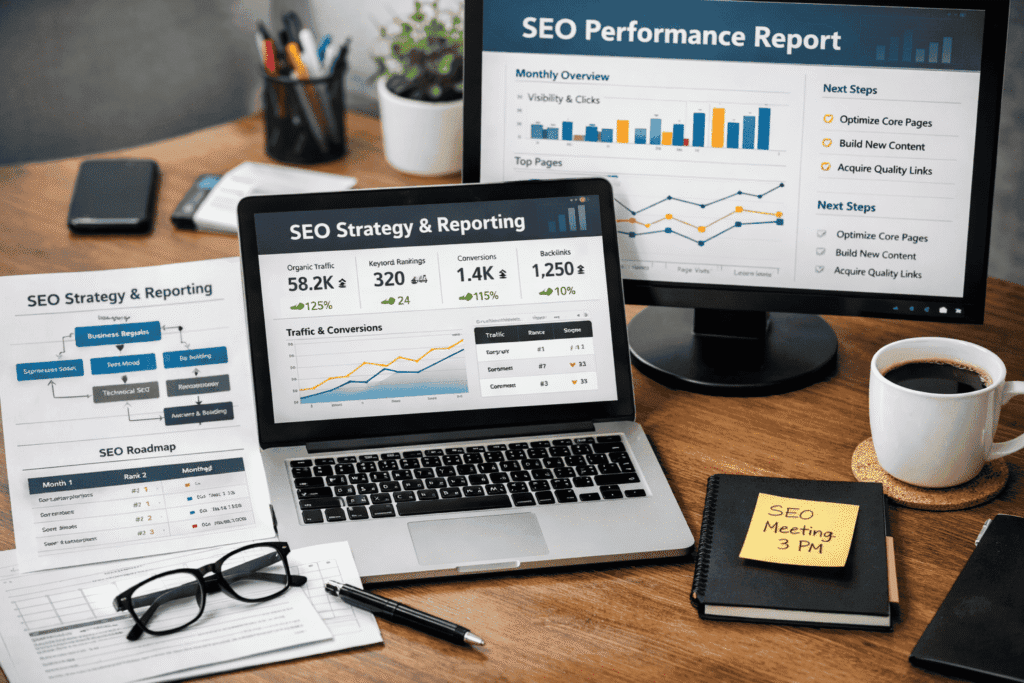
An effective SEO report should include organic traffic data, keyword rankings, search visibility, conversions, technical health, backlinks, key insights, and clear next steps for improvement.
How often should SEO reports be created?
Most businesses create SEO reports monthly, as this timeframe allows enough data to show meaningful trends while still enabling timely strategy adjustments.
What are the most important SEO metrics to track?
The most important SEO metrics include organic traffic, keyword rankings, impressions, click-through rate (CTR), conversions, engagement metrics, and backlink growth.
How do you measure SEO success?
SEO success is measured by improvements in search visibility, qualified organic traffic, conversions, and how well SEO contributes to overall business objectives such as leads or revenue.
What is the difference between SEO strategy and SEO tactics?
SEO strategy defines the overall direction and priorities, while SEO tactics are the specific actions taken, such as optimizing content, improving page speed, or building backlinks.
Can SEO reporting help improve rankings?
Yes, SEO reporting helps improve rankings by identifying what is working, uncovering issues early, and guiding data-driven decisions that refine and strengthen the overall SEO strategy.
What tools are commonly used for SEO reporting?
Common SEO reporting tools include Google Search Console, Google Analytics, keyword tracking tools, backlink analysis platforms, and custom SEO dashboards.
How long does it take to see results from an SEO strategy?
SEO is a long-term process. Initial improvements may appear within a few months, but consistent strategy execution and reporting typically deliver strong, sustainable results over time.