Sound familiar? Many plumbing businesses invest in a website build and then wait for organic traffic that never arrives. The site rarely turns out to be the problem. The signals it sends to Google almost always are.
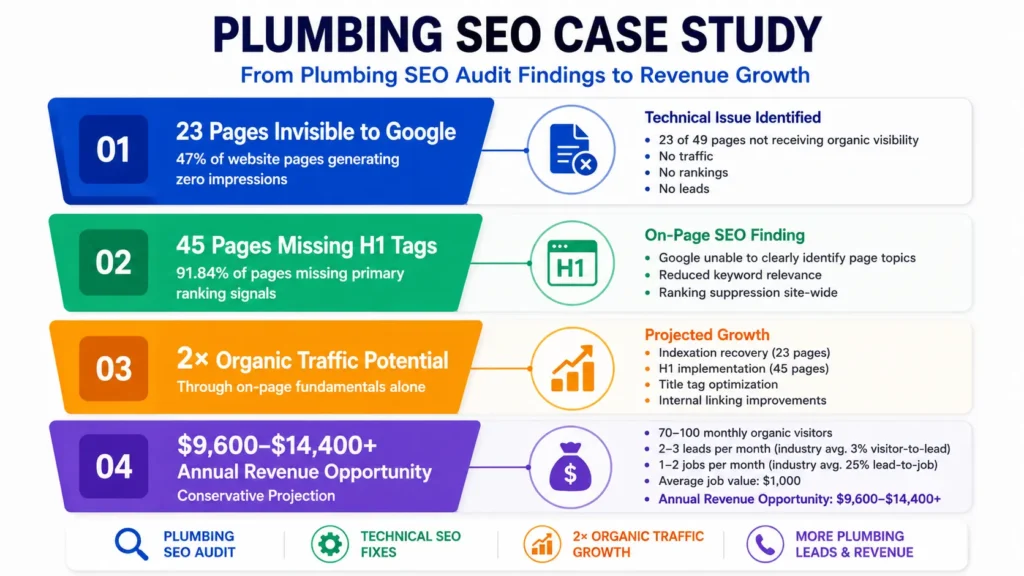
- 47% of the site (23 pages) was completely invisible to Google — generating zero organic impressions, zero clicks, and zero leads despite being fully built and live
- 91.84% of the remaining indexed pages had no H1 tag — meaning Google was guessing the topic of nearly every page it could actually find
Two issues. Half a website invisible. Nine-tenths of the rest misidentified. The 37-visitors-per-month figure wasn’t a mystery once you saw the data.
Technical Foundation
Every SEO engagement at Searchlyn begins with indexation — because there is no value in optimising a page that Google has never seen.
The Plumbing SEO Audit identified three critical technical blocks preventing full site indexation:
| Issue | Detail | Business Cost |
|---|---|---|
| Noindex directive | 1 page actively instructing Google to exclude it from the index | That page generates zero organic traffic regardless of content quality |
| Canonicalised page | 1 page surrendering its ranking signals to a different URL | Ranking authority being redirected away from the intended page |
| Soft 404 | 1 page returning a 200 OK status while showing a “not found” message | Confuses crawlers, wastes crawl budget, suppresses nearby page indexation |
Priority recommendation: Remove the erroneous noindex tag, correct the canonical, fix the soft 404, and submit a complete updated XML sitemap. Achievable within a two-week sprint — and capable of returning 23 pages to Google’s index before any content work begins.
On-Page Optimisation
One of the most important discoveries from this Plumbing SEO Case Study was the extent of on-page optimization issues affecting nearly every page on the site.
| Issue | Pages Affected | % of Site | Business Impact |
|---|---|---|---|
| Missing H1 tag | 45 | 91.84% | Google cannot determine page topic → wrong or no keyword rankings |
| Title tags over 60 characters | 29 | 59.18% | Truncated SERP listings → estimated 15–25% CTR loss |
| Duplicate title tags | 21 | 42.86% | Pages compete against each other → diluted ranking authority |
| Missing meta descriptions | 18 | 36.73% | Google writes its own snippets → lost conversion opportunity |
| Duplicate meta descriptions | 21 | 42.86% | Undifferentiated SERP listings → lower click-through rate |
| No anchor text on internal links | 49 | 100% | Zero topical context between pages → weakened site-wide authority |
The H1 issue alone is worth pausing on. As per Google Search Central: Headings and SEO Best Practices, The H1 is the clearest signal a page sends Google about its purpose. Without it, keyword attribution weakens, ranking potential is suppressed, and pages that should be capturing high-intent plumbing searches become effectively invisible — even when indexed. This wasn’t a marginal problem. It was the primary reason a 49-page site was performing like a brand-new domain.
On internal linking: every single page on the site had outlinks with no anchor text. Anchor text is how Google understands the topical relationship between pages. When every internal link is an untagged button or imageless click, no contextual signal flows anywhere. The site was passing link equity without giving Google anything to interpret.
“We built 49 pages and never realised we hadn’t told Google what any of them were about.” — Client reaction when the H1 data was presented
Content and Page Experience
The Plumbing SEO Audit also uncovered page experience issues impacting both rankings and conversions.
| Issue | Pages Affected | Business Impact |
|---|---|---|
| Images over 100KB (uncompressed) | 38 (40.86%) | Slow mobile load → 53% of visitors leave before page loads (Google data) |
| Missing image alt text | 33 (35.48%) | Accessibility gaps + missed image search visibility |
| Low content pages (<200 words) | 12 (24.49%) | Insufficient content for Google to match page to service-area queries |
| Difficult readability score | 5 (10.2%) | Poor UX for high-urgency homeowner searches |
| Missing image size attributes | 1 (1.08%) | Causes Cumulative Layout Shift → lower Core Web Vitals score |
On mobile — where 60%+ of local plumbing searches now originate — slow-loading, bloated-image pages turn away more than half of visitors before they ever read a word. Every one of those exits is a potential call that went somewhere else.
Audit Methodology
This audit was conducted using industry-standard SEO tools including Screaming Frog SEO Spider, Google Search Console, and manual on-page analysis. Findings were evaluated against Google’s Search Essentials documentation and current technical SEO best practices.
This Plumbing SEO Case Study revealed a prioritized roadmap capable of delivering an estimated 2× increase in organic traffic through foundational SEO improvements alone.
| Fix | Pages | Projected Impact |
|---|---|---|
| Indexation recovery | 23 pages | +30–35 organic visitors/month (estimated, at current page rate) |
| H1 implementation | 45 pages | Ranking signal restored → improved positions within 4–8 weeks of recrawl |
| Title tag rewrites | 29 pages | Estimated 15–25% CTR recovery on truncated SERP listings |
| Meta description rewrites | 39 pages | Restored control of SERP snippet → higher conversion from organic clicks |
| Image compression | 38 pages | Faster mobile load → estimated 20–35% reduction in mobile bounce rate |
| Anchor text implementation | 49 pages | Topical authority signals built across the entire site for the first time |
Revenue Projection
| Scenario | Monthly Visitors | Est. Leads/Month | Est. Jobs/Month | Est. Annual Revenue |
|---|---|---|---|---|
| Current state | 37 | < 1 | < 1 | ~$3,300 |
| Post-fix (conservative) | 70–100 | 2–3 | 1–2 | $9,600–$14,400 |
All projections estimated using industry-average conversion rates (3% visitor-to-lead), lead-to-job rates (25%), and a conservative plumbing job value of $1,000. Actual results depend on market size, implementation quality, and local competition.
We’ll identify exactly which pages are invisible to Google, what it’s costing you in leads and annual revenue, and what to fix first. No commitment. No fluff. Delivered within 5 business days.
Frequently Asked Questions
How many organic leads should a plumbing website be generating each month?
A properly optimised plumbing website with 40–50 pages in a competitive US market should generate a minimum of 3–10 organic leads per month from search alone, depending on market size and competition. A site generating fewer than 1 organic lead per month almost always has foundational on-page or indexation issues — the same issues Searchlyn’s audit process is built to surface and prioritise.
Why would a plumbing website with 49 pages only get 37 organic visitors per month?
The most common culprits are missing H1 tags, pages not indexed by Google, duplicate or truncated title tags, and internal linking structures that give Google no contextual signals about page purpose. In this audit, all four issues were present simultaneously — meaning Google couldn’t find, understand, or differentiate the pages even when it did crawl them. Fixing these fundamentals is the fastest path to meaningful organic traffic growth at any domain authority level.
What does a missing H1 tag do to my plumbing website’s rankings?
The H1 is the primary signal you send Google about what a page covers. Without it, Google infers your page’s topic from surrounding content — and frequently either misidentifies it or ranks it for weaker, lower-volume keyword variants. Across the 45 pages affected in this audit, missing H1 tags were the single biggest contributor to ranking suppression site-wide. Adding them is one of the highest-return on-page actions available and is executable in a single sprint.
How quickly can a plumbing website recover organic traffic after on-page fixes?
For technical and on-page changes — particularly indexation recovery, H1 implementation, and title tag rewrites — Google typically recrawls and reindexes updated pages within 4–8 weeks. Most clients working with Searchlyn see measurable ranking and traffic movement within the first 60 days of implementation, with compounding improvements over the following six months as Google processes the full scope of changes.
What is the ROI of fixing technical SEO issues on a plumbing website?
Based on conservative industry benchmarks, correcting the indexation gaps, H1 tags, title tags, meta descriptions, and internal anchor text issues identified in this audit is projected to deliver an estimated 2× organic traffic uplift — translating to an estimated $9,600–$14,400 in additional annual organic revenue. Unlike paid clicks, these gains compound month over month as rankings stabilize and authority builds. Searchlyn structures every engagement to recover this foundational lift first, before layering in content or link building.