HVAC SEO Case Study

95% of This HVAC Contractor’s Website Was Invisible to Google — Costing Them $120,000+ in Revenue

See how our SEO strategies deliver measurable growth—from higher rankings to increased traffic, leads, and revenue across industries.

HVAC SEO Case Study: Key Audit Findings

95.3%

Pages Invisible to Google

127 URLs

Canonical Errors Blocking Index

$0

Current Organic Traffic

0 DA

6 Local Citations only

Background

This HVAC SEO case study documents what Searchlyn found when a US-based HVAC contractor came to us with a 212-page website, a growing Google Ads budget, and a single frustrating reality: no organic traffic whatsoever. The business had invested in service pages, location-specific content, and supporting articles — a solid content foundation by any measure. Yet the HVAC SEO audit revealed that their organic channel was generating zero leads, zero calls, and zero revenue. Every inbound job was either paid or word-of-mouth.

This scenario is more common than most HVAC business owners realize. You build the website, assume Google will find it, and quietly expand your ad spend to fill the gap. What you don’t know is that your organic channel — the one that should be delivering leads at a fraction of the cost of paid clicks — has been silently switched off at the infrastructure level.

The Challenge

The US HVAC market is one of the most search-driven local service categories in existence. A homeowner with a broken system doesn’t browse — they search, read one or two results, and call within the hour. Average job values range from $3,000 for a repair to $6,000+ for a system replacement, and the homeowner’s intent at the moment of search is essentially pre-qualified. Ranking at the top of organic results in an HVAC market means capturing high-intent, ready-to-book traffic that paid ads can approximate but never fully replicate. The #1 organic result earns an average 28% click-through rate — a number that drops to under 3% by position 7.

What a complete HVAC SEO audit reveals in situations like this is rarely one isolated problem — it is a cascade, and this HVAC SEO case study is a clear example of that. A Screaming Frog technical crawl of all 212 pages, cross-referenced against a Google site: check, confirmed that only 10 pages had made it into Google’s index. The remaining 202 pages — service-area content, job-type landing pages, and supporting articles — were generating exactly zero impressions, zero clicks, and zero leads, despite being fully built and live on the domain.

With organic traffic confirmed at zero and a Domain Rating of zero, the business had no organic presence to speak of. At a conservative estimate of 50 monthly searches per local service page and a 2% visitor-to-lead conversion rate, those 202 invisible pages represent approximately 10,000 monthly search impressions currently returning nothing — and an estimated $120,000+ in annual organic revenue flowing instead to every competitor who is indexed.

The Strategy

Technical Foundation: A Three-Layer Canonical Crisis

Our HVAC SEO audit process always begins with indexation diagnostics, because optimizing a page Google cannot see is pure waste. What the crawl revealed here was not a single error but a compounding three-layer canonical failure — the most complete form of self-inflicted indexation damage we see in this industry.

The first layer: 105 URLs — 53% of the entire site — carried self-canonicalization signals that pointed Google away from the page itself. In effect, more than half the website was saying to Googlebot: “Don’t index me; the real version of this page is somewhere else” — while pointing to a URL that was itself misconfigured.

The second layer: 12 pages carried non-indexable canonicals, directing crawlers toward destination URLs that also cannot be indexed. The third layer: 10 pages had canonical tags placed outside the <head> element entirely, rendering them invalid — browsers and Googlebot parse out-of-<head> canonicals as structural noise and ignore them. Between these three canonical failure modes, the site had systematically told Google to stay out.

When we showed the client that 95% of their content budget had been spent building pages Google was explicitly being told to ignore, the response was immediate: “We had no idea. We assumed the website was working.”

The recommended remediation is a focused 30-day technical sprint: audit and strip every erroneous self-canonical, correct non-indexable canonical targets to point to live, indexable URLs, move all out-of-<head> canonicals into proper document position, generate and submit a clean XML sitemap, and trigger a full recrawl request through Google Search Console. Canonical remediation is the single highest-leverage fix available on this site — without it, every other optimization is invisible.

HTML Validation: Structural Errors Compounding the Damage

Beyond the canonical layer, the hvac seo audit identified a structural HTML validation problem on 10 pages: multiple <head> tags and multiple <body> tags appearing within the same document. This matters because canonical tags, title tags, and meta descriptions placed in secondary or malformed <head> elements are not reliably parsed by Googlebot.

In practical terms: even pages where the canonical intent was correct could be having those signals completely ignored due to corrupt page structure. The validation errors were compounding the indexation problem at the page level, independent of the canonical configuration. Fixing these requires a template-level correction in the CMS — not a page-by-page edit — and should be bundled into the same foundational sprint as the canonical work.

On-Page Optimization: The SERP Presentation Problem

Even the 10 pages that had reached Google’s index were underperforming in search results. Sixty pages — 30.3% of the site — have title tags exceeding 60 characters, causing them to be cut off in Google’s results with an ellipsis. Truncated title tags reduce click-through rate by an estimated 15–25%, meaning every indexed page with a long title is losing a measurable share of clicks before a single visitor arrives.

A further 66 pages exceed Google’s pixel width threshold for titles, confirming the truncation problem extends deep into the site’s template. Seven pages share duplicate title tags, and five pages carry multiple title tags in the same document — the latter causing Google to select or rewrite the title unpredictably, often with poor results for both CTR and relevance.

The meta description picture is similarly problematic. Thirty-eight pages carry descriptions over 155 characters, meaning they are cut off mid-sentence in search results — communicating nothing useful about the service before the visitor decides whether to click. 5pages carry multiple meta descriptions, and 7 share duplicate descriptions across different service pages, erasing the differentiation that meta copy should create between offerings. Across 60 title rewrites and 38 meta description rewrites, the projected impact is a conservative 15–25% CTR improvement on every page that reaches indexation — making every page-level optimization compound in value.

Internal Linking: A Site That Can’t Signal Relevance

The audit found that 166 internal URLs — 83.84% of the site’s internal link profile — use non-descriptive anchor text in their outlinks. Phrases like “click here,” “learn more,” or “this page” communicate nothing to Google about the content they point to. For an HVAC contractor trying to rank location-specific service pages for queries like “AC installation [city]” or “furnace replacement [city],” non-descriptive internal links actively suppress the topical relevance signals those pages depend on.

Internal anchor text is one of the most direct on-site signals Google uses to understand page context — and 83% of this site’s internal links are providing none. Correcting anchor text across the internal link architecture is a zero-cost, high-leverage optimization that strengthens every page’s ranking potential without requiring any external budget or link acquisition.

Local SEO: Nearly Invisible in the Map Pack Too

The hvac seo audit revealed just 6 local citations across the web — representing a critically underdeveloped local authority foundation. For a competitive HVAC market, a business typically needs 50–100+ consistent NAP (Name, Address, Phone) citations across directories, aggregators, and industry listings to build the local relevance signals Google uses to determine Map Pack eligibility. The Map Pack — the top three local results shown above organic listings — captures an estimated 44% of all local search clicks, according to BrightLocal’s Local Search Consumer Survey.

With only 6 citations and a Domain Rating of zero, this contractor has essentially no local authority signal in Google’s eyes, meaning Map Pack presence is not currently achievable regardless of any on-page improvements made. Citation building to a competitive baseline of 50–80 listings should be treated as a parallel workstream to the technical remediation — both are foundational, and neither produces full results without the other.

Results

This HVAC SEO audit delivered a clear, prioritized remediation roadmap to recover an estimated $120,000+ in organic revenue currently generating zero return. As a HVAC SEO case study, the findings here are particularly instructive because every revenue loss traced back to a single root cause: technical infrastructure failures that had made 95% of a fully-built website invisible. The projected outcomes by fix category are as follows.

01

Canonical tag remediation across 127 URLs

Root cause of the 95.3% indexation failure eliminated. Correcting canonical directives allows 127 service and location pages to re-enter Google’s index, restoring visibility across high-value revenue-generating assets within 30–60 days.

02

Indexation recovery across 202 pages

Recovering invisible pages creates an estimated 8,000–12,000 additional monthly search impressions. Based on industry-average HVAC conversion rates, this represents approximately $120,000+ in annual organic revenue opportunity.

03

Title tag rewrites across 60 pages

Optimized Meta titles across 60 indexed pages projected to increase organic CTR by 15–25%. At current search demand levels, this could generate 75–150 additional monthly visits without additional advertising spend.

04

Meta description rewrites across 38 pages

Improved SERP messaging across 38 pages expected to increase click-through rates by 5–10%, converting existing rankings into more website visits, quote requests, and qualified inbound leads.

05

Local citation building to 50–80 listings

Expanding to 50–80 authoritative listings strengthens local trust signals and improves Map Pack rankings, unlocking visibility for high-intent local HVAC searches in your service area.

06

Internal Linking across 166 URLs

Strategic internal linking across 166 URLs improves crawl efficiency and authority distribution, increasing ranking potential for core pages while accelerating indexation and content discovery.

Combined, these initiatives represent an estimated $120,000–$200,000 annual organic revenue opportunity. At present, the website captures virtually no organic traffic despite having 212 pages capable of generating qualified HVAC leads.
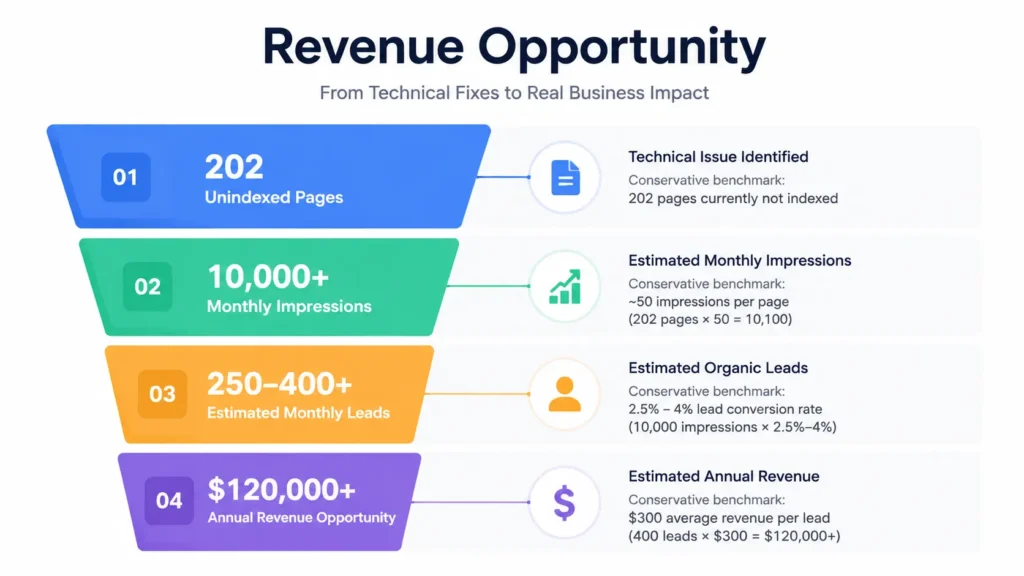
HVAC SEO audit revenue opportunity — estimated $120,000 annual organic revenue gap

Is Your Home Services Website Invisible Too?

Most HVAC and home services businesses assume their website is working. Our audits regularly show that 50–95% of their pages aren’t indexed — meaning zero organic leads, zero Map Pack presence, and a paid ads budget quietly compensating for a solvable infrastructure problem.

This field is required.

We’ll identify exactly which pages are invisible to Google, what it’s costing you in leads and annual revenue, and what to fix first. No commitment. No fluff. Delivered within 5 business days.

ree. No commitment. Delivered within 5 business days.

Ready to Find Out What Your Site Is Costing You?

This HVAC SEO audit uncovered a $120,000+ annual revenue opportunity by identifying critical indexing and technical SEO issues. Get a free audit to discover what’s limiting your visibility in Google, uncover missed lead opportunities, and receive a prioritized action plan to improve rankings and revenue.


Frequently Asked Questions

Why are most of my HVAC website’s pages not showing up on Google?

The most common cause is a canonical misconfiguration — tags embedded in your site’s code that instruct Google to ignore your own pages. In this audit, 53% of a 212-page website carried self-canonicalization errors that were silently blocking 202 pages from ever entering Google’s index. A further 12 pages had non-indexable canonical targets, and 10 had canonicals placed in the wrong document location. If your website has organic traffic near zero despite having multiple service or location pages, a canonical audit should be the first diagnostic step. Searchlyn identifies these issues as part of every free HVAC SEO audit — and they are often the complete explanation for why an otherwise well-built site generates no organic leads.

How many leads am I losing if my HVAC service pages aren’t indexed?

For a typical HVAC website with 200 unindexed pages, the lead loss is substantial. This home services SEO case study makes it concrete: at a conservative 50 monthly searches per page and a 2% visitor-to-lead conversion rate, partial indexation recovery alone can unlock tens of thousands of dollars in annual organic revenue — estimated based on industry averages. For this client, 202 unindexed pages represented an estimated $120,000+ in annual organic revenue opportunity currently generating zero return. Every month without a fix is another month that traffic, leads, and booked jobs flow to competitors who are indexed.

What does an HVAC SEO audit actually find?

A thorough technical audit for HVAC contractors — like the one Searchlyn conducts using Screaming Frog crawl data cross-referenced against Google’s own index — surfaces issues most business owners never see: canonical errors blocking indexation, HTML validation problems corrupting how Google reads your pages, title tags being silently cut off in search results, and internal links sending no relevance signals to your most important service pages. For this contractor, the HVAC SEO audit revealed a 95.3% indexation gap — 202 of 212 pages invisible — that fully explained their zero organic traffic despite a fully built website.

How long does it take to start getting organic leads after fixing technical SEO?

For indexation recovery specifically — the highest-impact fix available on most home services sites — Google typically begins re-crawling and indexing previously blocked pages within 30–60 days of canonical corrections and a clean XML sitemap submission. Organic lead flow generally begins emerging from month 2–3 as indexed pages start establishing rankings, with compounding growth through months 4–6. The critical point: technical fixes are the prerequisite. No amount of content creation or link building produces results while the pages themselves are blocked from Google’s index.

What is the ROI of fixing technical SEO for a home services business?

Organic leads cost 61% less than paid leads on average – and the traffic compounds over time rather than stopping when the ad budget runs out. For a home services business currently at zero organic traffic, restoring indexation, resolving on-page signals, and building local citations to a competitive baseline can shift inbound lead mix from entirely paid-dependent to a model where organic handles 40–60% of lead volume within 12 months. At a $4,000 average HVAC job value, even 5 additional organic leads per month represents $60,000 in incremental annual revenue — at a fraction of the cost-per-lead of paid advertising. A Domain Rating of zero means this site has no external authority signal to accelerate that transition — making citation and link building a parallel priority alongside the technical work. Searchlyn builds the technical foundation that makes that math possible.

Scroll to Top