- The Rules Changed. Most Websites Didn't.
- What Is On-Page SEO? (Quick Answer)
- How On-Page SEO Actually Works: The Mechanism Layer
- Core On-Page Elements, Defined
- How to do On Page SEO Audit
- The Data Behind On-Page SEO's Impact
- Traditional vs. Modern On-Page SEO: A Strategic Comparison
- The P.A.C.E. On-Page Authority Framework
- Metrics That Define On-Page SEO Success in 2026
- Applied Example: The P.A.C.E. Framework in Action
- Ready to Audit Your Pages?
- Frequently Asked Questions
- Fix Your On-Page SEO Gaps Before They Cost You Rankings
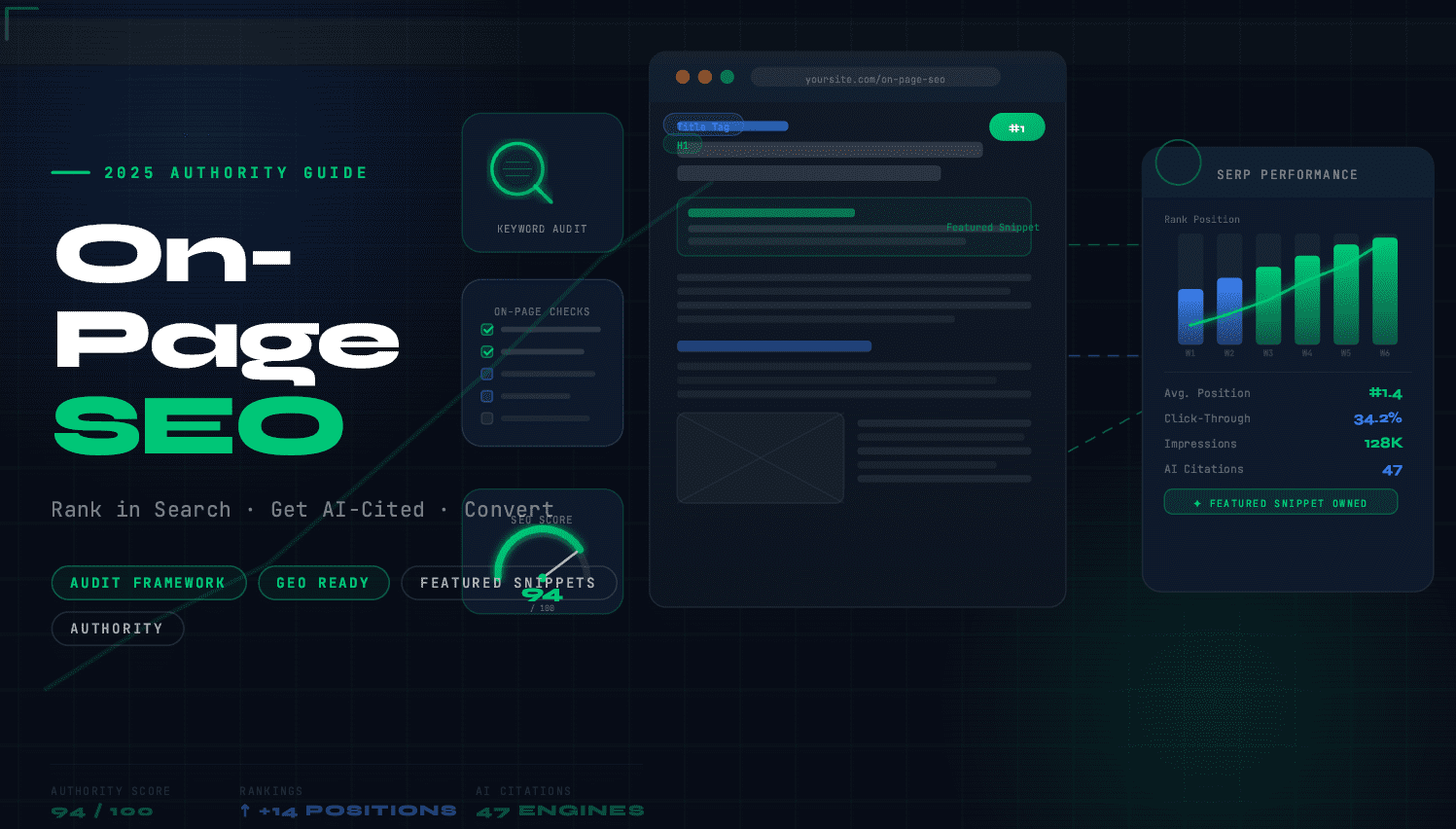
The Rules Changed. Most Websites Didn’t.
Google processes over 8.5 billion searches daily — and the sites claiming top positions in 2026 aren’t winning because they published more content. They’re winning because they understood a fundamental shift: search engines no longer just read pages. They evaluate them.
Algorithm updates like Helpful Content, Core, and the integration of AI-powered ranking signals have effectively retired the old playbook. Keyword stuffing, thin content, and shallow optimization are now liabilities, not strategies.
Meanwhile, on-page SEO — the discipline of optimizing individual pages to meet both user intent and search engine requirements — has become the most controllable, highest-leverage lever any brand has access to. If your organic traffic has plateaued, or you’re losing rankings you once held confidently, the answer is almost always rooted in on-page execution.
This guide isn’t a checklist. It’s a framework for understanding, auditing, and executing on-page SEO as a strategic discipline in 2026.
What Is On-Page SEO? (Quick Answer)
On-page SEO is the practice of optimizing individual web pages to improve their rankings in search engine results and attract relevant, qualified traffic. It encompasses everything visible on the page — content, headings, title tags, meta descriptions, internal links, and images — as well as the HTML-level signals that communicate relevance and structure to search engines.
Unlike off-page SEO, which involves external factors like backlinks, on-page SEO is entirely within your control. In digital marketing, on-page SEO functions as the foundation of your organic strategy: it signals to search engines what a page is about, demonstrates its authority, and confirms its alignment with user search intent. Without strong on-page fundamentals, no amount of link-building will produce sustainable rankings.
How On-Page SEO Actually Works: The Mechanism Layer
Modern search algorithms don’t just match keywords to queries. They evaluate topical depth, semantic relevance, user engagement signals, and content quality. Google’s systems — including BERT, MUM, and its AI-integrated ranking infrastructure — are designed to understand meaning, not just match text.
This means on-page content strategy to increase search engine rankings must account for three dimensions simultaneously: Relevance (does the page address the query?), Authority (does the content demonstrate expertise?), and Experience (does the page deliver what users expect?).
Core On-Page Elements, Defined
Title Tag:
The HTML <title> element that appears as the clickable headline in search results — the most visible on-page ranking signal you control. Keep it 50–60 characters, front-load the primary keyword, and write to match search intent. Add a power word or number to lift CTR. Google rewrites titles up to 76% of the time, so prioritise frontloading the right information over obsessing about character perfection.
Meta Description:
A 150–160 character summary beneath the search result title. Not a direct ranking factor, but a direct CTR driver. State what the page delivers, include the primary keyword naturally, and close with an action phrase. Keep it unique per page. Google rewrites descriptions ~63% of the time using your opening paragraph — so your first sentence and meta description should say the same thing.
Header Structure (H1–H3):
One H1 per page defining the core topic, H2s dividing it into major sections, H3s organising subtopics within each H2. Include the primary keyword in the H1 (20–70 characters). Use semantic keyword variations in H2s and H3s — not the same keyword repeated — to build multi-keyword ranking coverage. Framing H2s and H3s as questions that mirror “People Also Ask” queries is the most reliable path to featured snippets and AI Overview citations.
Body Content:
The substance of the page evaluated by Google for topical depth, semantic coverage, and genuine user value. Aim for topical completeness over word count — cover the primary query and every related question surrounding it. Content over 1,700 words consistently outranks shorter pages, but only when it fully satisfies intent. Structure key answers as standalone, extractable paragraphs to maximise featured snippet and AI citation eligibility.
Internal Links:
Hyperlinks connecting pages on your site — guiding users and distributing PageRank simultaneously. 67% of websites have pages with insufficient internal linking, and orphaned pages are invisible to both users and crawlers. Use descriptive, keyword-relevant anchor text. Target 3–8 contextual links per post. Link high-traffic informational pages toward commercial pages to move qualified traffic down the funnel.
Image Optimization:
Four layers: alt text, file naming, format/compression, and structured data. Alt text describes the image for crawlers and screen readers — keep it under 125 characters, include the keyword only where natural. Use descriptive filenames (on-page-seo-diagram.webp, not IMG_4821.jpg). Compress to WebP or AVIF format. 74% of websites have images with missing alt text — one of the most common and easily fixed on-page oversights.
URL Structure:
The readable slug after your domain communicates page topic before a word of content is read. Keep it 3–5 words, include the primary keyword, use hyphens not underscores, avoid dates and stop words, and stay under 60 characters — CTR drops 15% beyond that threshold. Once indexed and ranking, treat the URL as permanent: changing it without a 301 redirect risks authority loss that takes months to recover.
How to do On Page SEO Audit
An on-page SEO audit is a structured review of each page’s optimization against current ranking factors. A practical audit process follows four phases:
Phase 1 — Crawl & Inventory.
Use tools like Screaming Frog, Ahrefs, or Semrush to crawl your site and export all URLs with their title tags, meta descriptions, H1s, word counts, and canonical tags. Identify duplicates, missing elements, and pages with thin content.
Phase 2 — Intent Alignment Check.
For each high-priority page, compare the current content format and depth to the top three organic results for the target keyword. If you’re publishing a paragraph where competitors publish comprehensive guides, you’re misaligned with what the algorithm rewards.
Phase 3 — Technical On-Page Review.
Check page speed using Core Web Vitals data in Google Search Console. Review mobile rendering. Confirm structured data is implemented correctly. Audit internal linking to ensure high-value pages receive contextual links from related content.
Phase 4 — Content Gap Analysis.
Identify topics and subtopics covered by ranking competitors that your page omits. Fill these gaps with substantive additions, not padding.
The Data Behind On-Page SEO’s Impact
Why is on-page SEO important? The evidence is clear and consistent across independent research:
- Pages that include a keyword in their URL have a 45% higher CTR than those that don’t. Google is 57% more likely to rewrite meta titles that are too long. AIOSEO
- Structured data increases websites’ CTR by up to 40%, as it enhances visibility in rich results. SearchAtlas
- Articles exceeding 3,000 words generate triple the traffic of typical 1,400-word posts, earn 4× more shares, and attract 3.5× more backlinks. Link Assistant
“The gap between a page that ranks #1 and a page that ranks #5 is not only about backlinks — it’s also about content quality and on-page signal alignment.” — Consistently observed across SEO practitioner research.
These figures reinforce a strategic truth: on-page SEO is not a one-time setup task. It’s an ongoing optimization discipline that directly determines your share of organic visibility.
Traditional vs. Modern On-Page SEO: A Strategic Comparison
| Factor | Traditional On-Page SEO (Pre-2020) | Modern On-Page SEO (2026) |
|---|---|---|
| Keyword Strategy | Exact match density targeting | Semantic coverage + intent matching |
| Content Goal | Target a single keyword | Establish topical authority on a subject |
| Title Tags | Keyword stuffing for ranking signals | Balanced: keyword + compelling value proposition |
| Content Length | “More words = better rankings” | Appropriate depth for the query type |
| User Signals | Secondary consideration | Primary ranking reinforcement factor |
| AI Visibility | Not a consideration | Structured for featured snippets and AI citation |
| Internal Linking | Minimal, often templated | Strategic, contextual, authority-distributing |
| Measurement | Rankings and traffic | Rankings, CTR, engagement, AI citations, share of voice |
The shift is from mechanical optimization to strategic content engineering — where every element of a page is designed to serve both human readers and machine understanding simultaneously.
The P.A.C.E. On-Page Authority Framework
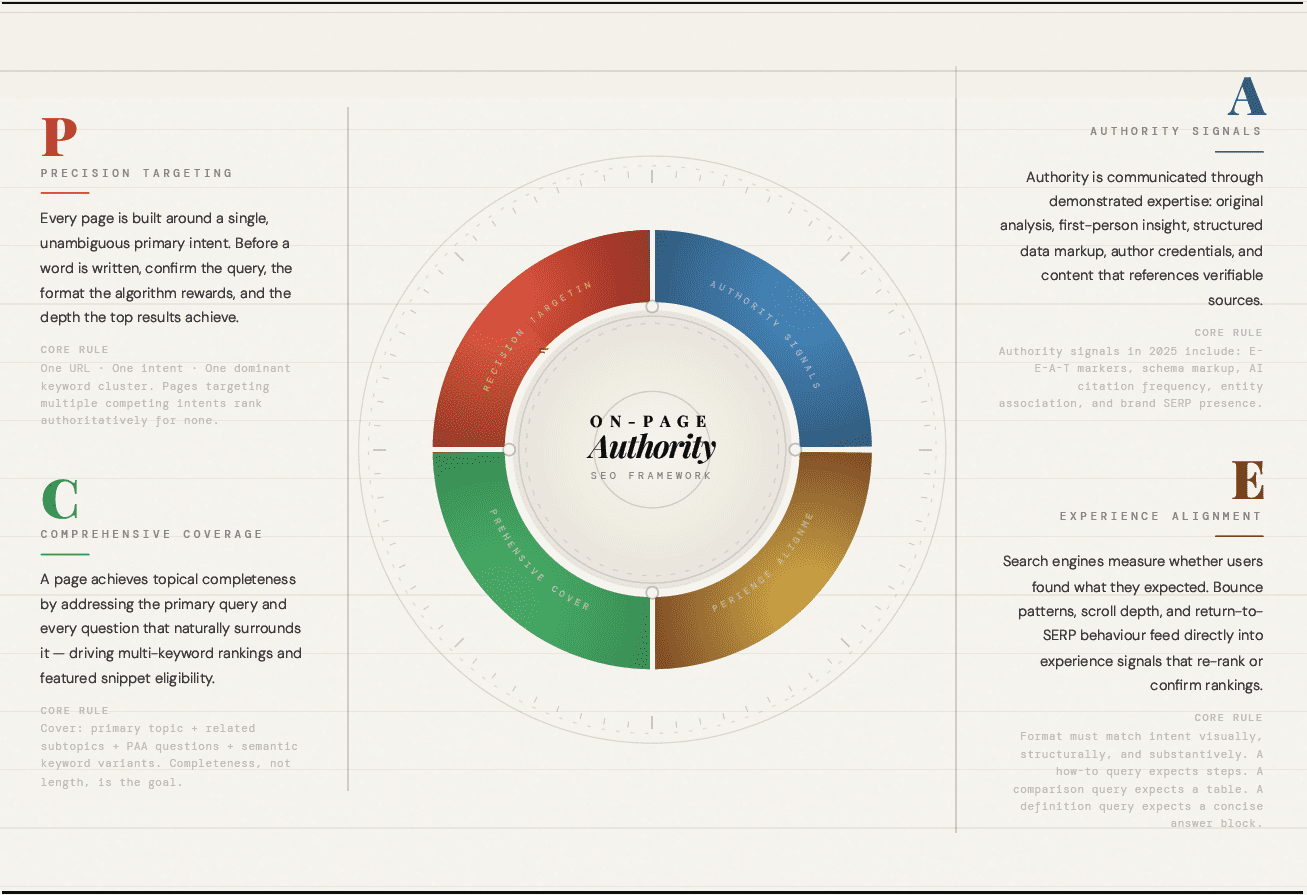
Effective on-page SEO in digital marketing requires a repeatable system. The P.A.C.E. Framework is a four-component model for building pages that rank, convert, and get cited.
P — Precision Targeting
Every page must be built around a single, clearly defined primary intent. Before writing a word, confirm: what query is this page designed to win? What format does the top-ranked content take? What depth is expected? Precision targeting eliminates content that tries to serve too many queries and ends up authoritative for none.
A — Authority Signals
Authority is communicated through demonstrated expertise. This means original analysis, first-person practitioner insight, structured data markup, author credentials, and content that references verifiable sources. In the AI era, authority signals also include how frequently your content gets cited by AI-generated answers.
C — Comprehensive Coverage
A page achieves topical completeness when it addresses the primary query and the questions that naturally surround it. Use tools like Semrush’s Topic Research, Google’s People Also Ask, and competitor content audits to identify coverage gaps. Comprehensive coverage is the primary driver of multi-keyword rankings.
E — Experience Alignment
Search engines increasingly measure whether users find what they expected when they land on a page. Bounce rate patterns, scroll depth, and return-to-SERP behavior all feed into experience signals. Experience alignment means formatting your content to match both the intent and the expectations of your target audience — visually, structurally, and substantively.
Metrics That Define On-Page SEO Success in 2026
Traditional KPIs (Still Relevant)
- Organic Rankings: Position tracking for primary and secondary keywords across target pages.
- Organic Traffic: Sessions attributed to non-paid search, segmented by landing page.
- Click-Through Rate (CTR): The percentage of impressions that result in clicks — a direct signal of title tag and meta description effectiveness.
Emerging AI-Era Metrics
- Featured Snippet Ownership: Whether your page holds the zero-position answer for target queries. Track via Semrush or Ahrefs.
- AI Citation Rate: How frequently your content appears as a cited source in ChatGPT, Perplexity, and Google AI Overviews. Emerging tracking tools include Profound and Otterly.ai.
- Entity Presence: Whether your brand and content appear as associated entities in knowledge graph results.
Visibility Beyond Rankings
- Share of Voice (SOV): Your brand’s percentage of total organic clicks across a defined keyword set, relative to competitors. SOV captures organic dominance more accurately than position tracking alone.
- Zero-Click Visibility: Impressions your content generates even when users don’t click — particularly relevant for brand awareness in AI-mediated search environments.
Applied Example: The P.A.C.E. Framework in Action
Scenario: A mid-sized B2B SaaS company offering project management software is ranking on page two for “project management software for remote teams” — high commercial intent, strong volume.
Precision Targeting: Audit reveals the page targets three overlapping queries with inconsistent intent signals. The solution: dedicate one URL to the commercial query with a clear product-led content structure.
Authority Signals: The page has no author bio, no structured data, and no original data. Add an expert author section, implement Article and FAQ schema, and incorporate one proprietary insight from customer usage data.
Comprehensive Coverage: Competitors on page one address integration capabilities, pricing transparency, and team size scalability. The page covers none of these. Three new sections are added covering each topic with substantive depth.
Experience Alignment: Heatmap data shows users scroll 40% of the page before leaving. A comparison table and video overview are added above the fold to reduce early exits.
Result (Hypothetical Projection Based on Industry Benchmarks): Pages implementing this level of structured on-page optimization typically see a 30–60% increase in organic CTR and a 1–3 position ranking improvement within 60–90 days of reindexing — based on documented case patterns from Moz and Ahrefs industry research.
Ready to Audit Your Pages?
Most on-page SEO problems aren’t discovered — they’re inherited. Pages go live, rankings don’t materialize, and the root cause sits undiagnosed in a title tag or a content gap that a structured audit would surface in hours. If your organic performance has stalled, the highest-leverage action you can take right now is a systematic on-page SEO audit of your top 20 pages. Not a full site overhaul. Not a new content calendar. Twenty pages, audited against the P.A.C.E. Framework, with clear prioritization of fixes by traffic impact. That’s where measurable results begin.
Frequently Asked Questions
What is on-page SEO in digital marketing?
On-page SEO in digital marketing refers to the optimization of individual web pages to improve their visibility in search engine results. It includes elements like title tags, meta descriptions, content depth, header structure, internal links, and image optimization — all factors directly controlled by the site owner and designed to align pages with user search intent.
Why is on-page SEO important?
On-page SEO is important because it determines whether search engines can accurately understand, evaluate, and rank your content. Without proper on-page optimization, even well-linked pages fail to reach their ranking potential. It also directly impacts user experience, click-through rates, and conversion performance — making it foundational to any effective digital marketing strategy.
How do I do an on-page SEO audit?
An on-page SEO audit involves four phases: crawling your site to inventory technical elements, checking content alignment with search intent, reviewing Core Web Vitals and mobile performance, and conducting a content gap analysis against top-ranking competitors. Tools like Screaming Frog, Ahrefs, Semrush, and Google Search Console are standard audit resources.
How does on-page SEO differ from off-page SEO?
On-page SEO covers everything you control directly on your website — content, HTML elements, internal links, and page structure. Off-page SEO involves external signals, primarily backlinks from other domains, that communicate authority to search engines. Both are necessary for strong rankings, but on-page optimization is the prerequisite that makes off-page efforts effective.
What on-page content strategy increases search engine rankings?
An effective on-page content strategy focuses on topical comprehensiveness, intent alignment, semantic keyword coverage, and structured formatting. Pages should address the primary query and surrounding subtopics, use natural keyword variation, implement structured data, and be formatted for readability — with headers, short paragraphs, and AI-extractable answer blocks that support featured snippet eligibility.
How long does on-page SEO take to show results?
On-page SEO improvements typically produce measurable ranking changes within 30–90 days, depending on crawl frequency, competition level, and the scale of changes made. Pages in competitive niches may require 60–120 days for full impact. Quick wins — like fixing title tags, improving meta descriptions, and adding internal links — can improve CTR within weeks of reindexing.