- The Rules Changed. Most SEO Strategies Didn't.
- What Is Off-Page SEO? (Quick Answer)
- How Off-Page SEO Actually Works: The Mechanism Layer
- The Three Pillars of Modern Off-Page SEO
- Off-Page SEO Ranking Factors: What Actually Moves the Needle
- The Data Layer: What Research Actually Shows
- Off-Page SEO: Traditional vs. Modern Approach
- The TRACE Authority Framework™
- Metrics That Matter in the AI Era
- Applied Example: The TRACE Framework in Practice
- Your Next Strategic Move
- Frequently Asked Questions
- Build Real Authority Before Your Competitors Do
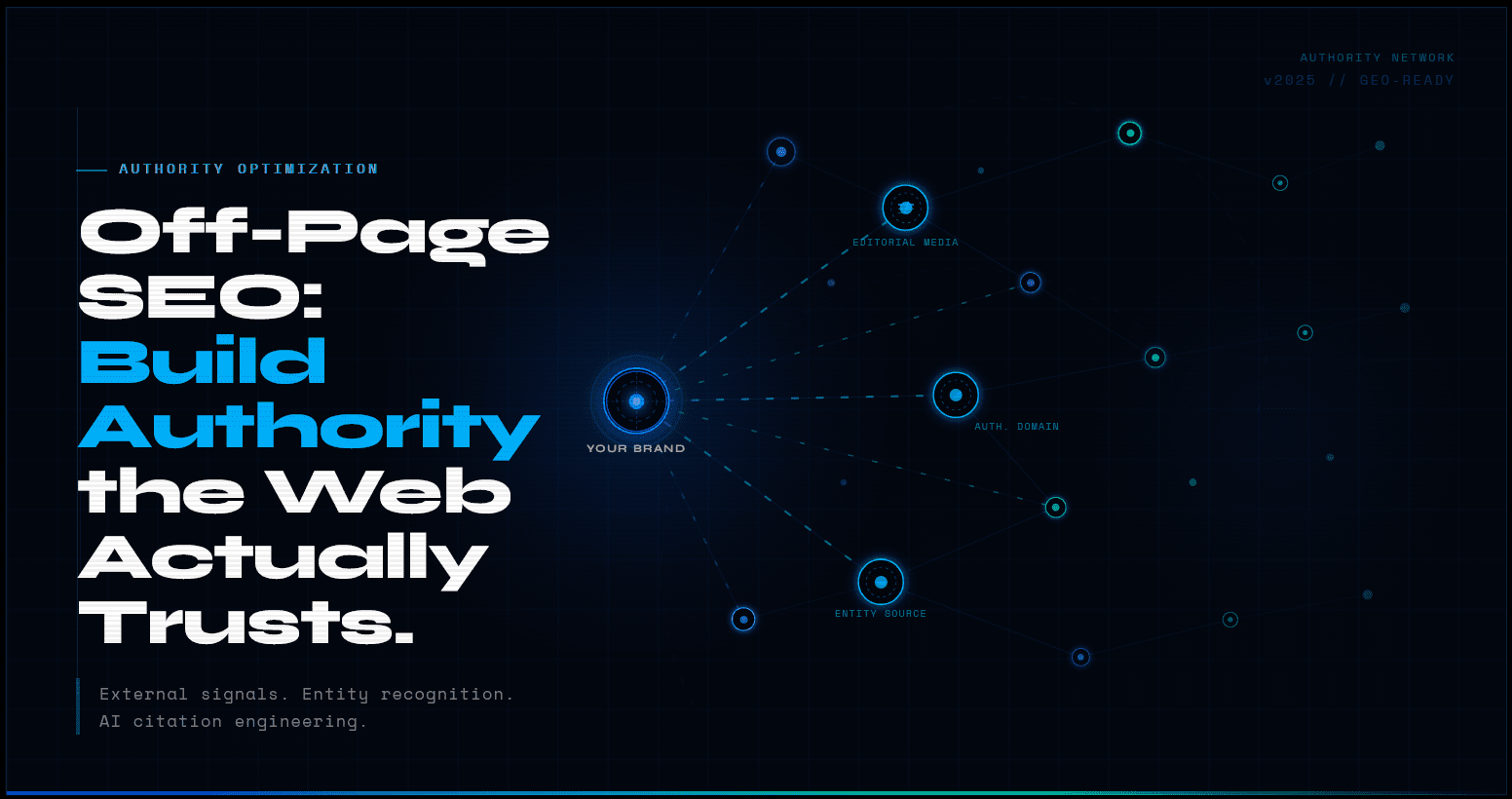
The Rules Changed. Most SEO Strategies Didn’t.
Here’s the uncomfortable truth: you can have technically perfect on-page SEO, a fast site, and clean architecture — and still lose to a competitor with weaker content but stronger external authority signals. That’s not a bug in Google’s algorithm. It’s the point.
Off-page SEO has always been the tiebreaker. But in 2026, it’s become something more: the primary mechanism by which AI engines, search generative experiences, and traditional rankings decide who gets cited and who gets ignored.
The shift isn’t subtle. Google’s AI Overviews, Perplexity’s sourcing logic, and ChatGPT’s retrieval behavior all favor entities with distributed trust signals across the web — not just sites with good content. If your off-page strategy is limited to link building, you’re already behind.
What Is Off-Page SEO? (Quick Answer)
Off-page SEO refers to all optimization actions taken outside your own website to improve its authority, trustworthiness, and search engine rankings. It encompasses off-page SEO backlinks, brand mentions, digital PR, entity signals, social proof, and citation building across external platforms. Unlike on-page SEO — which you control entirely — off-page SEO is largely earned. It reflects how the broader web perceives your brand. Search engines, particularly Google, treat these external signals as third-party votes of confidence. The quality, relevance, and diversity of those signals directly influence where you rank, whether you appear in featured snippets, and increasingly, whether AI engines select you as a trusted source. A strong off-page SEO foundation is not optional for competitive visibility in 2026.
How Off-Page SEO Actually Works: The Mechanism Layer
The Core Logic: External Validation
Search engines cannot read your mind about your own expertise. They infer authority from external behavior — who links to you, who mentions you, who cites you, and how consistently your brand entity appears across credible sources.
This is fundamentally a trust distribution problem. Google’s PageRank, even in its modern evolved form, rewards sites that attract links and citations from authoritative, topically relevant sources. But the mechanism has expanded well beyond links.
The Three Pillars of Modern Off-Page SEO
Pillar 1: Link Authority
Off-page SEO backlinks remain the highest-signal external ranking factor. But the metric that matters has shifted from quantity to topical relevance, domain trust, and link placement context. A single editorially placed link from an industry-authoritative publication outperforms dozens of directory submissions.
Key factors within link authority:
- Domain Rating / Domain Authority of the linking site
- Topical alignment between linking site and your content
- Anchor text diversity (branded, naked URL, partial match, generic)
- Link placement — in-body editorial links carry significantly more weight than footer or sidebar links
- Link velocity — unnatural spikes trigger algorithmic scrutiny
Pillar 2: Brand Entity Signals
Google’s Knowledge Graph and entity-based understanding means your brand must exist as a recognized entity, not just a website. This includes consistent NAP (Name, Address, Phone) data, Wikipedia mentions, Wikidata entries, branded search volume, and unlinked brand mentions that corroborate your existence and expertise.
Pillar 3: Trust & Authority Distribution
This includes third-party reviews, author authority signals, podcast appearances, press coverage, social proof, and syndication. These signals tell AI engines and search crawlers that real humans with real influence are referencing your work.
Off-Page SEO Ranking Factors: What Actually Moves the Needle
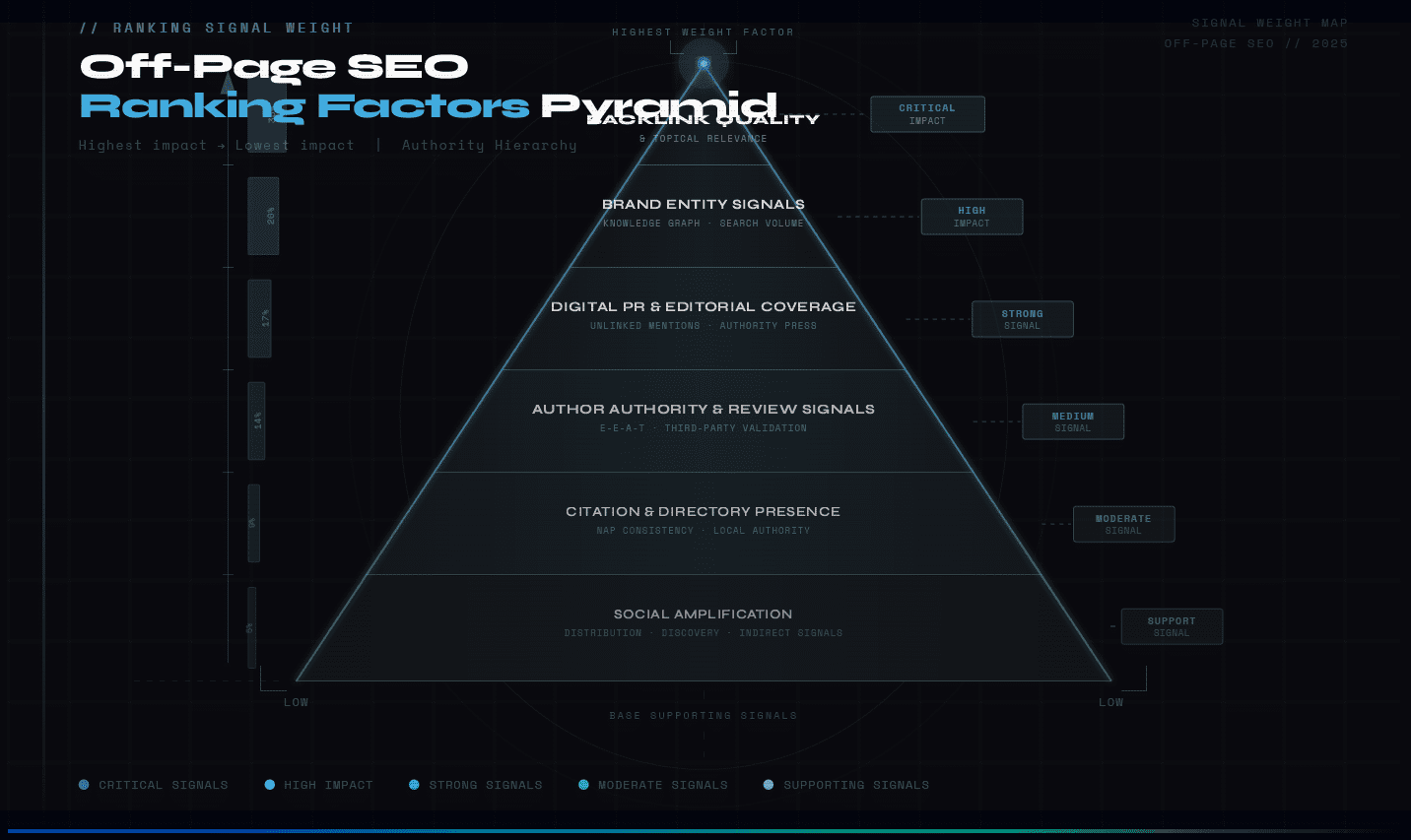
The most impactful off-page SEO ranking factors in order of evidenced weight:
- Backlink quality and topical relevance — consistently the highest-impact lever
- Branded search volume and entity recognition — Google correlates brand searches with authority
- Unlinked brand mentions — especially on high-authority publications
- Digital PR and editorial coverage — amplified by the velocity of external citation
- Review signals — critical for local and E-E-A-T (Experience, Expertise, Authoritativeness, Trustworthiness)
- Author entity signals — bylines on credible platforms strengthen topical authority
- Social amplification — indirect signal through engagement and content discovery velocity
The Data Layer: What Research Actually Shows
The evidence behind off-page SEO isn’t anecdotal. It’s structural.
- Backlinks remain Google’s #1 ranking factor alongside content relevance. Ahrefs’ large-scale ranking factor study confirmed that pages with more referring domains consistently outrank those with fewer, even when on-page factors are equalized.
- 92% of top-ranking pages have at least one external backlink, according to Ahrefs’ analysis of over one billion web pages. Pages with zero external backlinks almost never rank in the top 10 for competitive terms.
- Branded search volume is a proxy for authority: SEMrush research has indicated that branded queries correlate with higher organic click-through rates and serve as a positive trust signal in Google’s quality evaluation framework.
“The web’s external validation of your content is the one signal you cannot manufacture internally — and it’s the one Google trusts most.”
These figures reinforce a strategic reality: how to improve off-page SEO is not a question of tactics alone. It requires a systematic, multi-signal approach.
Off-Page SEO: Traditional vs. Modern Approach
| Dimension | Traditional Off-Page SEO | Modern Off-Page SEO (2026) |
|---|---|---|
| Primary Signal | Backlink volume | Topical authority + entity trust |
| Link Strategy | High-volume directory/guest post | Editorial PR + niche relevance |
| Brand Signals | Minimal focus | Core component of authority |
| AI Visibility | Not considered | Explicitly engineered |
| Measurement | DA/DR, raw link count | Share of voice, entity coverage, citation in AI engines |
| Anchor Text | Keyword-heavy | Branded + natural diversity |
| Content Role | Separate from link strategy | Integrated (linkable assets) |
| Review Signals | Local SEO only | Universal trust signal |
| Timeline | Quick wins prioritized | Compounding, long-term investment |
The gap between these two approaches explains why sites with aggressive traditional link profiles are being outperformed by brands with fewer but more strategically distributed authority signals.
The TRACE Authority Framework™
Most off-page SEO checklists treat tactics as isolated actions. The TRACE Authority Framework treats them as compounding system components.
T — Trust Anchor (Backlink Foundation)
The base layer. Earned editorial links from topically relevant, high-authority domains. Without trust anchors, no other signal reaches its full potential. Strategy: create genuinely citable assets (original research, frameworks, data studies) that attract links without manual outreach.
R — Reach Expansion (Mention & PR Layer)
Extend brand presence through digital PR, podcast appearances, expert roundups, and industry publications. The goal is unlinked mentions at scale on authoritative domains — these are processed as entity corroboration by both Google and AI language models.
A — Authority Transfer (Entity Signal Layer)
Formalize your brand entity. Claim and optimize Google Business Profile, Wikidata, Crunchbase, LinkedIn Company Page, and industry directories. Ensure NAP consistency across every citation. Entity completeness accelerates Knowledge Panel generation and AI recognition.
C — Credibility Proof (Social & Review Layer)
Accumulate third-party validation through structured review acquisition (Google, Trustpilot, G2, Capterra — platform-dependent). Author schema, expert bios, and bylined content on recognized platforms elevate E-E-A-T signals specifically.
E — Engagement Echo (Distribution & Amplification)
Distribute content through channels that generate secondary citations: LinkedIn thought leadership, industry newsletters, community platforms (Reddit, Quora), and content syndication. Each distribution point creates additional discovery pathways and potential link acquisition.
Each TRACE component is independently measurable and sequentially stackable — making it a practical framework for phased execution.
Metrics That Matter in the AI Era
Traditional KPIs (Still Relevant, No Longer Sufficient)
- Domain Authority / Domain Rating: Composite scores approximating link authority. Useful for benchmarking, not absolute signals.
- Referring Domains: The count of unique domains linking to your site. Diversity matters more than total links.
- Organic Ranking Position: Still the most legible performance metric for SEO investment.
- Link Velocity: Rate of new referring domain acquisition over time.
Emerging AI-Era Metrics
- AI Citation Rate: How frequently your brand or content appears in responses from ChatGPT, Perplexity, Google AI Overviews, and similar systems. Manually testable; increasingly trackable via tools like Profound or Otterly.ai.
- Entity Coverage Score: The breadth of platforms and sources where your brand entity is recognized and accurately represented.
- Share of Voice (SOV): Your brand’s percentage of total organic visibility within a defined keyword landscape versus competitors.
- Branded Search Volume Trend: A rising branded search curve signals growing authority independent of algorithm changes.
- Unlinked Mention Velocity: The rate of brand references without hyperlinks — a leading indicator of organic link acquisition and AI model familiarity.
Visibility Beyond Rankings
A site ranking #4 with strong AI citation, broad entity coverage, and high branded search volume is often more commercially durable than a site ranking #1 with a single thin authority signal. Off-page SEO ranking factors in 2026 operate across multiple surfaces simultaneously.
Applied Example: The TRACE Framework in Practice
Scenario: A B2B SaaS company offering project management software wants to break into competitive organic rankings dominated by established players.
Phase 1 — Trust Anchor (Months 1–3)
They commission an original industry report on remote team productivity, surveying 500 professionals. The study is pitched to 15 SaaS-focused publications and marketing newsletters. Result: 12 editorial placements, 8 of which include followed backlinks from domains with DR 50+.
Phase 2 — Reach Expansion (Months 2–4)
Leadership contributes bylined expert commentary to three recognized industry blogs and appears on two SaaS podcasts. Unlinked brand mentions increase by 40% within the tracking period.
Phase 3 — Authority Transfer (Ongoing)
They complete Wikidata and Crunchbase profiles, standardize NAP across 35 business directories, and establish a Google Knowledge Panel within 90 days of entity optimization.
Phase 4 — Credibility Proof (Months 3–6)
A structured review acquisition campaign increases G2 reviews from 11 to 67. Three case studies featuring customer ROI data are published, earning links from two customer company blogs.
Phase 5 — Engagement Echo (Ongoing)
Weekly LinkedIn content from the CEO generates consistent engagement. Two posts are syndicated by industry newsletters, each generating 3–4 additional backlinks.
Measurable Outcome (6-Month Mark):
Referring domain count up 34%, branded search volume up 58%, the brand appears in Perplexity responses for three core industry queries, and two target keywords move from page 2 to top 5.
Your Next Strategic Move
If your site is producing high quality content but not earning external signals, you don’t have a content problem — you have an authority distribution problem. The first step isn’t a tactic. It’s an audit. Run a referring domain analysis against your top three competitors. Identify the gap. Then determine whether your content assets are genuinely citable — or whether they’re written for readers but not engineered for citation. If you want an outside perspective on your current off-page SEO posture, a structured authority audit will surface the exact gaps the TRACE framework is designed to close. The audit takes one week. The compounding effect begins the day you start.
Frequently Asked Questions
What is off-page SEO and why does it matter?
Off-page SEO encompasses all optimization actions taken outside your website — including backlinks, brand mentions, digital PR, and entity signals — to improve your authority and rankings. It matters because search engines treat external signals as third-party validation of your site’s credibility. Without strong off-page signals, even excellent on-page content struggles to rank competitively for high-intent queries.
What are the most important off-page SEO ranking factors?
The most impactful off-page SEO ranking factors are backlink quality and topical relevance, branded search volume, unlinked brand mentions, digital PR coverage, review signals, and author entity authority. Link quality now consistently outweighs link quantity, and brand entity recognition has become a measurable ranking signal independent of the traditional link graph.
How do I improve off-page SEO without buying links?
To improve off-page SEO ethically, focus on creating genuinely linkable assets — original research, proprietary frameworks, and comprehensive guides — then distribute them through digital PR and expert outreach. Pursue podcast appearances, contributed articles, and strategic partnerships. Build your brand entity through consistent citation across directories and platforms. These methods generate compounding authority without link scheme risk.
How many backlinks do I need to rank on page one?
There’s no fixed number. What matters is the topical relevance and domain authority of linking sites relative to your competitors. Ahrefs data shows that ranking pages in competitive niches typically have between 30–500 referring domains, but a site with 40 highly relevant, high-authority backlinks will consistently outperform one with 400 low-quality links. Audit competitor backlink profiles to calibrate your specific target threshold.
What should an off-page SEO checklist include?
A complete off-page SEO checklist should cover: backlink gap analysis, referring domain diversity audit, brand entity completeness check (Wikidata, GBP, directories), unlinked mention monitoring, digital PR pipeline, review acquisition strategy, author schema implementation, branded search volume tracking, and AI citation monitoring. Prioritize the items that represent the largest gap versus your primary competitors.
Does social media impact off-page SEO?
Social media does not directly pass PageRank, but it impacts off-page SEO indirectly through content amplification, which increases discovery and link acquisition opportunities. High-performing social content reaches journalists, bloggers, and editors who may link to it. Additionally, social presence contributes to brand entity signals and branded search volume — both recognized components of modern authority evaluation.