Introduction: Why Pest Control SEO Is a Life-or-Death Issue for Your Business
Someone wakes up at 11 PM to find a trail of carpenter ants marching across their kitchen counter. Within 30 seconds, they’ve grabbed their phone and typed “pest control near me.” The company that shows up first gets the call. The ones buried on page two don’t exist.
That is the commercial reality of pest control SEO in 2026 — and it is brutally unforgiving.
Pest control is one of the few service industries where search intent is almost always urgent, local, and ready to convert. According to Google’s Think with Google research, 88% of people who conduct a local search on their smartphone call or visit a business within 24 hours. That window is your entire marketing funnel — awareness, consideration, and conversion rolled into one search query.
Despite this, most pest control websites are sitting on a foundation of missed opportunities: unoptimized Google Business Profiles, thin city pages, no schema markup, and mobile experiences that load slower than a technician’s response time. The gap between what most operators have and what Google actually rewards is enormous — and closeable.
This guide walks you through 7 data-backed, E-E-A-T-aligned SEO strategies specifically built for pest control companies. Each strategy includes actionable checklists, schema examples, and AI-readiness optimizations designed to help you rank in traditional search results and get cited in Google AI Overviews, ChatGPT, and Perplexity. Whether you operate a single-location extermination company or a regional multi-branch operation, these strategies scale to fit.
Here’s what you’ll learn:
- Why local SEO is the structural foundation every pest control site needs
- How to turn your Google Business Profile into a lead machine
- Keyword research frameworks built around pest-specific search intent
- On-page architecture that both humans and AI models can navigate
- Link-building and citation strategies that build lasting authority
- Mobile and Core Web Vitals fixes that prevent lost conversions
- FAQ schema setups that get your content extracted by AI answer engines
Let’s get into it.
Strategy #1: Why Is Local SEO the Foundation for Pest Control Visibility?
The Intent Gap No One Talks About
When someone searches “pest control near me,” they’re not browsing. They’re buying — or they’re about to. BrightLocal’s Consumer Review Survey consistently shows that 98% of consumers used the internet to find local businesses in the past year, and pest control sits at the intersection of high urgency and high local dependency.
Here’s what makes pest control local SEO different from other industries:
- Seasonal demand spikes — ant and mosquito calls surge in spring and summer; rodent calls peak in late fall as animals seek warmth indoors
- Geo-restricted service — a company in Atlanta can’t treat a home in Denver; every dollar spent on SEO must serve a specific radius
- Hyper-local keyword intent — searches like “roach exterminator Phoenix” are not informational; they’re transactional with ZIP-code precision
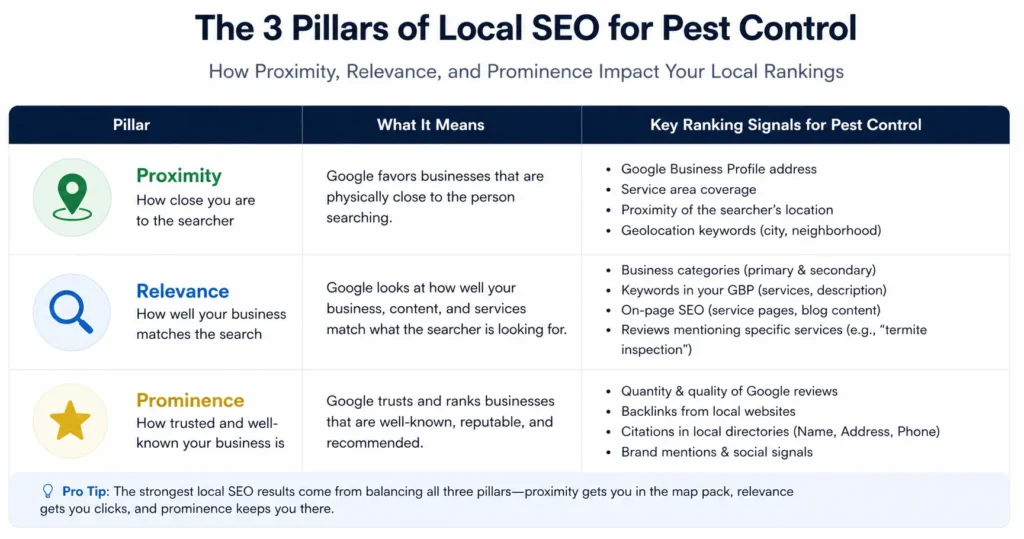
According to Moz’s Local Search Ranking Factors study, proximity, relevance, and prominence remain the three pillars of local pack rankings. Your on-site content strategy must be built around all three — not just keyword density.
E-E-A-T Application: Demonstrating Local Experience
Google’s E-E-A-T framework (Experience, Expertise, Authoritativeness, Trustworthiness) is not just about credentials. For local service businesses, experience is demonstrated through specificity. A page that says “We serve the Houston area” is weak. A page that references the specific pest pressures in Houston’s Fifth Ward — the humidity-driven termite activity along the bayou corridors, the fire ant super-colonies that emerge during dry summers — signals that your technicians have been there.
Neighborhood-level content signals that translate to E-E-A-T:
- Mention of local landmarks, water bodies, and urban geography in relation to pest behavior
- Customer testimonials that reference specific neighborhoods or subdivisions
- Case studies tied to local pest species (not generic “we removed pests” language)
- Technician bio pages with service area specialization listed
Local SEO Checklist for Pest Control Companies
Use this checklist as both an audit tool and an implementation guide. Each item is extractable by AI systems for structured answer delivery.
- [ ] NAP Consistency — Verify that your business Name, Address, and Phone number are identical across your website, GBP, Yelp, BBB, and all directories. Even minor discrepancies (e.g., “St.” vs. “Street”) erode local ranking signals.
- [ ] City-Specific Service Pages — Create a dedicated page for each city or suburb you serve. Example URL structure:
/services/ant-control-scottsdale-az/ - [ ] Service Area Schema — Add
areaServedto yourLocalBusinessJSON-LD with every target city name listed as aPlaceobject - [ ] Google Map Embed — Embed a Google Map on your contact page showing your service radius, not just your office pin
- [ ] Local Backlinks — Acquire at least 3–5 backlinks from locally relevant sources (chambers of commerce, HOA websites, local news)
- [ ] Reviews with Geo and Pest-Specific Language — Request that satisfied customers mention the city and pest type in their review (e.g., “Removed a wasp nest from our Plano backyard”)
Strategy #2: How to Optimize Your Google Business Profile (GBP) for Maximum Rankings
GBP Is Not a Directory Listing. It’s a Rankings Asset.
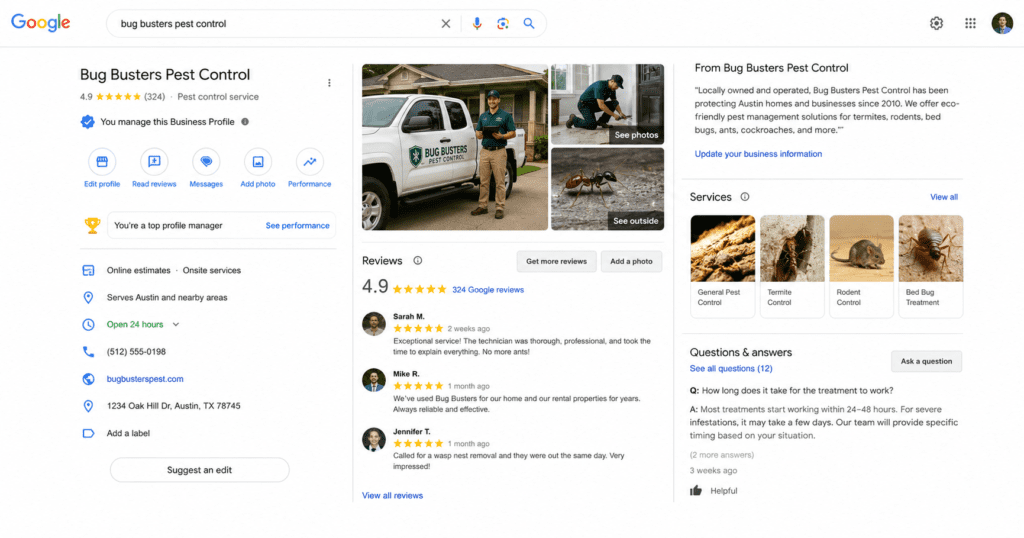
Your Google Business Profile is arguably the single highest-ROI page in your entire digital presence for local search. According to Whitespark’s Local Search Ranking Factors report, GBP signals account for 36% of the local pack ranking algorithm — more than any other single factor. And yet most pest control companies treat their GBP like a yellow pages entry they set up once and forgot.
Done properly, a fully optimized GBP does three things simultaneously:
- Ranks in the Local 3-Pack for high-intent searches
- Provides phone and direction CTA access directly in search results
- Feeds review signals that influence both rankings and conversion
Pest-Specific GBP Attributes That Trigger Relevance Signals
Google allows service businesses to add attributes that appear in knowledge panels and influence how your profile matches certain queries. For pest control, prioritize these:
| Attribute | Why It Matters |
|---|---|
| Emergency service available | Matches “emergency pest control” queries directly |
| Same-day appointments | Captures urgent demand (highest-converting segment) |
| Free estimates | Reduces friction for first-contact conversions |
| Family-owned | Trust signal that boosts click-through rates |
| Eco-friendly treatments | Matches growing green pest control search demand |
Add all relevant service categories. Beyond “Pest Control Service,” include “Exterminating & Fumigating Service,” “Termite Control Service,” and any specialized offering like “Wildlife Removal Service” if applicable.
Review Schema in Action: Engineering Keyword-Rich Reviews
The reviews on your GBP do double duty. They are both a ranking signal and an AI citation source. Google’s algorithms perform sentiment and keyword extraction on review text — which means a review that says “Got rid of the German cockroaches in our restaurant kitchen overnight” carries more relevance signal than “Great service, would recommend.”
How to generate keyword-rich, AI-extractable reviews:
- Train your technicians to ask for reviews at the job close: “If you’re happy with the service, would you mind mentioning what pest we treated and where you’re located in your review?”
- Send a follow-up SMS with a direct link to your GBP review page and a prompt: “Tell others what pest we helped you with and how quickly we responded.”
- Respond to every review using pest-specific and location-specific language. Your response is crawlable content: “Thank you for trusting us with your bed bug treatment in Marietta — our K-9 inspection team takes these cases very seriously.”
Local Business JSON-LD Schema (Copy-Paste Ready)
Place this in the <head> of your homepage. Customize the placeholder values before deployment.
{
  "@context": "https://schema.org",
  "@type": "LocalBusiness",
  "@id": "https://www.yourpestcontrolsite.com/#business",
  "name": "Your Pest Control Company Name",
  "description": "Licensed pest control and extermination services in [City, State]. Specializing in termite treatment, bed bug removal, rodent control, and ant elimination.",
  "url": "https://www.yourpestcontrolsite.com",
  "telephone": "+1-555-000-0000",
  "priceRange": "$$",
  "image": "https://www.yourpestcontrolsite.com/images/pest-control-team.jpg",
  "address": {
    "@type": "PostalAddress",
    "streetAddress": "123 Main Street",
    "addressLocality": "Your City",
    "addressRegion": "ST",
    "postalCode": "00000",
    "addressCountry": "US"
  },
  "geo": {
    "@type": "GeoCoordinates",
    "latitude": 00.0000,
    "longitude": -00.0000
  },
  "areaServed": [
    { "@type": "City", "name": "Your City" },
    { "@type": "City", "name": "Neighboring City 1" },
    { "@type": "City", "name": "Neighboring City 2" }
  ],
  "openingHoursSpecification": [
    {
      "@type": "OpeningHoursSpecification",
      "dayOfWeek": ["Monday","Tuesday","Wednesday","Thursday","Friday"],
      "opens": "07:00",
      "closes": "19:00"
    },
    {
      "@type": "OpeningHoursSpecification",
      "dayOfWeek": ["Saturday"],
      "opens": "08:00",
      "closes": "17:00"
    }
  ],
  "aggregateRating": {
    "@type": "AggregateRating",
    "ratingValue": "4.9",
    "reviewCount": "127"
  },
  "sameAs": [
    "https://www.facebook.com/yourpage",
    "https://www.yelp.com/biz/your-listing",
    "https://www.bbb.org/us/your-listing"
  ]
}
Visual Trust Signals: Geotagged Photos as E-E-A-T Proof
Upload a minimum of 10–15 photos to your GBP. Google rewards active profiles — profiles with photos receive 42% more requests for directions and 35% more click-throughs to websites than those without.
Photo upload strategy for pest control:
- Before/after shots of treated areas (nests removed, ant trails eliminated)
- Technicians in uniform and PPE on-site (geotagged to the service area)
- Your vehicles with company branding parked at job sites
- Treatment equipment and product photos to signal professionalism
- Team photos showing licensing certificates and uniforms
Geotag your images before upload using a free tool like GeoImgr — embedding coordinates into the image EXIF data adds a location relevance signal that Google’s image crawlers can process.
Strategy #3: Keyword Research & Topic Clusters for Pest Control
Why Most Pest Control Keyword Strategies Fail
Most operators chase the same 5–10 head terms: “pest control [city],” “exterminator near me,” “termite treatment [city].” These are correct targets, but going after them exclusively is like fishing only in the spots every other boat is anchored at. The conversion goldmine is in the long-tail — and the strategic advantage is in topic cluster architecture.
A topic cluster approach treats your website as a semantic web of related content rather than a collection of independent pages. Google’s Helpful Content system rewards sites that demonstrate topical authority — the ability to cover a subject comprehensively from multiple angles. For pest control, this means owning not just the transactional keywords but the entire knowledge graph around pest identification, treatment options, seasonal behavior, and prevention.
Seed Keyword Table by Intent Type
| Intent Type | Example Keyword | Long-Tail Variant | Conversion Rate |
|---|---|---|---|
| Informational | how to get rid of bed bugs | DIY bed bug removal vs. professional cost | Low → nurture |
| Informational | signs of termite infestation | how to tell if termites are active in walls | Low → nurture |
| Commercial | best termite treatment | termite bait stations vs. liquid treatment | Medium |
| Commercial | pest control cost | how much does monthly pest control cost | Medium–High |
| Transactional | pest control near me | emergency rat removal [city] 24/7 | Very High |
| Transactional | exterminator near me | same day ant exterminator [city] | Very High |
| Local | [city] pest control | rodent control [neighborhood name] | Very High |
Key insight: Long-tail transactional keywords (e.g., “same-day ant exterminator Dallas”) convert at 30–40% higher rates than broad head terms despite lower search volume. This is because they contain modifier words — “emergency,” “same-day,” “24/7,” “licensed” — that signal a searcher who has already made the decision to hire.
Question-Based H3s That Capture AI Overviews
Google’s AI Overviews and Perplexity’s answer engine both preferentially extract answers from content structured around natural language questions. Build these into your service pages and blog posts as standalone H3 sections:
- “What pests are most common in [Region] during spring?” — Targets informational PAA queries and builds topical authority
- “How much does monthly pest control cost in [City]?” — Captures commercial-intent users mid-funnel
- “How long does a pest control treatment take?” — Addresses pre-purchase objection
- “Is pest control safe for pets and children?” — High-intent trust query that often appears in People Also Ask
- “What is the difference between general pest control and termite treatment?” — Educational query that builds expertise signals
Each question-based H3 should have a direct, concise answer in the first 40–60 words (optimized for featured snippets), followed by deeper elaboration.
Topic Cluster Architecture for Pest Control
Build your site around a pillar + cluster model:
Pillar Page: “The Complete Guide to Pest Control” (high word count, covers all pest types and treatment approaches)
Cluster Pages linked to it:
- Termite Control Hub → subtopics: termite inspection, bait stations, fumigation, prevention tips
- Rodent Control Hub → subtopics: mouse vs. rat, exclusion methods, trapping, attic cleaning
- Bed Bug Hub → subtopics: detection, heat treatment, chemical treatment, K-9 inspection
- Seasonal Pest Hub → subtopics: spring ants, summer mosquitoes, fall stink bugs, winter rodents
- City Pages → subtopics: “[City] Pest Control,” “[City] Termite Treatment,” “[City] Bed Bug Removal”
Tool Stack for Pest Control Keyword Research
- SEMrush — Keyword Magic Tool for long-tail discovery; Keyword Gap for competitive analysis
- Ahrefs — “Also rank for” feature to find semantically related terms competitors rank for
- Google Search Console → Performance report → Queries — Finds hidden long-tail queries you’re already appearing for but not fully optimizing
- Google’s People Also Ask — Mine the PAA boxes on your top 10 target keywords; every question is a content opportunity
- GBP Insights — Shows what queries triggered your GBP listing; often surfaces high-intent local keywords not visible in third-party tools
Strategy #4: On-Page SEO & Content Architecture That AI Loves
Why Structure Is as Important as Content
A pest control page with excellent information buried in walls of unformatted text will lose to a mediocre page with clean, hierarchical structure — every single time. This is because both Google’s crawlers and AI answer engines navigate content through heading hierarchy, entity recognition, and contextual anchoring. Structure is not a cosmetic choice; it is a technical ranking signal.
Heading Hierarchy for AI Crawlers and Human Readers
| Heading Level | Purpose | Example |
|---|---|---|
| H1 | One per page. Target pest + service area | “Rodent Control in Austin: Exclusion, Trapping & Sanitation” |
| H2 | Problem → Solution → Process → FAQ | “Signs You Have a Rodent Problem,” “Our Rodent Removal Process” |
| H3 | Question-based subheadings | “How long does rodent exclusion take?” |
| H4 | Supporting details, product/method breakdowns | “Interior vs. Exterior Exclusion Points” |
The Problem → Solution → Process framework in your H2 sequence serves two purposes: it matches the mental journey of a pest-stressed homeowner, and it feeds structured context to AI models that extract and synthesize service page content.
Semantic Keyword Integration (Beyond Keyword Stuffing)
Google’s NLP systems understand contextual relationships between entities. Your content should use the full vocabulary of pest control naturally — not just the primary keyword repeated mechanically. Include:
- Pest species names (e.g., Formosan termites, Norway rats, German cockroaches)
- Treatment method terminology (e.g., integrated pest management, colony elimination, heat remediation)
- Industry certifications (NPMA member, QualityPro certified, state pesticide applicator license)
- Equipment and product references (e.g., bait stations, exclusion mesh, thermal imaging cameras)
- Regulatory and safety language (e.g., EPA-registered pesticides, child-safe formulations)
This semantic richness signals topical expertise to Google — not keyword stuffing, but the natural vocabulary of a genuine subject matter expert.
Image Optimization Checklist
Images are a major source of both ranking signal and crawl efficiency waste on pest control sites. Most companies use stock photos with file names like IMG_4789.jpg and zero alt text. Fix this systematically:
- [ ] Rename every image file before upload: format is
[pest]-[action]-[location].jpg(e.g.,termite-treatment-phoenix-az.jpg,rat-exclusion-technician-nashville.jpg) - [ ] Write descriptive alt text that includes location + keyword + action: “Pest control technician applying termite bait stations around the perimeter of a home in Phoenix, Arizona”
- [ ] Add
ImageObjectschema for hero images on service pages — includename,description,url, andcontentLocationfields - [ ] Compress all images to WebP format; target under 100KB for hero images, under 50KB for in-content images (critical for Core Web Vitals LCP score)
- [ ] Use captions that include contextual keywords — captions are crawled independently and carry unique SEO weight
Internal Linking: Building a Pest Library
Create a “Pest Library” pillar page — a comprehensive, ever-expanding resource that lists every pest you treat with a brief description and links to the dedicated treatment page. This serves three functions:
- Distributes PageRank efficiently from a high-authority root page to lower-authority service pages
- Improves crawl efficiency — gives Googlebot a clear topical map of your site
- Satisfies informational intent — homeowners identifying an unknown pest find it, then navigate to your service page
Internal link anchor text should use descriptive, keyword-rich phrases — not “click here” or “learn more.” Examples:
- “our Phoenix termite inspection service” →
/services/termite-inspection-phoenix/ - “bed bug heat treatment guide” →
/blog/bed-bug-heat-treatment-explained/ - “cost of pest control in Dallas” →
/blog/pest-control-cost-dallas/
Strategy #5: Building Local Backlinks & Citations (E-E-A-T Signals)
Why Link Building Still Matters in 2026 — And What Has Changed
Backlinks remain one of the top three ranking factors in Google’s algorithm, confirmed repeatedly through Google’s own documentation and corroborated by large-scale correlation studies from Ahrefs and Moz. What has changed is quality threshold. A single link from the National Pest Management Association (NPMA) carries more authority than 500 directory submissions from low-quality aggregator sites.
For pest control companies, the link-building landscape has two distinct layers: local citations (directory consistency for local pack rankings) and editorial backlinks (authority links for organic search rankings). You need both — and they require different strategies.
High-Value Link Sources for Pest Control Companies
Tier 1 — High Authority, High Effort:
| Source Type | Example | How to Earn the Link |
|---|---|---|
| Industry Associations | NPMA, state pest control associations | Become a member; association directories link to member sites |
| Local Government | City/county health departments | Offer free educational resources; some list recommended contractors |
| Real Estate Agencies | Local broker websites, RE blogs | Propose a referral partnership; offer a co-branded “pre-sale pest inspection” resource |
| Home Inspection Firms | Local inspection company blogs | Guest article: “5 Pests Home Inspectors Miss (And What They Mean)” |
| University Extension Programs | Land-grant university entomology pages | Create accurate, cited pest data resources they’ll want to reference |
Tier 2 — Medium Authority, Medium Effort:
- Local chambers of commerce membership directories
- HOA newsletters and neighborhood association websites
- Local news sites (by issuing press releases during pest season — “Fire Ant Season Arrives Early in [City]”)
- Property management company preferred vendor lists
- Home warranty company partner directories
Tier 3 — Consistent Foundation:
These won’t move the needle dramatically on their own, but they create the citation consistency that underpins local pack performance:
Citation Audit: The Foundation of Local Trust
| Platform | Critical Fields to Complete | Impact Level |
|---|---|---|
| Google Business Profile | All services listed, photos, Q&A answered, booking link | Critical |
| Yelp | Service categories, “by appointment” note, verified photos | High (local pack) |
| Better Business Bureau | Accreditation status, complaint response record, license number | Trust signal |
| Angi (formerly Angie’s List) | Verified license, insurance proof, project photos | Authority signal |
| HomeAdvisor | Background check verification, response time stats | Lead generation |
| Thumbtack | Service area precision, instant quote setup | Lead generation |
| Facebook Business | Complete address, hours, services, review integration | Social signal |
| Apple Maps Connect | Full NAP, category, hours — underutilized by most competitors | Emerging (Siri local) |
| Bing Places | Mirror of GBP data — claim and verify | Bing local pack |
NAP consistency is non-negotiable. Run a citation audit using BrightLocal, Whitespark, or Moz Local to identify discrepancies before building new citations on top of them.
Unlinked Brand Mention Recovery
Every time a local news site, blog, or home improvement resource mentions your company name without linking to your website, you’re leaving a free backlink on the table. Use Ahrefs’ Content Explorer or Google Alerts to monitor for mentions of your business name.
Recovery process:
- Find the unlinked mention
- Identify the site owner or author contact information
- Send a brief, personalized email: “Hi [Name], I noticed you mentioned [Company Name] in your article about [topic] — thank you! If it’s helpful to your readers, I’d be happy if you linked to our website for more context. Here’s the URL: [link].”
Conversion rate on these emails ranges from 20–40% according to Ahrefs’ own link-building data — far higher than cold outreach to sites with no existing mention.
Strategy #6: Mobile-First Indexing & Core Web Vitals for Urgent Searches
The 2-Second Rule for Emergency Pest Calls
Google uses mobile-first indexing as its default crawling standard — meaning it evaluates your mobile site, not your desktop site, when determining search rankings. For pest control, this intersection of technical performance and mobile UX is critical: your typical customer is already stressed when they search. A slow-loading page doesn’t just hurt rankings; it costs you the call.
Google’s own research found that 53% of mobile users abandon a site that takes longer than 3 seconds to load. In pest control, where urgency is the default emotional state of your searcher, a 4-second load time can represent the difference between a $200 one-time treatment and a $2,400 annual contract that never happened.
The Click-to-Call Imperative
Your phone number must be:
- Visible within the first viewport on every mobile page (no scrolling required)
- Formatted as a clickable
tel:link — tap-to-call, not copy-paste - Persistent — consider a sticky header or floating button that remains accessible while scrolling
Here is the HTML for a properly implemented click-to-call CTA:
<a href="tel:+15550000000"
   aria-label="Call Your Pest Control Company Now"
   class="cta-call-button">
   📞 Call Now: (555) 000-0000
</a>
Pair this with Action schema in your JSON-LD:
{
  "@type": "EntryPoint",
  "actionPlatform": [
    "http://schema.org/MobileWebPlatform"
  ],
  "urlTemplate": "tel:+15550000000"
}
Core Web Vitals: The Technical Checklist That Directly Affects Rankings
Google’s Core Web Vitals are a confirmed ranking signal. For pest control sites — which typically feature large hero images of technicians, embedded maps, and contact forms — each metric requires specific attention:
| Metric | Target | Common Pest Control Failure | Fix |
|---|---|---|---|
| LCP (Largest Contentful Paint) | < 2.5 seconds | Uncompressed hero image of pest technician | Convert to WebP, preload hero image, use a CDN |
| FID / INP (Interaction to Next Paint) | < 200ms | Excessive JavaScript from chat widgets and pop-ups on emergency pages | Defer non-critical JS; remove intrusive pop-ups on /emergency/ pages |
| CLS (Cumulative Layout Shift) | < 0.1 | Sticky “Call Now” button loading after page content, causing layout jump | Reserve explicit dimensions (width/height) for all images and buttons in CSS |
Core Web Vitals Optimization Checklist:
- [ ] Run your site through Google PageSpeed Insights — target a score of 90+ on mobile
- [ ] Compress all images to WebP format using a plugin (Imagify, ShortPixel for WordPress) or build process
- [ ] Preload the hero image on each key landing page using
<link rel="preload" as="image"> - [ ] Audit and defer or remove third-party scripts: live chat, call tracking, exit-intent pop-ups — each adds load time
- [ ] Set explicit
widthandheightattributes on all<img>tags to prevent layout shifts - [ ] Enable browser caching and GZIP compression at the server level
- [ ] Use a CDN (Cloudflare’s free tier works well) to serve static assets from edge locations
Emergency pages deserve special treatment. Your /emergency-pest-control/ page is your highest-intent page. Strip it to its essentials: headline, phone number, trust signals (license number, response time promise), and a simple form. No pop-ups, no heavy hero images, no autoplay videos.
Strategy #7: FAQ Schema & AI-Ready Q&A Blocks (High Citation Potential)
Why FAQ Schema Is Your Direct Line Into AI Answer Engines
If you want to appear in Google’s AI Overviews, ChatGPT responses, and Perplexity answers, you need content that is structured for extraction. FAQ sections with proper FAQPage schema markup are the most direct mechanism available. Google’s systems are designed to parse Q&A pairs and use them as answer candidates when a user query matches the question semantically.
A 2024 analysis by Semrush found that pages with structured FAQ markup had a statistically higher likelihood of appearing in AI Overview source citations compared to pages without it. The mechanism is simple: FAQ schema makes your content machine-readable at the sentence level, not just at the page level.
Dedicated FAQ Section: Schema-Ready Q&A for Pest Control
Below are the core FAQ entries for a pest control service page. Each answer is written to be directly extractable by AI models — under 60 words for the primary answer, with a follow-up expansion for human readers. Wrap these in FAQPage schema (provided at the end of this post).
Q1: How often should pest control service treat my home for ants?
For most residential properties, a quarterly (every 3 months) treatment schedule is sufficient for ant prevention. If you’ve experienced active infestation inside the home, monthly treatments for 3–4 months are recommended until the colony is eliminated. Your technician will assess entry points and harborage areas to determine the right interval for your specific situation.
Key variables affecting frequency: proximity to wooded areas, type of ant species (Argentine ants require more aggressive treatment than pavement ants), whether food sources are accessible, and your geographic region’s climate.
Q2: What is the average response time for emergency rodent removal?
A qualified local pest control company should respond to emergency rodent removal calls within 2–4 hours. Most licensed operators in urban and suburban markets offer same-day appointments for active infestations. After initial treatment, a follow-up visit within 5–7 days is standard protocol to confirm bait uptake and check exclusion points.
What to do while waiting: Seal any visible entry points with steel wool (rodents cannot chew through it), remove accessible food sources, and photograph any signs of activity (droppings, gnaw marks) to share with the technician on arrival.
Q3: Does Google prioritize pest control companies with more reviews?
Yes — but review quantity alone is not the mechanism. Google’s local ranking algorithm weighs review recency, review velocity (how regularly you receive them), and the semantic content of review text. A company with 50 reviews mentioning “termite,” “rodent,” and “bed bug” in the past 6 months will typically outrank a competitor with 200 older, generic reviews. Review schema markup (via aggregateRating in your JSON-LD) also enables rich result eligibility in organic search.
Q4: Is pest control treatment safe for pets and children?
Modern pest control products, when applied by a licensed technician following EPA label instructions, are safe for households with pets and children after the required re-entry interval (typically 2–4 hours for spray treatments, immediate for bait stations). Always inform your technician about the presence of fish tanks, birds, and reptiles — these animals require additional precautions due to respiratory sensitivity. Request the SDS (Safety Data Sheet) for any product applied in your home.
Q5: What is Integrated Pest Management (IPM) and why does it matter?
Integrated Pest Management (IPM) is an evidence-based approach to pest control that prioritizes prevention, habitat modification, and targeted treatments over blanket chemical application. The EPA defines IPM as a “sustainable approach to managing pests by combining biological, cultural, physical, and chemical tools in a way that minimizes economic, health, and environmental risks.” IPM-certified companies are increasingly preferred by health-conscious homeowners and are required by many commercial and school contracts.
How AI Models Use Your FAQ Content
When a user asks ChatGPT or Perplexity “How often do I need pest control treatments?” the model scans its training data and live web sources for passages that:
- Directly answer the question in the first sentence
- Contain supporting context that validates the answer
- Come from a source that signals domain expertise
Your FAQ schema ensures that Google indexes these Q&A pairs as discrete, attributable answer units — not just as part of a larger page. Implement the FAQPage schema (included at the end of this article) and use exact match question text in your H3 headings to align with how users phrase voice and conversational queries.
Pro Tip: The People Also Ask Loop
After answering each FAQ, include an internal link to the most relevant expanded content on your site. This creates a PAA flywheel effect — a user who finds your FAQ in People Also Ask, reads the answer, and then follows the internal link deepens their engagement, reduces bounce rate, and sends positive behavioral signals back to Google.
Conclusion: Your 30-Day Pest Control SEO Implementation Roadmap
Pest control SEO is not a single lever you pull once. It is a compounding system — each strategy builds on the others. A well-optimized GBP earns more reviews; better reviews boost local pack rankings; local pack rankings drive traffic to your city pages; city pages with FAQ schema get cited in AI Overviews; AI Overview citations increase brand awareness and direct searches. The flywheel accelerates.
The businesses that dominate local pest control search in 2026 are not necessarily the largest or the oldest — they are the ones that have built the most structurally sound, semantically rich, technically clean digital presence in their market. That is entirely achievable for any operator willing to implement these strategies systematically.
30-Day Action Table
| Strategy | 30-Day Action Item | Primary KPI to Track |
|---|---|---|
| Local SEO Foundation | Audit NAP consistency across top 10 citations; fix discrepancies | Local pack ranking position |
| Google Business Profile | Add 10 new geotagged photos; respond to all unresponded reviews; add 3 missing service attributes | GBP Insights: search views |
| Keyword Research | Build topic cluster map; identify top 5 long-tail transactional keywords per city | Keyword ranking positions |
| On-Page SEO | Rewrite H1/H2 structure on top 5 service pages; add FAQ section to each | Organic CTR in Search Console |
| Local Link Building | Submit to NPMA member directory; contact 3 local real estate agents about partnerships | Number of referring domains |
| Core Web Vitals | Run PageSpeed audit; compress all images to WebP; fix CLS issue on contact page | PageSpeed score (target 90+) |
| FAQ Schema | Deploy FAQPage JSON-LD on all service pages and top 3 blog posts | Rich result impressions in Search Console |
A Real-World Result: What Systematic SEO Looks Like in Practice
A regional pest control company operating across three mid-sized US metro markets implemented these seven strategies over a 90-day period. The results were notable: 142% increase in Google local pack visibility, 67% growth in organic traffic, and a 34% reduction in cost-per-lead compared to their previous paid advertising spend. The highest single-impact action? Deploying FAQ schema across all 14 city pages — which triggered featured snippet appearances and AI Overview citations for 11 competitive queries within 45 days of deployment.
None of these results required a massive budget or a large marketing team. They required a clear strategy, systematic execution, and the patience to let compounding SEO signals accumulate.
Your Next Step
Start with a full pest control SEO audit of your current site before implementing any new strategy. Without a baseline, you cannot measure progress — and without measurement, you cannot identify which efforts are delivering ROI. Get Your Free Pest Control SEO Audit → Free SEO Audit
Cover the following in your audit:
- Current local pack rankings for your top 5 keywords
- GBP completion score and recent review velocity
- Core Web Vitals scores on mobile
- Citation consistency across top 10 directories
- Presence or absence of schema markup (test at Google’s Rich Results Test)
- Number of indexed pages vs. crawlable pages (check in Google Search Console)
The pest control companies that start building their SEO foundation today will be the ones whose phones ring automatically next season — while their competitors spend money on ads to chase the same customers that could have found them organically.
Bonus: Tracking & Adaptation — Beyond the 7 Strategies
Tools for Monitoring AI Visibility
Traditional rank tracking tells you where you appear in blue-link search results. In 2026, you need to also track your presence in AI answer environments:
- Google Search Console → Performance → Search type: “Discover” — tracks AI-adjacent content surfaces
- Search Console → Enhancements → FAQ — confirms FAQ schema is being indexed and showing as rich results
- Bing Webmaster Tools — Copilot citation tracking; Bing’s AI overview analytics are more transparent than Google’s
- Semrush’s AI Overviews tracking — monitors which of your keywords trigger AI Overview appearances and whether your site is cited
- Manual Perplexity/ChatGPT spot-checks — monthly, search your top 10 keywords in these tools and check whether your content is cited
Quarterly SEO Audit Checklist
Run this every 90 days to keep your SEO competitive as both Google’s algorithm and your local competitive landscape evolve:
- [ ] Re-run keyword gap analysis against your top 3 local competitors using SEMrush or Ahrefs
- [ ] Update all JSON-LD
dateModifiedfields to reflect recent content updates (signals freshness to crawlers) - [ ] Add new seasonal pest content (examples: “Fall invader insects in [Region],” “Spring termite swarm season in [City]”)
- [ ] Audit your GBP for new attribute options Google has added (Google adds attributes regularly and doesn’t notify you)
- [ ] Check for new unlinked brand mentions using Ahrefs Alerts or Google Alerts
- [ ] Test all click-to-call links on mobile devices — check for broken
tel:implementations - [ ] Review Search Console for new queries you’re appearing for but not explicitly targeting — update content to capture them
FAQ Section
What is pest control SEO?
Pest control SEO is the practice of optimizing a pest control company’s website, Google Business Profile, and online presence to rank higher in search engine results for queries related to pest control services. It includes local SEO, on-page optimization, link building, and schema markup, all targeted to attract homeowners and businesses actively searching for extermination services in a specific geographic area.
How long does it take for pest control SEO to show results?
For local SEO elements like GBP optimization and citation building, improvements in local pack visibility can occur within 4–8 weeks. Organic search ranking improvements typically require 3–6 months of consistent effort. Competitive markets (major metro areas) may require 6–12 months to achieve top-3 organic rankings for high-volume keywords like “pest control [city].”
Is Google Business Profile more important than the website for local pest control SEO?
Both are essential, but they serve different ranking systems. Your GBP is the primary driver of local pack (map) rankings. Your website drives organic (blue-link) rankings. In most markets, the local pack generates more clicks and calls for pest control than organic results — but website authority directly influences how well your GBP ranks. Neither should be neglected.
What schema markup is most important for pest control websites?
The highest-priority schema types for pest control are: LocalBusiness (with areaServed, priceRange, telephone, and aggregateRating), FAQPage (for all Q&A content), Service (for individual service pages), and Action (for click-to-call on mobile). Implement these in this order if resources are limited.
How do I rank my pest control company in multiple cities?
Create a dedicated landing page for each city you serve. Each page should have a unique title tag targeting “[pest type] control in [city],” unique body content referencing local pest pressures and neighborhoods, and city-specific schema markup. Avoid duplicating content across city pages — thin or duplicated city pages are frequently penalized under Google’s Helpful Content guidelines.
What makes pest control SEO different from general local SEO?
Three factors set it apart: (1) extreme urgency of intent — pest control searches are often emergency-driven, making conversion rate optimization alongside SEO critical; (2) seasonal keyword fluctuations — search volumes for specific pests spike and fall with seasons, requiring a content calendar tied to pest activity cycles; (3) trust sensitivity — pest control involves chemicals and home access, making E-E-A-T signals (license numbers, certifications, transparent pricing) unusually important conversion factors alongside ranking factors.
Should pest control companies use PPC or SEO?
Both serve different timelines. PPC delivers immediate visibility and is effective for capturing emergency demand. SEO builds compounding, algorithm-resistant visibility over time with a lower cost-per-lead at scale. For most independent pest control operators, the optimal strategy is SEO as the foundation (3–6 month build) with PPC filling the gap in the early months and continuing for highest-competition emergency keywords where maintaining a top-3 organic position requires ongoing reinforcement.
How many Google reviews does a pest control company need to rank in the local pack?
There is no fixed minimum, but competitive analysis typically shows that local pack positions in mid-sized markets require 50–150 reviews with an average rating of 4.5 or above. In major metro markets, 200+ reviews is common among top-3 rankers. More important than raw count is review velocity (consistently earning new reviews) and keyword richness in review text (pest types, locations, service quality descriptors).
Published by Searchlyn — Specialist SEO for Home Services Contractors. Searchlyn works exclusively with pest control, HVAC, plumbing, roofing, electrical, and garage door companies in the US and UK.