Introduction
Your phone isn’t ringing as much as it should. You’ve got the crew, the equipment, and years of solid workmanship behind you — but the jobs keep going to competitors you know you’re better than. Here’s the uncomfortable truth: if they’re outranking you on Google, they’re getting the calls.
SEO for roofers isn’t optional anymore. In 2026, the first page of Google captures over 90% of all clicks, and the top three organic results alone account for more than 54% of all traffic, according to Backlinko. If you’re not there, you’re essentially invisible.
The roofing industry is fiercely competitive. In most mid-to-large markets, you’re fighting for attention against established local contractors, national franchise networks, and lead aggregators like HomeAdvisor and Angi — all of whom invest heavily in search visibility. The playing field is uneven, but it’s not unwinnable.
This guide will show you 7 proven SEO strategies specifically built for roofing businesses — covering everything from keyword research and local SEO to Google Business Profile optimization, content marketing, and the emerging world of AI search (AEO/GEO). By the end, you’ll have a clear, actionable roadmap to start attracting more qualified roofing leads through organic search.
1. Understanding SEO Basics: What Roofers Actually Need to Know
What Is SEO and Why Does It Matter for Local Roofers?
SEO (Search Engine Optimization) is the practice of improving your website and online presence so that search engines like Google rank you higher when potential customers search for services you offer.
For a roofing company, this means showing up when someone in your service area types “roof repair near me,” “emergency roof replacement [city],” or “how much does a new roof cost.” These are high-intent searches — the person is actively looking to hire someone. Ranking for them is the difference between a full calendar and an empty one.
Quick Definition: SEO for roofers is the process of optimizing your website, Google Business Profile, and online authority so that local homeowners and property managers can find you at the exact moment they need roofing services.
The Three Pillars of SEO
Understanding SEO starts with its three core components:
| SEO Pillar | What It Covers | Roofing Example |
|---|---|---|
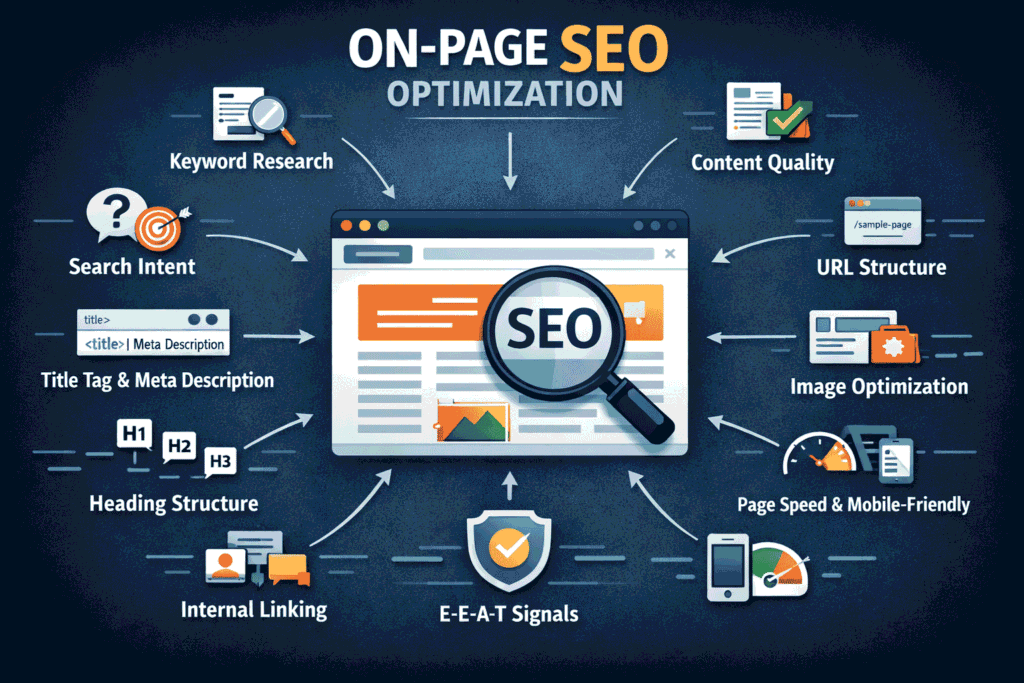
| On-Page SEO | Content, keywords, title tags, meta descriptions, headers | Optimizing your “Roof Replacement [City]” service page |
| Off-Page SEO | Backlinks, citations, brand mentions, reviews | Getting listed on Angi, earning links from local news |
| Technical SEO | Site speed, mobile-friendliness, crawlability, structured data | Fixing broken links, improving Core Web Vitals scores |
All three pillars work together. A roofing website with excellent content but no backlinks will struggle to rank. A site with great links but poor technical health will underperform. You need all three functioning properly to compete in 2026.
Why Keyword Research Is the Foundation
Before you do anything else — write content, build links, optimize pages — you need to know exactly what your customers are searching for. Keyword research tells you:
- What terms generate the most search volume in your area
- What intent sits behind each search (informational vs. ready to hire)
- How competitive each term is to rank for
- Which long-tail phrases you can realistically win quickly
Read more about Keyword Research in this guide → Keyword Research Guide (2026)
2. Conducting Effective Keyword Research for Roofing Companies
The Right Tools for Roofing Keyword Research
You don’t need to spend thousands on research tools to do this well. Here are the most effective options:
| Tool | Best For | Cost |
|---|---|---|
| Google Keyword Planner | Search volume data, local filtering | Free (requires Google Ads account) |
| Ahrefs | Competitor analysis, keyword difficulty | From $99/mo |
| SEMrush | Comprehensive SEO + PPC overlap data | From $129/mo |
| Google Search Console | Seeing what you already rank for | Free |
| Ubersuggest | Budget-friendly research | Free/Paid |
For most roofing businesses just getting started with SEO, Google Keyword Planner + Google Search Console is a perfectly viable starting point. Add Ahrefs or SEMrush when you’re ready to go deeper on competitor analysis.
Identifying Local Keywords and Long-Tail Phrases
The most valuable keywords for a roofing business are local + service-specific. Generic terms like “roofing company” are nearly impossible to rank for nationally, but “roofing company in [city]” or “metal roof installation [neighborhood]” are very winnable.
High-priority keyword categories for roofers:
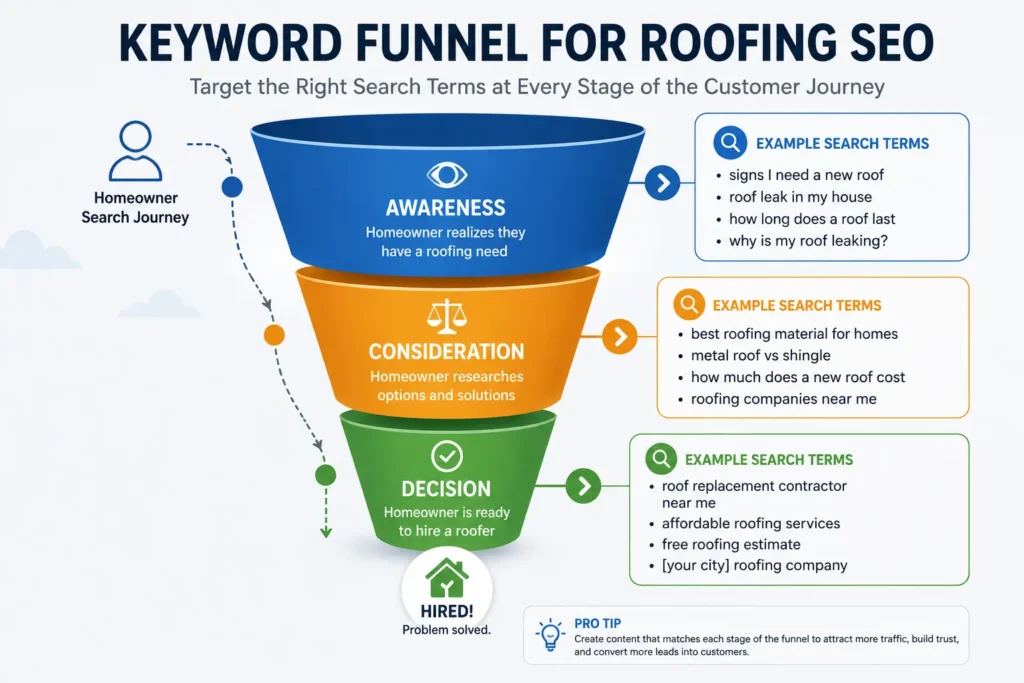
Commercial intent (hire-ready):
roof replacement [city name]emergency roof repair [city]roofing contractor near meflat roof installation [city]shingle roof repair [zip code]
Informational (research phase):
how much does a new roof cost in [state]signs you need a new roofhow long does a roof lastbest roofing material for [climate type]
Long-tail buying intent:
affordable roof replacement [city] free estimatelicensed roofing contractor [city] reviewsGAF certified roofer near [city]
Analyzing Competitor Keywords
One of the fastest ways to identify what works in your market is to study what your top local competitors already rank for.
Step-by-step competitor keyword analysis:
- Search “[your service] [your city]” on Google in an incognito window
- Note the top 3–5 organic results (not ads)
- Plug each competitor’s domain into Ahrefs or SEMrush
- Go to “Organic Keywords” to see every keyword they rank for
- Sort by estimated traffic — focus on top 20–30 terms
- Identify which keywords you don’t rank for yet
- Prioritize those with moderate volume (100–1,000/mo) and manageable difficulty (KD under 40)
This gives you a proven keyword list — terms you know convert because your competitors are already getting traffic from them.
3. Optimizing Your Website for Local SEO
Why Local SEO Is Non-Negotiable for Roofers
Local SEO is the specialized practice of optimizing your online presence to appear in geographically relevant searches. For roofing companies — which serve specific cities, counties, and zip codes — local SEO isn’t just important, it’s essentially your entire organic strategy.
According to Google, 76% of people who search for something nearby on their smartphone visit a related business within a day, and 28% of those searches result in a purchase. That’s an extraordinarily high conversion rate from search to real-world action.
Local SEO for roofers focuses on three main areas:
- Google Business Profile (GBP) — your listing in Google Maps and the Local Pack
- Location-specific website pages — service pages targeting each city or area you serve
- Local citations and NAP consistency — your Name, Address, and Phone number appearing correctly across the web
Creating Location-Specific Landing Pages
If you serve multiple cities or neighborhoods, you need a dedicated page for each location. A single homepage targeting “roofing services” will not rank in multiple cities simultaneously.
What a strong location page must include:
- Unique H1 containing the city name + primary service (e.g., “Roof Replacement in Austin, TX”)
- Unique body content — not copy-pasted from another city page (Google penalizes this)
- Local signals — mention of local neighborhoods, landmarks, weather patterns relevant to roofing
- Embedded Google Map of your service area
- Local schema markup (LocalBusiness + Service schema)
- Customer testimonials from that specific city
- Clear CTA with phone number click-to-call
Example location page URL structure:
yoursite.com/roofing-contractor-austin-tx/
yoursite.com/roof-repair-round-rock-tx/
yoursite.com/roof-replacement-pflugerville-tx/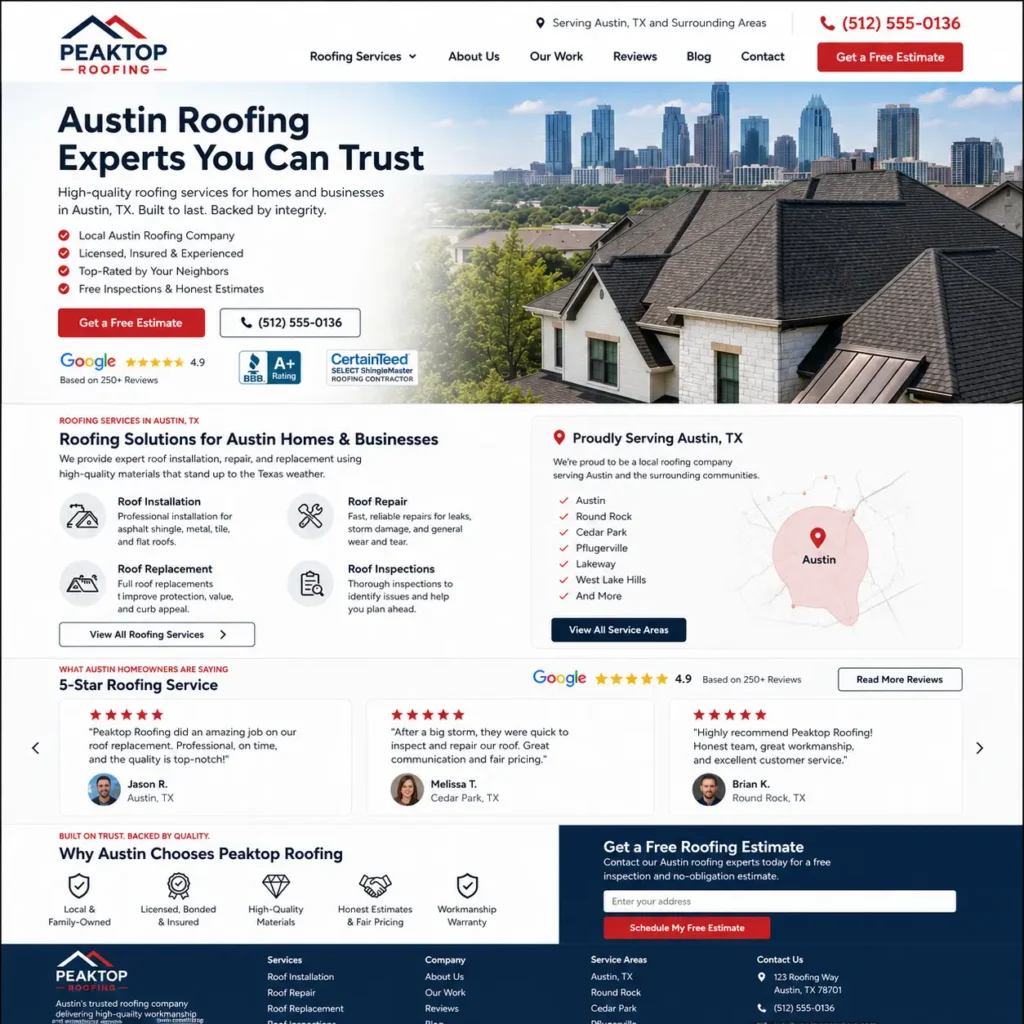
Optimizing Title Tags, Meta Descriptions, and Headers
On-page optimization isn’t glamorous, but it’s foundational. These three elements directly influence your click-through rate (CTR) from search results — which in turn affects your rankings.
Title Tag Best Practices:
- Keep between 50–60 characters
- Include primary keyword near the beginning
- Add city name for local relevance
- Example:
Roof Replacement in Austin, TX | [Company Name]
Meta Description Best Practices:
- Keep between 150–160 characters
- Include a value proposition + CTA
- Mention the city and primary service
- Example:
Need a new roof in Austin? [Company] offers expert roof replacement with free estimates and 10-year workmanship warranty. Call today.
Header (H1, H2, H3) Best Practices:
| Header Level | Purpose | Example |
|---|---|---|
| H1 | Primary topic of the page (use once) | Roof Replacement in Austin, TX |
| H2 | Major subtopics | Our Roofing Services / Why Choose Us |
| H3 | Supporting details | Asphalt Shingles / Metal Roofing / Flat Roofs |
Use keywords naturally in headers, but never stuff them. Google in 2026 understands context far better than it did even three years ago — it rewards natural, well-structured content over keyword-stuffed pages.
4. Building Quality Backlinks for Your Roofing Business
Why Backlinks Still Matter in 2026
Backlinks — links from other websites pointing to yours — remain one of Google’s most powerful ranking signals. A study by Ahrefs found that the #1 result in Google has 3.8x more backlinks than positions #2–#10. For a competitive local market like roofing, backlinks are often the deciding factor between page one and page two.
What makes a backlink valuable? Relevance (a home services directory linking to a roofer is more valuable than a random blog), authority (the linking site’s own trustworthiness), and context (the anchor text and surrounding content of the link).
7 Proven Backlink Strategies for Roofers
1. Local Business Directories
Start with the foundational citations: Google Business Profile, Yelp, HomeAdvisor, Angi, Houzz, the Better Business Bureau, and your local Chamber of Commerce. These are free, high-authority, and expected by Google for legitimate local businesses.
2. Supplier and Manufacturer Partnerships
If you’re a certified installer for manufacturers like GAF, Owens Corning, or CertainTeed, most of them maintain “Find a Contractor” directories on their websites. These are extremely high-authority links in the roofing niche — and you likely already qualify.
3. Local News and Community Sites
Offer to be quoted as a local expert on roofing topics (storm damage seasons, maintenance tips) for local news outlets. A single link from a regional news site can have more SEO impact than dozens of directory listings.
4. Guest Posts on Home Improvement Blogs
Write practical articles for home improvement websites, real estate blogs, or local lifestyle publications. Topics like “5 Signs Your Roof Won’t Survive Another Winter” serve readers well and position you as an authority.
5. Roofing Association Memberships
Joining organizations like the National Roofing Contractors Association (NRCA) or your state’s roofing association often comes with a directory listing and backlink.
6. Sponsorships and Community Involvement
Sponsor a local sports team, charity event, or school program. Most organizations post their sponsors on their website with a backlink. These links are genuine, relevant, and build brand recognition alongside SEO value.
7. Broken Link Building
Use tools like Ahrefs to find broken links on local home improvement or community websites, then reach out suggesting your content as a replacement. This delivers value to the website owner while earning you a link.
Local Citations: NAP Consistency Is Critical
A citation is any online mention of your business’s Name, Address, and Phone number (NAP). Inconsistent NAP data — your business listed as “Smith Roofing” on one site and “Smith Roofing Co.” on another, or different phone numbers across directories — confuses search engines and undermines your local rankings.
Key citation sources for roofers:
- Google Business Profile
- Apple Maps
- Bing Places
- Yelp
- HomeAdvisor / Angi
- Houzz
- Thumbtack
- Better Business Bureau
- Local Chamber of Commerce
- Nextdoor
Use a tool like BrightLocal or Whitespark to audit and fix citation inconsistencies across the web.
5. Leveraging Google Business Profile to Dominate Local Search
Setting Up and Optimizing Your Google Business Profile
Your Google Business Profile (GBP) is arguably the single most impactful thing you can optimize for local roofing leads. It’s what appears in Google Maps, the “Local Pack” (the three-business box that appears above regular search results), and increasingly in AI-generated answers from Google’s Search Generative Experience.
Complete GBP Optimization Checklist:
- Business name matches exactly across all citations
- Correct primary category: “Roofing Contractor”
- Add secondary categories: “Metal Roofing Contractor,” “Gutter Installation Service,” etc.
- Complete service area (list every city/zip you serve)
- Business description using primary keywords naturally (750 char limit)
- All services listed with descriptions and prices (where applicable)
- Minimum 10 high-quality photos (crew working, completed projects, before/after)
- Business hours current and accurate
- Primary phone number matches your website
- Website URL links to your homepage or location page
Customer Reviews: Your Most Powerful Local Ranking Signal
Reviews directly influence your position in Google’s Local Pack. According to BrightLocal’s 2025 Local Consumer Review Survey, 98% of consumers read online reviews for local businesses, and 46% say they would not use a business with less than a 4-star rating.
How to generate more roofing reviews consistently:
- Ask at the right moment — after a completed job, when the homeowner is standing in their driveway admiring the work, is the perfect time to ask for a review
- Send a follow-up text with a direct link to your Google review page within 24 hours of job completion
- Make it easy — shorten your Google review URL and include it in your email signature, on invoices, and on business cards
- Respond to every review — both positive and negative. Google rewards active profiles, and potential customers judge your professionalism by how you handle criticism
- Never incentivize reviews — this violates Google’s policies and can result in your GBP being suspended
Responding to Negative Reviews:
Always respond calmly and professionally. Acknowledge the issue, apologize for the experience, and offer to resolve it offline. A well-handled negative review can actually build trust with potential customers who see you take complaints seriously.
Google Posts and Q&A Features
Google Posts are short updates that appear directly on your GBP listing. Use them to:
- Announce seasonal promotions (spring inspection specials, storm damage assessments)
- Share completed project highlights
- Promote blog content or helpful guides
- Highlight certifications or awards
Post at least twice per month. Posts expire after 7 days (Events expire after the end date), so consistency matters.
Google Q&A is a public feature where anyone can ask questions about your business — and anyone can answer. Monitor this closely. Pre-populate it with common roofing questions and answers:
- “Do you offer free estimates?”
- “Are you licensed and insured?”
- “What roofing brands do you work with?”
- “Do you handle insurance claims?”
6. Creating Valuable Content That Attracts Roofing Clients
Why Content Marketing Works for Roofers
Most roofing companies don’t invest in content. That’s exactly why it works so well for the ones that do.
Quality content builds topical authority — Google’s way of recognizing that your website genuinely knows what it’s talking about. A roofer who publishes detailed, helpful content about roof maintenance, material comparisons, and storm damage claims sends a strong signal to Google that their website deserves to rank for roofing-related searches.
Beyond rankings, content builds trust. A homeowner researching whether they need a full replacement or just a repair will remember and contact the roofer whose article actually answered their question clearly.
Types of Content That Work Best for Roofing Businesses
| Content Type | Purpose | Example |
|---|---|---|
| Statistics/Data Posts | Earn backlinks, establish authority | “Roofing Industry Statistics 2026: Cost, Trends & Market Data” |
| How-To Guides | Capture informational searches | “How to File a Roof Insurance Claim After a Storm (Step-by-Step)” |
| Cost Guides | High-intent, commercial value | “How Much Does Roof Replacement Cost in [State]? (2026 Guide)” |
| Comparison Content | Pre-decision shoppers | “Metal Roof vs. Asphalt Shingles: Which Is Better for [Climate]?” |
| Local Guides | Hyperlocal SEO | “Best Roofing Materials for [City] Winters: A Contractor’s Perspective” |
| Before/After Case Studies | Build trust + conversion | “Storm Damage Roof Replacement in [Neighborhood]: Before & After” |
| Video Content | Engage + build authority | Time-lapse of a full roof replacement, roof inspection walkthroughs |
Crafting Educational Content That Converts
The best roofing content answers the questions your customers are already asking — before they even pick up the phone.
Content writing principles for roofers:
- Lead with the answer. Don’t bury the key information halfway through. Homeowners are busy; respect their time.
- Use real numbers. “A typical 2,000 sq ft asphalt shingle roof replacement in the Midwest costs between $8,000 and $14,000” is vastly more useful than “roof replacement costs vary.”
- Address objections. “Is it worth repairing or just replacing?” is a question every prospect has. Answer it directly.
- Include visual proof. Photos of completed local projects, material samples, and step-by-step process images dramatically increase engagement and time on page.
Promoting Content Through Social Media and Email
Creating the content is only half the work. You also need to distribute it.
Social media for roofers:
- Share before/after project photos on Facebook and Instagram
- Post educational clips on TikTok and YouTube Shorts (roof inspections, quick tips)
- Use Nextdoor to reach homeowners in your specific service neighborhoods
- Share your blog content on LinkedIn if you target commercial roofing clients
Email marketing for roofers:
- Build your list from past customers and estimate requests
- Send seasonal maintenance reminders (pre-winter, post-storm)
- Share new blog posts with a brief intro and link
- Promote limited-time offers (spring inspection specials, referral bonuses)
According to HubSpot, email marketing delivers an average ROI of $36 for every $1 spent — making it one of the most cost-effective channels available to local service businesses.
7. Monitoring and Analyzing Your SEO Performance
The Tools You Need to Track What’s Working
Investing in SEO without tracking results is like replacing a roof without checking the deck first — you’re working blind. These are the essential tools for monitoring your roofing SEO performance:
| Tool | What It Tracks | Cost |
|---|---|---|
| Google Search Console | Keywords, impressions, click-through rates, indexing issues | Free |
| Google Analytics 4 | Organic traffic, conversions, user behavior, form submissions | Free |
| Ahrefs | Backlinks, keyword rankings, competitor tracking | From $99/mo |
| BrightLocal | Local ranking tracking, citation audits, review monitoring | From $39/mo |
| Google Business Profile Insights | GBP views, calls, direction requests, photo views | Free |
Key Metrics Every Roofer Should Monitor Monthly
Traffic Metrics:
- Organic sessions — how many visitors are finding you through Google
- Impressions — how often your pages appear in search results
- Average position — where you rank for your target keywords
- Click-through rate (CTR) — what % of people seeing your listing actually click
Conversion Metrics:
- Phone call clicks (from mobile search)
- Contact form submissions
- Direction requests (from GBP)
- Free estimate requests
Backlink Metrics:
- Domain Rating (DR) growth over time
- Number of referring domains (unique sites linking to you)
- New vs. lost backlinks each month
Local SEO Metrics:
- GBP ranking position in your target cities
- Review count and average star rating
- GBP calls and messages generated
Adjusting Your Strategy Based on Data
Data without action is just noise. Review your metrics monthly and ask these questions:
- Which pages are generating calls? Double down on what’s working — publish more content in that category, add more cities with similar pages.
- Which keywords rank on page 2? Pages ranking positions 11–20 are the lowest-hanging fruit. A few targeted improvements (better content, more backlinks, improved internal linking) can push them to page one.
- Where are people dropping off? High bounce rates on service pages usually mean the page doesn’t match what the searcher expected — fix the messaging or content.
- Which cities are generating the most GBP inquiries? Focus your location page efforts there.
Set a monthly 30-minute SEO review calendar appointment. Consistency in reviewing beats intensity in occasional bursts.
8. Staying Updated with SEO Trends in 2026
The SEO Landscape Is Changing Fast — Here’s What Roofers Need to Know
2026 is not 2021. Google’s landscape has shifted dramatically, and the emergence of AI-powered search is rewriting the rules of visibility. Here’s what matters most right now:
AEO (Answer Engine Optimization): Tools like ChatGPT, Perplexity, and Google’s AI Overviews now answer roofing questions directly — often without users visiting any website. To appear in these AI-generated answers, your content needs to be:
- Concise and directly answering specific questions
- Structured with clear headings and definitions
- Supported by credible citations and real data
- Written in a factual, authoritative tone
GEO (Generative Engine Optimization): This newer discipline focuses on making your content easy for AI models to summarize and cite. Entity-based writing (clearly defining who you are, what you do, where you operate) and structured data (schema markup) are key.
Core Web Vitals: Google’s page experience signals — Largest Contentful Paint (LCP), Cumulative Layout Shift (CLS), and Interaction to Next Paint (INP) — continue to be direct ranking factors. In 2026, a slow mobile website is a ranking liability.
Voice Search: As smart home devices and mobile voice assistants become the default for quick queries, conversational long-tail keywords (“Who are the best roofers in [city]?” rather than “roofers [city]”) are increasing in value.
Resources for Ongoing SEO Education
- Google Search Central Blog — Official announcements of algorithm updates and best practices
- Ahrefs Blog — In-depth SEO studies and tactics
- Backlinko — Data-driven SEO guides and ranking factor research
- Search Engine Journal — Daily news and expert analysis
- Search Engine Land — Industry news and algorithm updates
Networking With Other Roofing and SEO Professionals
Don’t operate in a vacuum. Join roofing contractor associations, attend local business networking events, and participate in online communities (roofing contractor Facebook groups, contractor subreddits, LinkedIn industry groups). The best insights about what’s working in your specific market often come from peer conversations, not blog posts.
Conclusion: Your SEO Action Plan for 2026
SEO is not a one-time project — it’s a compounding business asset. Every location page you publish, every review you earn, every quality backlink you acquire makes the next lead cheaper and easier to get. Done consistently, SEO becomes the most cost-effective client acquisition channel a roofing company can have.
Here’s a quick recap of the 7 proven strategies:
- Master the basics — understand on-page, off-page, and technical SEO before investing heavily in any one area
- Do proper keyword research — find the exact terms your local customers are searching, then build your content around them
- Optimize for local SEO — create location-specific pages, maintain NAP consistency, and target the Local Pack aggressively
- Build quality backlinks — earn links from directories, manufacturer pages, local media, and industry associations
- Dominate Google Business Profile — optimize every field, generate consistent reviews, and post regularly
- Create valuable content — publish content that genuinely answers homeowner questions and builds your topical authority
- Track and adjust — review your metrics monthly and make data-driven decisions about where to invest your time and budget
Your next step: Start with your Google Business Profile. If it’s incomplete, fix it this week. If it’s solid, focus on generating 5 more reviews in the next 30 days. Then move to your website and identify the three most important location pages to create or improve.
SEO compounds. Every month you delay is a month your competitors are pulling further ahead. Start today.
Frequently Asked Questions
Why should roofing companies invest in SEO for roofers instead of relying solely on paid ads?
Investing in SEO for roofers builds long-term organic authority that generates leads without a continuous cost-per-click fee. While paid ads stop delivering traffic the moment your budget runs out, a strong organic presence captures high-intent searches consistently. Statistics show that local SEO delivers a 5x higher return on investment compared to traditional digital ads. Searchlyn utilizes advanced schema markup to ensure your roofing business appears prominently in organic search results. This methodology secures sustainable traffic for roofing companies across both the US and UK markets.
How does Searchlyn optimize a roofer’s digital presence to win more commercial roofing contracts?
Searchlyn builds specialized commercial content hubs backed by deep entity optimization to position your business as a regional authority. Commercial procurement managers look for verifiable technical expertise and corporate stability during their vendor search process. We integrate technical schema markup and clear structural data so search algorithms accurately categorize your commercial capabilities. Our data indicates that optimized commercial landing pages experience a 35% increase in qualified project inquiries. This system establishes your brand as the definitive local authority for large-scale roofing projects.
How long does it take for a new roofing website to rank on the first page of Google?
Roofing websites typically see measurable ranking improvements and increased organic traffic within 60 to 90 days of implementing a technical SEO strategy. Securing highly competitive top spots for primary keywords generally requires four to six months of consistent optimization. Searchlyn accelerates this timeline by fixing critical crawling errors using Screaming Frog and building out localized content assets. Our historical campaign data reveals that comprehensive technical optimization compresses the authority-building timeline by up to 40%. We provide transparent milestones so roofing contractors can easily track their growth from month to month.
How much does professional roofing SEO cost per month for a residential roofing company?
Professional roofing SEO campaigns at Searchlyn start at $1100 per month and scale based on your local market competition. This investment covers comprehensive technical audits, hyper-local content creation, link building, and Google Business Profile management. Investing in comprehensive organic optimization yields a lower cost-per-lead over time compared to running temporary local service ads. Industry data shows that companies allocating a baseline budget to organic search see a 44% increase in total revenue within the first year. We tailor our packages to ensure residential roofers maximize their local market share efficiently.
What is Answer Engine Optimization and how does it help roofers get found on AI search tools?
Answer Engine Optimization is the practice of structuring website content so conversational AI models can easily synthesize and cite your business. Traditional SEO focuses heavily on keyword rankings, whereas AEO optimizes for direct answers to complex user queries. Searchlyn utilizes a specialized schema-first content architecture to ensure your business data is easily readable by conversational engines. Our recent testing indicates that websites optimized for AEO receive up to 60% more citations in AI summaries. This proactive approach keeps your roofing company visible as consumer search habits evolve.
Which specific local citation directories are most critical for emergency roof repair visibility?
The most critical local directories for emergency visibility are Google Business Profile, Apple Maps, Bing Places, and specialized home service platforms. Optimizing these primary entities ensures your business details are consistent across the entire mapping ecosystem. Mobile searches account for over 60% of emergency roofing queries, making accurate map placement vital for capturing urgent leads. Searchlyn manages your digital footprint across these networks to ensure your business displays correctly during localized searches. Maintaining clean citation data across major directories directly improves your visibility within the local map pack.
How can a roofing contractor rank higher in the Google Map Pack in highly competitive cities?
Ranking higher in the Google Map Pack requires a combination of proximity optimization, consistent review velocity, and localized link building. Google’s local algorithm heavily prioritizes businesses that demonstrate active engagement and high regional relevance. Industry benchmarks reveal that businesses inside the top three map positions receive up to 44% of all local clicks. Searchlyn uses advanced geolocation signals and hyper-local citation building across high quality directories to boost map prominence. This targeted local strategy helps roofers dominate search results in competitive metropolitan areas across the US and UK.
How does Searchlyn ensure a roofing website gets cited in Google AI Overviews for storm damage queries?
Searchlyn targets Google AI Overviews by publishing data-rich storm damage guides that feature clear, unambiguous answers to common insurance questions. Google’s generative search engine prioritizes content that uses clear tables, bulleted lists, and structured data definitions. Our proprietary AEO and GEO frameworks are designed to align your website content with the exact informational nodes AI models extract. Case studies show that structured informational formatting increases the likelihood of gaining an AI Overview citation by 55%. This strategy places your roofing brand directly in front of homeowners during critical weather events.
How do online reviews and customer feedback impact a roofing company’s local search rankings?
Online reviews impact local search rankings by serving as a primary trust signal within Google’s search algorithms. A steady stream of positive feedback confirms your business legitimacy and directly strengthens your overall search visibility. Google’s search quality evaluator guidelines place immense weight on experiential proof and real-world consumer trust. Our analytics show that roofing companies with automated review acquisition systems experience a 25% lift in map interactions. Searchlyn integrates review acquisition methodologies to safely grow your organic rating and reinforce your authority.
What core differentiator sets Searchlyn apart from traditional digital marketing agencies working with roofers?
Searchlyn differentiates itself by combining traditional local optimization with cutting-edge Answer Engine Optimization and Generative Engine Optimization frameworks. Most marketing agencies rely entirely on outdated keyword strategies that fail to capture modern AI-driven search traffic. We implement a schema-first technical architecture that explicitly defines your business entities for platforms like Gemini, ChatGPT, and Perplexity. Our data-driven methodology consistently delivers higher organic authority and more qualified leads for home service businesses. This forward-looking approach ensures your roofing company stays ahead of both competitors and search engine updates.
Last updated: May 2026 by Searchlyn team