- Introduction
- I. What Is Off Page SEO and Why Does It Matter?
- II. Building High-Quality Backlinks
- III. Social Media Engagement
- IV. Guest Blogging
- V. Influencer Outreach
- VI. Online Reputation Management
- VII. Local SEO Techniques
- VIII. Content Marketing as an Off Page SEO Engine
- IX. Forum Participation and Community Engagement
- X. Conclusion: Building Off Page SEO Authority That Compounds
- Turn Search Visibility Into Sustainable Business Growth through our SEO Services
- Frequently Asked Questions
Introduction
Your website could be technically flawless — lightning-fast, perfectly structured, every on-page element dialled in — and it can still languish on page three of Google. Why? Because search engines don’t just evaluate what’s on your site. They evaluate what the rest of the internet says about your site.
That’s the domain of off page SEO techniques — the external signals, relationships, and authority-building actions that tell Google, Bing, and AI-powered search engines like Perplexity and ChatGPT that your site deserves to rank.
In 2026, off page SEO is more nuanced than ever. Spammy link schemes are long dead. What remains is a discipline that blends digital PR, content strategy, community building, and brand authority into a coherent system that compounds over time.
In this guide, you’ll learn 8 battle-tested off page SEO techniques — each explained with real-world context, actionable steps, and the reasoning behind why they work. Whether you’re an SEO professional, a business owner, or a content marketer, this article gives you a complete playbook.
What is Off Page SEO?
Off page SEO refers to all optimisation activities performed outside your own website to improve its search engine rankings. This includes acquiring backlinks, building brand mentions, engaging on social media, managing online reputation, and more. Unlike on-page SEO, off page SEO depends heavily on external entities — other websites, platforms, and people.
Watch this video for a quick walkthrough of the most effective Off Page SEO Techniques in 2026.
I. What Is Off Page SEO and Why Does It Matter?
Defining Off Page SEO
Off page SEO encompasses every signal that originates outside your own domain but influences how search engines assess your website’s authority, relevance, and trustworthiness. Think of it as your site’s reputation in the broader web ecosystem.
Google’s algorithm — even in its most advanced 2026 iteration — still relies heavily on external signals to break ties between pages of similar on-page quality. These signals include:
- Backlinks (the volume, quality, and relevance of sites linking to you)
- Brand mentions (cited with or without a hyperlink)
- Social engagement signals
- Reviews and ratings on third-party platforms
- Content syndication and citations in AI systems
Why Off Page SEO Matters for Rankings
According to Backlinko’s analysis, the number of domains linking to a page correlates with rankings more than any other single factor. Meanwhile, Search Engine Roundtable found that 65% of pages have zero backlinks — and those pages generate virtually no organic traffic.
The implication is stark: without a deliberate off page strategy, even excellent content will remain invisible.
Beyond rankings, off page SEO in 2026 directly influences your AEO (Answer Engine Optimisation) standing. When ChatGPT, Perplexity, or Gemini pull sources for their answers, they heavily favour sites that demonstrate external authority — the exact signals off page SEO builds.
II. Building High-Quality Backlinks
What Are Backlinks?
A backlink — also called an inbound link — is a hyperlink from one website pointing to another. Search engines treat backlinks as votes of confidence. When a respected publication links to your site, it signals to Google that your content is credible and worth surfacing.
But not all backlinks carry equal weight. A link from The Guardian is worth vastly more than a link from a newly created blog with no traffic. Google’s PageRank algorithm, and the machine learning layers built on top of it, evaluate the quality, relevance, and context of every linking domain.
Quality Over Quantity: The Non-Negotiable Rule
The era of buying 500 directory links is over — it has been for years. Google’s Penguin algorithm and its subsequent ML-powered iterations penalise manipulative link patterns. What matters now:
| Factor | Why It Matters |
|---|---|
| Domain Authority (DA) | Links from high-DA sites pass more ranking power |
| Topical Relevance | A link from a marketing blog to a marketing site carries more weight than one from an unrelated niche |
| Link Placement | Contextual, in-body links outperform footer or sidebar links |
| Anchor Text | Descriptive, varied anchor text signals relevance without over-optimisation |
| Link Velocity | Unnatural spikes in link acquisition can trigger algorithmic scrutiny |
| Follow vs. No-Follow | Followed links pass equity; no-follow/sponsored links still drive traffic and brand signals |
Strategies for Acquiring High-Quality Backlinks
1. The Skyscraper Technique
Pioneered by Brian Dean at Backlinko, this involves:
- Identify high-traffic content in your niche with strong backlink profiles (use Ahrefs or SEMrush)
- Create a demonstrably superior version — more comprehensive, more current, better designed
- Reach out to every site linking to the original, offering your upgraded resource
2. Digital PR and Data-Driven Content
Original research earns links because it becomes a primary source. Surveys, industry reports, and proprietary data studies are regularly cited by journalists and bloggers.
Consider creating:
- Annual industry benchmark reports
- Salary or pricing surveys
- Original case studies with measurable outcomes
3. Broken Link Building
- Use Ahrefs Site Explorer or Check My Links (Chrome extension) to find broken outbound links on authoritative sites in your niche
- Create a replacement resource that matches the dead link’s topic
- Email the webmaster: “Hey [Name], I noticed you’re linking to a page that’s no longer live at [URL]. I created a similar resource here — might be a good replacement.”
This approach has a high success rate because you’re genuinely solving a problem for the site owner.
4. HARO / Connectively (Source-Based Link Building)
Help A Reporter Out (now Connectively) connects journalists with expert sources. By consistently responding to relevant queries with expert commentary, you earn mentions and links in major publications — Forbes, Business Insider, Inc., and more.
5. Competitor Backlink Analysis
Using Ahrefs’ Link Intersect tool or SEMrush’s Backlink Gap, identify sites linking to your top 3–5 competitors but not to you. These represent warm opportunities because the site owner is already receptive to linking within your niche.
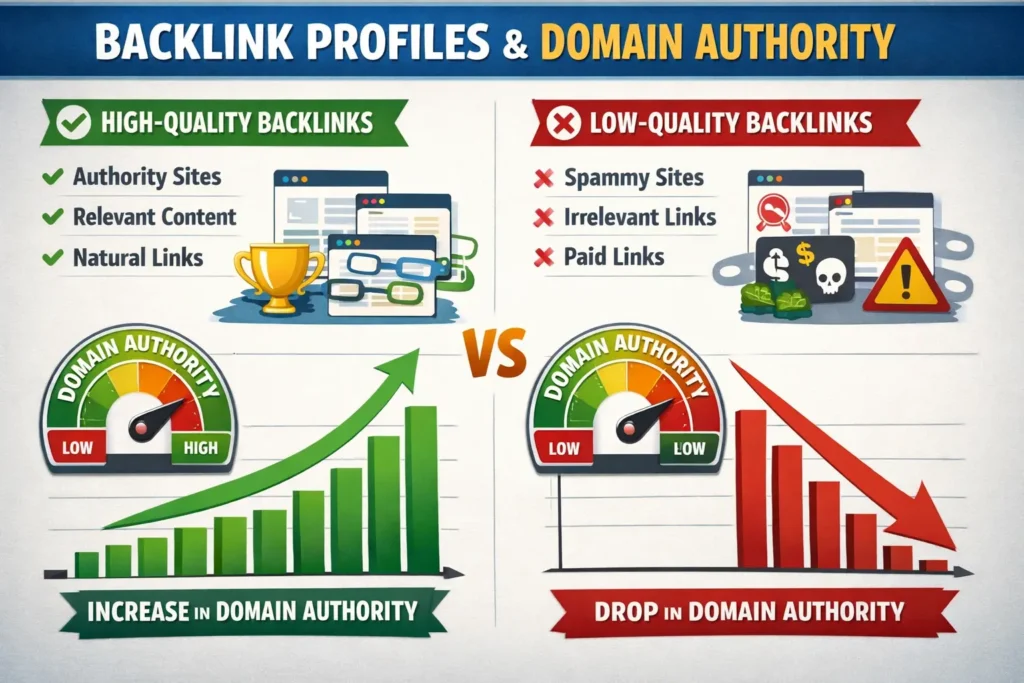
Pro Tip: Always prioritise links from topically relevant, editorially-controlled sites. A single link from a niche-authority domain can outperform 100 links from irrelevant directories.
Learn more about backlink outreach → Off Page SEO Services
External Resource: Ahrefs Backlink Checker | Google’s Link Spam Policies
III. Social Media Engagement
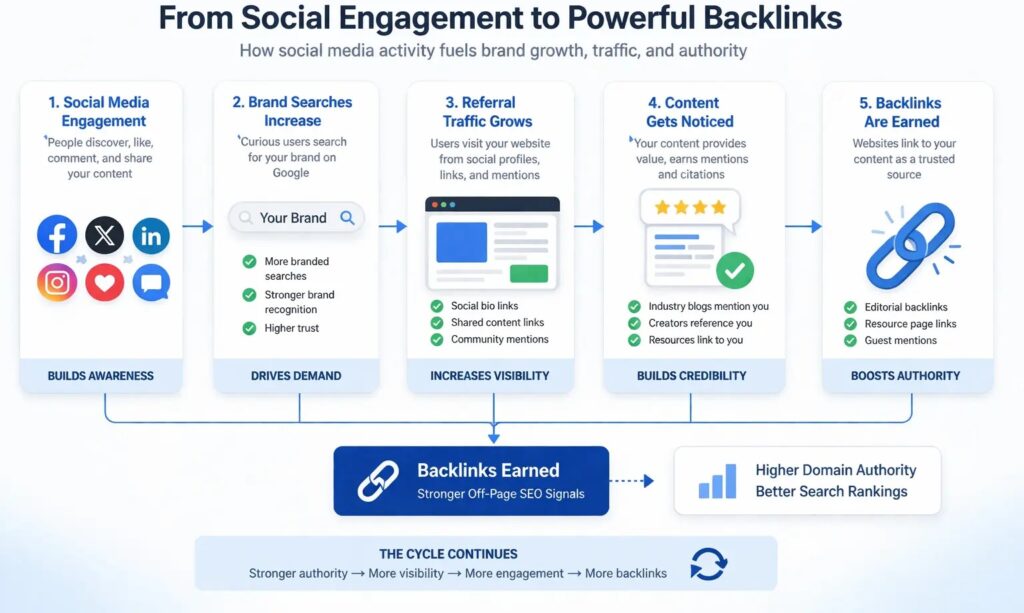
The Role of Social Media in Off Page SEO
Let’s be precise: social media signals are not direct ranking factors in Google’s algorithm. Google’s John Mueller has confirmed this multiple times. However, the indirect effects of strong social media presence are substantial and well-documented.
Here’s how social media fuels off page SEO:
- Content amplification → more eyeballs → more backlink opportunities
- Brand search volume increases → a positive signal to Google that your brand has genuine demand
- Faster content indexing → Google crawls socially shared content more quickly
- Referral traffic → social visitors who engage reduce bounce rate and improve engagement signals
- Relationship building → influencers and bloggers discover your content and link to it
Best Practices for Social Media Engagement
| Platform | Best Content Type | SEO Benefit |
|---|---|---|
| Long-form posts, original data, thought leadership | B2B brand authority, executive visibility | |
| X (Twitter) | Threads, data snippets, commentary | Fast indexing, journalist discovery |
| YouTube | Tutorials, case studies, how-tos | Second largest search engine; video snippets |
| Genuine community participation | High-DA referral links, community trust | |
| Infographics, visual guides | Long-tail image search traffic | |
| Groups, community content | Referral traffic, audience building |
Social Media Engagement Tactics That Move the Needle:
- Repurpose long-form content into native posts, carousels, and threads — each platform rewards native formats
- Engage authentically in comments and discussions — this builds relationships that lead to organic citations
- Tag relevant influencers and thought leaders when sharing content that references their work
- Use social listening tools (Mention, Brand24, Sprout Social) to join conversations where your expertise is relevant
- Pin your best-performing content to profile tops for sustained visibility
Measuring Social Media’s Impact on SEO
Track these metrics to understand social’s downstream SEO influence:
- Referral traffic from social platforms (Google Analytics > Acquisition > Social)
- Branded search volume trends (Google Search Console > Performance > Queries)
- Backlink acquisition rate correlated with content sharing spikes (Ahrefs alerts)
- Content indexation speed after social sharing
IV. Guest Blogging
What Is Guest Blogging and Why Does It Still Work?
Guest blogging — writing and publishing articles on another website’s blog — remains one of the most effective off page SEO techniques in 2026, provided it’s done with genuine value in mind. The practice fell into disrepute when low-quality, mass-produced guest posts flooded the web. But when executed with editorial rigour, it delivers:
- A contextual backlink to your site (often dofollow)
- Exposure to an established, relevant audience
- Third-party authority endorsement (a form of EEAT signal)
- Relationships with editors and site owners in your niche
Matt Cutts famously declared “guest blogging is done” in 2014 — but he was specifically addressing spam-driven guest posting. High-quality, expert-written guest posts on authoritative sites continue to rank, earn links, and drive referral traffic more than a decade later.
How to Identify Suitable Blogs for Guest Posts
Target the right sites using these filters:
- Domain Authority ≥ 40 (check via Ahrefs or Moz’s free DA checker)
- Real traffic — use Ahrefs Site Overview or SimilarWeb to verify
- Topical alignment — the blog’s subject matter should overlap with yours
- Editorial standards — does the blog have an “About” page, author bios, and original content? Good sign. Does it publish 10 guest posts a day from unknown authors? Red flag.
- Active readership — check comments, social shares, and engagement metrics
Search operators to find guest post opportunities:
"your niche" + "write for us"
"your niche" + "guest post guidelines"
"your niche" + "contribute an article"
"your niche" + "submit a guest post"
Also look at where your competitors are guest posting — use Ahrefs to filter a competitor’s backlink profile by “links from” to find editorial placements.
Tips for Writing Effective Guest Posts
A guest post that gets rejected wastes everyone’s time. One that gets accepted but generates no traffic wastes yours. Here’s how to make guest posts count:
- Read the target blog deeply — understand their tone, audience sophistication, and content gaps before pitching
- Pitch a specific angle that hasn’t been covered, not a generic topic
- Write for their audience first — your backlink is secondary to delivering genuine value to their readers
- Include original insights — data, case studies, or first-hand experience you can’t Google
- Use your author bio strategically — link to a relevant landing page or lead magnet, not just your homepage
- Promote the piece on your own channels — this gives the host site more traffic and makes them want to work with you again
Key Principle: Guest blogging is a relationship, not a transaction. The sites that earn the most from guest posting are the ones that consistently deliver exceptional content and treat every placement as a long-term partnership.
V. Influencer Outreach
Influencer Marketing as an Off Page SEO Techniques
When most people hear “influencer marketing,” they think brand deals and Instagram promotions. But in SEO terms, influencer outreach is a sophisticated authority and link acquisition strategy. Working with the right influencers — creators, bloggers, journalists, and industry experts with established audiences — can deliver:
- Editorial backlinks from their websites or guest posts
- Social amplification to audiences that include other creators who may link to your content
- Brand mentions across high-traffic platforms
- Co-created content that earns links independently
Identifying and Engaging the Right Influencers
Tier Your Targets:
| Tier | Follower Range | Best For |
|---|---|---|
| Nano-influencers | 1K–10K | Niche authority, high trust, affordable |
| Micro-influencers | 10K–100K | Engaged communities, content creators |
| Mid-tier | 100K–500K | Scale + credibility |
| Macro/Mega | 500K+ | Brand awareness (less targeted, more expensive) |
For SEO purposes, nano and micro-influencers in your specific niche are often the highest-value targets. A blogger with 8,000 monthly readers in the B2B SaaS space has a far more relevant audience than a general lifestyle influencer with 500,000 followers.
Tools for Finding Influencers:
- BuzzSumo — Find who shares content in your niche
- Followerwonk — Twitter-specific influencer discovery
- Hunter.io — Email finding for outreach
- SparkToro — Understand what your audience reads and follows
Engagement Framework:
- Follow and genuinely engage with their content for 2–4 weeks before pitching
- Reference specific work of theirs in your outreach — show you’ve actually read their content
- Lead with what you’re offering them (exclusive data, co-authorship, a unique story) — not what you need
- Offer flexible collaboration formats: guest posts, quotes for your articles, joint webinars, podcast appearances
Measuring Influencer Collaboration Impact on SEO
- Monitor backlink acquisition in Ahrefs after each collaboration
- Track referral traffic from influencer platforms (Google Analytics)
- Measure branded search volume changes (Google Search Console)
- Track content shares and secondary link acquisition (who linked to the content after the influencer shared it?)
VI. Online Reputation Management
What Is Online Reputation Management (ORM) in SEO?
Online Reputation Management (ORM) is the practice of actively shaping and influencing how your brand appears across search results, review platforms, social media, and AI-generated summaries. In SEO terms, it’s a trust-building discipline that affects both click-through rates and rankings.
Google’s EEAT framework (Experience, Expertise, Authoritativeness, Trustworthiness) is explicitly evaluated through reputation signals. A site with glowing reviews, strong brand mentions, and expert-attributed content will consistently outperform a technically-similar site with a weak or negative reputation profile.
The SEO Consequences of Poor Reputation
- Negative reviews on Google, Trustpilot, or G2 reduce click-through rates from SERPs
- Negative press can rank for branded search queries, cannibalising traffic
- Low trust scores suppress visibility in AI-generated search answers
- Poor ORM signals can influence Google Quality Rater assessments
Techniques for Managing and Improving Online Reputation
1. Proactive Review Generation
Encourage satisfied customers to leave reviews on platforms relevant to your industry:
- Google Business Profile (critical for local businesses)
- Trustpilot (e-commerce, B2B services)
- G2 / Capterra (SaaS)
- Yelp (restaurants, local services)
- Clutch (agencies)
The method matters. Email or SMS requests sent within 24–48 hours of a positive interaction yield the highest conversion rates. QR codes placed at physical locations or in email signatures reduce friction further.
2. Responding to Reviews (Positive and Negative)
Google’s own guidelines note that responding to reviews signals engagement and trustworthiness. For negative reviews:
- Respond within 24 hours
- Acknowledge the issue without being defensive
- Offer a resolution and move the conversation offline
- Never delete or try to manipulate reviews — this violates platform policies and signals untrustworthiness
3. Brand SERP Management
Your “brand SERP” — the search results that appear when someone Googles your brand name — is your digital storefront. Optimise it by:
- Claiming and optimising your Google Business Profile
- Publishing active social profiles that rank for your brand name
- Creating a Wikipedia or Wikidata entry (for established brands)
- Publishing an “About” page with clear authorship and credentials
- Earning coverage in publications that rank for your brand name
4. Content-Based Reputation Defence
If negative content ranks for your brand, publish high-quality, authoritative content that outranks it. Press releases, in-depth case studies, expert interviews, and media coverage can all suppress unwanted SERPs over time.
Tools for Monitoring Online Reputation
| Tool | Primary Function | Pricing |
|---|---|---|
| Google Alerts | Basic brand mention monitoring | Free |
| Brand24 | Real-time mention tracking + sentiment | Paid |
| Mention | Social + web monitoring | Paid |
| ReviewTrackers | Review aggregation across platforms | Paid |
| Semrush Brand Monitoring | Integrated with SEO toolset | Paid |
VII. Local SEO Techniques
Why Local SEO Is one of the Distinct Off Page SEO Techniques
For any business serving a specific geographic area — a law firm, a dental practice, a restaurant, a regional agency — local SEO is the highest-ROI off page strategy available. According to Search Engine Journal, 76% of people who search for something nearby on their smartphone visit a business within a day, and 28% of those searches result in a purchase.
Local off page SEO differs from general off page SEO because it involves location-specific signals that traditional backlink strategies don’t address.
Strategies for Enhancing Local SEO
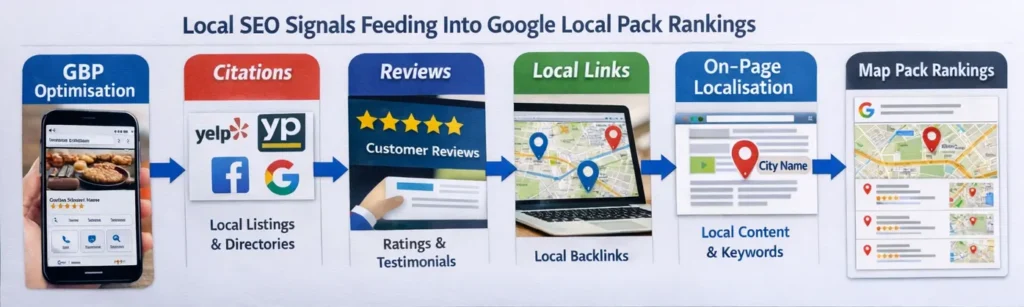
1. Google Business Profile (GBP) Optimisation
Your GBP is the single most important local SEO asset. To maximise it:
- Complete every field — categories, services, hours, photos, attributes
- Post weekly updates (Google Posts) to show active management
- Enable messaging and respond to questions promptly
- Add photos consistently — businesses with 100+ photos get 520% more calls per BrightLocal
2. NAP Consistency
NAP (Name, Address, Phone Number) must be identical across every online listing — your website, GBP, directories, and social profiles. Inconsistencies confuse search engines and dilute local ranking signals.
3. Local Citation Building
Citations are mentions of your business’s NAP on third-party websites. Build citations on:
- General directories: Yelp, Yellow Pages, Bing Places, Apple Maps
- Industry-specific directories (legal directories for lawyers, Houzz for contractors, etc.)
- Local directories: local Chamber of Commerce, city business directories
- Data aggregators: Foursquare, Data Axle, Neustar Localeze — these feed hundreds of smaller directories
4. Local Link Building
Earn backlinks from locally relevant sources:
- Sponsor local events and earn links from event pages
- Partner with complementary local businesses for cross-linking
- Get listed in local news coverage (“Best of [City]” lists)
- Contribute to local blogs or community organisations
5. Localised Content Creation
Create content targeting local search intent:
- City-specific landing pages (“SEO Services in Manchester”)
- Local case studies with named clients (with permission)
- “Best [service] in [city]” guides that reference local context
The Role of Local Listings and Reviews
BrightLocal’s 2025 Local Consumer Review Survey found that 97% of consumers read online reviews for local businesses. Review signals — quantity, recency, rating, and owner responses — are a confirmed local ranking factor.
Read more about out Local SEO – Our local SEO services
VIII. Content Marketing as an Off Page SEO Engine
Reframing Content Marketing as Off Page SEO Techniques
Most people think of content marketing as an on-page or owned-media activity — and it is. But its off page power is equally significant. When content is extraordinary, it becomes a link magnet, citation source, and authority signal that amplifies all other off page SEO efforts.
The connection is direct: content → shares → brand mentions → backlinks → authority → rankings.
According to Averi’s report, businesses that publish 16+ blog posts per month receive 3.5x more traffic than those publishing 0–4 posts. But it’s not volume that drives off page impact — it’s format and depth.
Types of Content That Earn Backlinks and Off Page Signals
| Content Type | Why It Earns Links | Example |
|---|---|---|
| Original Research / Statistics | Becomes a primary source cited by others | “2026 SEO Benchmark Report” |
| Ultimate Guides | Comprehensive reference content | “The Complete Guide to Technical SEO” |
| Free Tools / Calculators | Linked to as a resource repeatedly | ROI Calculator, Readability Scorer |
| Infographics | Embedded by other sites (with credit) | Visual SEO checklist |
| Case Studies | Cited as real-world proof | “How We 3x’d Organic Traffic in 90 Days” |
| Expert Roundups | Participants share and link to the piece | “27 SEO Experts on 2026 Priorities” |
| Data Visualisations | Shared widely on social; embedded by journalists | Interactive ranking trends chart |
Content Distribution Strategies for Maximum Off Page Impact
Publishing great content without distributing it is like building a shop in the middle of a forest. Distribution is what activates the off page SEO benefits.
Distribution Framework:
- Email newsletter — share with existing subscribers immediately after publication
- Social media native posts — adapt the content for each platform’s format (don’t just paste the link)
- Community sharing — share in relevant Slack communities, Reddit subreddits, Facebook groups, LinkedIn groups — only where genuinely relevant
- Content syndication — republish on platforms like Medium, LinkedIn Articles, or industry publications (with canonical tags where possible)
- Blogger/journalist outreach — notify relevant creators who might find the piece linkworthy
- Podcast pitching — use your content as a talking point to earn podcast appearances that link back to your site
- PR distribution — if the content includes data, issue a press release to targeted journalists
IX. Forum Participation and Community Engagement
Why Forum Engagement Is an Underrated Off Page SEO Techniques
In the relentless pursuit of backlinks and press mentions, most SEO practitioners overlook the compounding authority of genuine community participation. Forums, discussion boards, and online communities — Reddit, Quora, niche-specific forums, and Slack communities — represent a unique off page opportunity that simultaneously builds brand visibility, earns referral traffic, and creates natural link opportunities.
The key word is genuine. Dropping links in forums without contributing is spam. It gets removed, it gets accounts banned, and it has zero SEO value. But authentic participation — where you answer questions with real expertise, build a reputation, and occasionally reference relevant resources — has both direct and indirect SEO benefits.
Benefits of Community Engagement for SEO
- Referral traffic — Quora answers and Reddit threads can drive consistent traffic for years
- Brand authority — being known as a genuine expert in community spaces builds the kind of trust that influences purchase decisions and link requests
- Natural link opportunities — as you build reputation in communities, people begin to reference and link to your content organically
- Content ideation — forums reveal exactly what questions your target audience is struggling with, making them invaluable keyword and content research tools
- Long-tail keyword visibility — Quora and Reddit pages rank for thousands of long-tail queries; your answers can appear in AI-generated search results
According to BackLinko, Reddit is now one of the top 10 most-visited websites globally, and Google’s 2025 algorithm updates have significantly boosted Reddit content in search results — making community participation a genuine ranking opportunity.
Best Practices for Effective Forum Participation
- Choose the right communities — identify where your target audience actually spends time, not just where it’s easy to post links
- Complete your profile — a full profile with a real name, photo, and bio builds credibility
- Contribute first, link later — establish yourself by answering questions without any self-promotion for the first several contributions
- Be genuinely helpful — answer the specific question asked, not a generalised version that lets you promote yourself
- Reference your content only when it’s the best answer — and frame it as a resource recommendation, not a promotion
- Be consistent — episodic forum participation has minimal impact; weekly engagement compounds
Platforms Worth Prioritising
| Platform | Best For | Typical SEO Benefit |
|---|---|---|
| B2C, tech, marketing communities | Referral traffic, community authority | |
| Quora | Long-form expert answers | SERP visibility, referral traffic |
| LinkedIn Groups | B2B professional networking | Brand authority, relationship building |
| Slack Communities | Industry-specific niches | Referral traffic, collaboration |
| Industry forums (e.g., Warrior Forum, Moz Community) | Specialist niches | Backlinks, niche authority |
How Forum Engagement Boosts SEO Indirectly
The clearest path from forum participation to SEO gain runs through reputation. When you’re known in your niche — when people recognise your name and expertise — they:
- Seek out your website directly (branded search increase)
- Reference your content when they write their own articles (organic backlinks)
- Invite you to contribute to guest posts, podcasts, and roundups (authority amplification)
- Cite you in AI-generated answers that pull from community content
X. Conclusion: Building Off Page SEO Authority That Compounds
Off page SEO is not a checklist you complete once. It’s a long-term authority-building system — one where each technique reinforces the others and the results compound over months and years.
Recap: The 8 Off Page SEO Techniques
- Building High-Quality Backlinks — The foundation of off page authority; focus on relevance, editorial control, and relationship-driven acquisition
- Social Media Engagement — Amplifies content reach, accelerates indexing, and fuels brand search volume
- Guest Blogging — Earns editorial backlinks and exposes your expertise to new, established audiences
- Influencer Outreach — Leverages trusted voices for authority endorsement and content amplification
- Online Reputation Management — Protects and builds the trust signals Google uses to evaluate site quality
- Local SEO Techniques — Dominates geo-specific searches through GBP, citations, and local content
- Content Marketing — Creates link-magnet assets that attract backlinks passively over time
- Forum Participation — Builds niche authority, drives referral traffic, and creates organic link opportunities
A Holistic Approach Is Non-Negotiable
The brands dominating organic search in 2026 aren’t the ones doing one of these techniques exceptionally well. They’re the ones executing all of them with strategic consistency. A single excellent backlink from a digital PR campaign gets amplified by your social following, is discovered by forum communities, and gets referenced by an influencer — creating a flywheel that accelerates with each cycle.
Your Next Steps
- Audit your current off page profile using Ahrefs or SEMrush — identify gaps and opportunities
- Prioritise the 2–3 techniques most aligned with your current resources and stage of growth
- Build a 90-day off page plan with specific targets for backlinks, guest posts, and community engagement
- Track progress monthly — domain authority, referring domains, branded search volume, and organic traffic
The gap between where your site ranks today and where you want it to rank is, in large part, an off page gap. Close it deliberately, and close it with quality.
Frequently Asked Questions
Last updated: April 2026 by Searchlyn team