- The $200 Billion Question Nobody Is Answering Honestly
- Quick Answer: SEO or Google Ads: Which Is Better ?
- How Each Channel Actually Works
- The Data Layer: What the Numbers Actually Say
- Comparison Table: SEO vs. Google Ads
- The SPAR Growth Framework
- Metrics That Matter: Old KPIs vs. AI-Era Visibility
- Hypothetical Case Study: B2B SaaS Company, 18-Month Horizon
- Your Next Strategic Move
- Frequently Asked Questions
- Turn Search Visibility Into Sustainable Business Growth through our SEO Services
The $200 Billion Question Nobody Is Answering Honestly
Every marketing budget meeting eventually debates on the standoff – SEO or Google Ads: Which is better? One side argues that you can’t buy your way to credibility. The other side argues waiting 12 months for seo organic traffic while the competitors buy the top ranking spot is just bad math.
Here’s the uncomfortable truth: “Most of the content answering this question is written by the agencies that sell one or the other. This article isn’t that”
The digital marketing in 2026 has shifted in ways that make this decision more consequential than ever before. Google’s AI Overviews are reshaping everything about organic clicks. Cost-per-click (CPC) rates in many competitive industries and sectors have nearly doubled in last three years. And your SEO organic traffic now competes not just with paid ads but with AI-generated answer boxes that give users what they need without even a single click.
Choosing wrong doesn’t just waste budget today – it compounds on long term. Here’s how we can choose right.
Quick Answer: SEO or Google Ads: Which Is Better ?
SEO and Google Ads serve different business stages and timelines. SEO builds long-term, compounding organic authority over 6–18 months, reducing cost per acquisition by creating owned traffic assets. Google Ads delivers immediate visibility and precise targeting, but traffic stops the moment ad spend stops. SEO is ideal for longer sales cycles, content-driven audiences, and sustainable growth. Google Ads works best for fast lead generation, product launches, seasonal campaigns, or high-ticket services. The optimal strategy isn’t choosing one over the other—it’s sequencing them correctly based on your growth phase.
How Each Channel Actually Works
What SEO Does Mechanically
Search engine optimization is the practice of structuring your website, optimizing the content, and building high authority off-site signals so that search engines rank your pages for relevant queries without paid placement. Why SEO is important at a technical level comes down to three distinct pillars: Crawlability (can the search engines access your content?), Relevance (does your content match the intent of the user?), and Authority (do credible external sources validate your domain expertise?).
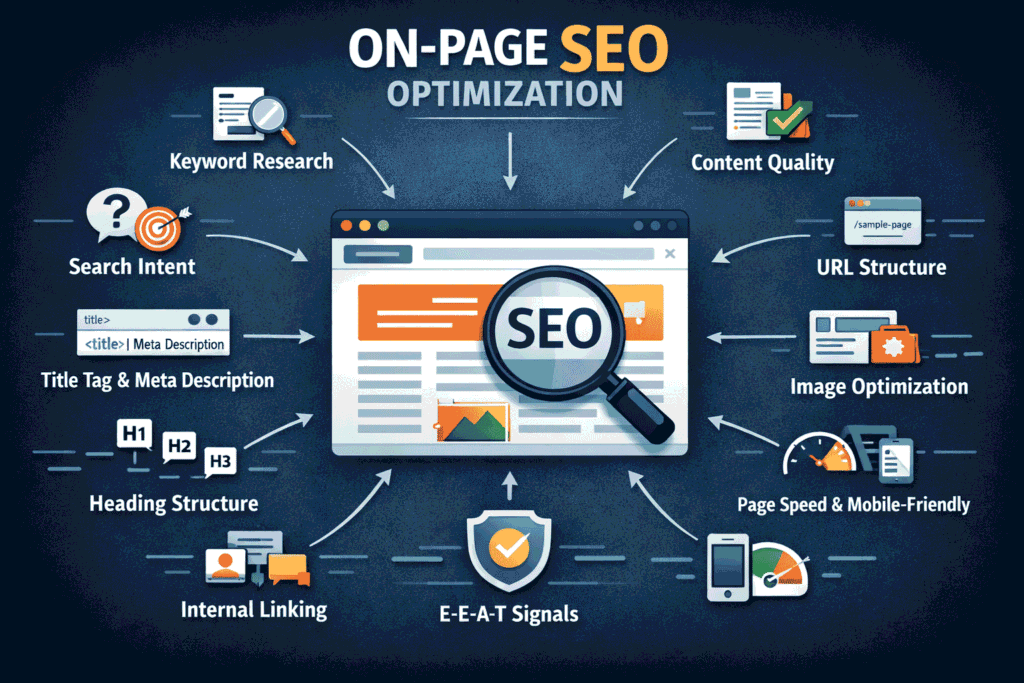
Where SEO is used extends well beyond just blog content. Technical SEO governs site architecture and page speed for better user experience. On-page SEO controls metadata, headers, and keyword integration. Off-page SEO builds the domain authority through high quality backlinks and brand mentions. Local SEO captures geo-intent searches for Local business. In 2026, GEO — Generative Engine Optimization — extends these principles into optimizing for the business for AI-cited visibility.
What Google Ads Does Mechanically
Google Ads operates on an auction model. You bid on your target keywords; Google scores your bid against your Quality Score (relevance, expected CTR, landing page experience) to determine the ad rank. You pay only when someone clicks your link or content. This pay-per-click (PPC) model gives you immediate page-one presence, granular audience targeting, and real-time performance data that you can measure. What it doesn’t give you: permanence, compounding returns, or trust signals that come from earned organic ranking through SEO.
The Core Structural Difference
SEO builds an valuable asset for Business while Google Ads rents visibility for Business. This isn’t an argument for one thing over the other – it’s a clarification of what you’re actually purchasing with each dollar of your marketing budget.
The Data Layer: What the Numbers Actually Say
The following findings come from widely cited industry sources and publicly available research:
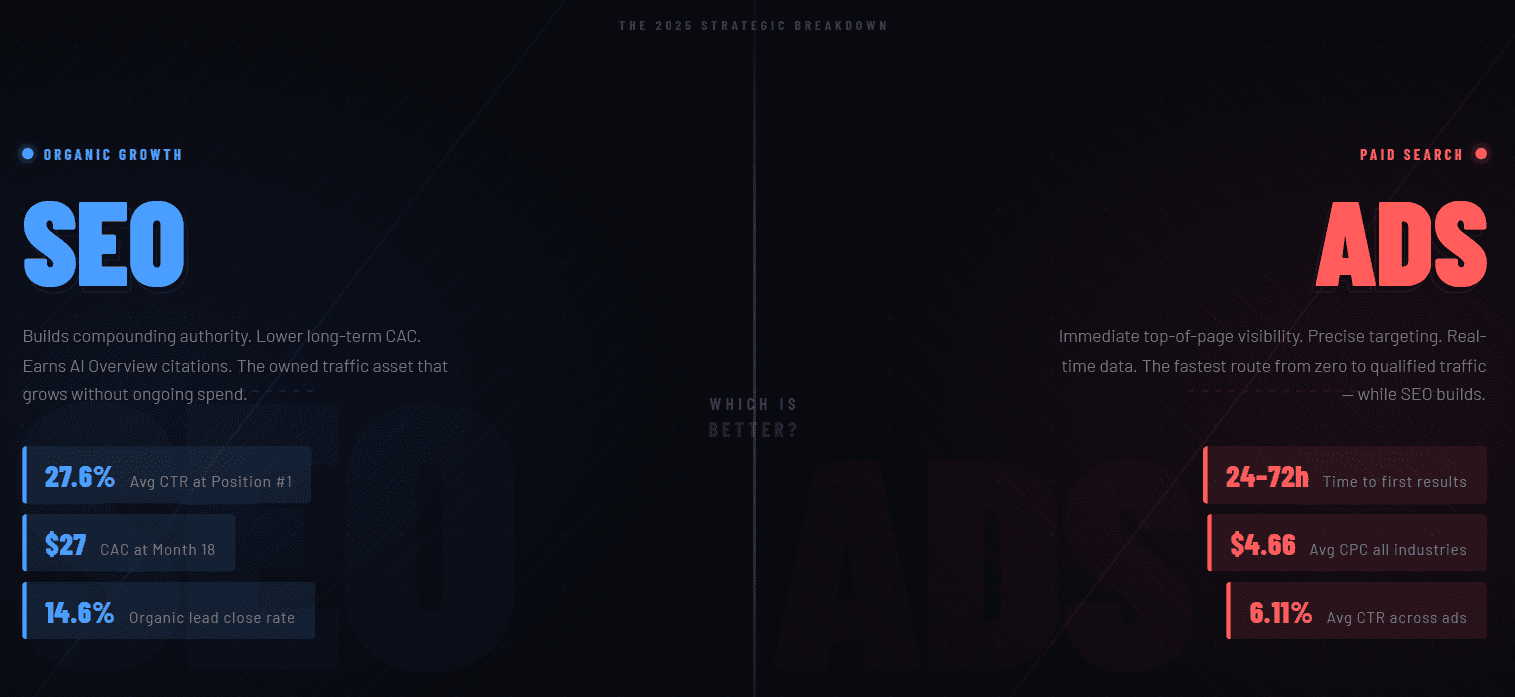
- Google Ads average CTR across all industries is 6.66% (WordStream, 2025), while the top organic position captures an average CTR of 27.6% (Backlinko, 2025). Organic clicks outperform paid clicks in click-through rate at the top position — but most websites never reach position one.
- The average cost-per-click for Google Ads across all industries is $4.66, rising to over $9 in legal, financial services, and insurance verticals (WordStream, 2024). At scale, paid acquisition costs can become structurally prohibitive.
- SEO leads have a 14.6% close rate compared to 1.7% for outbound marketing leads (Search Engine Journal, sourced from HubSpot data). Organic searchers carry higher commercial intent because they initiated the discovery — a key reason why SEO matters in long-cycle B2B environments.
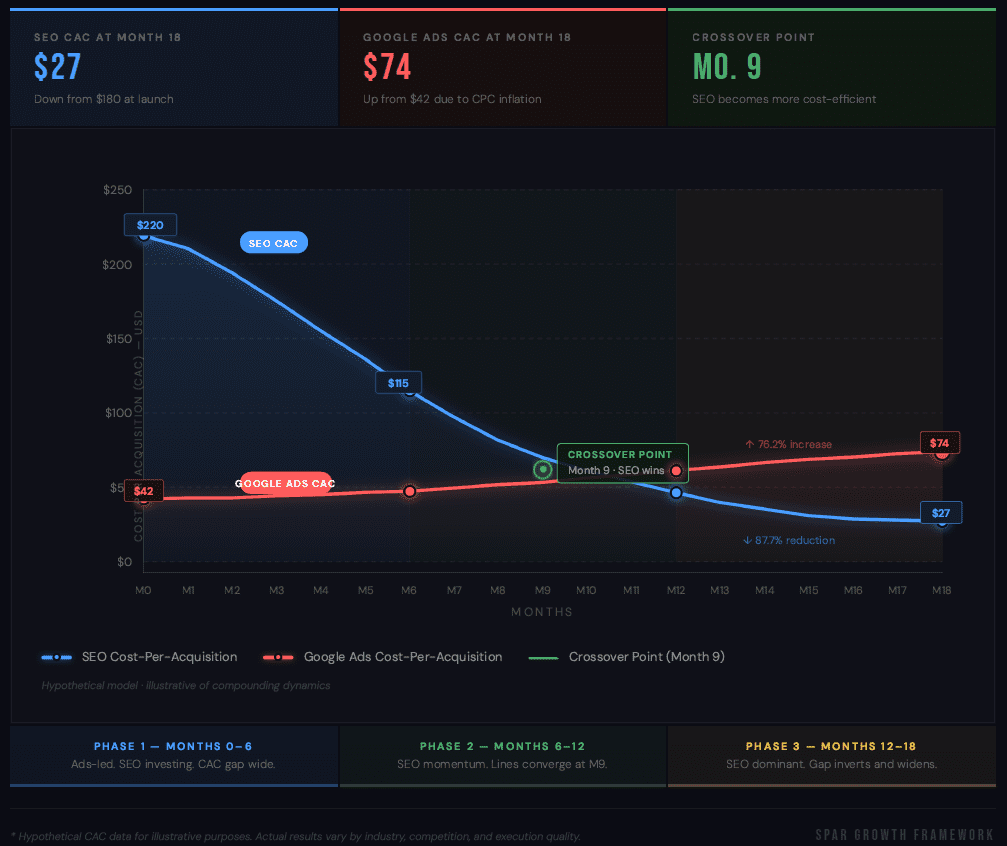
“Organic search consistently delivers a lower cost-per-acquisition than paid search at scale — but only after the compounding phase, which most businesses abandon before it begins.”
Hypothetical model · illustrative of compounding dynamics –
Comparison Table: SEO vs. Google Ads
| Factor | SEO | Google Ads |
|---|---|---|
| Time to Results | 6–18 months | 24–72 hours |
| Cost Structure | Upfront investment; lower ongoing CAC | Continuous spend required |
| Traffic Sustainability | Compounds over time | Stops when budget stops |
| Targeting Precision | Intent-based; limited demographic control | Keyword + demographic + behavioral |
| Trust Signal | High (earned placement) | Lower (labeled as ad) |
| Scalability | Content and authority scale | Budget scales |
| Data Feedback Loop | Slower (months) | Immediate (days) |
| Best Use Case | Authority building, long-term growth | Fast lead gen, product launches |
| AI Visibility (2025) | High — GEO-optimized content gets cited | Low — ads not cited by AI engines |
| Conversion Rate (avg) | Higher intent, variable CVR | Controllable via landing page |
The SPAR Growth Framework
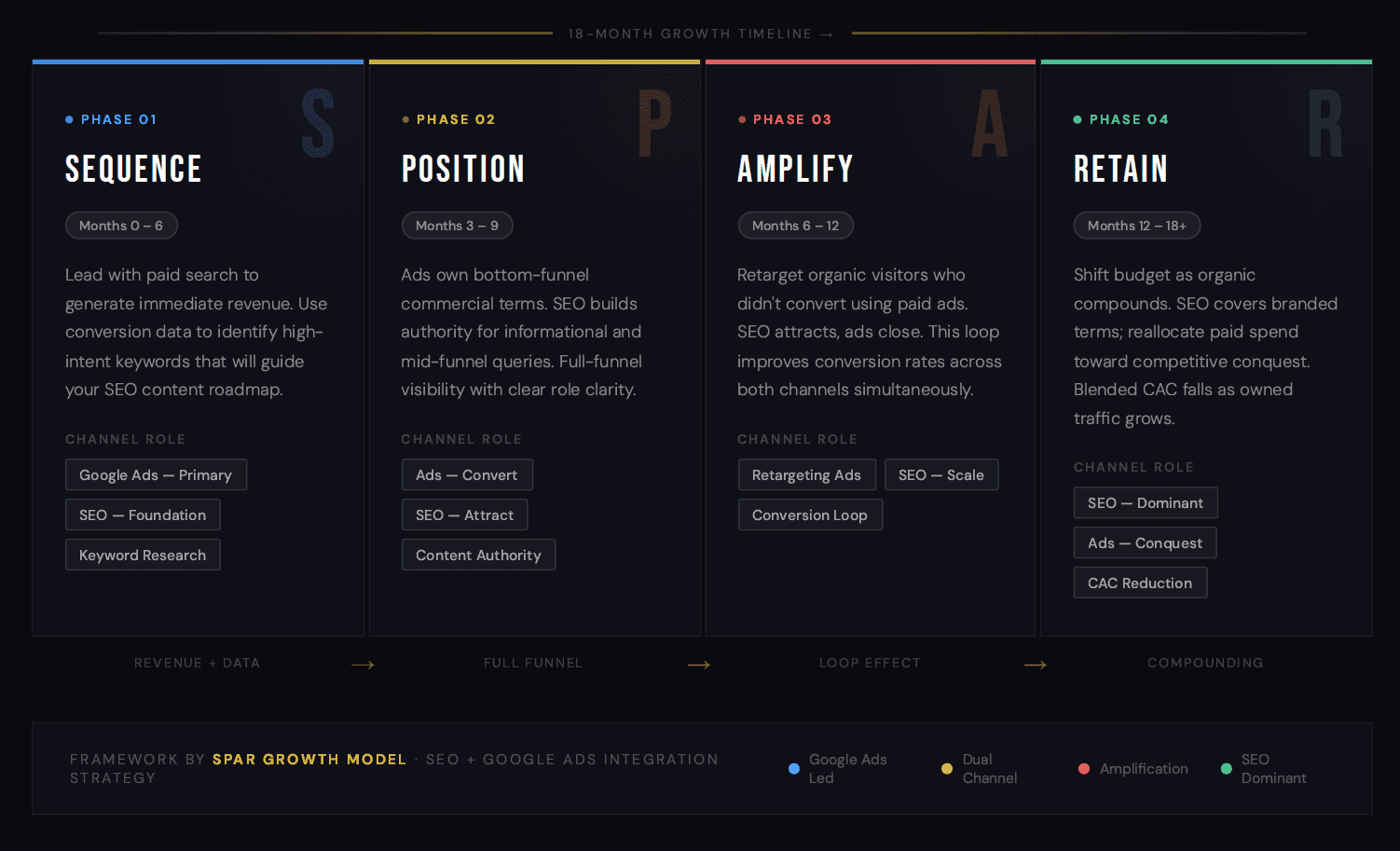
SPAR — Sequence, Position, Amplify, Retain
This is a strategic model for integrating SEO and Google Ads based on your business lifecycle stage rather than treating them as separate competitors.
S — Sequence
Don’t choose between either SEO or Google Ads. Simply Sequence them. Businesses in initial months 0–6 with no organic footprint yet should lead with paid ads to generate revenue and gather keyword conversion data. That data directly informs your SEO content priorities, removing the guesswork from organic strategy.
P — Position
Use Google Ads to own high-commercial-intent terms immediately while SEO builds authority for informational and mid-funnel terms in background. This creates full-funnel visibility with role clarity: ads convert, SEO attracts, Result? – Business grows sustainably!
A — Amplify
Once SEO content begins ranking (months 6–12), use Google Ads to retarget organic visitors who didn’t convert. This amplification loop dramatically improves overall channel efficiency — organic attracts, paid closes.
R — Retain
Shift budget allocation as seo organic traffic compounds. By month 18–24, mature SEO should be reducing reliance on paid acquisition for branded and informational terms, freeing ad spend for competitive conquest terms.
Each stage of SPAR is measurable and reversible. The SPAR model prevents the false binary and builds a defensible traffic architecture helping the business to grow sustainably!
Metrics That Matter: Old KPIs vs. AI-Era Visibility
Traditional KPIs
- Organic keyword rankings – your position for targeted keywords and terms
- Paid impression share – percentage of available impressions you managed to capture
- Click-through rate – ratio of clicks to impressions
- Cost per click / Cost per acquisition – this tells about efficiency of paid spend
- Conversion rate – percentage of visitors completing a required goal action like buying, subscribing, etc.
These remain valid but incomplete going forward. Rankings are becoming increasingly volatile with AI Overviews pushing the organic results below the fold.
Emerging AI-Era Metrics
- AI Citation Rate — how often your content appears as a source in chat bots like ChatGPT, Perplexity, or Google AI Overviews. Not yet standardized but trackable through brand mention monitoring.
- Zero-Click Visibility — your brand or answer appears in a featured snippet or AI Overview without the need of user clicking. Builds awareness even when it suppresses clicks.
- Share of Voice — what percentage of total impressions across your keyword set does your brand capture, across organic, paid, and AI surfaces?
- Entity Authority Score — how consistently search engines and AI models associate your brand with specific topics. This is strengthened through structured data, consistent brand mentions, and citation accumulation.
Why SEO matters now: Google Ads cannot earn AI citation. Only content-based SEO – specifically, well-structured, authoritative, schema-marked content – can appear in AI Overviews and third-party AI tools. This gives SEO a new opportunity and category advantage it didn’t have few years ago.
Hypothetical Case Study: B2B SaaS Company, 18-Month Horizon
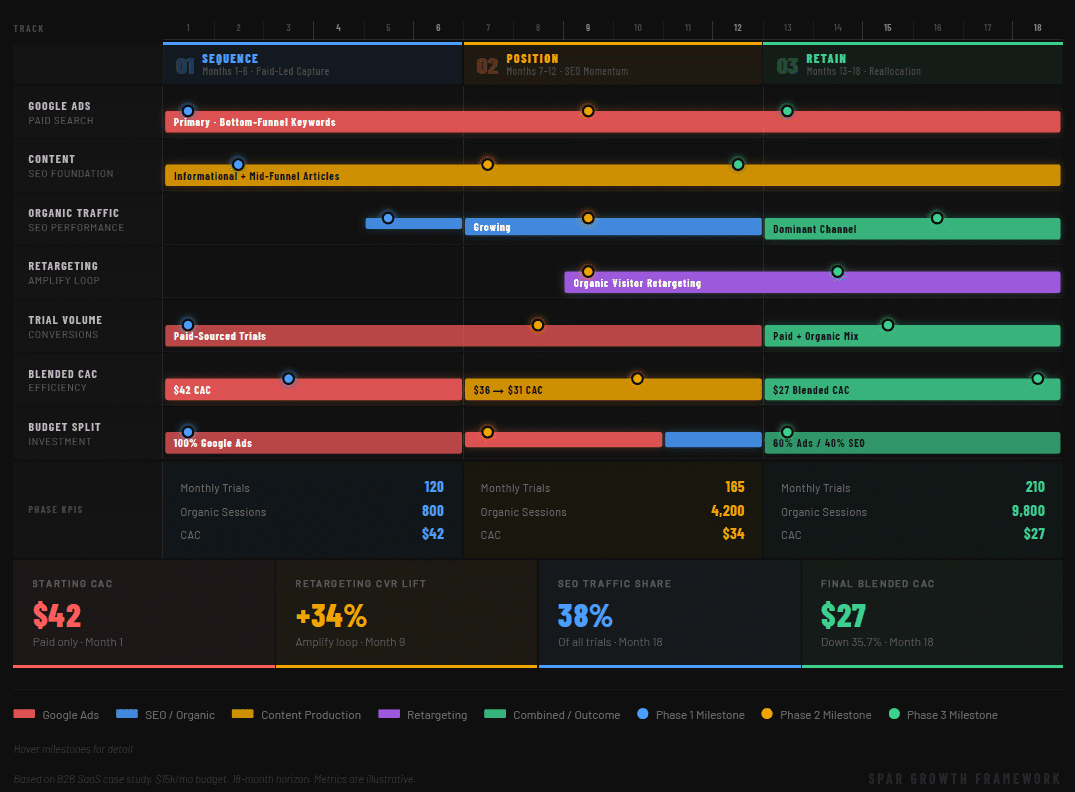
Based on B2B SaaS Hypothetical Case Study. $15k/mo budget. 18-month horizon. Metrics are illustrative.
Scenario: A project management SaaS targeting mid-market operations teams. Monthly ad budget: $15,000. Zero domain authority. Category-level keyword CPCs averaging $8–12.
Phase 1 (Months 1–6) — Paid-Led Capture Google Ads campaigns targeting bottom-funnel terms (like “project management software for operations teams”) generated 120 trials per month at $42 CAC. Simultaneously, content production began targeting informational queries with mid to high-volume, low-competition potential.
Phase 2 (Months 7–12) — SEO Momentum Builds Six informational articles reaches page one. SEO Organic traffic grows from 800 to 4,200 monthly sessions. Retargeting ads serving organic visitors improved paid conversion rates by 34% — the SPAR amplification loop in action.
Phase 3 (Months 13–18) — Reallocation Branded keyword spend reduced as organic captured those terms. $4,000/month reallocated from branded to competitive conquest campaigns. Blended CAC fell from $42 to $27. SEO organic traffic now contributes 38% of all trials.
Result: Neither channel alone achieved this. The sequence & SPAR did!
Your Next Strategic Move
If you’ve reached this point, you’re not looking for a generic answer — you’re evaluating where to put real budget. The right question isn’t “SEO or Google Ads?” It’s: “What does our pipeline need in the next 90 days versus the next 18 months?” If you need volume now: start with Google Ads, but build SEO infrastructure in parallel. If you have enough runway and a content driven advantage: invest in SEO first, use ads to accelerate conversion on your best organic pages. Either way, the worst position is inaction while your competitors compound.
Audit your current organic footprint and paid performance in a single session. Map your keyword set across both channels. Identify where you’re paying for terms you could own organically within 12 months — that gap is your immediate opportunity.
Frequently Asked Questions
Is SEO or Google Ads better for a new business?
For most new businesses with limited brand recognition and immediate revenue needs, Google Ads provides faster results while SEO is being built parallel. However, neglecting SEO entirely in the early stage means paying for traffic indefinitely which is not sustainable for any business . A parallel approach – paid for conversion, organic for authority – produces the strongest compounding outcome.
Why SEO is important for long-term growth?
SEO builds an owned seo organic traffic asset that appreciates and compounds over time. Unlike paid ads, well-ranked content continues generating clicks without ongoing spend on those. Why SEO is important comes down to compounding ROI: the cost-per-acquisition decreases as rankings mature, while paid costs either hold steady or increase with competition.
How long does SEO take to show results?
Most websites begin seeing measurable organic movement in 4–6 months for lower-competition terms and 9–18 months for competitive categories. Timeline varies based on your overall SEO Strategy – domain authority, content quality, technical foundation, and link acquisition rate.
Can Google Ads hurt SEO?
No. Running Google Ads has no direct negative effect on organic rankings. Google has confirmed that paid spend does not influence organic algorithm placement. However, allocating all budget to ads while neglecting SEO investment creates long-term structural dependency on paid traffic.
What is a realistic Google Ads budget for small businesses?
For meaningful data and optimization, most Google Ads specialists recommend a minimum of $1,500–$3,000/month in competitive B2C markets. Less than this typically produces insufficient click volume for statistically valid optimization. Budget requirements scale with keyword CPC in your category.
Does SEO still work with AI Overviews taking clicks?
Yes, but the value proposition has shifted. High-ranking content now earns AI Overview citations, which builds brand authority even without a click. Additionally, users who click through from organic results below AI Overviews demonstrate higher intent. SEO organic traffic quality has increased even as raw click volume for some queries has decreased.