Introduction: Why “Good Content” Still Doesn’t Rank
One of the biggest SEO misconceptions is that publishing good content is enough. It isn’t. Search engines don’t rank content because it’s well-written—they rank it because it’s optimized for relevance, clarity, structure, and intent.
That gap between writing content and optimizing content is where most websites lose rankings, traffic, and conversions.
In this guide, you’ll learn:
- What content optimization really means in modern SEO
- How search engines evaluate optimized content
- A step-by-step content optimization process you can apply to any page
- Common mistakes that silently kill rankings
- A practical checklist you can reuse at scale
This is not about keyword stuffing. It’s about aligning content with how search actually works.
What Is Content Optimization (In Practical Terms)?
Content optimization is the process of systematically improving content so search engines and users both understand, trust, and prefer it.
Optimized content achieves three things simultaneously:
- Relevance – It precisely matches search intent
- Accessibility – It’s easy to crawl, parse, and understand
- Performance – It engages users and drives outcomes
If any one of these breaks, rankings suffer.
How Search Engines Evaluate Optimized Content
Search engines don’t “read” content like humans. They analyze signals.
Key Evaluation Signals
- Keyword and topic alignment
- Content structure and hierarchy
- Internal contextual relationships
- Engagement signals (scroll, dwell time, interaction)
- Semantic depth and coverage
- Freshness and accuracy
Content optimization is about engineering these signals intentionally.
The Content Optimization Framework (Step-by-Step)
Step 1: Align Content With Search Intent
Before optimizing anything, answer this:
Why is the user searching this query right now?
There are four dominant intent types:
- Informational (learn something)
- Navigational (find a brand or page)
- Commercial (compare options)
- Transactional (take action)
Optimization rule:
If your content format doesn’t match intent, no amount of SEO fixes will save it.
Example:
- “content optimization checklist” → structured, scannable, actionable
- “what is content optimization” → explanatory, conceptual, beginner-friendly
Step 2: Optimize Primary & Secondary Keywords (Correctly)
Keyword optimization is not repetition—it’s placement and context.
Where your primary keyword should appear naturally:
- Title (once)
- URL
- H1
- First 100 words
- Meta description
- Image alt text
- One or two H2s (if relevant)
Secondary keywords:
- Support the topic, not compete with it
- Appear in subheadings and body contextually
- Expand semantic coverage
Wrong approach: forcing keywords
Right approach: building topic completeness
Step 3: Optimize Content Structure for Scannability
Well-optimized content is skimmable first, readable second.
Structural best practices:
- One clear H1
- Logical H2 → H3 hierarchy
- Short paragraphs (2–4 lines max)
- Bullet points for processes and lists
- Tables for comparisons and frameworks
Search engines reward clarity because users engage with clarity.
Step 4: Expand Semantic Depth (Topical Optimization)
Modern content optimization goes beyond keywords.
You must cover:
- Related subtopics
- Common follow-up questions
- Synonyms and variations
- Conceptual relationships
Ask while optimizing:
- Does this answer everything a user needs?
- What would the next logical question be?
- What context would a beginner miss?
This is how you build topical authority, not just rankings.
Step 5: Optimize Internal Linking Context
Internal links do more than pass authority—they define meaning.
Best practices:
- Link from relevant, high-authority pages
- Use descriptive (not generic) anchor text
- Group content into topic clusters
- Link both up (pillar) and across (related pages)
Optimized internal linking helps search engines understand:
- Content hierarchy
- Topic ownership
- Page importance
Step 6: Optimize Content for Engagement Signals
User behavior matters.
Search engines observe:
- Time on page
- Scroll depth
- Interaction patterns
- Bounce behavior
Engagement optimization techniques:
- Clear introductions that promise value
- Visual breaks (lists, tables, images)
- Logical flow (no abrupt topic jumps)
- Strong subheadings that guide reading
If users stay, search engines trust.
Step 7: Optimize for Freshness & Accuracy
Content decay is real.
You should regularly:
- Update outdated examples
- Refresh statistics and tools
- Add new sections where gaps emerge
- Improve clarity based on performance data
Evergreen content still needs maintenance.
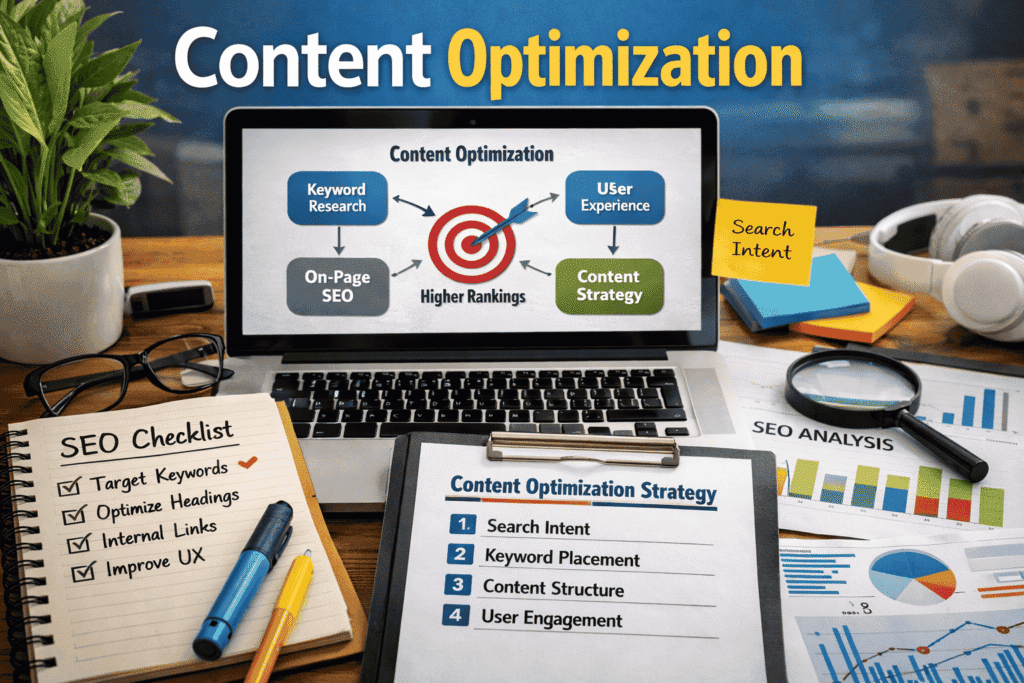
Content Optimization Checklist (Reusable)
Use this before publishing or updating any page:
Intent & Strategy
- Search intent clearly matched
- Primary keyword mapped correctly
- Secondary keywords support topic
On-Page Optimization
- Optimized title and meta description
- Clean URL structure
- Proper heading hierarchy
Content Quality
- Comprehensive topic coverage
- Clear explanations and examples
- Actionable takeaways
UX & Engagement
- Scannable formatting
- Logical flow
- Internal links added
Common Content Optimization Mistakes
Mistake 1: Optimizing Only for Keywords
Keywords without intent alignment fail.
Mistake 2: Over-Optimizing Headings
Stuffed H2s reduce clarity and trust.
Mistake 3: Ignoring Existing Content
Optimization often works better on existing pages than new ones.
Mistake 4: Writing for Search Engines, Not Humans
The algorithm follows users—not the other way around.
Practical Takeaways
- Content optimization is a system, not a single tactic
- Intent alignment comes before keyword placement
- Structure and clarity are ranking advantages
- Semantic depth builds long-term authority
- Optimized content compounds over time
Conclusion: Content Optimization Is the Real SEO Multiplier
You don’t need more content—you need better-optimized content.
When content is optimized for intent, structure, depth, and engagement, rankings become more predictable, traffic becomes more qualified, and conversions improve naturally.
If SEO is the engine, content optimization is the tuning that makes it powerful.
Frequently Asked Questions About Content Optimization
What is content optimization in SEO?
Content optimization in SEO is the process of improving website content to align with search intent, keywords, structure, and user experience so it ranks higher in search engines and performs better for users.
Why is content optimization important for rankings?
Content optimization helps search engines understand relevance and quality while improving engagement signals like time on page and scroll depth, which directly influence rankings.
How do I optimize content for search intent?
To optimize content for search intent, analyze top-ranking pages, identify whether the intent is informational, commercial, or transactional, and match your content format, depth, and structure accordingly.
What is the difference between content optimization and keyword optimization?
Keyword optimization focuses on placing keywords, while content optimization includes intent alignment, structure, semantic coverage, internal linking, and user engagement improvements.
How often should content be optimized?
Content should be optimized whenever rankings decline, traffic drops, or search intent changes. High-performing pages should be reviewed every 3–6 months for freshness and accuracy.
Can existing content be optimized for better SEO?
Yes, optimizing existing content often delivers faster SEO results by improving relevance, structure, keyword alignment, and internal links without creating new pages.
Does content length matter for content optimization?
Content length matters only when it supports search intent. Optimized content should be as long as necessary to fully answer the query, not longer.
What are the most important on-page elements for content optimization?
The most important on-page elements include the title tag, meta description, headings, internal links, keyword placement, content structure, and readability.
How does content optimization improve conversions?
Content optimization improves conversions by clarifying messaging, addressing user objections, improving readability, and guiding users toward actions through structured content.
Is content optimization enough to rank without backlinks?
Content optimization can improve rankings significantly, but competitive keywords often require backlinks in addition to optimized content to achieve top positions.